· junior secondary kenya
CBC Explained Kenya How CBE Works for Grades 7 to 12
19 min read
A Grade 7 learner comes home with a task that doesn't look like the old homework many parents remember. Instead of “revise and answer questions 1 to 20”, the learner is asked to observe a home practice, build something simple, interview a family member, or explain a process in their own words. The parent looks at the paper and asks a fair question. Is this still schoolwork, or are teachers sending classwork home?
In many staffrooms, teachers are asking a similar question from the other side. They've taught the lesson, given an activity, marked a short task, and now they must record evidence of learning in a way that fits the new system. What exactly counts? What should be tracked? How does this connect to the bigger picture beyond this week's lesson?
That confusion is why so many people search for CBC explained Kenya. They aren't only asking for a definition. They want to know what changed in real life.
Table of Contents
- Introduction What CBC Really Means for Your Family and Classroom
- Understanding CBC and CBE in Kenya Today
- How the CBE Structure Works for Grades 7 to 12
- Assessment and Progression From CEAs to National Scores
- Weekly Planning and Classroom Practice That Makes CBE Work
- How Parents and Students Can Track Mastery at Home
- Putting It All Together Your Next Steps With CBE
Introduction What CBC Really Means for Your Family and Classroom
In Kenya today, many people still say CBC, but the system has formally shifted into Competency-Based Education, or CBE. That change matters because it helps us see the idea more clearly. This is not only a new syllabus. It is a way of organising learning around what a learner can do, show, apply, and improve.
A learner who memorises steps but can't use them in a new situation is not yet fully competent. A learner who can explain, demonstrate, create, solve, and reflect is moving in the direction the system wants. That's the heart of the change.
The national transition has not happened in one jump. Kenya reached a major milestone in January 2025, when the first cohort moved into Grade 9 under the restructured system, and by January 2026 the country was preparing for the Grade 10 senior school transition. The reform also followed a 42-member taskforce report submitted on 1 August 2023, which recommended rebranding CBC as CBE. That history shows the shift is part of a longer national reform, not just a renamed timetable or a fresh booklet from school (Kenya's CBE transition milestones and taskforce background).
Practical truth: Most confusion disappears when parents and teachers stop asking, “What chapter are we covering?” and start asking, “What should this learner be able to do by the end of this strand?”
For families, this means homework may look more practical and less repetitive. For teachers, it means planning can't end at content coverage. The lesson, the activity, the class evidence, and the follow-up all belong together.
That's where many explainers stop too early. They define CBC, mention competencies, and leave readers with theory. Daily school life needs something more useful. Parents need to understand why the report language changed. Teachers need a simple weekly loop they can repeat. Learners need to know how one week's weak strand affects the next week's work.
The system starts making sense.
Understanding CBC and CBE in Kenya Today
On Monday, a teacher introduces a strand. By Friday, question is not whether learners copied the notes. The question is whether they can show the skill, and whether the evidence from that week should change next week's lesson.
That is the heart of competency-based learning in Kenya.
Many parents hear “competency-based” and worry that school has become lighter or less serious. Teachers sometimes hear the same complaint. CBE still expects strong academic learning, but it measures that learning by what a learner can do with knowledge, not only what the learner can repeat in an exercise book.
A cooking analogy: memorising a recipe versus preparing the meal
A learner may recite every step of making chapati and still struggle to mix the dough well, control the heat, or notice when the pan is too hot. Another learner may forget one sentence in the recipe but still prepare the chapati properly, explain the method, and correct mistakes along the way.
The second learner is showing competency.
Classroom learning works the same way. A learner needs knowledge, but knowledge must move into action. That is why teachers collect evidence through class tasks, oral responses, practical work, short written exercises, projects, and observation over time. Each piece of evidence helps answer one practical question. Has this learner mastered the strand taught this week, or does the teacher need to reteach part of it next week?
Why the language shifted from CBC to CBE
Competency-Based Curriculum points mainly to the curriculum design. It tells you what should be taught.
Competency-Based Education is wider. It includes what is taught, how it is taught, how evidence is collected, how progress is judged, and how support is given when a learner has not yet mastered a skill.
That change in language matters because a school can cover the syllabus and still miss the purpose of the reform. If lessons stay fixed on notes, drilling, and end-term marks alone, the classroom may look busy while learners remain weak in specific strands.
CBE asks a harder and more useful question. After teaching, what can the learner now demonstrate?
The terms that confuse parents and teachers most
Three terms cause trouble because they sound technical, yet they shape daily planning.
- Learning area is the broad subject space, such as Mathematics or Integrated Science.
- Strand is a major topic area within that learning area.
- Sub-strand is the smaller skill or content area under the strand.
This is not just official language for reports.
A teacher does not plan “Mathematics” in the abstract for the week. The teacher plans a strand, teaches a sub-strand, checks evidence from class activities or CEAs, then records which learners have mastered that part and which learners need support. Parents also understand reports better when they read them at strand level rather than treating every low score as a general subject weakness.
“Weak in Maths” is too wide to guide action. “Weak in number patterns” or “weak in experimental skills” gives the teacher and parent a clear next step.
Why this matters in real school life
Families searching for CBC explained Kenya are usually trying to understand why school now asks for demonstrations, projects, discussions, observation records, and regular class evidence.
The answer is simple. CBE is built around usable learning.
If a learner performs weakly in one strand during the week, that result should not wait for exam day to matter. It should shape the next cycle of teaching. A careful teacher uses that weak-strand evidence to adjust grouping, choose a different activity, reteach a skill, or give more guided practice before moving too far ahead.
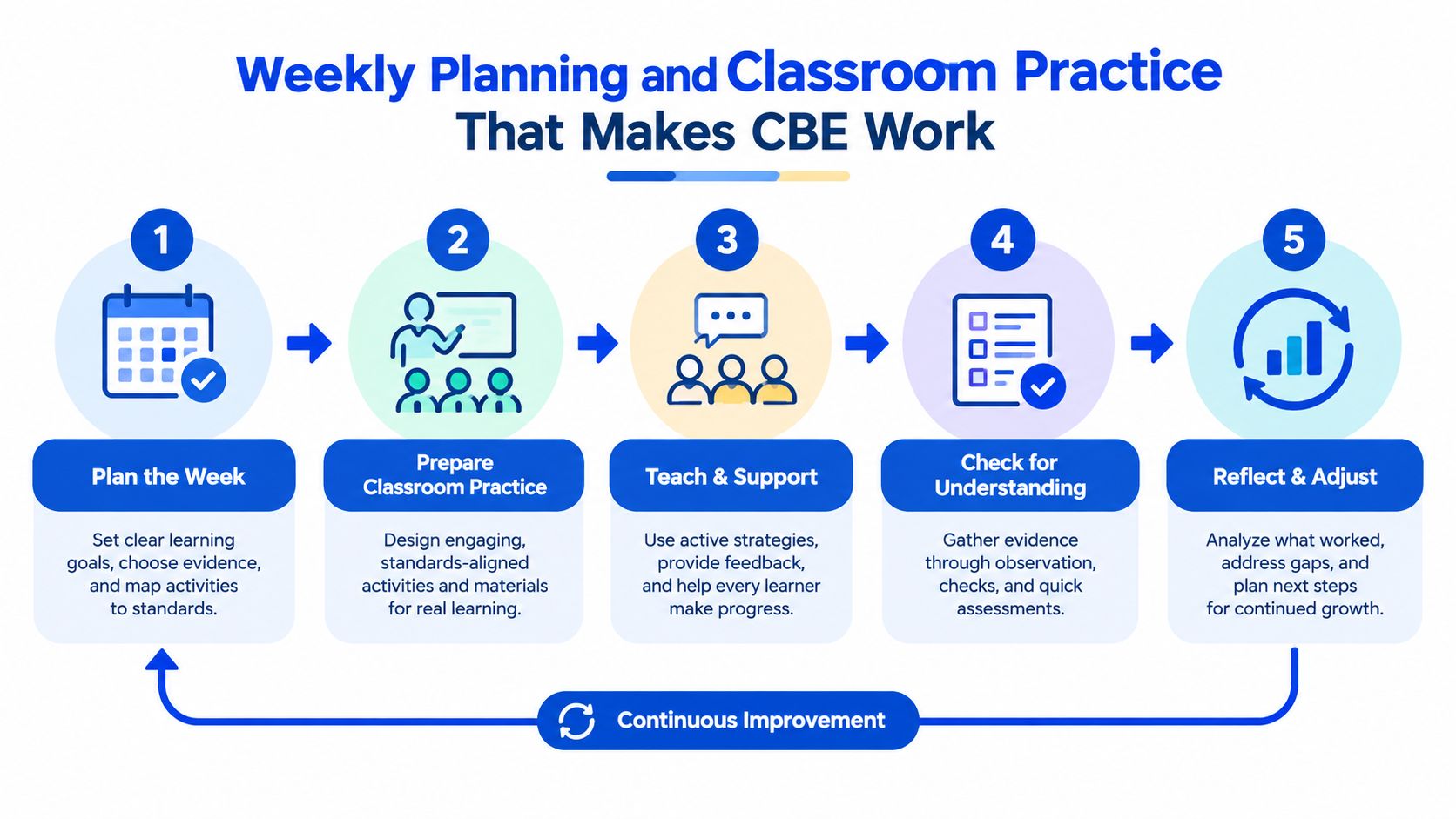
So CBE is not only a new name for the curriculum. It is a weekly classroom loop. Plan the strand. Teach it. gather evidence through class work and CEAs. Check who has mastered it. Then use that information to decide what next week's lesson should fix, strengthen, or extend.
How the CBE Structure Works for Grades 7 to 12
Parents often understand the philosophy first, then get lost at the structure. They ask where Grade 7 fits, how many learning areas there are, and what changes when a learner moves toward senior school.
Grade 7 is more structured than many people realise
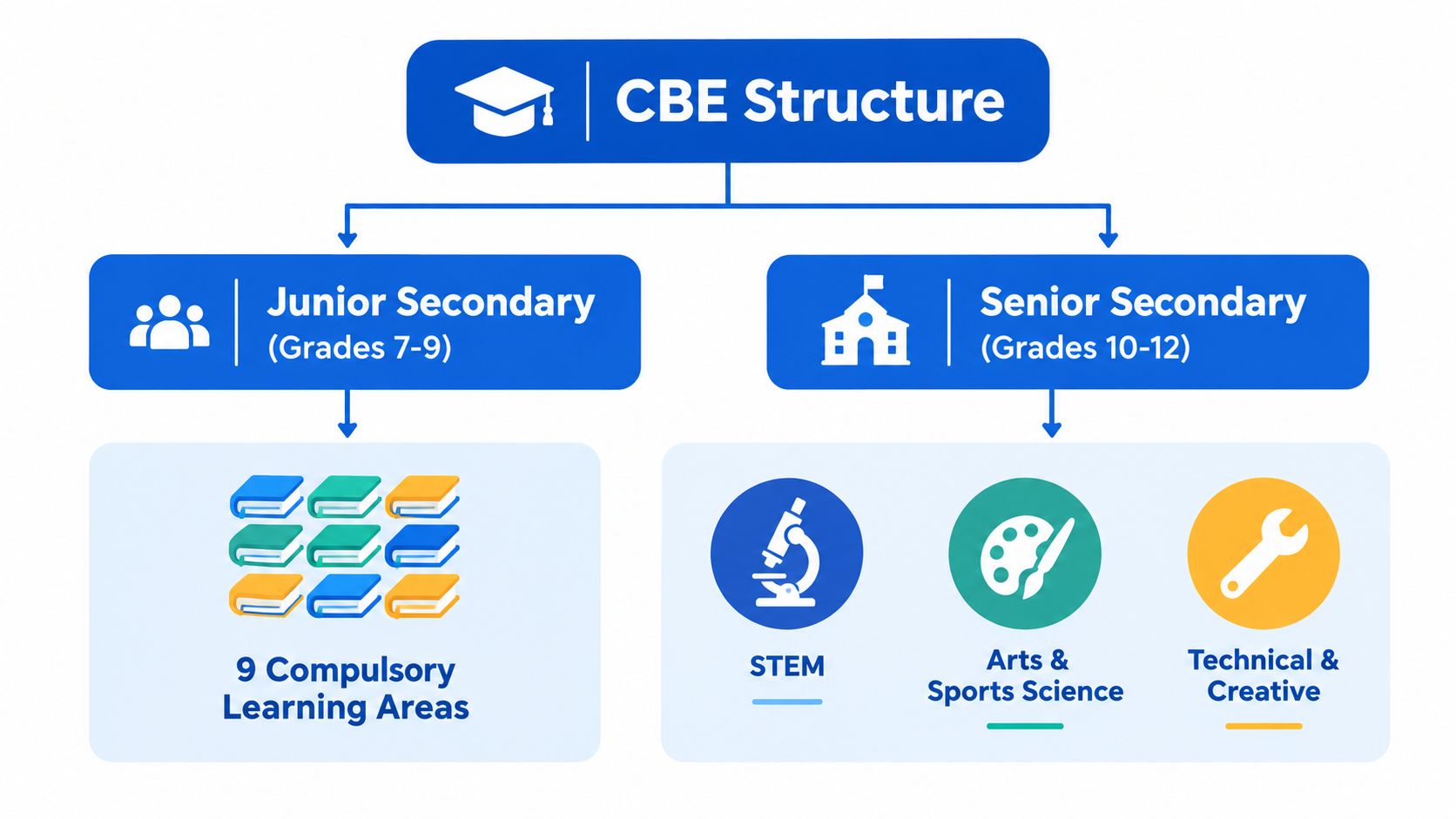
At Grade 7, the junior secondary structure was revised after the 2024 review to 9 compulsory learning areas, replacing an earlier arrangement that had 14 learning areas including optional pathways. The current Grade 7 framework includes English, Kiswahili or Kenyan Sign Language, Mathematics, Integrated Science, Social Studies, Pre-Technical Studies, Agriculture and Nutrition, Creative Arts and Sports, and Religious Education, while foreign languages remain optional (Grade 7 learning areas after the 2024 review).
That list helps parents in one important way. It shows that Grade 7 is not a vague transition year. It is a clearly organised entry point into junior secondary under CBE.
What teachers need to map each week
A school timetable may show “Integrated Science” on Tuesday morning. But the actual planning work sits at a lower level.
A teacher usually needs to know:
- The learning area the lesson belongs to
- The strand being taught
- The sub-strand being developed
- The evidence that will show whether learners understood
- The follow-up for those who didn't yet meet the expectation
This is why some teachers feel CBE is heavier at first. The teaching itself is familiar in many ways. What has changed is the need to be more deliberate about mapping the lesson to the curriculum structure.
Junior secondary and the move toward senior school
In junior secondary, the aim is not only to expose learners to subjects. It is to build a clearer picture of their strengths, interests, and progress before they move into senior school. By the time learners approach the next transition, schools and families need more than raw marks. They need a learning history that makes sense.
This short visual helps many families grasp the flow before the details become technical.
Why structure matters in daily practice
If a school only records general subject scores, it misses the CBE logic. A learner may appear fine in a subject overall and still have a weak strand that will hurt later understanding.
That is why structured tracking matters. It helps a teacher see whether the learner is progressing evenly or carrying hidden gaps from one week into the next.
A parent can use the same idea at home. Instead of asking, “How many marks did you get?” ask, “Which strand was difficult this week?” That one change often leads to a better conversation.
A timetable shows where the class goes. Strands show what the learner is building.
By Grades 10 to 12, that structure becomes even more important because learning, assessment, and progression are expected to link more clearly over time. That brings us to the part that worries most families. How the scores build.
Assessment and Progression From CEAs to National Scores
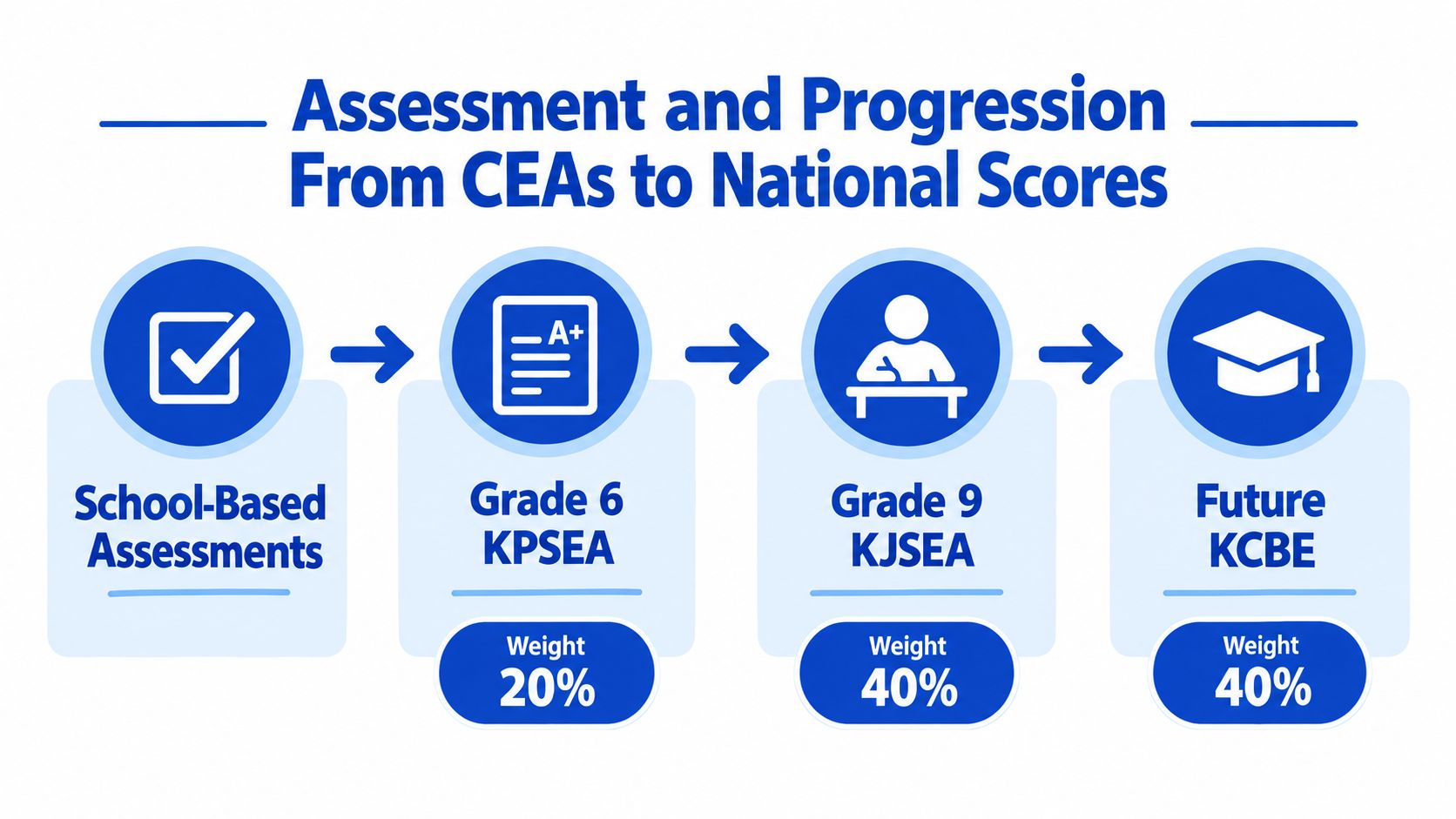
Assessment under CBE is not meant to be one big event at the end. It is designed as a chain of evidence built across stages. That's why teachers keep hearing about CEAs, school-based assessment, progression records, and reporting bands.
The weights matter because the years are connected
Kenya's CBE assessment architecture is stage-weighted. Grade 7 to 8 school-based assessments contribute 20% to the KJSEA, the Grade 9 national assessment contributes 60%, and the earlier KPSEA contributes the remaining 20%. At Grade 12, the planned arrangement is that the national summative exam contributes 70% of the final KCBE score, while school-based continuous assessment contributes 30%, split evenly between Grades 10 and 11 at 15% each (assessment weights and reporting structure under CBE).
That means a teacher in Grade 7 is not recording small class evidence for decoration. Those records belong to a longer assessment story.
How CBE scores build across grades
| Stage | Weight in Final Score | Purpose |
|---|---|---|
| Grade 7 to 8 school-based assessments | 20% | Builds continuous evidence before KJSEA |
| Grade 9 national assessment | 60% | Provides the main junior secondary summative score |
| KPSEA | 20% | Carries earlier primary-stage evidence into the total |
| Grade 10 school-based assessment | 15% of planned Grade 12 final score | Contributes to senior school continuous assessment |
| Grade 11 school-based assessment | 15% of planned Grade 12 final score | Adds another year of continuous evidence |
| Grade 12 national summative exam | 70% of planned Grade 12 final score | Final senior school certification component |
Why reporting bands matter
The same assessment structure also uses an eight-level achievement scale mapped into four reporting bands. Those bands are Exceeding Expectations, Meeting Expectations, Approaching Expectations, and Below Expectations (same assessment structure and reporting bands).
For families, this changes how report cards should be read. A broad score may hide issue. A strand-level band gives a clearer direction for support.
For teachers, it creates a professional discipline. Evidence must be consistent enough that what is recorded in school can be explained later. If a learner's school-based evidence contributes to a weighted national pathway, the scoring logic cannot be casual.
The Grade 9 transition is where many families need help
One area that still confuses many households is the move from junior secondary toward senior school. Reporting has shown that families still want clarity on placement criteria, costs, and how choices affect admission. The same reporting notes that the 2025 KJSEA involved 1,130,459 candidates, which shows how large this transition challenge is (reporting on KJSEA scale and family concerns).
If assessment is weighted across years, then every CEA should answer two questions. What did the learner manage today, and what evidence will still matter later?
That is why schools need records that are clear, traceable, and linked to strands. Without that, continuous assessment becomes paperwork instead of useful evidence.
Weekly Planning and Classroom Practice That Makes CBE Work
CBE either becomes manageable or exhausting. The difference usually lies in whether a teacher runs a repeatable weekly loop.
Start with one strand, not the whole subject
A practical week begins with a narrow target. Instead of saying, “I'm teaching Mathematics this week,” say, “I'm teaching this strand and these sub-strand outcomes.”
That one decision helps everything else line up. The activity, the examples, the class questions, and the short assessment stop feeling random.
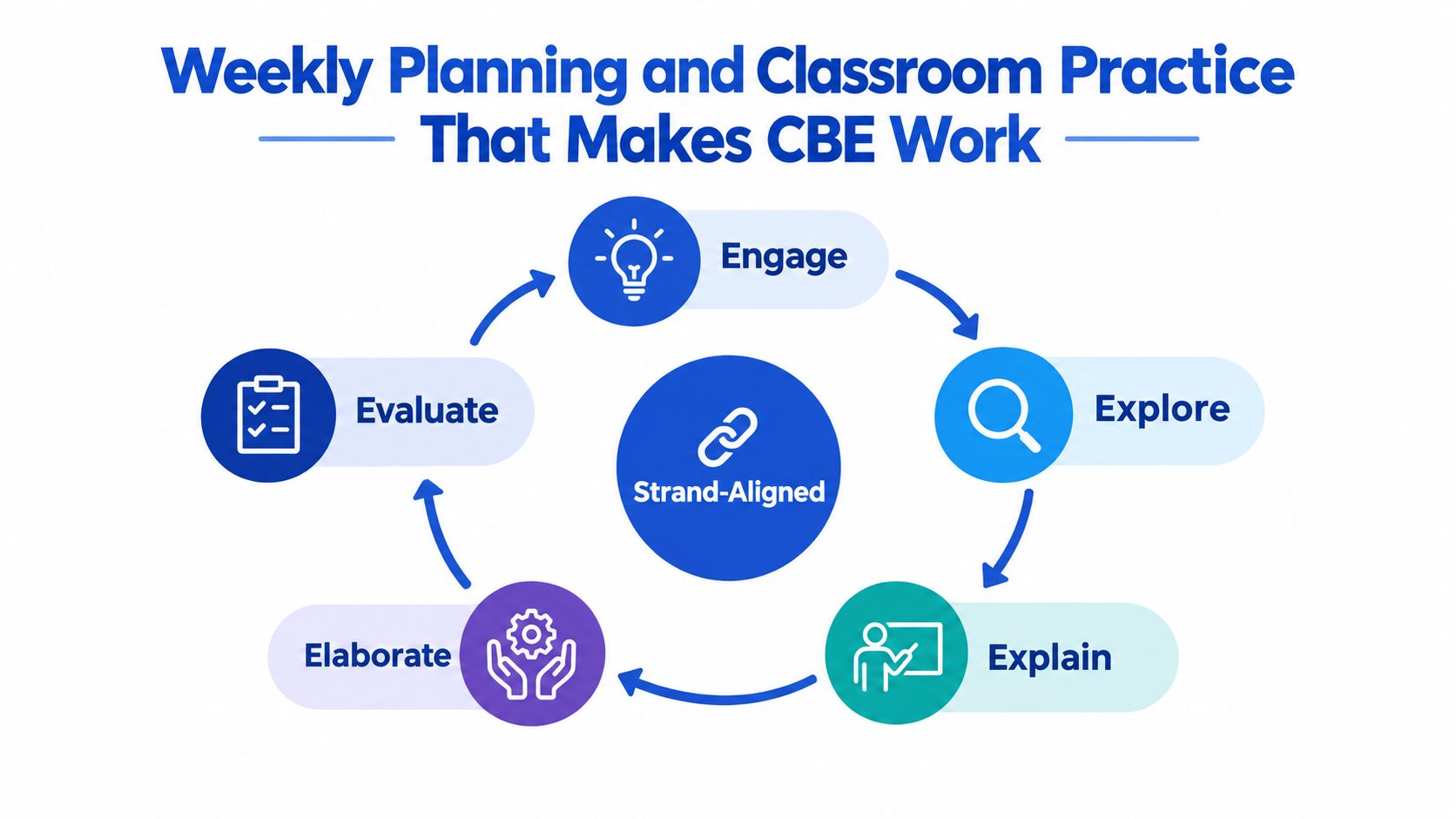
A workable classroom loop
Many teachers already teach in a pattern close to this, even if they don't name it formally.
Engage. Begin with something that wakes up prior knowledge. A local example, a quick object, a short question, or a familiar problem works well.
Explore. Let learners try, observe, discuss, sort, compare, test, or predict. They begin thinking with their hands and words, not only copying notes.
Explain. Bring the class together and name the concept clearly. Correct misconceptions while they are still small.
Elaborate. Give a task that applies the learning in a new way. Competency becomes visible.
Evaluate. End with a short check linked to the same strand. It can be oral, written, practical, or a brief quiz.
A strand-aligned planning approach such as a CBC lesson plan workflow for Kenya can help teachers keep these steps tied to the exact curriculum item being taught.
What to do with weak-strand evidence
The most useful CEA is not the one that produces the neatest mark list. It is the one that tells the teacher what to do next Monday.
If several learners struggle with the same sub-strand, reteach that part differently. Use a simpler example, pair stronger and weaker learners, change the task format, or give another short practice before moving on.
If only a few learners struggle, the class doesn't always need a full repeat lesson. Small group support may be enough.
“This week's CEA is next week's lesson guide.”
That sentence captures the CBE classroom better than long policy language.
Planning under real Kenyan conditions
Independent Kenya-based research on CBC implementation found strong links between implementation quality and operational constraints. One junior secondary study reported resource deficiencies at 85.4%, inadequate access to teaching technologies at 85.2%, teacher expertise gaps at 87.8%, and difficulty assessing learning outcomes effectively at 69.5%. The same research also noted that inadequate infrastructure, limited instructional materials, and weak teacher preparedness affected implementation, and it recommended regular in-service support and better resourcing (Kenyan field evidence on implementation constraints).
That research matches what many teachers already know from experience. A useful workflow must assume shared devices, weak connectivity, uneven training, and limited preparation time. In such settings, low-data tools, offline access, projector-ready lesson delivery, and guided CEA workflows are not luxuries. They are practical supports.
One example is Keybaki, which offers a Nairobi-built planner, curriculum library, and strand-mapped CEAs for Grades 7 to 12. Its classroom design follows the weekly loop of planning, teaching, and evaluation, and it supports constrained devices and offline cache.
How Parents and Students Can Track Mastery at Home
Many parents feel guilty because they can't sit beside a learner every evening, explain every topic, or buy every extra material. Under CBE, support at home doesn't need to look like full-time tutoring.
The home role is not to replace the teacher
The parent's job is usually simpler than it sounds. Watch for patterns. Ask specific questions. Help the learner build a routine. Follow the strand that needs support.
Recent Kenyan reporting has highlighted a real burden on families. Parents have reported struggling with the cost of materials, limited time to support homework, and poor sensitisation about their role. The same coverage notes that some teachers were still reported as using older 8-4-4-style testing habits despite CBC's practical direction (Kenyan reporting on parent burden and implementation friction).
That means families need realistic habits, not perfect ones.
A simple weekly home routine
A home routine can be short and still help.
- Ask about one weak area: “Which strand felt hard this week?”
- Check one piece of evidence: a book, task, correction, short quiz, or teacher note
- Give one focused practice slot: even a short revision period can help when it matches the actual strand
- End with reflection: “What can you now do better than last week?”
This kind of support works better than general pressure.
What students can do for themselves
Learners also need to stop thinking only in subject totals. A practical learner asks:
- Which strand am I improving in?
- Which sub-strand still confuses me?
- Can I explain this without copying notes?
- Can I solve a similar task on my own?
A strand-based learner portfolio helps with this because it turns revision into a map instead of a guessing game. A guide such as this learner portfolio approach for CBC mastery tracking can help families organise work by evidence rather than by loose piles of exercise books.
The strongest home question is not “Did you finish homework?” It is “What can you do now that you couldn't do before?”
If there are several children in one home
Many Kenyan homes support more than one learner at the same time. That makes long supervision difficult. In that case, don't try to manage every subject every day.
Choose one evening for checking progress. Let each child identify one strong strand and one weak strand. Keep the conversation short and regular. Consistency helps more than intensity.
For learners, this reduces panic. For parents, it turns support into a habit instead of a burden that only appears before exams.
Putting It All Together Your Next Steps With CBE
The clearest way to understand CBE is to stop seeing it as a set of new words and start seeing it as a connected weekly loop. A teacher plans from a strand. The class learns through activity and explanation. A CEA checks what stuck. The weak areas shape the next lesson. The learner and parent then respond to the same evidence at home.
That is why CBC explained Kenya cannot end with philosophy alone. The system lives in ordinary routines. Sunday planning. Tuesday delivery. Friday checks. Weekend revision. Next week's reteaching.
If you're a teacher, begin with one class and one strand. Track the evidence more carefully than the marks. Notice what your CEA is telling you to reteach.
If you're a parent, ask fewer broad questions and more precise ones. Don't ask only whether your child passed. Ask which strand needs another look.
If you're a school leader, help teachers reduce duplication. A good process is one where planning, teaching, assessment, and reporting support each other instead of competing for time.
If you're a learner, remember this. A weak strand is not a fixed label. It is a signal. It tells you where effort should go next.
CBE works best when everyone uses the same map. One strand at a time. One CEA at a time. One weekly review at a time.
Keybaki gives Kenyan teachers, parents, students, and schools one shared CBE workflow for Grades 7 to 12. It links strand-based lesson planning, classroom delivery, CEAs, and home mastery tracking so the same weekly evidence can guide the next lesson instead of being lost in separate files. If you want to see how that looks in practice, visit Keybaki.
Comments
Loading…