· CBC lesson plan
CBC Lesson Plan: A Practical 5E Guide for Grades 7–12
17 min read
Tuesday morning starts with a familiar squeeze. A teacher has the KICD curriculum design open on a phone, a printed scheme of work spread across the desk, and a 40-minute period already eaten by attendance, movement, and shared materials. The task is to fit the CBC approach into the time that is left.
A practical CBC lesson plan ties the strand, learner outcome, activity, and evidence together. It has to hold up in a crowded room, with limited devices, weak connectivity, and learners who may only have one family phone at home. It should also feed the next lesson, because the assessment from this lesson is what shapes the one after it.
Table of Contents
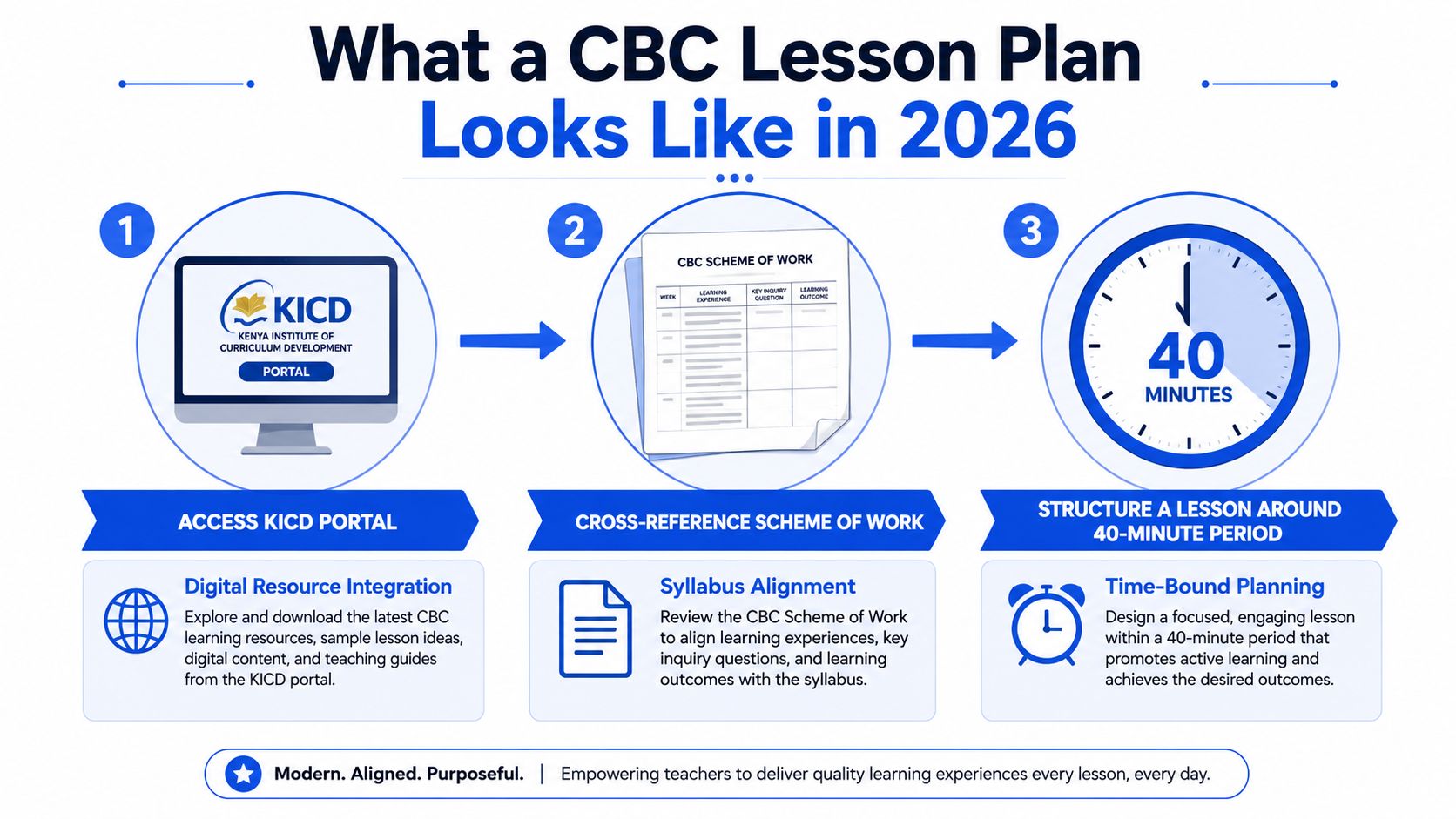
- What a CBC Lesson Plan Looks Like in 2026
- Writing Objectives Tied to Strands and Sub-Strands
- Drafting the Five 5E Blocks for a Real Period
- Differentiation Strategies Inside One 5E Plan
- The Weekly Planning Loop From CEA to Next Lesson
- Classroom and Home Workflows for Low-Bandwidth Realities
What a CBC Lesson Plan Looks Like in 2026
A workable CBC plan follows a closed loop:
strand → objective → 5E lesson → CEA evidence → next lesson
Every part has a job. The strand anchors the content, the objective defines the learner's performance, the 5E blocks organise the period, and CEA evidence shows what learners can do next. The following week's plan then responds to that evidence. This sequence also has to function with a shared family phone, a low-resolution projector, or printed materials when devices and connectivity are limited.
Kenya's curriculum transition makes this link more important. The first cohort of Competency-Based Curriculum learners entered Grade 9 on 6 January 2025, with transition to Grade 10 scheduled for 2026 and the first KCSE under the fully transitioned system planned for 2027, as reported in the Kenya News account of the national reforms. Junior secondary covers Grades 7 to 9, while senior secondary covers Grades 10 to 12, organised around STEM, Social Sciences, and Arts & Sports Science pathways.
A lesson therefore sits within a pathway, a strand, a sub-strand, and a sequence of assessment decisions. It connects to the work before it and supplies evidence for the work after it.
The weekly documents that must agree
A teacher normally produces or updates several connected artefacts:
- The scheme of work: This maps strands, sub-strands, outcomes, activities, resources, and assessment across the teaching period.
- The lesson plan: This turns one planned segment into learner activities, teacher prompts, resources, differentiation, and evidence.
- The assessment record: This captures what learners demonstrated during the lesson and where support is needed.
- The parental communication slip: This gives the learner and family a simple message about progress, practice, or a gap requiring attention.
Under 8-4-4, planning often centred more heavily on syllabus coverage and preparation for an end-of-cycle examination. CBC places greater weight on competencies, observable performance, continuous evidence, and learner activity. The practical constraints remain: periods are short, classes may be large, and resources are often shared.
Practical rule: Keep one planning thread. Repeat the strand and objective consistently in the scheme, lesson plan, assessment record, and home message.
Why 5E earns its place
The 5E sequence gives those documents a common spine. Engage activates prior knowledge, Explore gives learners something to investigate, Explain names and organises the idea, Elaborate transfers it to a new context, and Evaluate produces evidence.
A plan can include lively activities without showing what learners achieved. It can also include a useful assessment that bears little relation to the lesson. Linking each 5E block to a visible learner action keeps the activity and evidence together, without creating a template that adds paperwork but fails to inform the next lesson.
The practical test is simple. Another teacher should be able to see the strand, identify what learners will do, locate the evidence to collect, and teach the period with the available materials. That is a classroom-ready plan, rather than a file prepared only for checking.
Writing Objectives Tied to Strands and Sub-Strands
A CBC lesson plan starts with the strand. Before choosing activities, locate the grade, learning area, strand, and sub-strand in the KICD curriculum design, then read the intended learning outcome closely. A useful strand and sub-strand guide can clarify the terminology, but check the final wording against the relevant curriculum design.
The objective must state what learners will demonstrate and what evidence will show it. Use this pattern:
The learner will [observable verb] + [specific competency] + [evidence of mastery].
For a Grade 8 Agriculture lesson under the Food Production and Processing sub-strand, “Learners will understand food processing” is too broad. It names no performance and gives the teacher no clear basis for judging achievement.
A stronger objective is: “By the end of the lesson, the learner will describe a suitable food-processing method for a selected farm product and justify the choice in a short oral or written response.” The observable verb is “describe.” The competency involves selecting and reasoning about a method, while the justification supplies evidence. The final task is visible before the activity is chosen.
Keep the outcome teachable
A 40-minute period can support one main performance and, where needed, one supporting outcome. If learners must compare methods, they need the vocabulary and criteria first. If they must demonstrate a procedure, allow time for preparation, action, observation, and feedback. A long list of outcomes usually produces rushed teaching and weak evidence.
Write the CEA while drafting the objective. In the Agriculture example, pairs could complete a comparison table, followed by an individual explanation of why one method suits the selected product. The teacher then sees whether each learner can apply the idea, rather than merely copy a definition.
Copy-pasted objectives from online banks often break alignment with KICD. The wording may belong to another grade, strand, or level of difficulty. A polished sentence can still lead to the wrong classroom task, especially when the available materials or learner experience differ.
| Component | Example, Grade 8 Agriculture | What to Check |
|---|---|---|
| Verb | Describe and justify | Is the action observable? |
| Competency | Select a suitable food-processing method for a farm product | Does it match the sub-strand? |
| Evidence | Oral or written justification using a stated reason | Can the teacher collect and record it? |
Record a quick check in the scheme book: strand, sub-strand, verb, evidence. Then carry the same wording into the 5E blocks, the assessment record, and the home message. In a closed-loop CBC plan, the evidence gathered this week should shape the next lesson, whether the record is kept on a shared family phone, in a notebook, or through a low-resolution projector. If one part is missing, the objective is not ready for the 5E blocks.
Drafting the Five 5E Blocks for a Real Period
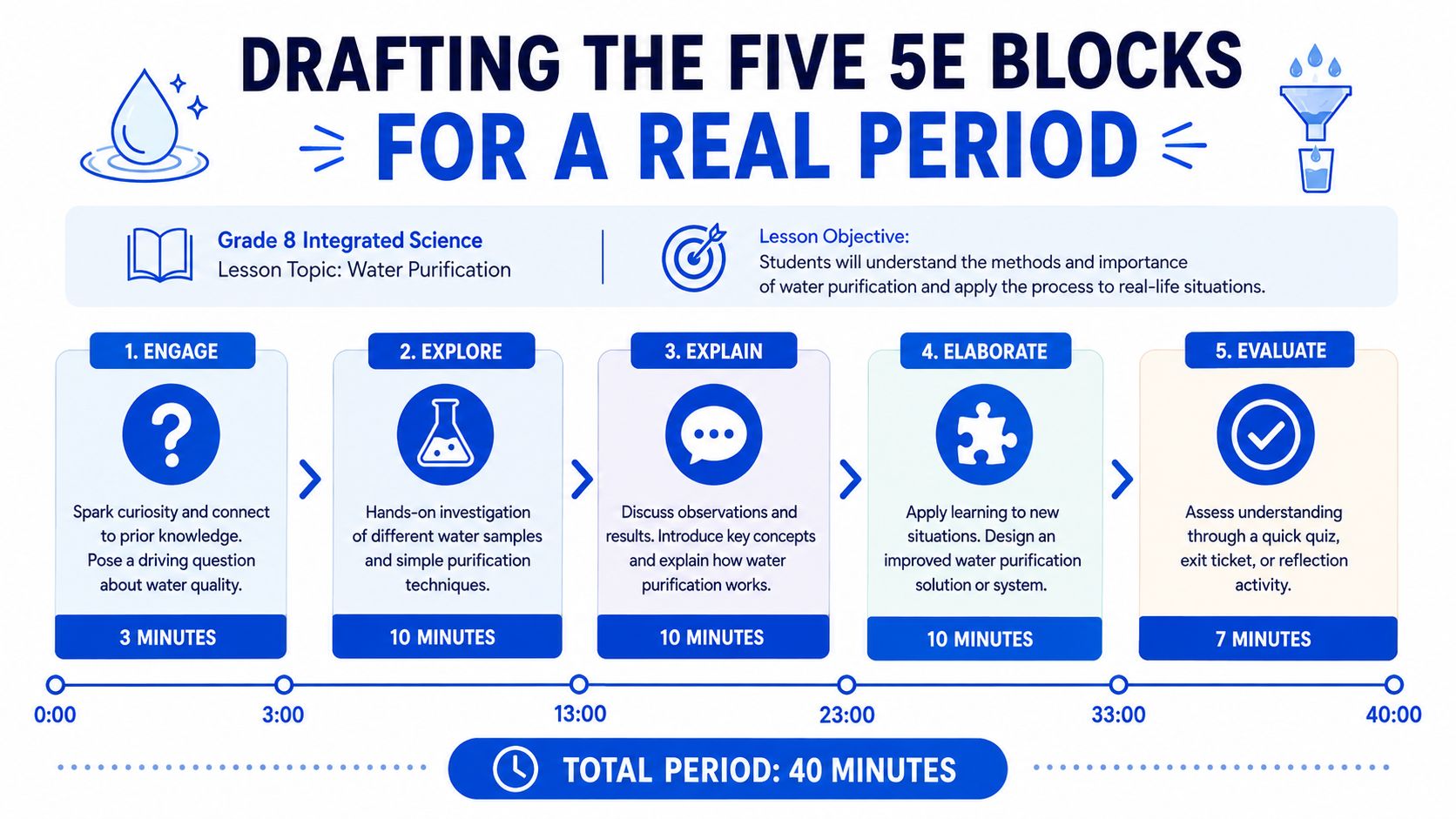
For Grade 8 Integrated Science on water purification, the resources can remain simple: sand, gravel, charcoal, a clear bottle, a container, water, and a board or printed diagram. The purpose is to observe filtration and distinguish it from wider household water-safety practices. The 5E blocks should fit the period, produce usable evidence, and leave a record that can guide the next lesson.
A workable 40-minute sequence
Engage, 3 minutes. Ask, “If muddy water passes through a bottle filled with sand and gravel, is it safe to drink?” Take two or three quick responses without correcting them. The question surfaces prior knowledge and gives learners a reason to investigate.
Explore, 10 minutes. In small groups, learners place gravel, sand, and charcoal in a clear bottle, pour the sample through, and observe the change. Each group records what changed and what remained. Learners handle the materials, compare observations, and discuss whether clearer water is automatically safe water. A shared phone photo or a low-resolution projected diagram can preserve the setup where materials are limited.
Explain, 5 minutes. Use a board sketch or printed diagram to name filtration, identify the role of each layer, and state the limits of the process. Ask learners to connect the vocabulary to what they observed. Keep the notes short, because the next block needs time for application.
Elaborate, 12 minutes. Give pairs a household water-safety situation. One pair might explain what filtration can do, while another suggests an additional treatment step or safe storage practice. Learners state the problem, propose an action, and give a reason. The task carries the idea beyond the bottle and shows whether learners can apply it in a familiar setting.
Evaluate, 10 minutes. Collect a one-page exit slip with a diagram label, one observation, and a short response to the safety question. Add an oral check by asking selected learners why clear water is not automatically safe. Record evidence against the objective, then note which response should shape the next lesson. The record can sit in a notebook, on a shared family phone, or in a simple class file.
The supplied visual shows a different allocation for the later blocks, with Explain, Elaborate, and Evaluate each shown as 10, 10, and 7 minutes within the same 40-minute period. Either split can work. Protect time for evidence rather than treating the timetable as fixed.
When the period collapses
If assembly or delayed movement removes time, shorten Elaborate first, but keep a brief Evaluate block. Use a two-question exit slip and one oral check instead of ending without evidence.
For an assembly day, use this fallback:
- Engage with one question.
- Explore through a teacher demonstration or quick group observation.
- Explain with three board points.
- Evaluate with one written response.
For a double period, retain the same sequence and expand Explore and Elaborate. Add a comparison of filtration materials, a learner-generated diagram, or a short household-safety presentation. The added time should strengthen evidence, not extend teacher talk.
The plan works when each block prepares the next. Without an observation from Explore, Explain turns into a lecture. Without an objective-linked Elaborate task, Evaluate becomes a random quiz. In a closed-loop CBC plan, the evidence from this period belongs in next week's planning, even when the only available tools are a shared phone, a notebook, or a low-resolution projector.
Differentiation Strategies Inside One 5E Plan
A mixed class can work from one CBC lesson plan when the teacher changes the support, not the strand outcome. Each 5E block should show who may need a prompt, a model, extra language support, or a more demanding application. This is practical in Kenya, where implementation research reports inadequate preparation, limited resources, overcrowding, and weak ICT infrastructure as recurring constraints. The same study recorded lack of administrative support at 88.7%, limited educational resources at 85.4%, inadequate technology access at 85.2%, overcrowded classrooms at 70.7%, and insufficient planning or adaptation time at 62.8% in its findings Kenya research on CBC implementation constraints.
In a water-purification lesson, emerging learners might receive labelled material cards or a partly drawn filtration diagram. Learners who finish early can compare the functions of the layers and explain the process limits. All learners still investigate the same scientific idea, produce evidence against the same objective, and work within the available period.
Change the support, not the destination
During Engage, accept an answer in English, Kiswahili, or the learner's strongest available language, then restate the key term in classroom English. During Explore, assign roles such as materials manager, recorder, observer, and reporter. Rotate the roles in later activities so one learner is not continually shielded from writing or speaking.
During Explain, use bilingual sentence stems such as, “Filtration removes ___ from water,” with familiar Kiswahili vocabulary where it supports understanding. The teacher is building a bridge into subject language while keeping the scientific term visible.
During Elaborate, set up stations or paired prompts with different levels of scaffolding. One card can provide decision criteria; another can ask learners to generate those criteria. The expected reasoning remains comparable because every learner connects an action to a reason. Practical differentiated instruction examples can help teachers prepare these variations before the lesson.
Assessment can vary in form while retaining the core demand:
- Emerging writers: Complete sentence stems and label a diagram.
- Oral learners: Give a paired verbal defence while the teacher records the response against the same criteria.
- Independent writers: Explain the process and its limitation in their own words.
- Fast finishers: Apply the reasoning to a new household situation.
| 5E Phase | Mixed-Ability Move | Multilingual Move | Low-Print Move |
|---|---|---|---|
| Engage | Offer an oral or drawn response | Accept a familiar-language answer, then recast key terms | Use a real object or demonstration |
| Explore | Provide labelled materials for learners needing support | Pair vocabulary with gestures and visible objects | Share one material set among groups |
| Explain | Give a partially completed diagram | Use English and Kiswahili sentence stems | Draw the explanation on the board |
| Elaborate | Add extension prompts for early finishers | Let pairs rehearse before reporting | Use one scenario card per group |
| Evaluate | Offer written or oral response routes | Clarify instructions in a familiar language | Use a shared board checklist |
In a low-device classroom, these moves can run from the board, exercise books, one shared phone, or a low-resolution projector. The teacher watches the evidence, changes a prompt, redistributes a role, or adds a concrete example without stopping the whole class. That adjustment keeps the 5E sequence tied to the strand and makes the next planning decision easier.
The Weekly Planning Loop From CEA to Next Lesson
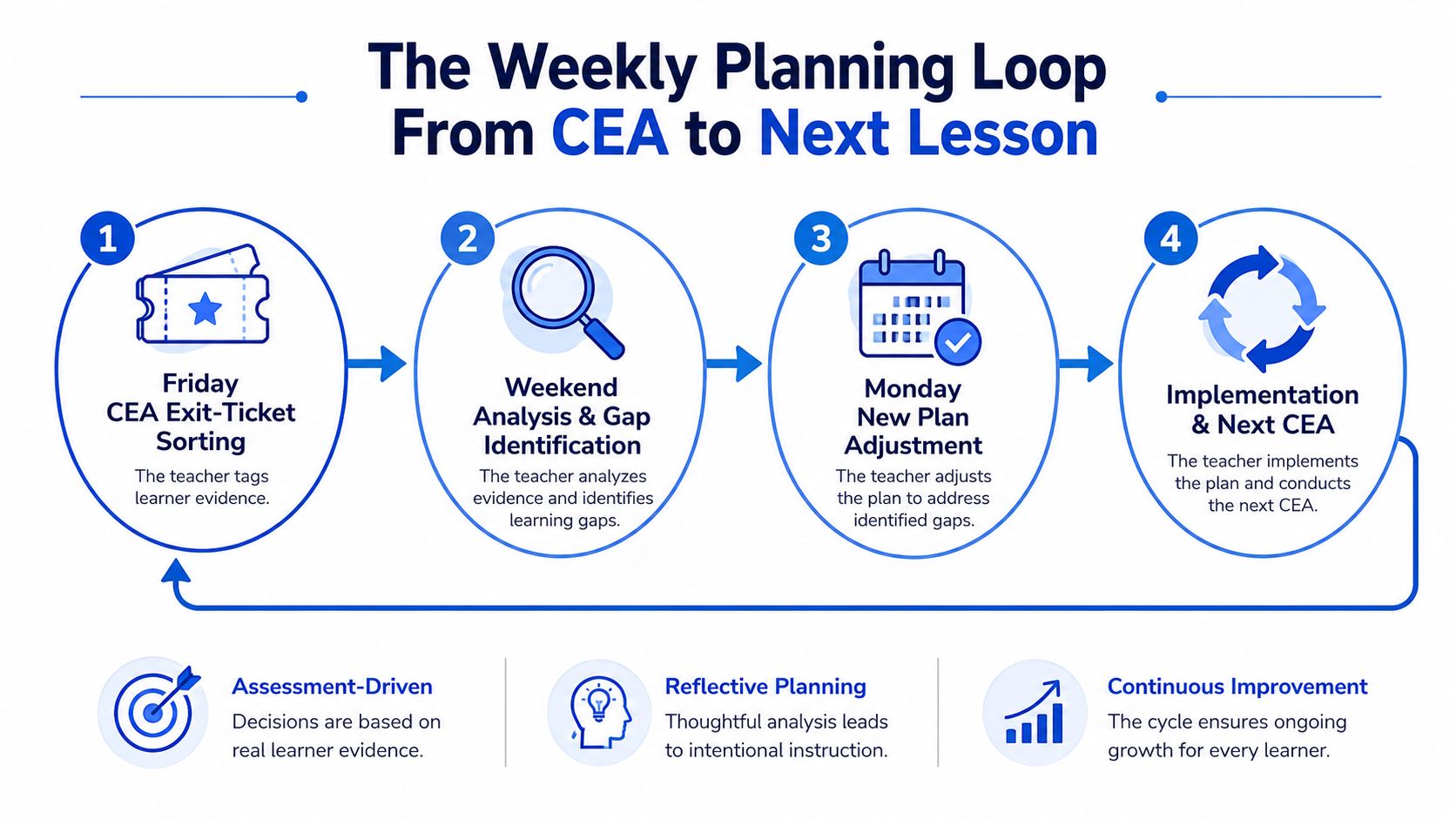
Friday's exit tickets become Monday's planning evidence when they are sorted against the strand, sub-strand, and evidence criterion named in the objective. Record the class-wide gap, then mark learners who need another explanation, a different representation, or closer practice. A short note is enough if it leads to a clear teaching decision.
A Grade 9 Mathematics example shows the loop. If many learners can substitute values but cannot solve linear equations, Monday's Engage prompt should expose that difficulty. The Explore block can then use a balance model or a visible sequence of inverse operations before learners work with symbolic equations. Keep substitution as one retrieval prompt. Give the weaker sub-strand the main teaching time.
A notebook version that works
Use four columns:
| Strand | CEA Score | Next-Week Action | Time Allocation |
|---|---|---|---|
| Linear equations | Record the class evidence | Rebuild the first Explore task around inverse operations | Main lesson focus |
| Substitution | Record the class evidence | Open with one retrieval prompt | Brief review |
| Graph interpretation | Record the class evidence | Add a pair-check during Elaborate | Targeted practice |
The record can stay in a notebook, spreadsheet, or school assessment file. The format matters less than the action. “Revise Mathematics” is too broad for Monday morning. “Use a balance model, solve one equation with a partner, and defend each step” tells you what to prepare and what to listen for.
A Kenya CBC implementation study reported that 66.5% of teachers said they had not been trained on CBC implementation, while 52.3% reported being incompetent in preparing schemes of work. It also linked weak schemes of work with defective lesson plans and records of work the Kenya CBC implementation study. The study reported low capacity to select suitable CBC teaching approaches, with a mean of 2.42 and standard deviation of 0.26. Group work and drama were used fairly often, with means of 2.54 and 2.63 respectively.
The practical lesson is to check the scheme before polishing the lesson template. Choose the method that fits the evidence, class size, available materials, and the 40-minute period. A formative assessment approach has value when the evidence changes the next prompt, grouping decision, or explanation.
Planning check: If Friday's evidence cannot change Monday's Engage or Explore block, the assessment is being stored rather than used.
Classroom and Home Workflows for Low-Bandwidth Realities
On Monday, the teacher should be able to teach even if the connection disappears. The lesson PDF, activity instructions, and CEA rubric can be cached offline the day before. In the morning, print only what must be held by learners, usually the exit ticket, one scenario sheet, or a diagram. Project the lesson structure if the screen is available, but keep the board version ready because a shared projector may lag when it handles heavy video.
A learner device shouldn't be a hidden prerequisite. Groups can work from one printed sheet, one textbook, or one teacher-led demonstration. If learners share a family phone, send the essential follow-up as a small text message or a compact document rather than assuming every learner can stream a lesson at home.
A Monday-to-Friday routine
Monday, pre-load. Cache the plan, the key diagram, and the assessment rubric. Open every file before class so you know it displays correctly on the available screen.
Tuesday, deliver offline. Run the five blocks with board notes, local materials, and printed prompts. Learners can participate fully without logging into anything.
Wednesday, handle shared hardware. If a projector is available, use it for a still image, worked example, or short visual. Don't let a slow video consume the period. A printed frame or board sketch can carry the same discussion.
Thursday, prepare the fallback. Keep a paper version of instructions, a non-digital activity, and a short formative check. This protects the lesson from a failed connection or unavailable device.
Friday, close the record. Mark the exit tickets, note the sub-strand gap, and log the evidence in a notebook first. Sync it later when connectivity returns, rather than delaying planning because the platform is unavailable.
Home access without a smartphone
For Elaborate work, give learners a printed task that can be completed with household observations, an exercise book, or a conversation with a parent or guardian. A learner without a smartphone can still describe a water-safety practice, solve a Mathematics problem, or explain a process in writing.
Parent communication should be short and actionable. A strand-based message can state what was practised, what the learner demonstrated, and what to discuss at home. Where families use USSD menus or M-Pesa messages, the communication must remain readable without a link, video, or large attachment.
The bandwidth budget is simple:
- Upload: The smallest essential lesson file, one activity sheet, and the CEA instructions.
- Cache: The full lesson plan, diagrams, examples, and rubric before entering class.
- Print: Only the exit ticket, shared task card, or material that learners must hold.
- Project: Still visuals and concise prompts, with board notes as the backup.
- Record: Scores and observations offline, then synchronise when the network allows.
A platform such as Keybaki provides a CBE-mapped library for Grades 7 to 12, a 5E lesson planner, projector-ready presentation, offline cache, English and Kiswahili content, and continuous assessments linked to strands and sub-strands. It can sit alongside a paper notebook and school scheme, rather than requiring every learner to own a device.
The goal isn't to make the classroom look digital. It's to keep the strand, activity, evidence, and next action connected when the network, screen, or family phone can't be relied on.
If you're spending Sunday rebuilding the same CBC lesson plan and still losing the link between assessment and next week's teaching, visit Keybaki to explore its strand-mapped 5E planner and continuous assessment workflow. Use it alongside your existing scheme, paper records, and classroom routines to prepare lessons that remain usable on shared devices and offline.
Comments
Loading…