· Keybaki
Learner Portfolio CBC: A Practical Guide for Kenyan Schools
17 min read

On Sunday evening, a Grade 8 teacher opens three exercise books, a folder of printed rubrics and a pile of half-completed assessment sheets. The task is to “update the portfolios” before Monday, but the papers don't show a clear learning story. Some entries have dates but no comments. Others show that a learner took part in an activity, yet give no evidence of what the learner understood or still needs to practise.
That experience is common in Kenyan schools. The learner portfolio in CBC is meant to support continuous evidence of progress, but it can easily become another reporting requirement. A useful portfolio should help a teacher decide what to reteach next week, help a parent understand a specific learning gap and help a learner recognise personal growth. The difference comes from how evidence is selected, reviewed and connected to planning.
Table of Contents
- Why Most Learner Portfolios Fail in Kenyan Classrooms
- What Evidence Belongs in a CBE-Aligned Portfolio
- Building and Maintaining Portfolios Week by Week
- Physical Versus Digital Portfolio Formats
- Common Pitfalls That Turn Portfolios Into Paperwork
- Privacy and Data Protection for Digital Portfolios
- Your Term-Long Portfolio Action Plan
Why Most Learner Portfolios Fail in Kenyan Classrooms
The instruction sounds simple: “Keep a portfolio for every learner.” The trouble begins when the school provides no shared method. One teacher saves activity photographs, another files marked assignments, and a third keeps assessment sheets in a cupboard. By term's end, the school may have plenty of paperwork but little evidence that can be compared, discussed or used to plan teaching.
Kenya's curriculum framework describes a portfolio as a purposeful and systematic collection of work samples, self-assessments and goal statements that demonstrates progress over time. It also refers to major learning activities, assessment projects and relevant documents, with teachers and learners reviewing the contents periodically. The KICD Basic Education Curriculum Framework points to an active working record, not a decorated file stored for inspection.
Activity versus evidence: what proves learning
A photograph of a group building a model confirms participation. It does not show whether a learner can explain the scientific principle, interpret results or improve the design. An English poster shows an output. Its value increases when the entry also identifies the learning objective, includes a rubric comment and records the learner's reflection.
Practical rule: Keep an entry only if another teacher or parent can see what was attempted, what was achieved and what should happen next.
The collection process also matters. Teachers who wait until the end of term often find that learners have forgotten the purpose of their work, scores must be reconstructed and missing evidence cannot easily be replaced. A thick file can therefore appear complete while showing little reliable progression.
Make the portfolio answer three questions
A lightweight portfolio should answer three questions for every selected entry:
- What was the learner expected to demonstrate? Name the strand, sub-strand or competency.
- What evidence was produced? Attach the work sample, assessment record or documented performance.
- What happens next? Add a short teacher comment, learner reflection or follow-up activity.
Use the same structure in a physical folder, spreadsheet or digital platform such as Keybaki. The format matters less than whether the record leads to a teaching decision. In a low-resource classroom, one carefully chosen entry each week is more useful than a file filled with every worksheet.
This approach also improves parent communication. Instead of saying that a learner is “weak in science”, a teacher can show an energy investigation, identify the uncertain skill and suggest a suitable classroom or home activity.
The strongest portfolios become part of weekly teaching. A teacher reviews a small group of entries, spots a recurring misconception and adjusts the following lesson. A learner selects one piece to improve and writes a realistic goal. A parent sees progress through evidence rather than file thickness. The portfolio earns its place when it closes the loop between assessment and next-week planning.
What Evidence Belongs in a CBE-Aligned Portfolio
A useful CBE-aligned portfolio is selective. It contains evidence tied to an intended competency, not every worksheet a learner completes. Kenya's curriculum guidance connects assessment over time with projects, journaling, profiles and portfolios, and expects learners, with teacher support, to build a record of performance as competencies are taught. The selection should therefore begin with the learning objective, followed by evidence that makes the objective visible.
Work samples
A work sample may be written, drawn, recorded or created digitally. In Grade 9 Integrated Science, a learner studying energy might include a labelled design, investigation observations and a short explanation of how energy changes form. The value lies in the reasoning shown, not in proof that the learner attended the activity.
In Grade 10 English, a journal entry can connect to a particular sub-strand. The learner might submit an early draft, a revised paragraph and a reflection explaining how feedback improved clarity or organisation. Together, the drafts show development more clearly than a final mark alone.
Assessment records
A mathematics continuous assessment record belongs in the portfolio when it connects the score to the skills assessed. Include the task, relevant strand, teacher comment and learner response to errors. A score without context is difficult to interpret. A marked problem-solving task that identifies a misconception gives the next lesson a clear starting point.
Early-grade CBA guidance requires portfolio entries to include work samples for each sub-task, teacher scores and comments, learner reflection, and the date each sub-task was completed and assessed. It allows a portfolio to be physical, electronic or both. The KNEC portfolio guidance offers secondary teachers a useful standard, particularly its attention to dates and comments.
Reflection and goals
Self-assessment needs specific language. “I did well” gives little direction. “I can calculate simple ratios, but I still confuse the units when explaining my answer” tells the teacher what to address. A goal should identify the next skill and the evidence that will show improvement.
Use a simple entry format:
| Portfolio field | Example |
|---|---|
| Learning focus | Explain energy transformation |
| Evidence | Investigation notes and labelled model |
| Teacher comment | Explanation identifies the input energy but misses the output |
| Learner reflection | I need to explain what happens after the transformation |
| Next action | Revise the explanation and discuss it with a partner |
Participation evidence has a place in performance, creative and collaborative tasks. Pair it with an artefact, observation note, rubric or reflection that shows learning. Teachers matching evidence to competency descriptors can consult this guide to CBC assessment rubrics.
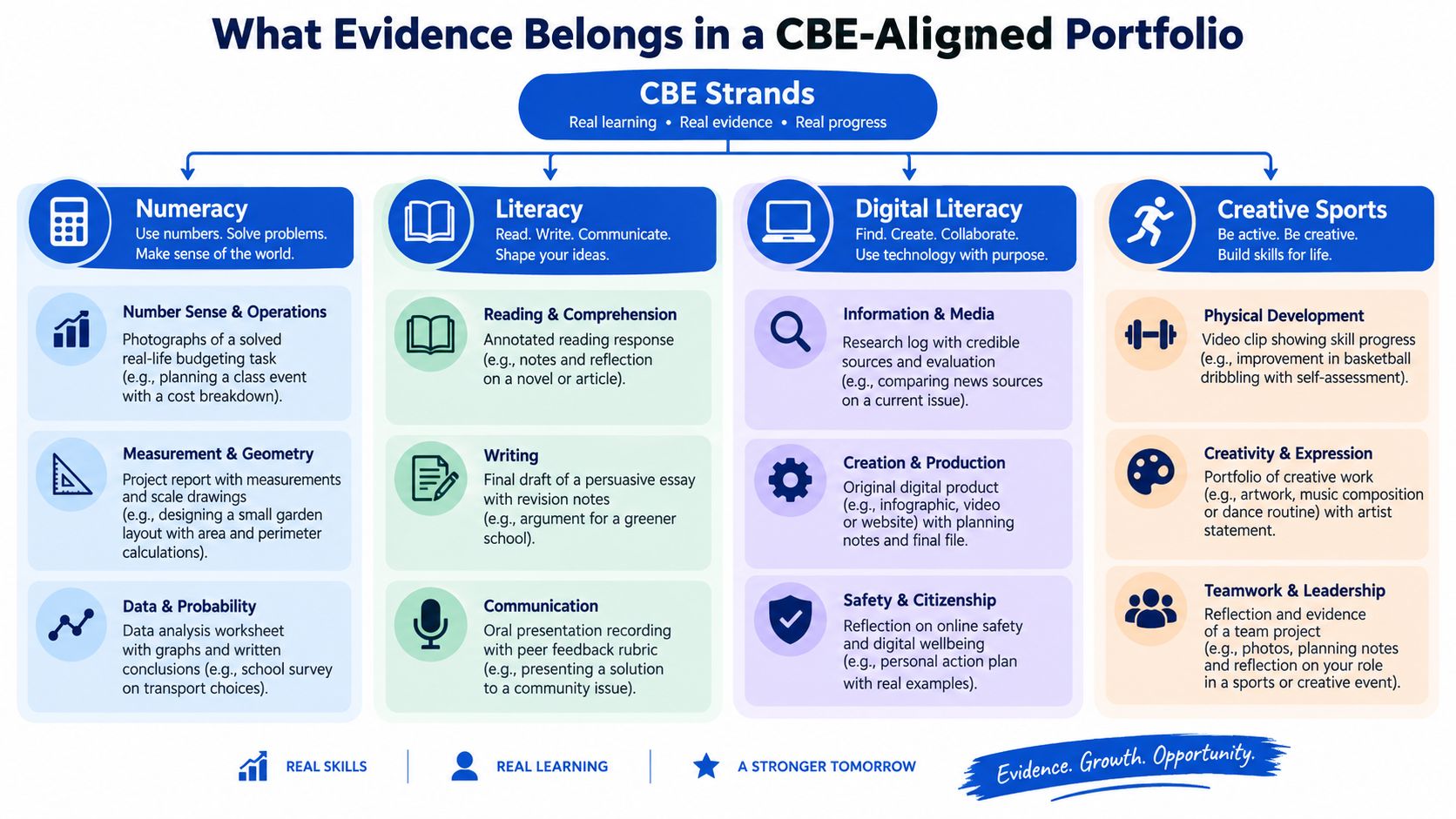
A practical test is to ask whether an entry explains achievement, shows progress or points to the next teaching response. If it does none of these, leave it out of the core portfolio. One well-chosen weekly entry can support planning better than a file packed with unexamined worksheets.
Building and Maintaining Portfolios Week by Week
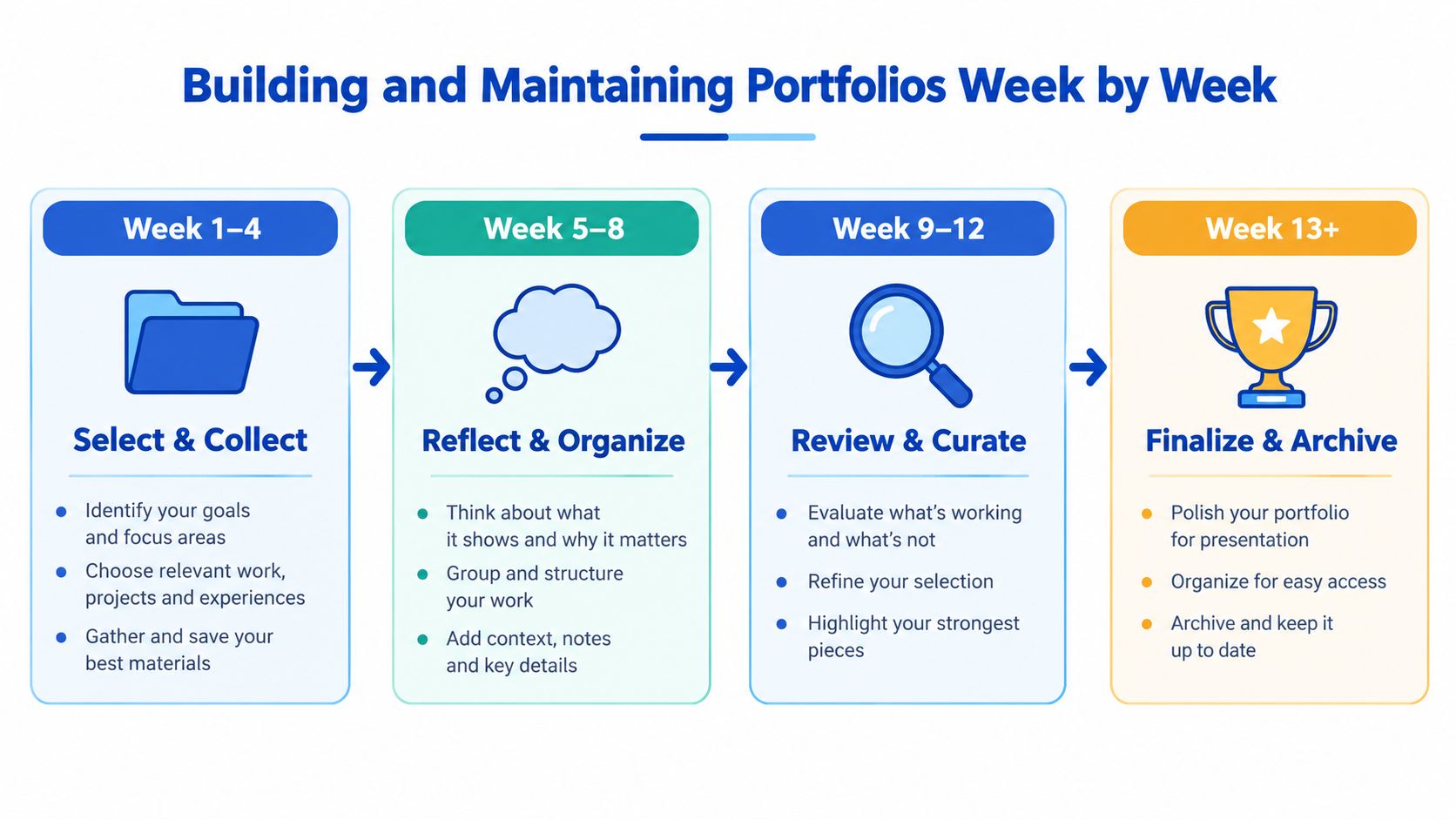
A portfolio becomes manageable when the school treats it as a routine rather than a special project. KNEC's staged process begins with selecting learning objectives, introducing the portfolio to learners and collecting samples, then moves through presentation, reflection and stakeholder involvement. Research on portfolio use in Bungoma County also highlights teacher training as an important condition for consistent use.
A workable weekly rhythm
At the beginning of a teaching cycle, select the objectives that need portfolio evidence. Don't promise to archive everything. A teacher might choose one investigation in Integrated Science, one extended writing task in English and one problem-solving task in Mathematics, provided each selection represents a meaningful learning focus.
During the teaching week, tell learners what evidence they're collecting and why. Give each sample a clear label with the learner's name, date, subject, strand or sub-strand and task. In a physical system, use a cover sheet or divider. In a digital system, use the equivalent fields.
Set aside a short review period before the week ends. The teacher records a concise comment, the learner completes a reflection and any missing information is corrected while the task is still fresh. A comment such as “revise” isn't enough. “Your graph has the correct values, but the axis labels are missing” guides action without creating a long marking exercise.
The weekly checklist
- Select: Identify the learning objective that will generate evidence.
- Explain: Tell learners what a useful portfolio entry includes.
- Collect: Save one representative work sample or assessment record.
- Tag: Add the date, subject, strand and sub-strand.
- Respond: Record a focused teacher comment.
- Reflect: Ask the learner what was easy, difficult or worth improving.
- Plan: Use the pattern of errors to shape the next lesson.
- Review: Share selected progress with a parent, mentor or department lead when appropriate.
For a low-resource classroom, the process can run with exercise books, manila folders and a class register. The important feature isn't the technology. It's the regular connection between evidence and teaching decisions. A school can also combine formats, keeping large physical artefacts in the classroom while recording photographs, reflections and assessment summaries electronically.
Review in batches, not at the deadline
A weekly sample is more useful than a large end-of-term sorting exercise. Department teams can agree on a minimum structure, moderate selected entries and identify gaps before reports are due. Learners should also curate their own work. They can choose a strong piece, a piece that improved after feedback and a piece that shows a current target.
The teacher remains responsible for assessment judgement, but learners should understand the record and contribute to it. That shared responsibility is what turns a portfolio from a file held by the school into evidence owned by the learner.
Physical Versus Digital Portfolio Formats
Kenya's CBA guidance allows portfolios to be physical, electronic or a combination of both. The right choice depends on the school's resources, the type of evidence being collected and who needs to review it. A physical folder may be the most practical starting point for artwork, handwritten drafts and three-dimensional projects. A digital record is often easier for searching, sharing and connecting assessment results to planning.
| Consideration | Physical portfolio | Digital portfolio |
|---|---|---|
| Storage | Requires labelled folders, shelves and classroom space | Uses managed digital storage, but depends on device access |
| Durability | Can be damaged, misplaced or affected by handling | Can preserve copies, but requires account and backup controls |
| Access | Immediate when the file is present | Can support remote review when connectivity and permissions allow |
| Evidence type | Strong for handwritten and physical work | Strong for audio, video, photographs and linked assessments |
| Review burden | Manual sorting and cross-referencing | Easier to search when entries are consistently tagged |
| Privacy | Physical access must be controlled | User permissions, secure sign-in and data governance are essential |
A digital platform doesn't automatically solve poor portfolio practice. If teachers upload every worksheet without a strand, comment, or next action, the school has moved clutter from a cupboard to a screen. Digital tools work when they enforce useful fields and make evidence easier to retrieve.
Connect assessment to planning
The greatest practical benefit comes when assessment and planning share the same curriculum structure. If a teacher records a CEA result against a strand or sub-strand, the next lesson can respond to that information without manually comparing several files. A platform such as Keybaki combines a CBE-mapped library for Grades 7 to 12, Continuous Evaluation Assessments and a lesson planner, with learner and parent views that present weak-strand information and revision activities. Its value for portfolio work lies in connecting the evidence record to the next teaching decision, rather than storing an isolated digital folder.
That connection also supports parent communication. A weekly weak-strand briefing can give a family a clearer starting point than a general statement that a learner needs to work harder. Parents can see the area requiring attention and support a focused revision activity without trying to recreate the teacher's work.
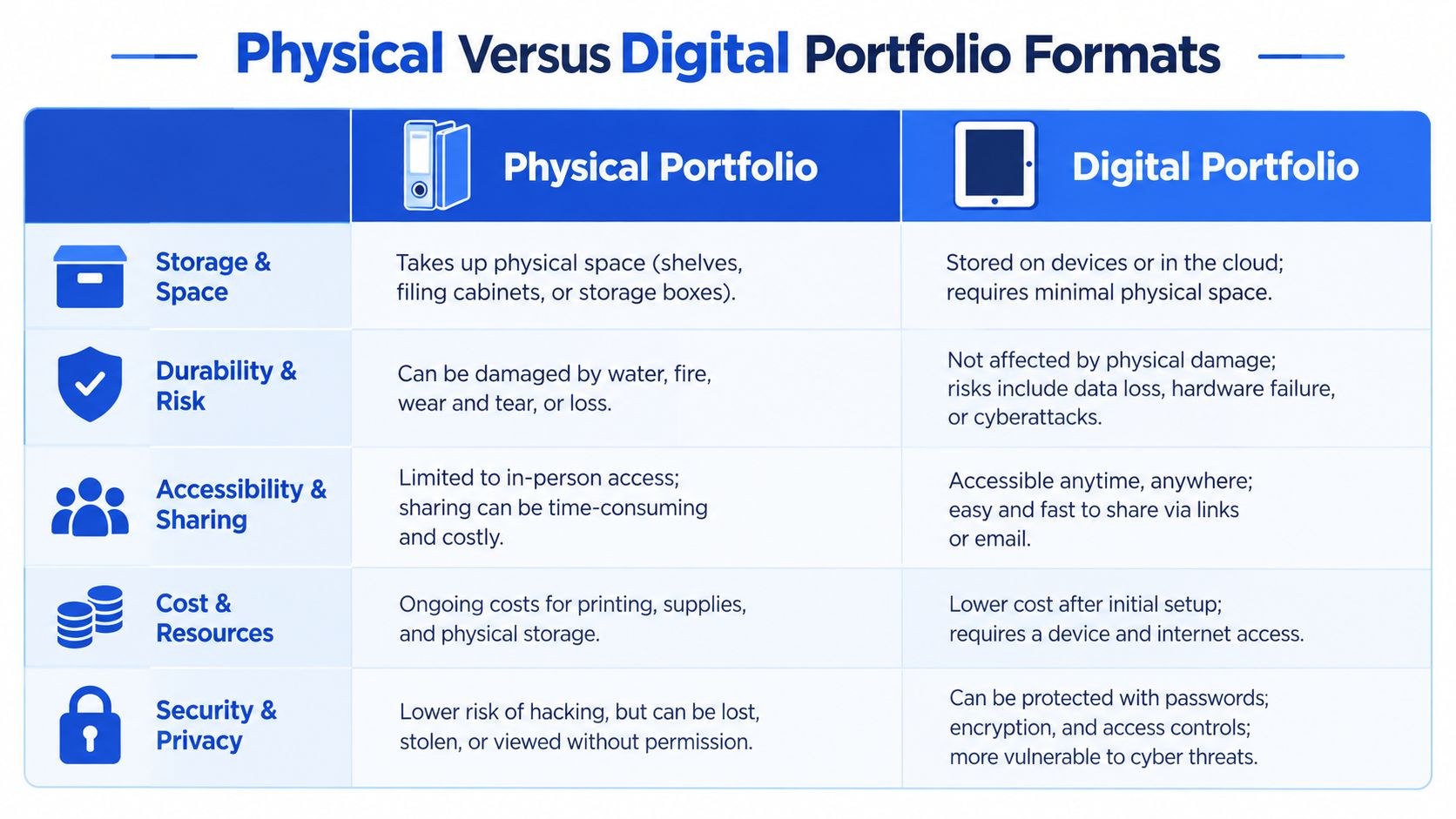
The choice needn't be ideological. Many Kenyan schools will get better results from a hybrid system, physical for work that must be handled and digital for indexing, reflections, assessments and parent visibility. Before adopting any platform, test whether teachers can enter evidence quickly, learners can access their own records and school leaders can review the basis of a judgement.
For schools considering broader digital delivery alongside portfolios, this overview of CBE e-learning in Kenya gives useful context for evaluating access, classroom use and home support.
Common Pitfalls That Turn Portfolios Into Paperwork
The biggest operational failure is not the portfolio idea. It's the absence of an agreed answer to a basic question: what counts as sufficient evidence? Research on Nairobi secondary-school e-portfolios treated portfolio assessment as an authentic model, but its attention to content requirements and design reflects the need for consistent structure across schools. The Nairobi e-portfolio research is relevant because a digital format still needs clear evidence rules.
Baringo County findings add another warning. Learners weren't being guided to build showcase portfolios, which weakened the monitoring of progress over time. When students are passive recipients of folders, they don't learn how to select evidence, explain improvement or set a next goal.
Failure patterns teachers can identify quickly
The activity album contains photographs of group work, attendance records and certificates. It looks busy, but it doesn't show the learner's individual contribution or understanding. Fix it by attaching a brief observation, the learner's product and a criterion-based comment.
The mark register stores scores without the task or competency. It tells you that a learner received a result, but not whether the difficulty came from interpretation, calculation, communication or application. Keep the task reference and one concise diagnostic note.
The end-term dump gathers work after teaching has moved on. The evidence may be authentic, but its instructional value has disappeared. Set a weekly collection point and use the review to adjust the next activity.
The teacher-only file keeps learners and parents outside the process. Learners then see portfolios as inspection documents rather than records of their own growth. Give them responsibility for reflections and selected entries, while the teacher retains professional judgement.
Create a minimum viable structure
A school doesn't need identical content in every subject, but it does need consistent fields. Agree that each core entry will contain:
- The learning focus and curriculum location.
- The date and task description.
- The learner's work or performance evidence.
- A teacher score, rubric or observation comment.
- A learner reflection or goal.
- The next action, where further support is needed.
Review the structure with teachers before introducing it to learners. If a field doesn't inform teaching, reporting or reflection, remove it. The purpose is not to create a perfect archive. It's to create an auditable, readable record that can support a real decision.
Privacy and Data Protection for Digital Portfolios
A learner portfolio contains personal information, performance records and often photographs, audio or video. Moving from a physical file to a digital platform doesn't remove the school's responsibility. It makes access, consent, storage, correction and deletion decisions more visible.
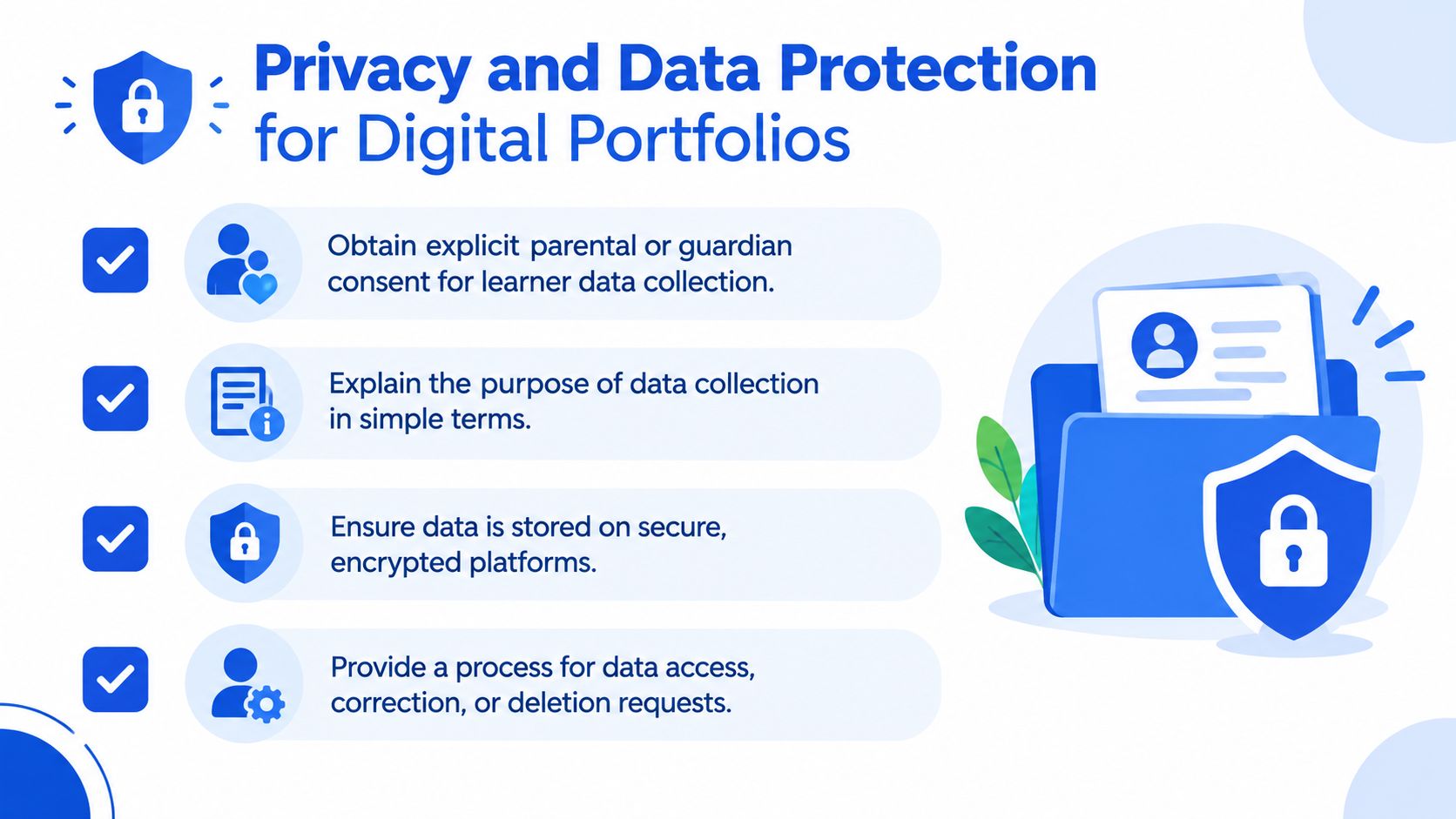
Begin by identifying what the school needs. A portfolio usually requires learner identification, curriculum evidence, assessment comments and controlled stakeholder access. Avoid collecting unrelated details because a form allows it. Explain the purpose in language that parents and learners can understand, and document the consent process where personal data or media requires it.
Set access by role
A learner should see personal work and feedback. A parent or guardian should see the records connected to their child. A subject teacher needs access to the learners and subjects they teach, while a school leader may need broader oversight for moderation and quality assurance. Shared family phones require particular care. A multi-child profile should not expose one learner's records when another child signs in.
Use individual profiles, strong authentication and PIN-based separation where appropriate. Staff should also know what happens when a teacher changes school, a learner transfers or a parent loses access. A simple access register and clear handover process prevent old accounts from remaining active.
Check the platform and school process
- Consent: Record the appropriate parental or guardian consent for collecting and using learner data.
- Purpose: Tell families why the data is collected and how it supports learning.
- Security: Confirm that the platform uses suitable safeguards, secure authentication and protected storage.
- Permissions: Limit access to the people who need the information for teaching, support or oversight.
- Accuracy: Provide a way to correct an incorrect name, score, comment or uploaded file.
- Retention: Define how records are handled when a learner transfers, completes schooling or requests deletion where applicable.
- Export: Make sure the school can retrieve a usable record rather than being locked into one provider.
- Offline use: Check how cached entries synchronise after connectivity returns and how duplicate records or conflicts are resolved.
The Kenya Data Protection Act guide can help school leaders frame these questions. Privacy should be part of the workflow from the first upload, not an issue addressed after a device is lost or an unauthorised person views a learner's record.
Connectivity also needs a practical plan. A school with unstable internet should decide which tasks can happen offline, how staff confirm a successful sync and where temporary physical notes are stored. A digital portfolio is dependable only when its recovery process is as clear as its upload process.
Your Term-Long Portfolio Action Plan
A term-long plan works when each person has a small, clear responsibility. The teacher selects useful evidence and responds to patterns. The learner explains the work and chooses goals. The parent reads the record and supports the next step without taking over the assignment.
Teacher checklist
At the start, agree on portfolio fields and choose the learning objectives that need evidence. During weekly teaching, collect representative samples, record the curriculum location and add a focused comment. Before the next week begins, review patterns in the evidence and adjust grouping, practice or reteaching.
Keep department moderation practical. Teachers can compare selected entries, discuss whether the evidence supports the judgement and resolve differences in how rubrics are interpreted. The portfolio should make this conversation easier because the work and comments are visible.
Learner checklist
Learners should label their work, keep drafts where improvement matters and write reflections that name a specific strength or difficulty. They can select evidence that shows achievement, progress after feedback and a current learning target. A useful goal is connected to a competency and can be checked through later work.
This habit also prepares learners to discuss their learning with adults. “I'm weak in Mathematics” becomes “I can solve the first part of the problem, but I need more practice explaining the final step.”
Parent checklist
Parents should look for the learning focus, evidence, teacher comment and next action. Ask the learner to explain one selected entry and describe what changed between an earlier and later attempt. Weekend support should reinforce the identified skill through reading, discussion, practice or revision, not duplicate the teacher's entire lesson.
A portfolio is working when meetings become more specific, teachers spend less time reconstructing evidence and learners can explain their own goals. It should also make continuous assessment more useful by showing which strands need attention and whether later work responds to that need. The strongest sign isn't a thicker file. It's a clearer teaching decision the following week.
Keybaki connects CBE-mapped lessons, continuous assessments, learner evidence and weekly weak-strand feedback in one shared workflow for teachers, parents and learners. Visit Keybaki to see how a digital portfolio can support practical planning and clearer progress conversations in your school.
Comments
Loading…