· CBE assessment methods
CBE Assessment Methods for Grades 7 to 12
18 min read
A Grade 8 teacher starts the week with more than lesson notes. There are exit tickets to read, SBA folders to organise, practical work to prepare, and learners who reached different levels of understanding on Friday. The difficult question isn't whether to assess. It's which CBE assessment method should produce useful evidence this week, and how that evidence will guide the next lesson.
Kenya's framework for Junior Secondary School and pre-vocational CBE requires both formative and summative assessment. Formative assessment is delivered through School Based Assessment, while summative assessment includes national assessment, with approved methods ranging from projects and inquiry to collaborative, differentiated, computer-based and authentic assessment. The Guidelines for Implementation of Junior Secondary Education place these methods within classroom practice, not only at the end of a cycle.
The practical challenge is closing the loop. A teacher needs to plan an assessment, collect evidence, score it fairly, identify the weak strand, and use that finding in the next teaching cycle without retyping the same information. A weekly workflow on Keybaki can connect those stages, while still leaving professional judgement with the teacher.
Table of Contents
- What a Grade 8 Teacher Actually Does on Monday Morning
- The Six Core CBE Assessment Methods Explained Simply
- Comparing Methods, Workload, and Best Grade Bands
- Real Classroom Examples and Rubrics for Grades 7 to 12
- Scheduling Assessments Across a Real CBE Week
- How Each Method Connects to KJSEA and Senior School Scores
- Keeping CBE Assessment Fair Across Schools With Different Resources
- A Practical Checklist for Teachers, Parents, and Students
What a Grade 8 Teacher Actually Does on Monday Morning
At eight o'clock on Monday, Ms Wanjiku has last Friday's exit tickets spread across her desk. Most learners identified the difference between sandy and clay soil, but several confused permeability with water retention. Beside the tickets sits a stack of SBA folders for a science investigation, each learner's previous observation notes, and the lesson plan for the new week.
She begins by sorting the tickets like beans. One pile contains learners who can explain the idea and apply it. Another contains learners who remember a definition but can't use it in a new example. The final pile needs a short reteaching activity before the class moves ahead. This simple sorting exercise turns a general impression into an instructional decision.
Next, she balances the week like a market tray. A quick formative check will show whether learners understand the starting point. A performance task will reveal what they can do with the knowledge. A portfolio entry will preserve development over time. A peer review will let learners examine quality using a shared checklist, while a CEA will provide a short, focused check of the strand.
The Monday decision
Ms Wanjiku doesn't give every learner the same type of task because it's familiar. She asks:
- What needs diagnosing? An entry ticket or oral question may be enough.
- What needs seeing? An observation schedule can capture behaviour during a practical activity.
- What needs comparing over time? A portfolio is more useful than a single mark.
- What needs a common check? A written task or CEA can provide a consistent reference point.
- What needs learner ownership? Self and peer assessment can make the success criteria visible.
On Keybaki, she records the selected assessment against the relevant strand and prepares the week's sequence. Her Friday scores won't sit in a separate notebook. They'll show which learners met the intended competency, which evidence is missing, and which strand should return to Monday's plan.
That is the shift from assessment as paperwork to assessment as a weekly teaching tool. The six methods below become manageable when each has a clear job.
The Six Core CBE Assessment Methods Explained Simply
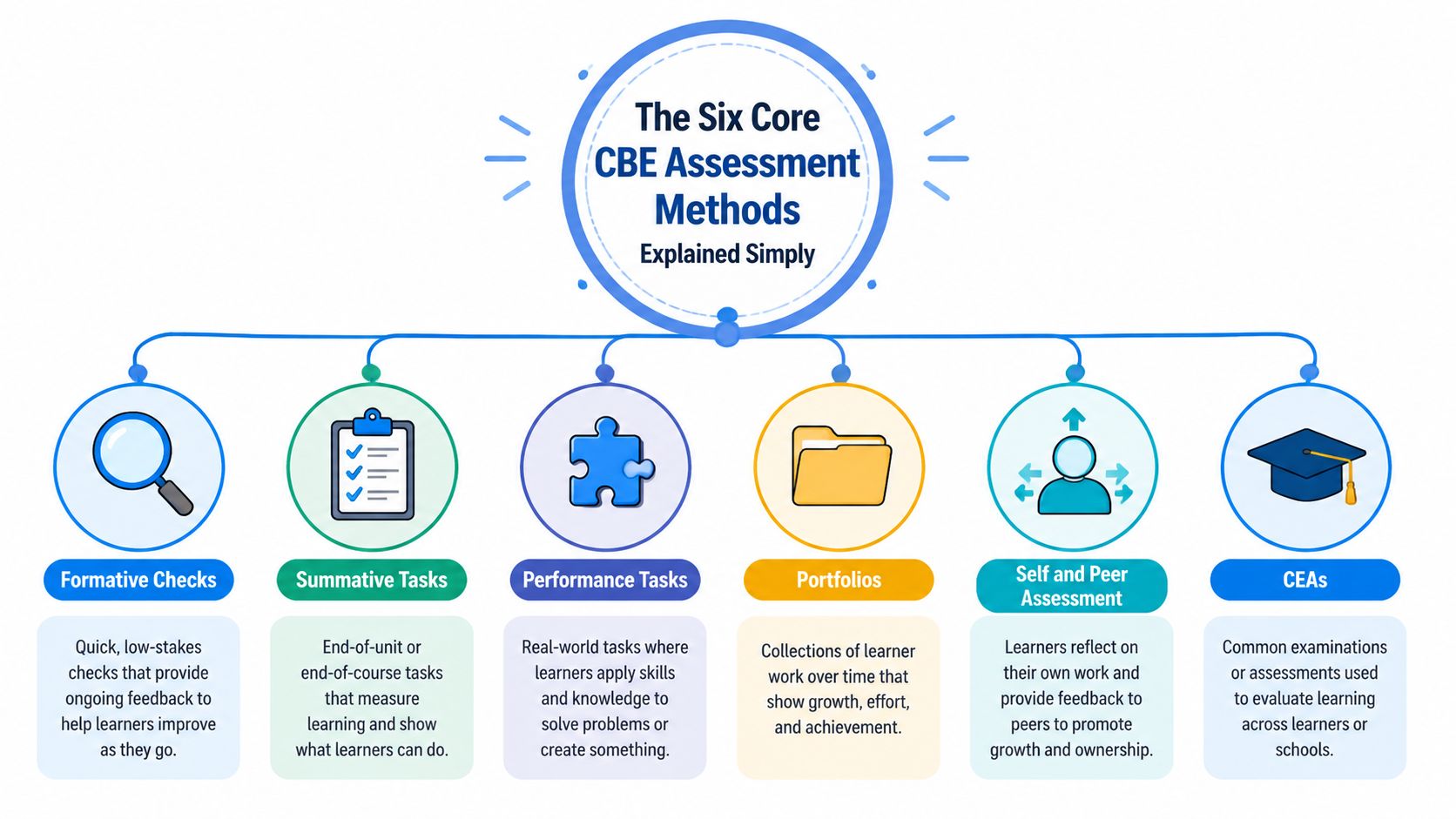
Think of a cooking lesson. Formative checks are tasting the soup while it cooks. A teacher asks a question, watches a demonstration, or uses an exit ticket to find out what needs adjusting before the meal is served.
Summative tasks are the finished dish. They come after teaching and ask learners to demonstrate what they can do at a defined point. A written test may be appropriate, but it shouldn't be the only evidence when the competency involves practical performance or communication.
Performance tasks ask learners to use knowledge in action. In Grade 7 science, that might mean planning and carrying out a simple investigation. In Grade 10 business studies, it could involve presenting a basic enterprise idea. The evidence is the product, process, explanation, or demonstration.
Portfolios are the recipe book kept over time. They bring together selected work, drafts, feedback, reflections, and improvements. A portfolio helps the teacher see growth rather than treating every task as an isolated event.
Self and peer assessment give learners a structured role in judging quality. They aren't a replacement for the teacher's judgement. Learners use a checklist or rubric to identify what they achieved, what needs work, and what evidence supports their view.
CEAs, or Continuous Evaluation Assessments, are short, strand-linked checks that can be scheduled during the term. A CEA may confirm whether a learner can recall, explain, apply, or distinguish key ideas before the next teaching decision.
Match the method to the evidence
The KNEC Competency Based Assessment Framework names observation schedules, checklists, and rating scales as core assessment instruments. An observation schedule records learner behaviour during a specific task. A checklist shows whether expected behaviours are present. A rating scale describes or quantifies the level of performance.
A rubric brings these judgements together in clear descriptors. Written tests still have a place, especially when a teacher needs to check knowledge efficiently, but the instrument should match the intended evidence.
Keybaki can hold the result against the learner and strand. A quiz produces marked responses and mastery information. A performance task needs the teacher's recorded rubric judgement. A portfolio needs uploaded work, feedback, and reflection. The important point is simple: the digital record should preserve what the learner did, not just a final score.
Comparing Methods, Workload, and Best Grade Bands
No single method can show every part of a competency. A quick check is efficient but may not reveal how a learner works through a practical problem. A portfolio shows development but requires organised selection and feedback. Teachers need a deliberate mix rather than six assessments competing for attention in the same week.
The workload figures below are planning categories, not official national timings. Schools should adjust them to class size, subject, task complexity, and available support.
CBE Assessment Methods at a Glance
| Method | What It Measures | Best Grade Band | Workload | Evidence Type |
|---|---|---|---|---|
| Formative checks | Immediate understanding and misconceptions | Grades 7–9 | Low | Exit ticket, oral response, quick response record |
| Summative tasks | Achievement at the end of a teaching sequence | Grades 7–12 | Medium | Written test, completed assignment, marked response |
| Performance tasks | Application, process, practical skill, and communication | Grades 7–12 | High | Demonstration, project, presentation, observation record |
| Portfolios | Growth, revision, reflection, and accumulated evidence | Grades 10–12, with early use in Grades 7–9 | Medium to high | Selected work, drafts, feedback, reflection |
| Self and peer assessment | Learner reflection and judgement against criteria | Grades 7–12 | Low to medium | Checklist, peer comment, self-assessment slip |
| CEAs | Focused strand mastery and readiness for the next lesson | Grades 7–12 | Low | Auto-marked or teacher-marked quiz record |
Formative checks suit the quick mastery decisions common in Grades 7 to 9. Portfolios become especially useful in Grades 10 to 12, when learners need to show how their work has developed and how they respond to feedback. CEAs fit the senior-school runway because they can provide regular evidence without turning every lesson into a major examination.
Spread the marking load
A teacher might use a formative check for the whole class on Monday, observe selected groups during Tuesday's practical, collect one portfolio item on Thursday, and schedule a CEA on Friday. Keybaki can keep the strand, task, result, and next action connected, so the teacher doesn't copy marks across separate books and spreadsheets.
Practical rule: If the evidence won't change a teaching decision, simplify the assessment or remove it.
Real Classroom Examples and Rubrics for Grades 7 to 12
A method becomes easier to use when teachers can see the learner's work and the record that remains afterwards. These three classroom scenes show how the evidence can differ across the secondary phase.
Grade 7 science investigation
The class receives three soil samples. Learners form a hypothesis about which sample will allow water to pass through most quickly, agree on a procedure, record observations in a table, and write a conclusion. The teacher watches the process rather than marking only the final answer.
A four-level rubric might use Exceeds Expectation, Meets Expectation, Approaching Expectation, and Below Expectation. It assesses hypothesis quality, procedure accuracy, data-table completeness, and conclusion reasoning.
| Achievement Band | Grade 7 Science Investigation | Grade 10 English Portfolio Entry | Grade 12 Cluster Mock |
|---|---|---|---|
| Exceeds Expectation | Clear testable hypothesis, controlled procedure, accurate table, reasoned conclusion linked to evidence | Insightful interpretation, purposeful revision, specific reflection on choices | Accurate responses, strong reasoning, clear application of marking criteria |
| Meets Expectation | Testable hypothesis, mostly accurate procedure, complete table, conclusion uses recorded results | Coherent interpretation, visible revision, reflection identifies improvement | Secure knowledge, relevant responses, organised work with minor gaps |
| Approaching Expectation | General hypothesis, incomplete controls, partial table, conclusion repeats an observation | Basic summary, limited revision, reflection names a change without explaining it | Some correct knowledge, uneven application, incomplete sections |
| Below Expectation | No testable hypothesis, unsafe or unclear procedure, missing data, unsupported conclusion | Unfinished entry, little evidence of revision, reflection absent or unrelated | Major gaps in knowledge, responses largely unsupported or missing |
A learner who Meets Expectation might write, “The sandy sample allowed water through first because the spaces between particles were larger.” The portfolio assessor would open the dated investigation sheet, the completed data table, the rubric, and the teacher's observation note.
Grade 10 English portfolio entry
In English, learners write a reflective essay on a set novel. The first draft shows a plot summary with limited interpretation. The teacher adds feedback stamps asking for a stronger claim, a supporting passage, and a clearer explanation of the character's decision.
The learner submits the revised draft, a self-assessment slip, and a short reflection. The learner records a move from Approaching Expectation to Meets Expectation, supported by a specific change in the essay rather than a general statement such as “I improved”.
The assessor opens both drafts, the feedback record, the revised essay, and the self-assessment slip. That sequence matters because the portfolio shows the learning process, not only the polished product. Teachers can also use the competency-based assessment examples as a reference when designing similarly observable tasks.
Grade 12 cluster subject practice
A Grade 12 teacher sets a cluster subject practice paper under conditions that resemble the expected national format. The marking scheme identifies the required points for each response, while the teacher records errors by competency rather than only adding the raw mark.
The result is then interpreted through the achievement bands EE, ME, AE, and BE, using the school's approved reporting descriptors. A portfolio assessor would open the question paper, the marking scheme excerpt, the learner's script, the error analysis, and the band decision.
Scheduling Assessments Across a Real CBE Week
A workable CBE week doesn't ask learners to produce a major project every day. It places small checks early, gives learners time to practise, and reserves more demanding evidence for the end of the teaching sequence.
A copyable Monday-to-Friday rhythm
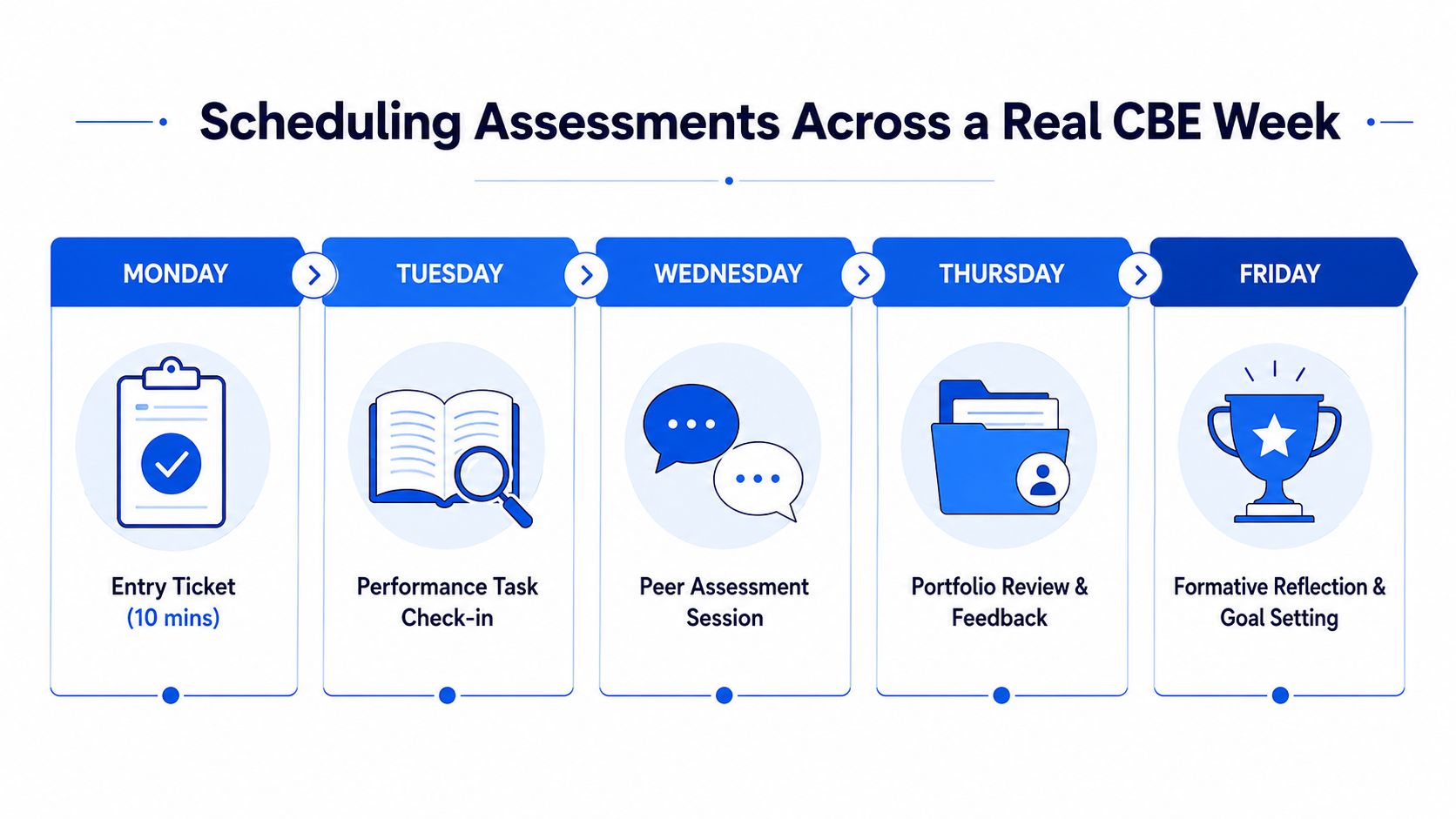
- Monday, diagnose. Begin with a 10-minute entry ticket on the strand taught the previous Friday. Use period reminders to make the task routine, then sort responses into secure, developing, and reteaching groups.
- Tuesday, apply. Run a performance task check-in. In science, observe the investigation procedure. In humanities, listen for the use of evidence during group work.
- Wednesday, develop. Continue the practical or inquiry task. Record one observation per learner or group using a checklist, rather than relying on memory at the end of the lesson.
- Thursday, review. Give learners a peer-assessment checklist. They compare work against the criteria, write one useful comment, and identify one revision.
- Friday, confirm. Use the school timetable software guidance to protect the assessment period, then combine a short summative quiz, portfolio submission, and 15-minute reflection slip.
Close the loop on Saturday
On Friday, the teacher scores the quiz and reviews the task evidence. Keybaki's CEA scheduler can keep the short assessment attached to the relevant strand, while portfolio capture preserves the reflection and selected work. The result should answer one operational question: what must return to the next 5E plan?
Assessment fatigue falls when teachers avoid testing every skill in every format. Use quick formative checks early, let learners warm up through practice and collaboration, then place the heavier performance or summative evidence later in the week.
By Saturday morning, the dashboard should show completed assessments, missing evidence, learners who need support, and weak strands ready for Monday's reteaching plan. The teacher begins the next week with an instructional decision, not a pile of unorganised marks.
How Each Method Connects to KJSEA and Senior School Scores
Kenya's current Grade 7 to 9 scoring model separates school-based evidence from national checks. School-based assessments from Grades 7 and 8 contribute 20% to the KJSEA score, the Grade 9 national assessment contributes 60%, and the earlier KPSEA score contributes the remaining 20%, as reported by The Star's education coverage.
That structure changes the meaning of a missing SBA record. Continuous evidence collected in classroom practice is not decorative paperwork. It forms part of the learner's pathway record, while the national assessment provides a separate external check.
Mapping classroom evidence
| CBE Method | KJSEA SBA, 20% | Summative Component, 20% | National Assessment, 60% | Achievement Band Produced |
|---|---|---|---|---|
| Formative checks | Strong fit for regular evidence | Limited direct use | Prepares learners for national formats | EE, ME, AE, or BE when interpreted through reporting criteria |
| Summative tasks | Can contribute where recorded as SBA | Direct fit for end-of-sequence evidence | Supports preparation, not a substitute | EE, ME, AE, or BE |
| Performance tasks | Observation and recorded demonstration | Applied task evidence | National tasks may test related application | EE, ME, AE, or BE |
| Portfolios | Accumulated classroom evidence | Selected work and reflection | Provides preparation evidence | EE, ME, AE, or BE |
| Self and peer assessment | Supporting evidence and reflection | May accompany a task | Indirect preparation value | Supports the teacher's band judgement |
| CEAs | Strand-linked continuous evidence | Can provide a common school check | Helps learners practise focused responses | EE, ME, AE, or BE |
The national reporting framework uses EE, ME, AE, and BE achievement bands, so a percentage-only assessment engine misses part of the reporting logic. Teachers need rubrics and descriptors that explain what a learner can demonstrate at each band.
For parents, the implication is important. A learner's Term 1 evidence can influence the quality of the record that supports later reporting, even though the learner will still complete a national assessment. Teachers should keep evidence dated, linked to a strand, and supported by the instrument used.
The CBA KNEC portal guide can help schools think about the reporting workflow, but no portal can repair evidence that was never collected or moderated. The professional task remains classroom-based: teach, observe, record, review, and reteach.
Keeping CBE Assessment Fair Across Schools With Different Resources
Assessment isn't automatically fair. A learner's evidence can be shaped by the resources available in the school, the teacher's workload, connectivity, class size, and the support a family can provide at home.
A rural day school may have limited laboratory equipment, shared textbooks, and intermittent internet access. An urban extra-county school may offer more practical materials and stronger digital access. If both schools assess the same science competency through a resource-heavy task without moderation, the scores may reflect opportunity as much as learner reasoning.
Kenya reporting has raised concerns about this implementation gap. Continuous CBE assessment requires tracking, documentation, and reporting over time, while large classes increase the workload burden, as discussed in coverage of the CBE implementation burden.
Resource Gaps and Their Effect on CBE Evidence Quality
| Resource Gap | Distortion in CBE Evidence | Moderation Habit |
|---|---|---|
| Limited laboratory equipment | Practical skill may be judged through an artificial or incomplete task | Use shared task alternatives and agree on evidence descriptors |
| Unequal textbook access | Learners may produce different levels of background detail | Provide a common source pack or teacher-prepared extracts |
| Weak connectivity | Digital submissions may be missing or delayed | Accept offline evidence and upload when access returns |
| Large classes | Teachers may record broad impressions instead of individual evidence | Use rotating observation groups and short, dated notes |
| Unequal home support | Portfolio polish may reflect adult assistance | Require learner reflections and in-class checkpoints |
Moderation that protects validity
Schools can hold cross-school rubric anchor sessions, rotate sample portfolios between neighbouring schools, and maintain a shared photo evidence bank for practical tasks where consent and data safeguards are in place. Standardised CEAs on Keybaki can provide a common strand check, reducing the effect of local differences in task design.
Every Friday, a teacher can audit three random portfolios. Check that each includes a dated observation note, the learner's work, the relevant rubric, and a score that matches the descriptor. If the evidence doesn't support the band, pause before locking the result.
Parents can ask three direct questions at a meeting:
- Which rubric descriptors are used across the class or department?
- What evidence supports my child's current band?
- How does the school moderate results when equipment or access differs?
A fair system doesn't pretend that schools have identical conditions. It makes the conditions visible and uses shared criteria to keep decisions defensible.
A Practical Checklist for Teachers, Parents, and Students
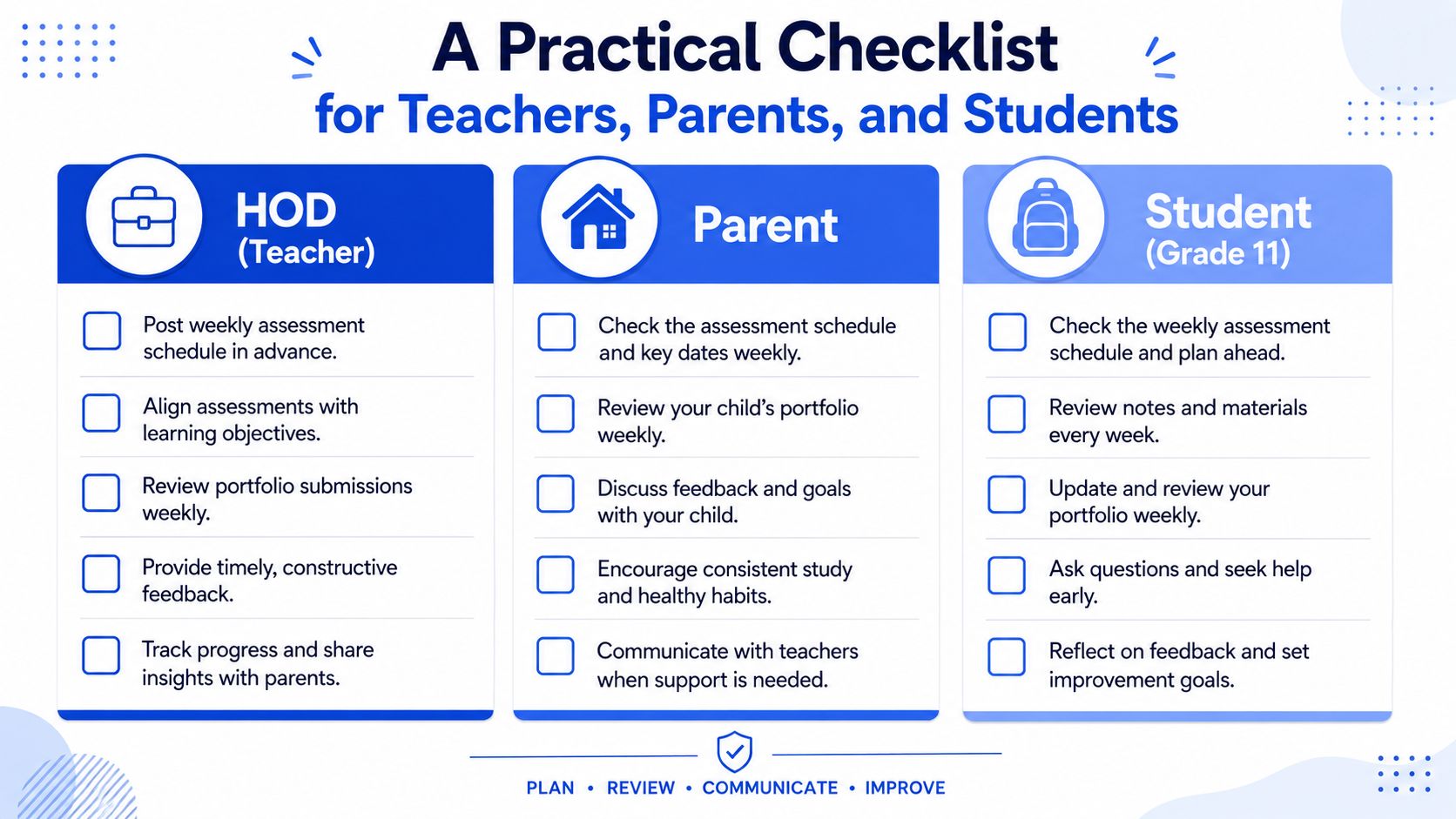
A department can pin this checklist above the staffroom board, a parent can keep it inside the learner's exercise book, and a Grade 11 student can review it each Sunday.
Teacher and HOD checklist
- Choose deliberately: For each strand during the term, select a formative check, summative task, performance task, portfolio entry, and CEA where appropriate.
- Name the instrument: Attach an observation schedule, checklist, rating scale, rubric, or written test to the evidence.
- Plan the loop: Set the 5E plan and assessment on Monday, collect evidence from Tuesday to Thursday, score on Friday, and identify one reteach strand.
- Audit weekly: Check three random portfolios for dates, learner work, observation notes, and rubric alignment.
- Moderate together: Compare anchor samples with colleagues and neighbouring schools before results become high-stakes records.
Parent checklist
- Review weekly: Ask to see the learner's current strand strengths and weaknesses.
- Verify evidence: Ask which task and rubric produced the reported band.
- Check support: Ask what the learner should practise at home and how the school will reteach the weak area.
Student checklist
- Know the target: Read the competency and success criteria before starting.
- Show the process: Keep drafts, calculations, observations, feedback, and revisions.
- Reflect meaningfully: Name the skill that improved and the next action needed.
Start this week by choosing one strand, scheduling its CEA, and preparing the evidence instrument before the lesson begins. That small act makes Friday's score more useful because it already has a clear place in Monday's reteaching plan.
Keybaki connects CBE-mapped planning, CEAs, portfolio evidence, and mastery reporting in a weekly workflow for Grades 7 to 12. Visit Keybaki to schedule this week's assessment and turn strand results into the next lesson plan without retyping the evidence.
Comments
Loading…