
· junior secondary kenya
What Is Junior Secondary in Kenya Explained Simply
15 min read
Junior secondary in Kenya is Grades 7 to 9, typically for learners aged 12 to 15, and it sits between primary school and senior secondary in the CBE system. It was introduced nationally in January 2023 as Kenya moved from the old 8-4-4 structure towards Competency-Based Education.
A parent may first meet the new system at the end of Grade 6, when a child who has always spoken about “primary school” begins preparing for a different learning stage. The uniform may change, the timetable may become fuller, and several teachers may handle different learning areas. At home, the questions often come quickly: Is Grade 7 still primary school? What subjects will the learner take? How does assessment work? Which pathway will the child follow later?
The simplest way to understand junior secondary is to think of it as a bridge. Primary school gives learners a foundation. Senior secondary gives them a more focused direction. Junior secondary is the bridge where they strengthen skills, explore interests, and prepare for the demands of the next stage.
That bridge must be well built. A school needs trained teachers, suitable rooms, learning materials, a workable timetable, and regular evidence of what learners understand. A family also needs clear communication, because strong attendance and progression don't automatically mean that every learner has mastered literacy, numeracy, or the skills needed for a senior-school pathway.
This guide explains what junior secondary means, how Kenya rolled it out, what learners study, how assessment connects to senior-school placement, and what parents, teachers, learners, and school leaders can do each week to support progress.
Table of Contents
- Introduction to Junior Secondary in Kenya
- What Junior Secondary Means and Who It Serves
- How Junior Secondary Was Rolled Out Across Kenya
- Inside the Junior Secondary Curriculum and Assessments
- Junior Secondary Compared to Senior Secondary
- What to Expect in Class and at Home
- Practical Tips and Common Questions for Kenyan Families
Introduction to Junior Secondary in Kenya
The move from Grade 6 to Grade 7 can feel like a small step on paper and a major change in real life. A learner may still be using familiar exercise books and learning in the same community, but the expectations begin to shift. There are more subjects to organise, more specialised teaching, and greater responsibility for keeping up with different strands of work.
Junior secondary is the middle tier of Kenya's Competency-Based Education system. It covers Grades 7, 8, and 9, and serves learners who are typically 12 to 15 years old. It comes after primary education and before senior secondary, where learners pursue broader pathway areas such as STEM, Social Sciences, or Arts and Sports.
The stage is not primary school with a new name. The basic structure of Competency-Based Education gives junior secondary its own place in the learner's development. Learners continue building foundational knowledge, but they also work with practical tasks, applied competencies, problem-solving activities, and more deliberate exploration of their interests.
The bridge idea
A useful family conversation might sound like this:
Think of Grade 7 as the start of a bridge, not the end of primary school. The learner carries forward what was built in primary, strengthens weak areas, and gradually discovers which senior-school direction may suit them.
That explanation helps parents avoid two common mistakes. The first is treating junior secondary as an entirely separate world where primary knowledge no longer matters. The second is assuming that a learner has already chosen a permanent career pathway. Junior secondary is a preparation and exploration stage, while senior secondary brings more specialisation.
The practical experience still varies between schools. Some learners may have strong access to subject teachers and materials, while others may face crowded timetables, staffing pressure, or limited facilities. Understanding the policy is therefore only the beginning. Families also need to ask how the school is delivering the curriculum and how it identifies learners who need support.
What Junior Secondary Means and Who It Serves
Start with the name. Junior secondary means the part of secondary education that follows primary school and comes before senior secondary. In Kenya's CBE structure, it covers Grades 7 to 9 and generally serves learners aged 12 to 15.
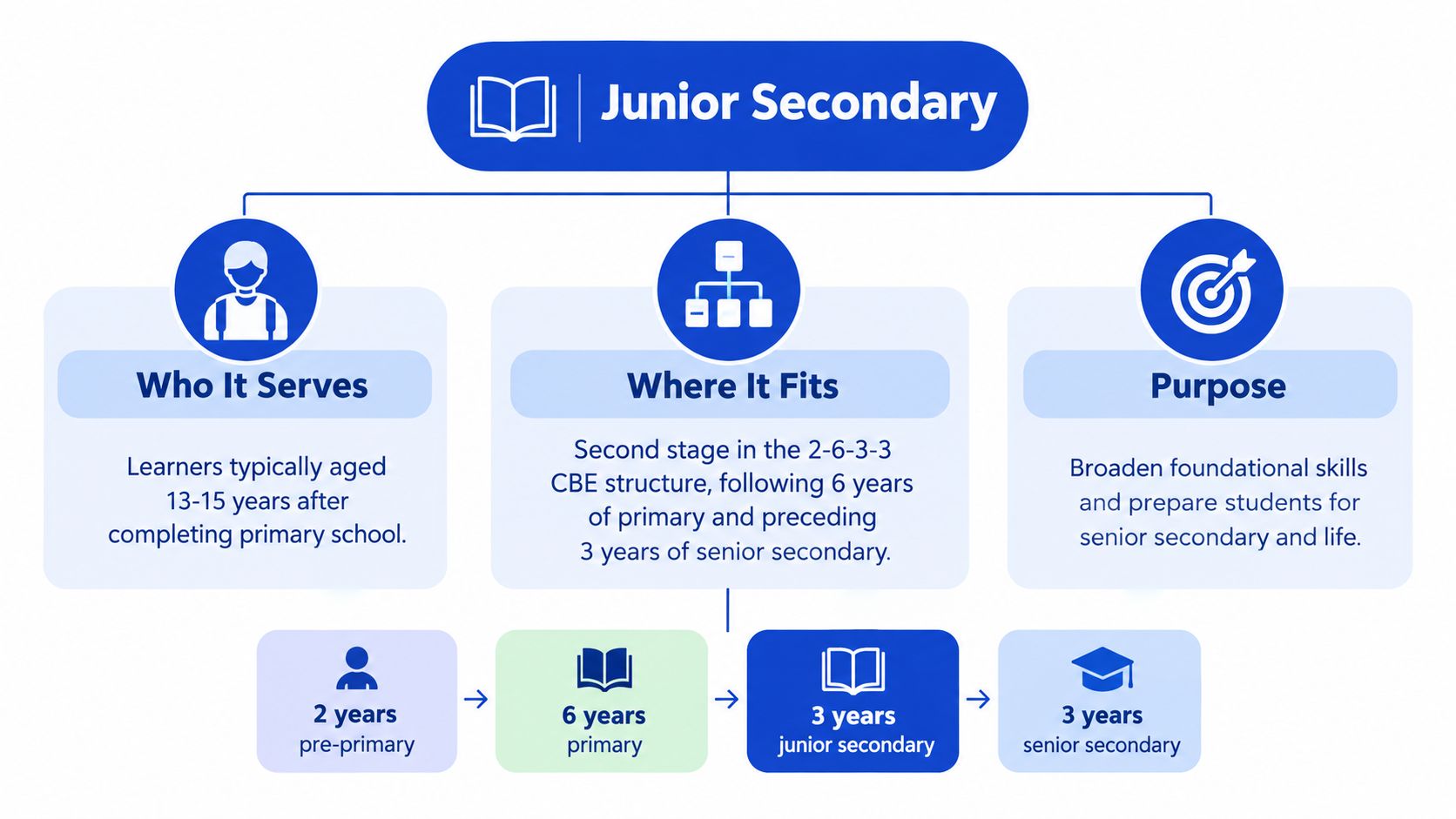
The wider structure is commonly expressed as 2-6-3-3:
- 2 years of pre-primary, where children begin early learning.
- 6 years of primary, covering the foundation years.
- 3 years of junior secondary, covering Grades 7, 8, and 9.
- 3 years of senior secondary, covering Grades 10, 11, and 12.
This arrangement differs from the old 8-4-4 model. Under 8-4-4, learners spent eight years in primary school before moving into four years of secondary education. Under CBE, the middle stage has been separated into junior and senior secondary so that learners can develop competencies and explore areas of interest before entering the more specialised senior-school years.
Why the stage matters
Junior secondary serves three connected purposes.
First, it broadens learning. Learners meet academic, practical, creative, social, and technical experiences rather than being pushed immediately into a narrow area.
Second, it strengthens the foundation. A learner may have passed through primary school without fully mastering particular reading, writing, mathematical, or practical skills. Junior secondary should provide opportunities to identify and address those gaps.
Third, it prepares learners for senior secondary. By the end of Grade 9, schools and families need a clearer picture of a learner's abilities, interests, and readiness for possible pathways.
After completing Grade 6, a learner moves into the junior-secondary stage through the national transition process. The key point for a parent is simple: Grade 7 is not Form One under a different label. It belongs to a different curriculum structure, with its own learning areas, assessment approach, and expectations.
A school can explain the transition clearly by showing families the learner's timetable, subject list, assessment calendar, and support arrangements. Parents should feel free to ask what happens when a learner struggles, how teachers report progress, and how practical learning is organised.
How Junior Secondary Was Rolled Out Across Kenya
A Grade 7 learner may arrive at school while another learner is beginning Form One. That overlap explains why Kenya introduced junior secondary in stages. The rollout formally began in 2023, when Ministry of Education guidance directed the pioneer Grade 7 cohort to report one week before the 8-4-4 Form One intake. The guidelines describe a planned five-year phase-in and phase-out period scheduled to run from January 2023 to December 2027. They also state that later Grade 7 cohorts would report at the end of January or the beginning of February after completing Grade 6. These arrangements appear in the Ministry of Education implementation guidelines.
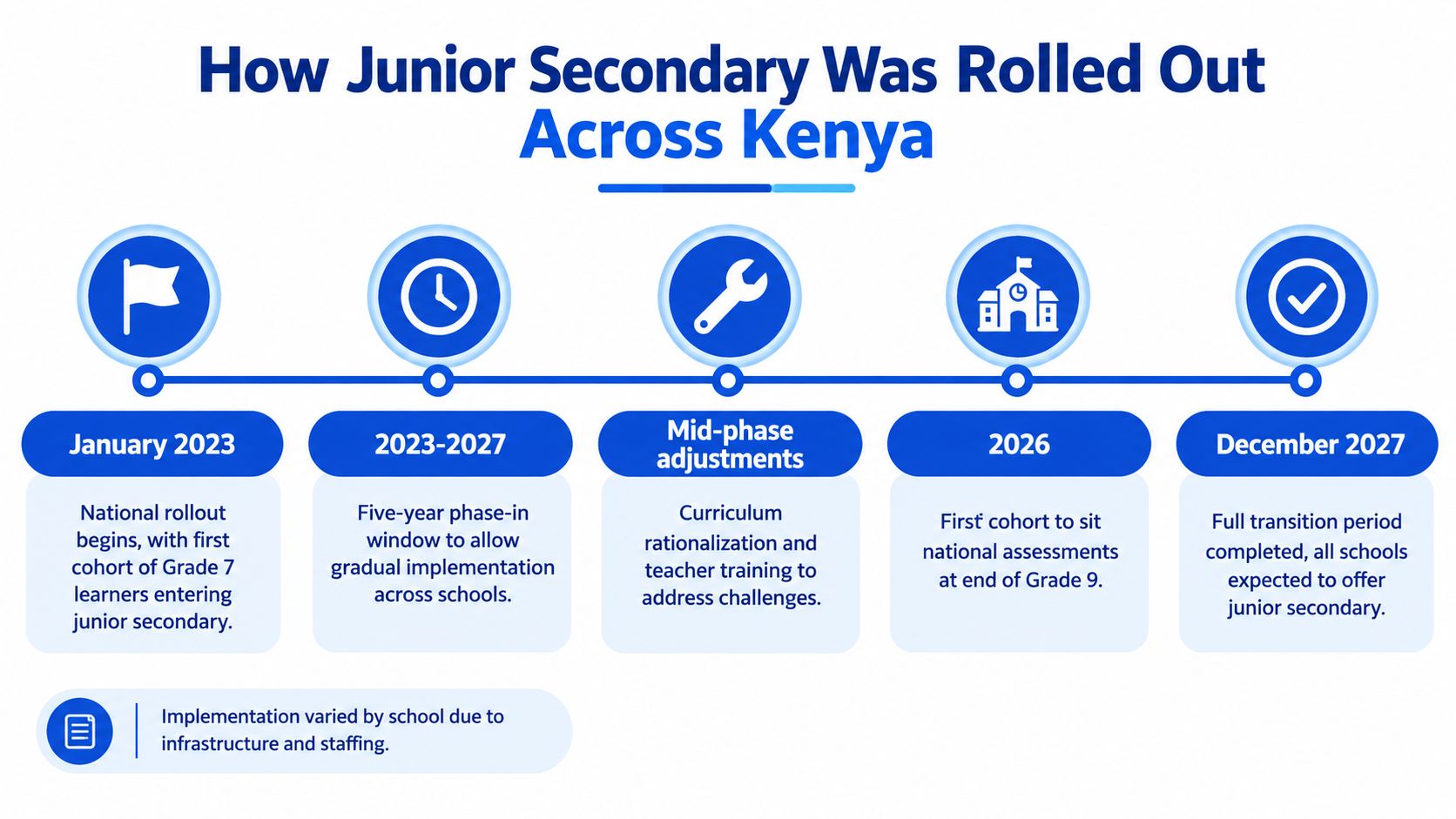
Schools therefore had to run two arrangements at once. The 8-4-4 Form One intake continued as the new CBE junior-secondary stage started. Phasing the change gave schools and government institutions time to adjust staffing, classrooms, learning materials, reporting systems, and curriculum delivery.
The resource question
A timetable on paper still depends on teachers, rooms, materials, and funding. For FY 2024/25, the government budgeted KSh25.5 billion for Junior Secondary capitation and KSh3.4 billion for Junior Secondary infrastructure, according to the Education Sector Report. Independent reporting in 2026 continued to describe capitation shortfalls affecting school operations.
This is why the same grade can feel different from one school to another. One school may have laboratories, workshops, learning materials, and enough subject teachers. Another may combine classes, share facilities, or change its timetable when resources do not arrive as expected.
The pressure reaches the classroom. Teachers may have less time for practical work, slower coverage of planned content, or fewer opportunities to give prompt feedback. A school curriculum tracking system for CBC Kenya can help a school see what has been taught and what remains, but it cannot provide teachers, facilities, or dependable funding.
Parents can ask questions that reveal the situation: Which learning areas are available? Are practical lessons scheduled? How does the school handle shortages? How does it report missed work and recovery plans? Those answers show how the rollout is being experienced beyond the label “junior secondary.”
Inside the Junior Secondary Curriculum and Assessments
Junior secondary has a compact curriculum structure. Education-sector reporting describes nine core subjects delivered across about 40 lessons per week, as reflected in the Kenya curriculum designs and learning areas. That combination creates a dense timetable, so teachers must sequence work carefully and check understanding regularly.
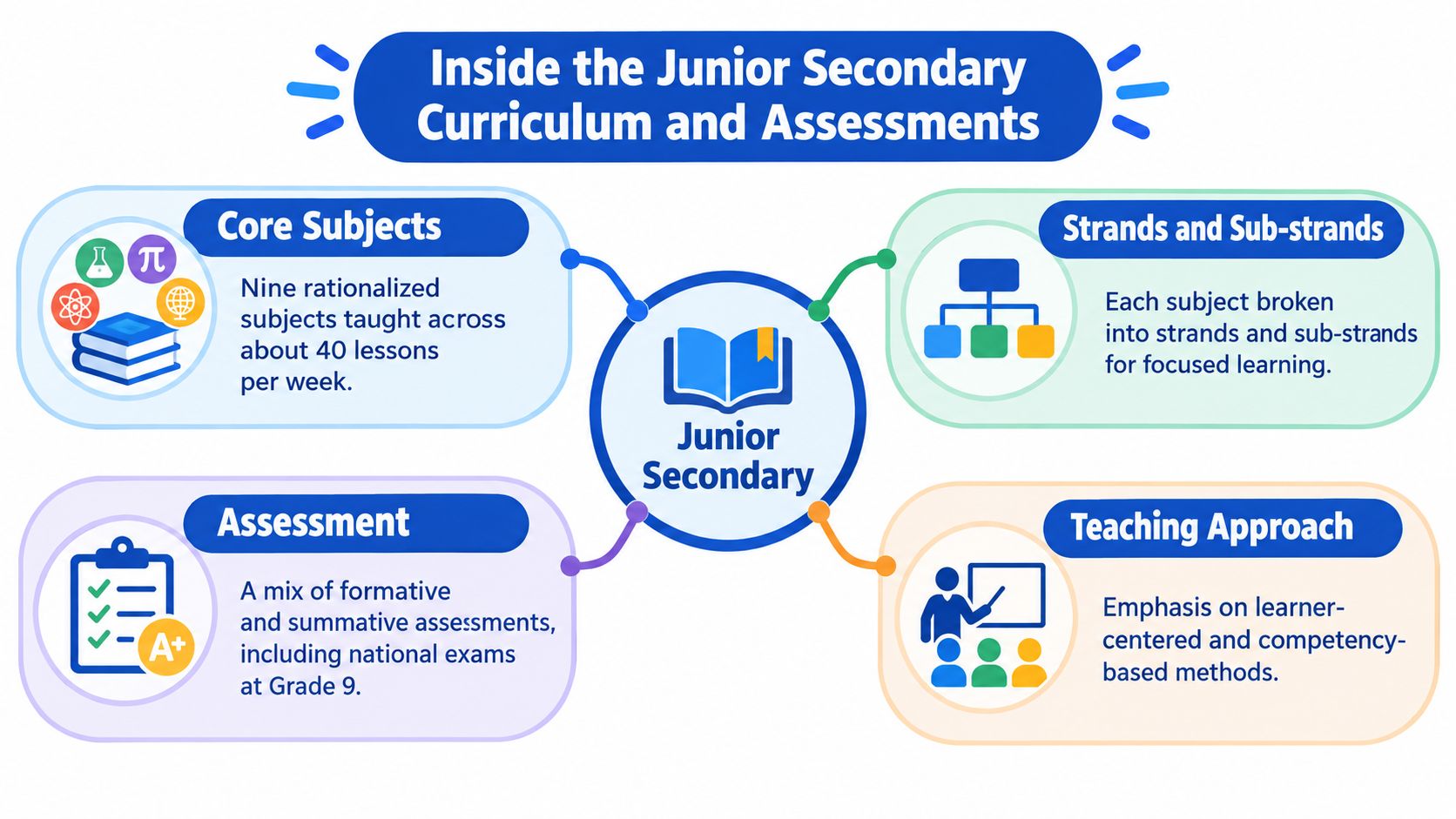
The learning areas include integrated science, pre-technical learning, mathematics, languages, social studies, agriculture, and applied competencies. The exact classroom experience depends on the school's timetable and available facilities, but the principle is consistent. Learners should encounter knowledge through explanation, practice, investigation, application, and reflection.
From subjects to strands
A parent may hear a teacher say that a learner is weak in a “strand” rather than in an entire subject. That distinction matters.
A subject is the broad learning area. A strand is a major topic within it, and a sub-strand is a more focused part of that topic. For example, a learner may be comfortable with some mathematics work but struggle with a particular strand involving number operations, measurement, or data. A general statement such as “the learner is poor at mathematics” doesn't tell the family what to practise.
Teachers need strand-level information because the timetable leaves little room for repeated teaching of everything. A short weekly check can show whether learners understood the previous lesson, whether a misconception is spreading, and whether the next lesson should include reteaching.
How assessment supports progression
Assessment in CBE is not limited to one final examination. Teachers use classroom activities, tasks, observation, exercises, and Continuous Evaluation Assessments to gather evidence of learning. At the end of Grade 9, the Kenya Junior Secondary Education Assessment, or KJSEA, contributes to placement into senior school.
The important question isn't only whether a learner completed an assessment. It is whether the results help the teacher decide what happens next. If a class performs poorly on one strand, the following week should include a correction lesson, guided practice, or a different explanation.
A mark tells you what happened. A strand-level result helps you decide what to teach next.
A practical lesson may begin with a question or demonstration, move into group exploration, develop the concept through explanation, give learners an applied task, and finish with an evaluation. This is the 5E approach, and it fits CBE because learners are expected to do more than copy notes.
Teachers and parents who want a broader explanation of classroom evidence can review these CBE assessment methods, then ask the school how assessment results are shared and acted upon.
Junior Secondary Compared to Senior Secondary
A learner entering Grade 7 is not choosing a career yet. The learner is building a wide base, then using evidence from schoolwork to understand which direction may fit later. Junior secondary keeps learning broad and develops competencies, while senior secondary gives learners more focused pathway choices.
| Feature | Junior Secondary Grades 7-9 | Senior Secondary Grades 10-12 |
|---|---|---|
| Main purpose | Build foundational skills, competencies, and broad understanding | Develop deeper learning within a selected pathway |
| Learner position | Exploring strengths and interests | Moving into more focused study |
| Curriculum focus | A compact set of compulsory learning areas, including academic and applied learning | Pathway-oriented learning in areas such as STEM, Social Sciences, or Arts and Sports |
| Assessment role | Continuous classroom evidence and Grade 9 KJSEA | Assessment connected to senior-secondary learning and progression |
| School experience | Learners may study across a wide range of areas | Learners spend more time in subjects connected to their chosen direction |
| Family question | What does the learner understand, enjoy, and need to strengthen? | Which pathway and learning combination best fits the learner? |
Junior secondary gives learners repeated chances to investigate, communicate, solve problems, complete practical tasks, and express ideas creatively. A single strong project, or one difficult test, should not decide a learner's future. Teachers and families need to notice patterns across time.
Senior secondary narrows the field. A learner may move towards STEM, Social Sciences, or Arts and Sports, guided by assessment evidence, interests, available school options, and advice. The pathway choice does not replace literacy, numeracy, communication, or self-management. These skills remain useful in every direction.
The change from broad learning to focused study also exposes a resourcing and readiness bottleneck. Junior secondary may require crowded timetables, suitable teachers, learning materials, and capitation that reaches daily classroom needs. If those supports are thin, a learner can complete the grades without receiving enough practice in the foundations senior school expects.
Published reporting on the 2025 KJSEA recorded 1,130,459 learners sitting the assessment, with 59.09% demonstrating STEM pathway potential, 46.52% Social Sciences potential, and 48.73% Arts and Sports potential, as reported by the Nation coverage of junior-to-senior readiness. These figures show potential across pathway areas. They do not guarantee that every learner has mastered the reading, number, communication, and study habits needed for the next stage.
What to Expect in Class and at Home
Junior secondary works best when planning, teaching, assessment, and home support form one loop. A teacher plans a lesson, learners practise a skill, the teacher checks understanding, and the next lesson responds to the evidence. Parents don't need to recreate a classroom at home, but they do need a simple way to see what the learner is practising.
For teachers
A 5E lesson plan can turn a curriculum strand into a sequence that learners can follow. The teacher may begin with an everyday problem, allow learners to explore, explain the underlying idea, give an application task, and use a short evaluation before ending the lesson.
The useful follow-up happens after marking. If the evaluation shows that learners misunderstood one step, the teacher can place that strand into the next week's revision rather than moving ahead and leaving the gap hidden.
For parents and learners
A parent can support the loop with a short weekly routine:
- Ask for the weak strand: Find out the specific skill that needs practice, not only the subject name.
- Set a small revision queue: Let the learner complete a manageable group of questions before adding more.
- Use the available device wisely: A shared family phone can support learning if content is downloaded or cached when connectivity is available.
- Review the explanation: Ask the learner to teach the idea back in their own words.
- Protect consistency: Short, regular practice is easier to sustain than a stressful revision session just before an assessment.
Learners should keep their own record of upcoming strand quizzes, corrections, and questions for the teacher. Streaks and badges can encourage regular practice, but the target is understanding. A learner who notices, “I can solve the first example but not the second,” has already identified a useful question.
For school heads
School leaders need a clear view of coverage and support. They can check whether departments are reaching the planned strands, whether assessments are being completed, and whether weak results lead to reteaching. Reporting should help a head see where a timetable, facility, staffing arrangement, or teaching resource is blocking progress.
The strongest system is not the one with the most records. It is the one that turns evidence into the next practical action for the teacher, learner, and parent.
Practical Tips and Common Questions for Kenyan Families
A learner may return from school with a timetable, assignments, and a pathway conversation that feels confusing at home. Families can make it manageable by connecting each week's work to one clear question: what does the learner understand, and where is support needed?
- Ask for one specific skill: Find out which strand needs attention, rather than discussing only the subject.
- Set a realistic routine: Choose a short practice time that fits chores, meals, travel, and rest.
- Check the correction: Ask the learner to explain why an answer was wrong and how it could be improved.
- Notice repeated errors: A pattern may require reteaching or another explanation, not punishment.
- Discuss interests gradually: Pay attention to practical, scientific, social, creative, and sporting activities without forcing a pathway choice too early.
Does moving to senior school prove readiness?
No. Progressing to the next stage confirms movement through the system, but it does not by itself show strong literacy, numeracy, or independent learning. As noted earlier, a national assessment found that about a third of learners transitioning from junior school to senior school lacked basic literacy and numeracy skills.
Families should therefore look beyond promotion. Can the learner read instructions, explain reasoning, work with numbers, complete a task without constant prompting, and apply an idea to a new example? These questions reveal readiness more clearly than a transition decision alone.
What do the transition figures tell us?
Recent transition figures show that many learners are progressing through the system, while preparation remains uneven. High enrolment does not guarantee that every classroom has enough teachers, learning materials, timetable space, or individual support. For families, this can appear as crowded lessons, limited practice, or a learner advancing with gaps that have not been addressed.
Junior secondary is therefore both a learning stage and a national resourcing and readiness test. Capitation, timetable density, and pathway information affect what learners experience each day. Parents, teachers, and school leaders can respond by agreeing on one or two weekly goals, checking evidence of progress, and acting early when a learner falls behind.
Keybaki gives Kenyan CBE teachers a strand-mapped digital library, 5E lesson-planning tools, timetable support, and Continuous Evaluation Assessments linked to learner mastery. Parents and learners can use its weekly weak-strand briefings and revision queues to connect home practice with classroom needs. Explore Keybaki as one way to organise junior-secondary learning.
Comments
Loading…