· scheme of work template
Scheme of Work Template for Kenya CBE: Free Guide 2026
14 min read

Sunday night in a Kenyan junior secondary staffroom has a familiar sound. Pages rustle, a laptop charger fights for a socket, and the teacher who meant to rest ends up trying to build next week from scattered notes, half-filled exercise books, and a stack of subject files. That is usually when the scheme of work template stops looking like paperwork and starts looking like survival.
A good template saves time because it forces order before the term starts. The Ministry of Education says Junior Secondary schemes must be developed by the teacher from the curriculum designs, include administrative details, week, lesson, strand, sub-strand, specific learning outcomes, learning experiences, key inquiry questions, learning resources, assessment, and reflection, and be ready by the first week of every term (Ministry guidance on Junior Secondary implementation). That structure is not there to make life harder, it is there because weekly planning, assessment, and lesson delivery in CBE are joined at the hip.
The teacher who uses a clean template is not chasing the week. The template carries the week, the strands, and the evidence trail so the work stays visible and manageable, even when the timetable is tight and the class is mixed ability. If you still treat the scheme as a form to file, you will keep rebuilding the same plan every Sunday. If you treat it as a working system, the term becomes easier to steer.
Table of Contents
- Why You Still Need a Scheme of Work Template in CBE
- Scheme of Work Template Structure for Kenyan CBE
- How to Plan Weekly 5E Lessons from Strands
- Integrating Continuous Evaluation Assessments Correctly
- Adapting the Scheme for Multi-Class and Low-Tech Settings
- Putting It All Together Before Term Starts
Why You Still Need a Scheme of Work Template in CBE
A teacher only feels the value of a scheme when Sunday night starts slipping. One book holds the strand, another the lesson plan, a third the assessment notes, and memory is left to connect the rest. CBE planning then becomes tiring because the pieces are scattered, not because the curriculum is unworkable.
The Ministry's guidance is clear. Junior Secondary schemes must be built from curriculum designs, ready for the first week of the term, and aligned to the weekly lesson allocation expected in school planning. In practice, that means your template needs a column that links the weekly lesson allocation to the strand code, so a supervisor can check coverage without opening separate lesson notes. That is why a scheme of work template is not a filing form. It is the working map that keeps the term moving.
What the template really does
A good template cuts repeat work. It lets the teacher set out strands, sub-strands, resources, and assessments once, then adjust the pace to fit the class. It also makes handover easier when a colleague steps in, because the term's logic is already visible.
Practical rule: if the template does not help you plan next week from this week's evidence, it is too static.
The difference shows up fast when the term gets busy. A teacher with a scattered file spends Friday evening hunting for what was taught, what was assessed, and what still needs support. A teacher with a proper scheme opens one document, sees the sequence, and moves straight to the next decision.
The scheme also supports the weekly loop that CBE demands. What you planned, what you taught, and what learners showed in the assessment should all sit in the same record, so the next week starts with facts instead of guesswork. That is easier to share with heads of department and, where needed, with parents who ask what the class is covering.
For a clear distinction between the scheme and the day-to-day lesson note, see the guide on scheme of work vs lesson plan in CBC. The lesson plan handles the classroom moment, while the scheme holds the wider term logic.
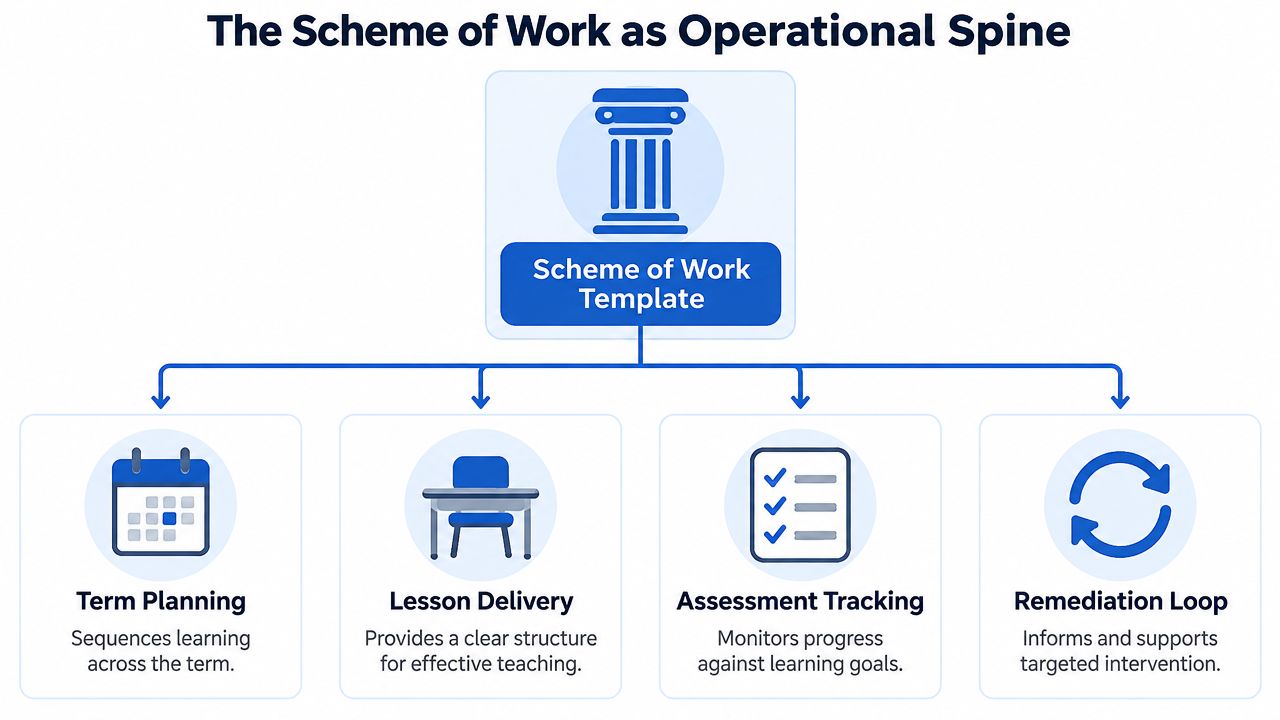
When the template works well, it also reduces stress around scattered resources. A printed chart, a textbook page, and a worksheet no longer sit in separate piles, because the scheme shows where each item belongs in the week. That is the core gain: less searching, more teaching.
Scheme of Work Template Structure for Kenyan CBE
A usable template earns its place when it helps you prepare, teach, and review without forcing extra sorting on Sunday night. The Ministry asks for administrative details, week, lesson, strand, sub-strand, specific learning outcomes, learning experiences, key inquiry questions, learning resources, assessment, and reflection, so leaving out a field usually means extra work later. A neat blank grid can look impressive and still fail in real CBE planning.
The fields that should not be missing
Start with the practical identifiers. School, subject, class, term, teacher name, and week make the document fit filing, supervision, and handover. Then move to the curriculum fields, strand and sub-strand first, followed by the specific learning outcomes that show what the learner should be able to do.
Practical rule: write the assessment beside the outcome, not after the term has ended.
The template should also leave room for learning experiences, key inquiry questions, learning resources, assessment, and reflection. That order keeps the scheme tied to classroom work instead of becoming a filing exercise. A teacher who lists resources without a matching assessment often ends up with a clean plan that never checks learning properly.
A quick self-check helps before term starts:
- Administrative details: confirm the class, subject, term, and teacher are correct.
- Curriculum alignment: match each week to a strand and sub-strand, not a loose topic.
- Learning outcomes: use an observable outcome, for example, “Learner can classify fractions as proper or improper and justify with a diagram,” not “Understand fractions.”
- Inquiry questions: use questions that guide the lesson, not vague prompts.
- Assessment: state how evidence will be gathered, marked, or reviewed.
- Reflection: leave space for what will change after the lesson or week.
That self-check saves time because it catches weak wording before it enters the file. A template can still look editable and fail in practice if the headings are cramped, repeated, or too tight for notes. The better layout gives you space to record what worked, what did not, and what needs a change next week. That matters in CBE, where the scheme should support the weekly loop of planning, CEA results, and parent visibility, especially in schools where printing, storage, and internet access are limited.
For teachers who want the lesson plan to sit beside the scheme, the CBC lesson plan guide shows how the curriculum block, teaching block, assessment block, and follow-up block fit together without wasting motion.
How to Plan Weekly 5E Lessons from Strands
A strand can stay abstract on paper until you turn it into one week of real lessons. In a Kenyan secondary classroom, that means mapping the strand to what learners will meet on Monday, what they will try by midweek, and what you can check by Friday. A good scheme of work template makes that weekly loop easy to follow, even when time is tight and resources are limited.
From strand to daily rhythm
Start with the strand and sub-strand, then write the learning outcomes in language that fits the class level. From there, shape the week around the 5E cycle, but do not force every stage into one period. Some lessons need more room for exploration, while others need quicker explanation and checking.
| Day | 5E Phase | Learning Move | Check |
|---|---|---|---|
| Mon | Engage | Use a short problem, pattern, or question to surface prior knowledge. | Quick oral responses or board work. |
| Tue | Explore | Let learners try, sort, measure, compare, or discuss with the resource at hand. | Observe group work and note misconceptions. |
| Wed | Explain | Tighten the concept and name the correct method or principle. | Short class responses or guided examples. |
| Thu | Elaborate | Set a related task that asks learners to apply the idea in a new way. | Review work from pairs or groups. |
| Fri | Evaluate | Check what has stuck and record who needs support. | Exit slip, short exercise, or teacher notes. |
That rhythm respects the timetable. You do not need a dramatic activity every day, and you do not need to squeeze the full 5E cycle into one lesson if the class period is short. The plan only needs to stay visible across the week so it still works during observation, handover, or interruption.
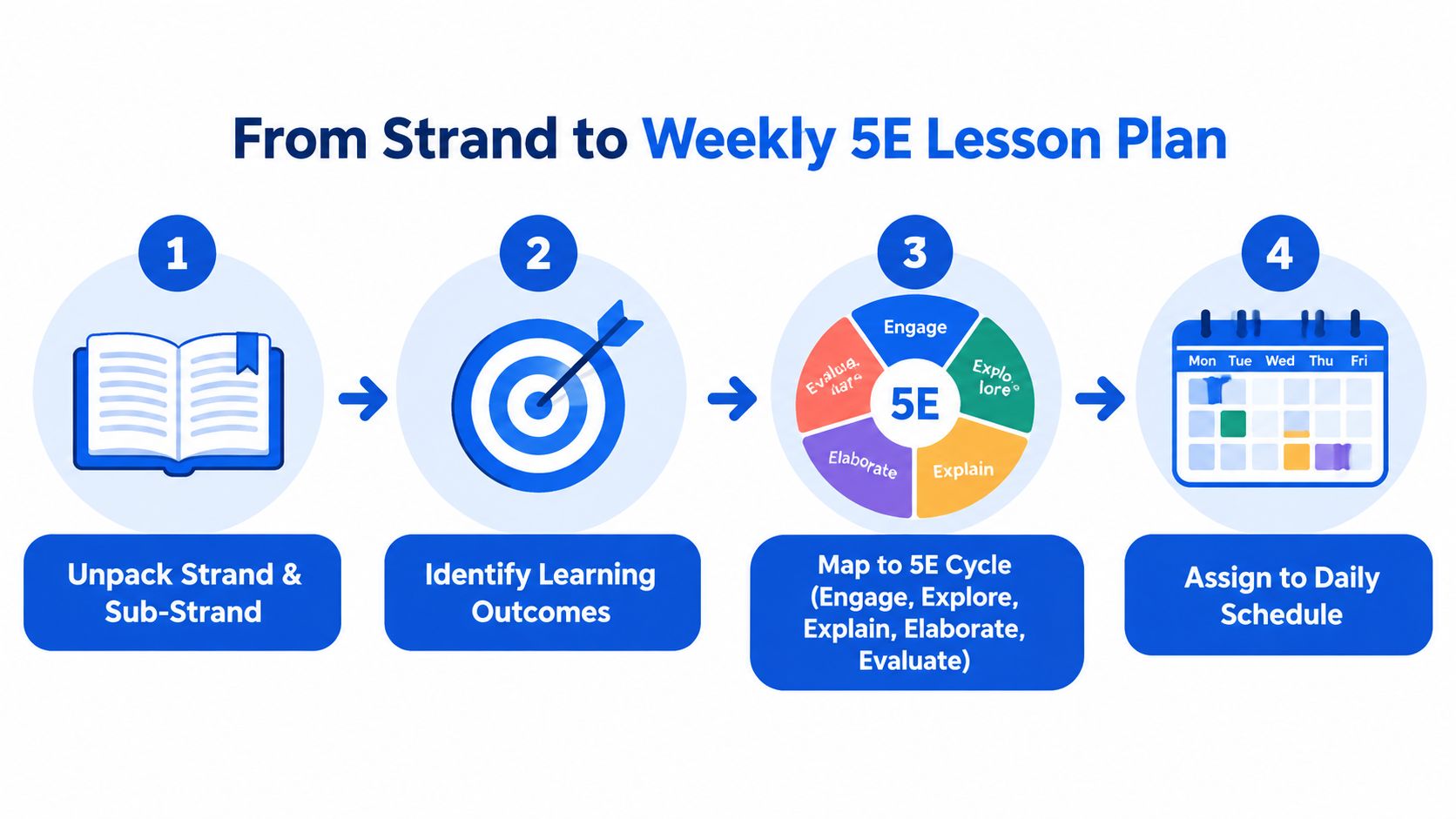
The strongest weekly plan is the one another teacher can pick up and use without guessing. Show the learning move for each day, the resource that supports it, and the check that tells you whether the class is ready to move on. If you want a direct example of how the scheme and the lesson plan fit together, the CBC lesson plan guide shows that handover clearly.
What usually goes wrong
The most common mistake is writing outcomes that are too broad for one week. Another is planning activities first and outcomes later, which makes the week look busy but weakens alignment. A third is relying on one worksheet to carry the whole week, then finding on Friday that the assessment gives no useful feedback.
A strong weekly plan stays short and workable. It names the strand, narrows it to one realistic focus, and assigns the 5E steps to actual periods. That is what keeps the term manageable and makes the scheme useful as a live planning tool, not a file that sits untouched after Sunday evening.
Integrating Continuous Evaluation Assessments Correctly
Assessment should sit inside the week, not after it. If the work is moving in a CBE classroom, the evidence has to move with it, so the teacher can see what to reteach while the topic is still warm.
Map the assessment to the strand
A weekly scheme works better when the assessment matches one strand and one clear learning target. If a lesson covers sub-strand 7.2, the check should stay inside that focus instead of drifting into unrelated recall or a random worksheet mix. That keeps the evidence usable, and it makes the next lesson easier to shape.
A practical rhythm helps. Use a short strand check after introduction, then a weekly check at the end of the lesson cycle, and save broader review tasks for times when the term really calls for them. The point is to get a decision you can act on, not to crowd the timetable with marks.
If you want a clear guide to that kind of classroom checking, the CBC assessment methods article sets out the main options in practical terms.
If the result does not change next week's teaching, it was only paperwork.
That is why the assessment column in the scheme should show the exact activity, the expected evidence, and the response for learners who miss the target. A teacher in a busy secondary school cannot afford vague notes like “assess understanding.” Write the check in a form that can drive the next plan, especially where books, time, and follow-up support are limited.
Keep the marking fast and useful
After a 5-question strand check on sub-strand 7.2, record mastery as 0-2 = reteach, 3-4 = guided practice, 5 = extension, then paste the 0-2 names directly into next week's Elaborate column. That gives the scheme a living loop, because the assessment output feeds straight into the next lesson instead of waiting in a notebook.
Keep the note brief enough to survive a full teaching load. If the class shows a split pattern, write it plainly, for example “8 learners need reteach on identifying evidence, 6 are ready for extension.” That kind of record helps with parent visibility too, because you can explain what was done, what was checked, and what comes next without rebuilding the whole story at home.
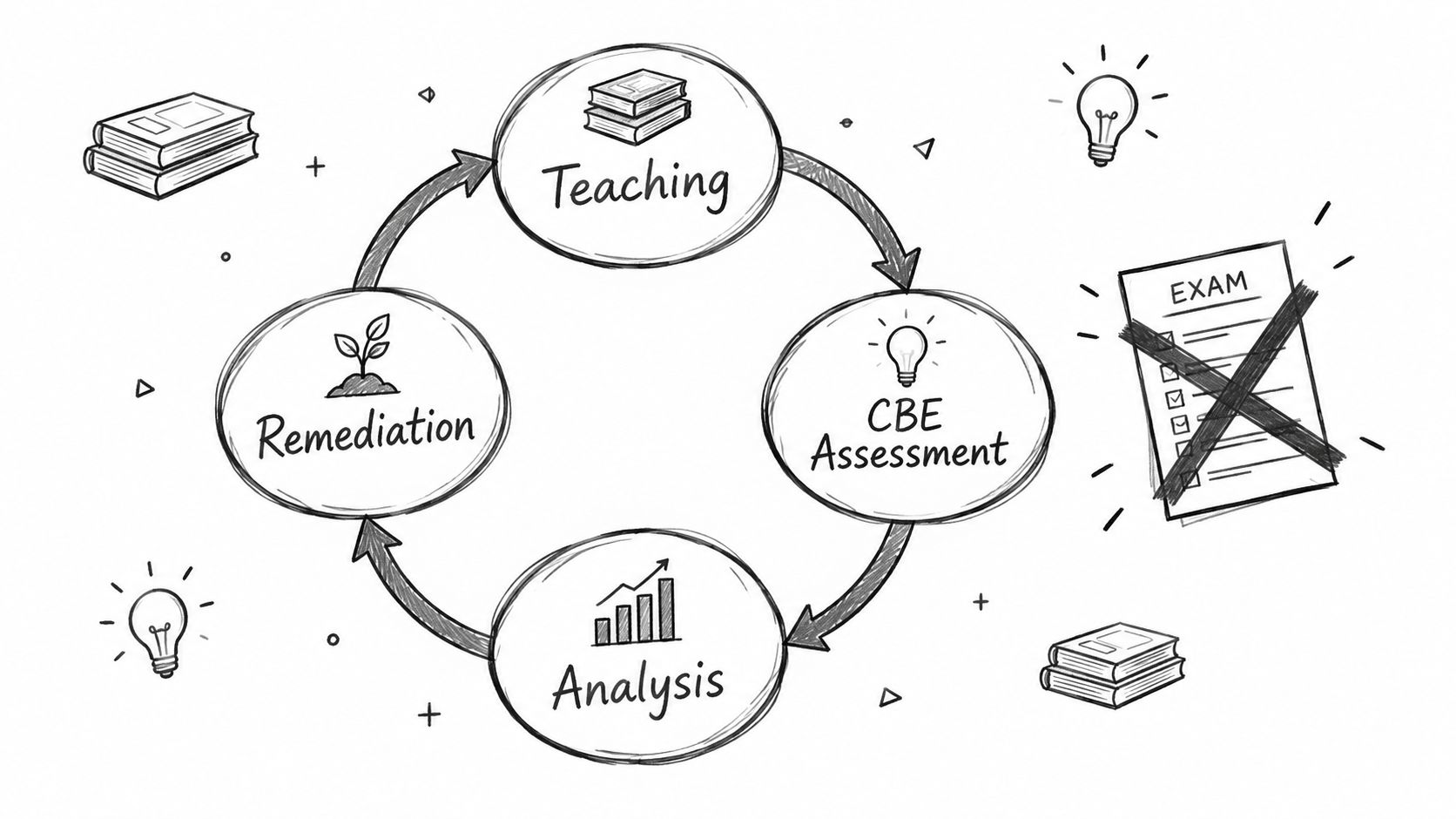
The circular flow in the image below matches the actual classroom cycle: teaching, assessment, analysis, then remediation. That is the true value of a scheme of work template in CBE. It keeps the week connected.
Adapting the Scheme for Multi-Class and Low-Tech Settings
Not every Kenyan classroom runs on a laptop, a projector, and reliable internet. Some teachers share a device with family members at home, some work with low-resolution school screens, and some need a paper copy that can survive a chalk-dusted bag. In those settings, the best format is the one that stays readable and usable when technology gets in the way.
Paper, digital, and hybrid
A paper-based scheme is dependable when electricity, connectivity, or device access is unstable. It is easy to annotate, easy to carry, and easy to pin beside a desk for daily reference. The weakness is that updates are manual, so weak strands and revised notes can get lost if the teacher does not keep discipline.
A digital-only scheme is cleaner for search, copying, and sharing. It suits a teacher who moves between classes or wants to revise quickly before a lesson. The downside is obvious, if the screen is small or the file is hard to open, the plan becomes annoying instead of helpful.
A hybrid setup is usually the most practical choice. Keep the master scheme digitally, then print the week or term view for quick use in class. That way, edits can be made in one place while the classroom copy remains visible during teaching.
Practical rule: if a parent or student can't read the plan on a shared phone, simplify the layout before you call it accessible.
That last point matters in CBE homes where one phone may serve several children. The scheme, or the learner-facing summary derived from it, should stay clean enough for quick checking of weak strands, upcoming work, and revision priorities. For many schools, that means avoiding dense tables that look tidy on a computer but collapse on a small screen.
Putting It All Together Before Term Starts
The final check is simple, but it saves headaches. Every strand should be covered, every assessment should point to a learning outcome, and every resource should be ready before the first week begins. That is the difference between a scheme that sits in a file and a scheme that drives classroom work.
A quick final check
A teacher can run through the whole document in minutes if the structure is sound.
- Coverage: Each week should connect to a strand or sub-strand.
- Timing: The weekly lesson load should match the actual timetable.
- Assessment: Every check should show what evidence will be collected.
- Resources: Books, charts, devices, or worksheets should be named clearly.
- Reflection: Leave space for what the class response tells you to change.
One short example captures the value. A Grade 8 teacher enters week one with a scheme that already names the strand, the weekly outcome, the resources, and the assessment. On Monday, the class struggles with one concept. By Wednesday, the teacher adjusts the remaining lessons, and by Friday the weak learners get a short reteach task while the stronger ones move ahead. That is what a living scheme does, it turns the week into a working loop rather than a pile of separate documents.
The same loop helps heads of department, because the plan shows what was intended, what was assessed, and what support is needed next. It also helps parents, because the weak strand can be named clearly instead of buried in general comments. When the scheme is used properly, everybody sees the learning journey more clearly.
If you want to build your term plan faster without losing the CBE structure, use Keybaki to link strands, weekly planning, and assessment in one place. It gives teachers, parents, and students a shared weekly loop, which makes scheme-of-work planning easier to follow and easier to act on. Visit Keybaki and see how the planning, teaching, and assessment pieces can sit together more cleanly.
Comments
Loading…