
· KCSE placement process
Placements - Education Kenya: A 2026 Guide
15 min read

A parent checks the phone before breakfast, hoping for a placement message. At the same time, a teacher may be waiting for a posting update, while a university student is trying to secure an attachment letter before the institution's deadline. In Kenya, the word placement can describe several different decisions, and confusing them can lead to missed documents, weak choices, or unnecessary anxiety.
This guide brings the main meanings together. It explains learner placement under the Competency-Based Education framework, teacher deployment through the Teacher Service Commission, and academic attachments for students in higher education. The practical question is always the same: what happens next, who makes the decision, and what should you do now?
Table of Contents
- Understanding Placements in the Kenyan Education System
- How Student Placements Work Under the CBE Framework
- Navigating Teacher Deployment via the Teacher Service Commission
- Internships and Attachments in Higher Education
- Common Problems and How to Resolve Them
- Leveraging Digital Tools for Smoother Transitions
Understanding Placements in the Kenyan Education System
A family may use “placement” to mean the senior school assigned to a learner. A teacher may use it to mean a new station after deployment. A university student may use it to mean an attachment opportunity required before completing a course. These are different systems, with different decision-makers and different evidence.
Three meanings of placement
Student placement concerns movement through the school system. Under CBE, a learner's assessment record, pathway interests, subject combinations, and available school capacity all matter. The result isn't a reward for the highest mark. It's closer to a matching exercise, where the Ministry tries to align learners with programmes and spaces that schools can provide.
Teacher deployment is an employment decision. The Teacher Service Commission considers the teacher's professional profile and the needs of schools when assigning or transferring staff. A teacher therefore needs to read a posting letter differently from a learner's placement result. One confirms an employment station, while the other confirms an education pathway and school.
Academic attachment belongs to higher education. A student may be sent to a hospital, school, laboratory, engineering firm, office, or other approved workplace to apply classroom learning. The attachment usually connects to course requirements, supervision, assessment, and institutional approval.
Practical rule: Before asking whether a placement is correct, identify which placement system you're dealing with. The right office for a learner isn't necessarily the right office for a teacher or university student.
The three systems share a basic lesson. A decision can only be understood properly when you check the information behind it. For a learner, that may mean assessment records and pathway availability. For a teacher, it may mean qualifications, current station details, and deployment records. For an attachment student, it includes the placement letter, institutional requirements, and host organisation's acceptance.
Families should also separate placement from progression. A learner can progress academically but receive a school that doesn't offer the first subject combination requested. A teacher can remain professionally qualified but be assigned to a different county or school. A student can pass coursework but still need a documented attachment before graduation.
The rest of the process becomes easier when you treat placement like a journey with checkpoints. First, confirm the record. Next, understand the matching rules. Then, check the available options. Finally, act through the authorised channel and keep proof of every request.
How Student Placements Work Under the CBE Framework
For many families, Grade 9 placement into senior secondary school feels like a single announcement. In practice, it involves several linked decisions. The learner has an assessment profile, the family has pathway preferences, and schools have different subject combinations and physical capacity.
The most useful analogy is a puzzle. The learner's results are some pieces, the preferred pathway is another piece, and the school's available spaces form the board. A strong academic profile can help a learner fit a preferred option, but the system still has to find a school with the right combination and an available place.
The scoring picture
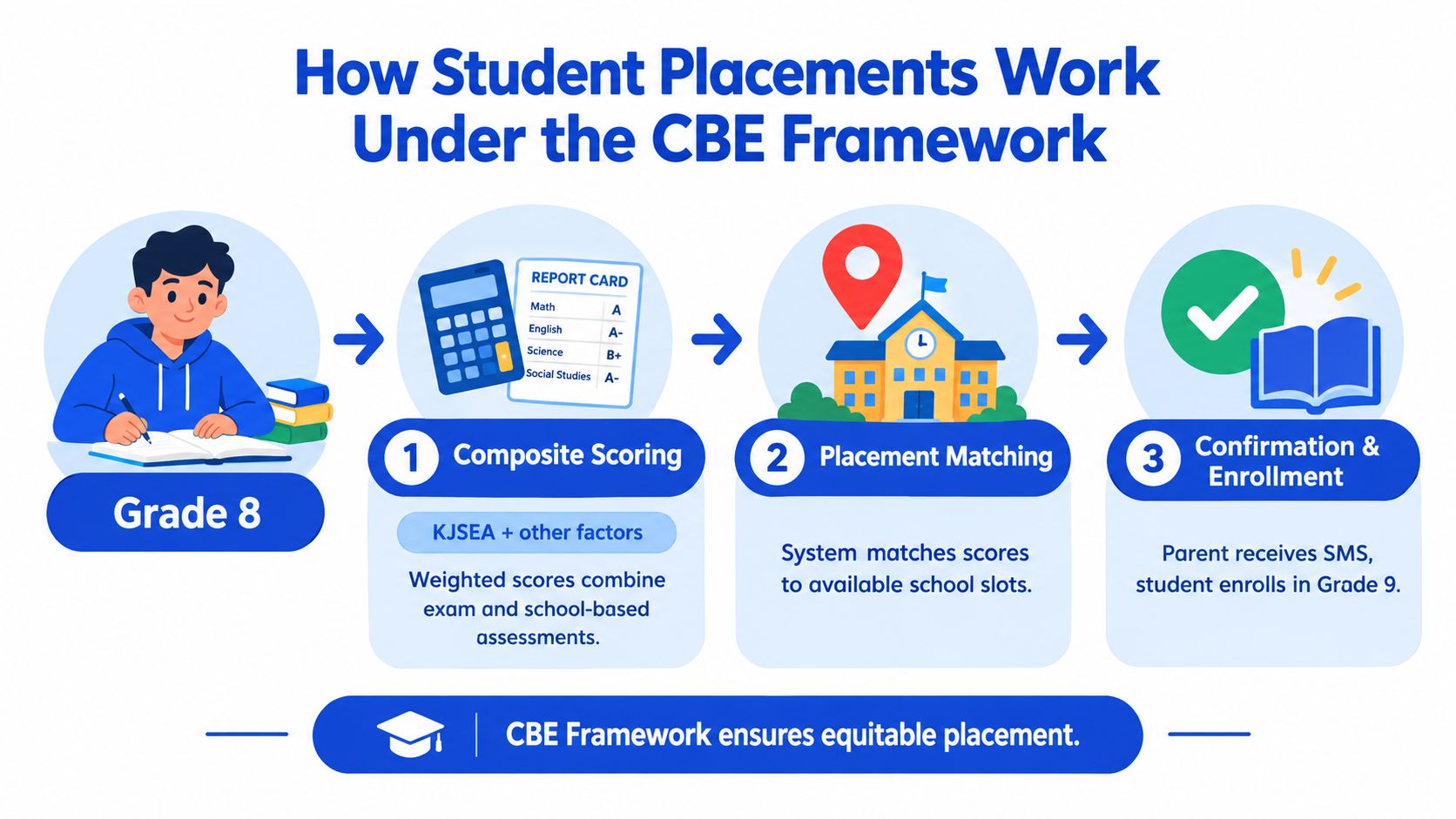
Recent coverage describes the composite score as combining KJSEA at 60%, SBAs at 20%, and KPSEA at 20% in the placement model, as reported by The Standard's explanation of the CBE grading system. In plain language, the final picture isn't based on one assessment alone. National assessment evidence and school-based evidence are brought together.
That distinction matters for parents. A learner's everyday work, recorded through school-based assessment, forms part of the record used in the transition. Revision before a national assessment still matters, but families shouldn't treat the final assessment as the only evidence of ability.
The process can be understood in four stages:
- The system gathers the learner's assessment profile. This includes the components used in the composite score.
- The learner's pathway and subject interests are considered. The broad options include STEM, Social Sciences, and Arts and Sports Science. The actual subject combination still depends on what a school offers.
- The placement system matches the learner with available spaces. School type, pathway provision, and capacity influence the outcome.
- The family confirms the result and prepares for reporting. Keep the message, placement details, and any official instructions safely.
Kenya's 2025 transition shows the scale of the exercise. 1,516,340 Grade 9 learners were placed into senior secondary schools, with 756,354 placed in public institutions and 759,986 in private institutions, according to Education News coverage of the senior school placements. At that volume, placement isn't a small administrative task. It's a national capacity-allocation problem.
Why a high score may not produce the first choice
Parents often ask, “If my child scored well, why didn't they get the preferred school?” The answer may involve subject-combination availability rather than a simple ranking. A school may have a strong reputation but lack space, laboratories, boarding capacity, or the specific combination selected by the learner.
The Ministry's budget reporting records junior secondary enrolment rising from 1,272,830 to 3,705,467 learners, while public secondary enrolment increased from 3,646,398 to 4,253,155 across the reported years, as shown in the Education Sector Report from the National Treasury. Those figures help explain why accurate school profiles and pathway-capacity records matter. More learners require careful matching of classrooms, teachers, facilities, and programmes.
If a family needs to understand the next stage, the Grade 9 to Grade 10 transition guide can help connect placement decisions with preparation for senior school. The practical response to an unexpected result is to check the learner's record, confirm the pathway offered by the assigned school, ask about the available subject combination, and use the authorised review process when a genuine mismatch exists.
Navigating Teacher Deployment via the Teacher Service Commission
A teacher's deployment letter can produce the same emotional reaction as a learner's placement message, especially when the new station is far from home or differs from expectations. The important difference is that teacher deployment is a professional staffing decision administered through the Teacher Service Commission, not a school admission process.
The Commission has digital human-resource tools, including the Integrated Human Resource Management System, commonly known as iHRMS. Teachers should treat the digital record, the posting letter, and the information held by the current and receiving institutions as connected documents. If one record differs from another, the mismatch needs to be addressed promptly.
What shapes a deployment decision
A deployment may reflect several practical considerations:
- Professional qualifications: The teacher's trained subjects and registration details affect the type of work they can undertake.
- School need: Staffing gaps and the availability of teachers in particular subjects influence allocation.
- Geographic distribution: The Commission may need to move staff to areas with greater demand.
- Employment records: The current station, designation, and service history should match the official record.
- Administrative evidence: A teacher requesting review needs clear supporting documents rather than an informal explanation alone.
The exact outcome isn't always obvious from the letter. A teacher should first confirm the station, reporting instructions, effective date, designation, and subjects listed. Then compare these details with the information shown through the official TSC channel and the records held by the school.

A sensible response to an unexpected posting
Don't ignore a posting because it appears incorrect. Start by saving the letter and taking screenshots of the relevant digital record. Ask the head of the current school to confirm the release details, then contact the receiving school to establish whether the station has received the same information.
A useful document file may contain:
- the deployment or transfer letter
- the teacher's identification and TSC details
- professional certificates where relevant
- previous station information
- medical or family-supporting documents where they form part of the review request
- copies of every submitted letter and acknowledgement
A deployment problem becomes harder to solve when the teacher has no record of what was submitted, when it was submitted, or who received it.
Teachers should use official TSC communication channels and avoid relying on social-media screenshots or forwarded messages. If the school cannot resolve the discrepancy, escalate through the appropriate TSC office, keeping the language factual and the request specific. Ask whether the issue concerns a data error, a reporting instruction, a transfer decision, or a request for reconsideration. Each problem needs a different remedy.
Internships and Attachments in Higher Education
A university or college student may hear “placement” and assume it means a job. That assumption causes trouble. An academic attachment is normally part of learning and assessment, while an internship may be structured as workplace experience that supports employability, professional exposure, or recruitment.
The two can overlap, but they aren't interchangeable. A student should ask the institution which one is required before accepting an opportunity.
| Question | Academic attachment | Internship |
|---|---|---|
| Main purpose | Apply course learning in an approved setting | Build workplace experience and professional confidence |
| Institutional role | Often monitored and assessed by the college or university | May be organised by the student, institution, or employer |
| Evidence required | Placement letter, logbook, supervisor feedback, and report may be required | Employer confirmation and an experience record are usually important |
| Best first contact | Department attachment coordinator or academic supervisor | Career office, professional network, employer, or internship coordinator |
Match the opportunity to the course
A nursing student needs a placement that supports supervised clinical learning and follows the institution's professional requirements. A student training to become a teacher may need experience in a school, lesson observation, preparation, delivery, and reflection. An engineering student may need exposure to technical operations, safety procedures, design work, site practice, or laboratory processes.
The host organisation matters because the student must be able to perform meaningful tasks. A prestigious name won't compensate for an attachment where nobody supervises the learner or signs the required records.
Before applying, prepare a short CV, an introduction letter, the institution's placement form, and evidence of the academic requirement. Then ask the host about reporting arrangements, working hours, supervision, safety, transport, and the documents they'll issue at the end.
Turn attachment into evidence
Students should keep a weekly record of tasks, skills practised, problems encountered, and feedback received. This makes the final report easier to write and gives the student examples to discuss in interviews.
Don't describe the experience only as “attended attachment”. Explain what you did, what tools or procedures you used, and how you responded to supervision. A student who connects classroom theory to a real task presents stronger evidence than one who merely lists the organisation's name.
Choose an attachment for the learning it provides, not only for the name printed on the gate.
The best time to begin is before the institution's application window becomes urgent. Ask the department for its approval process, confirm whether the proposed host is acceptable, and obtain written confirmation before reporting. If the placement changes, inform the institution rather than making a private arrangement that may later fail assessment requirements.
Common Problems and How to Resolve Them
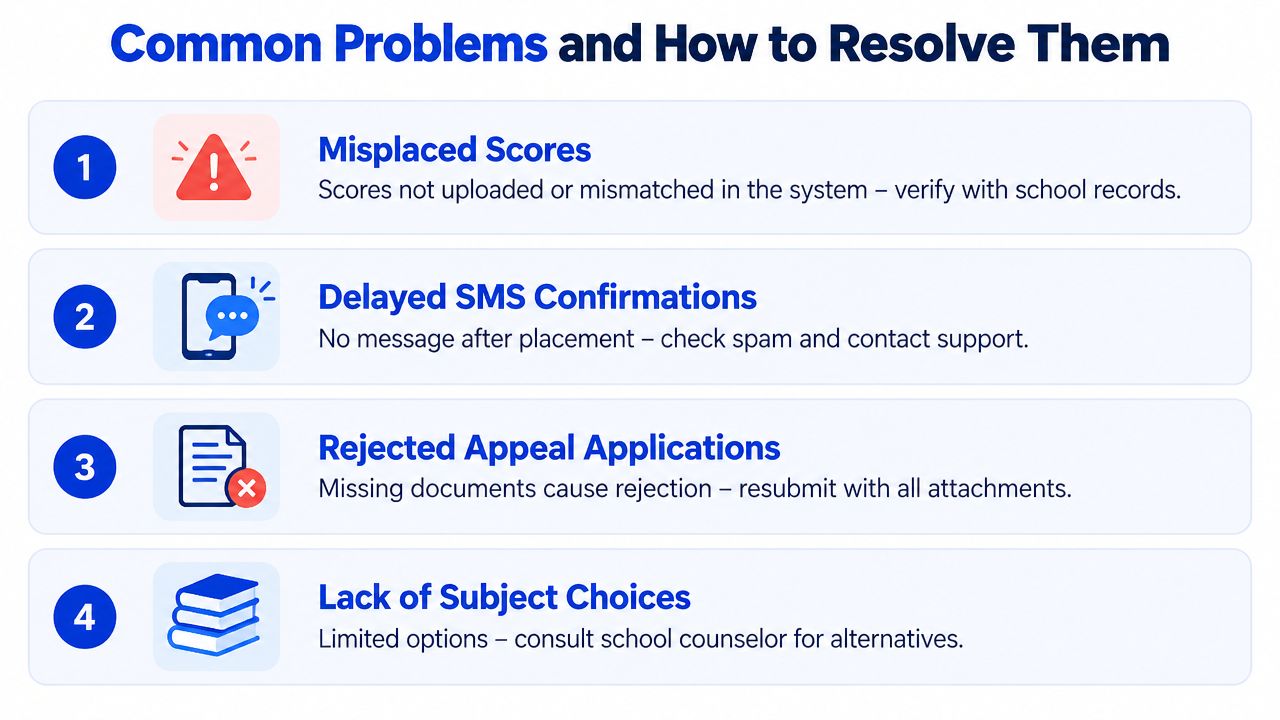
Placement systems can fail in different ways, but the first response should be similar: identify the record, identify the responsible office, and create an evidence trail. A delayed message, a wrong score, a rejected appeal, and an unavailable subject combination aren't the same problem, even though all of them feel like a dead end.
Start with a troubleshooting checklist
Misplaced scores: Compare the online result with the school's assessment records. Ask the school administrator or examination contact to confirm whether the information was uploaded correctly. Keep copies of the result and the supporting school record before requesting correction.
Delayed SMS confirmations: Don't assume that no message means no placement. Check the official portal or authorised confirmation route, verify the phone number used, and ask the school or relevant support office for guidance. Never pay an unofficial person to “release” a result.
Rejected appeal applications: Read the rejection reason carefully. Missing documents, incomplete fields, an unsuitable pathway request, or lack of capacity can lead to different outcomes. Correct the exact problem and keep proof of resubmission.
Unavailable subject choices: Ask the assigned school which combinations it offers and whether an alternative pathway fits the learner's strengths. A choice that sounds similar may lead to different subjects, so get the answer in writing where possible.
For questions about curriculum records and school-based assessment, the KNEC CBA portal guide can help families understand where assessment information sits and what they should verify with the school.
Separate an error from a limitation
An incorrect learner name or missing assessment is a record problem. A school lacking the requested combination is a capacity or programme problem. A teacher whose posting letter differs from the digital record has an employment-record problem. A university student whose host isn't approved has an institutional-compliance problem.
The solution depends on that classification. Record problems require verification and correction. Capacity problems require an alternative or an authorised review. Employment problems require TSC engagement. Attachment problems require the department or coordinator to approve a suitable host.
If the school or institution cannot resolve the issue, escalate with a short written summary. Include the learner or teacher details, the original decision, the specific discrepancy, the action already taken, and the remedy requested. County education offices, Ministry channels, TSC offices, and institutional registries can act more effectively when the request is precise.
Leveraging Digital Tools for Smoother Transitions
Placement anxiety often grows in the quiet periods before and after an official decision. A parent may know the desired pathway but not know whether the learner is ready for its subjects. A teacher may receive feedback on classroom performance but lack a simple way to organise follow-up. A student preparing for attachment may collect documents without tracking the skills they still need to demonstrate.
Digital tools can't control the Ministry's allocation decision, and they can't replace an official posting letter or institutional approval. They can, however, make preparation more deliberate by showing what a learner understands, where gaps remain, and what should be practised next.
Move from revision pressure to regular evidence
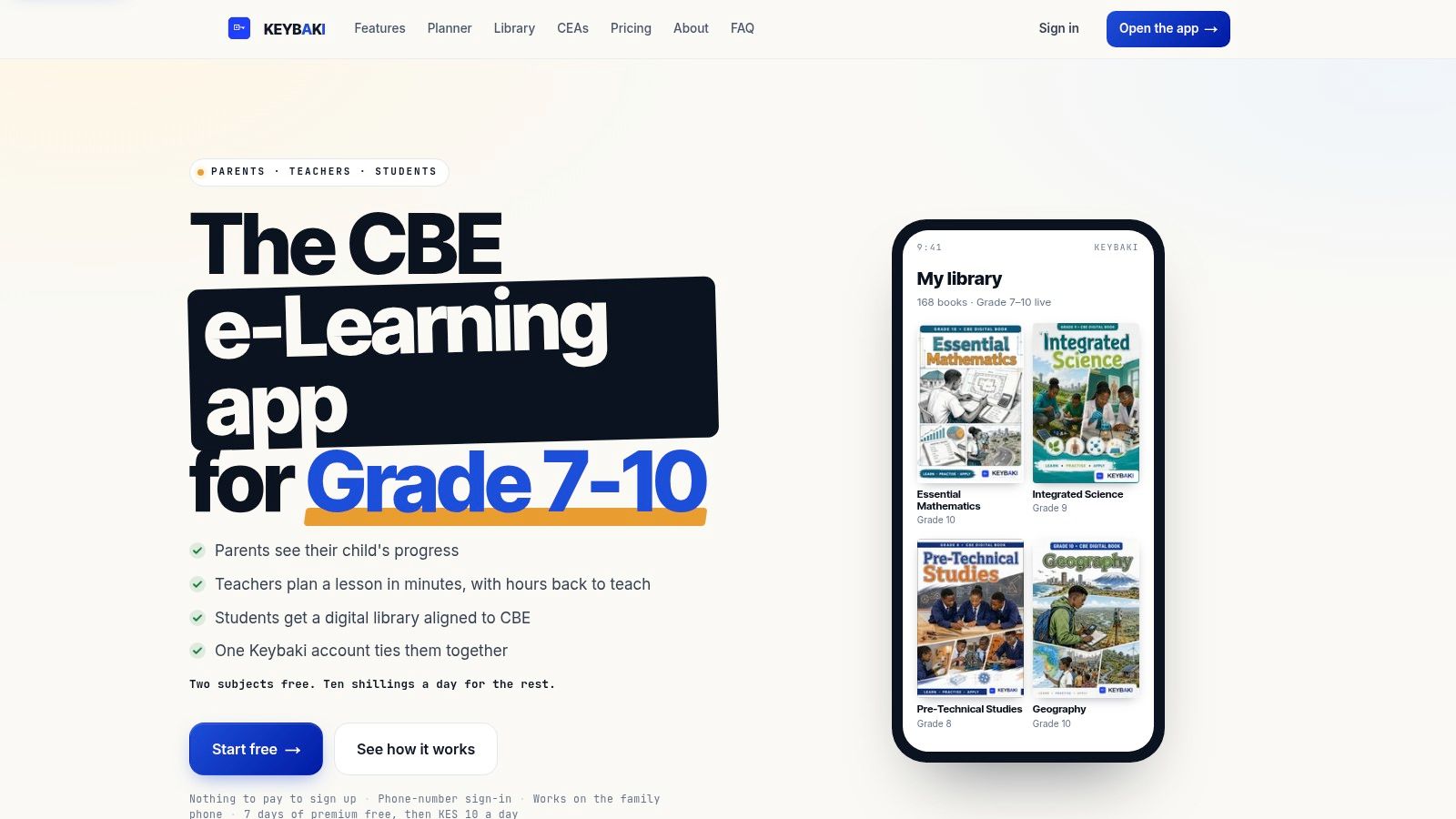
A CBE-mapped platform such as Keybaki connects curriculum strands, lesson planning, continuous evaluation assessments, and parent or student feedback. Its digital library covers Grades 7 to 12 across 14 subjects, while its 5E lesson planner organises learning through Engage, Explore, Explain, Elaborate, and Evaluate stages.
The practical value lies in the weekly loop. A teacher can schedule a strand assessment, review mastery information, and identify areas that need reteaching. A parent can use a weak-strand briefing to discuss a specific learning gap instead of asking only, “Have you revised?”
That approach supports pathway conversations without pretending to predict placement. If a learner is interested in STEM, regular mathematics and science evidence can inform the discussion. If the learner prefers Social Sciences or Arts and Sports Science, families can examine engagement and progress in relevant learning areas. The decision remains a shared conversation involving the learner, family, and school.
Use technology to improve readiness, not to promise a placement outcome it cannot guarantee.
Access also matters. Keybaki provides phone-number sign-in, offline cache, English and Kiswahili content, and PIN-based multi-child profiles for a family phone. Those features address practical barriers for households that don't have a dedicated computer for every learner, although families should still confirm official placement information through Ministry or school channels.
Keep learning connected to school decisions
A learning management system for CBE schools can help teachers, parents, students, and school leaders work from more consistent records. The strongest routine is simple: plan a lesson, practise the strand, assess understanding, review the result, and adjust the next lesson.
The same discipline helps after placement. Once a school and pathway are confirmed, the learner can use feedback to identify the subjects needing early support. Parents can ask for evidence of progress, teachers can target weak areas, and the learner can build a study routine before difficulties become visible in major assessments.
Here's a short explanation of how a connected digital learning routine can support CBE preparation:
Whether you're following a learner's senior school transition, checking a teacher deployment, or preparing for an academic attachment, keep the same practical habit: verify the official decision, save the supporting records, and act early when something doesn't match. Digital learning tools can strengthen preparation, but official institutions remain responsible for placement, deployment, and approval decisions.
Keybaki gives CBE families and schools a shared space for mapped lessons, continuous assessments, weak-strand feedback, and pathway preparation across Grades 7 to 12. Visit Keybaki to explore a practical way to turn placement uncertainty into organised weekly learning.
Comments
Loading…