
· senior school pathways
Grade 9 to Grade 10 Transition: A Complete CBE Guide
14 min read

Kenya's Grade 9 to Grade 10 transition has moved from policy discussion to a national operational test. By February 23, 2026, the Ministry of Education reported that transition had reached 98% nationwide, after earlier January reports placed it at 61% and then 75% during mop-up efforts. Capital FM reported the 61% early transition figure, while later reporting covered the move from 75% towards full enrolment and the county-level gaps behind it. The Interior Ministry reported the January reporting progress.
Those figures tell parents something important. A learner can be selected on the national platform and still fail to report because of distance, fees, placement confusion, family circumstances, or school capacity problems. The Grade 9 to Grade 10 transition isn't complete when a name appears on a list. It's complete when the learner reaches a suitable Senior School, joins the right pathway, and receives the teaching and resources promised by the curriculum.
Table of Contents
- Understanding the Grade 9 to Grade 10 Transition Under CBE
- Choosing the Right Senior School Pathway
- Administrative Steps for Enrolment and Placement
- Preparing Teachers and Schools for Senior School Intake
- Using Digital Tools to Build Academic Readiness
- Managing the Social and Emotional Shift
- Your Transition Timeline and Action Checklist
Understanding the Grade 9 to Grade 10 Transition Under CBE
The first Grade 9 cohort moving into Senior School in January 2026 marked a historic stage in Kenya's Competency-Based Education rollout. The first Senior School reporting date was set for January 12, 2026, and the transition introduced the fourth tier of the CBC structure. Ministry-linked reporting outlines the January 2026 transition and national selection process.
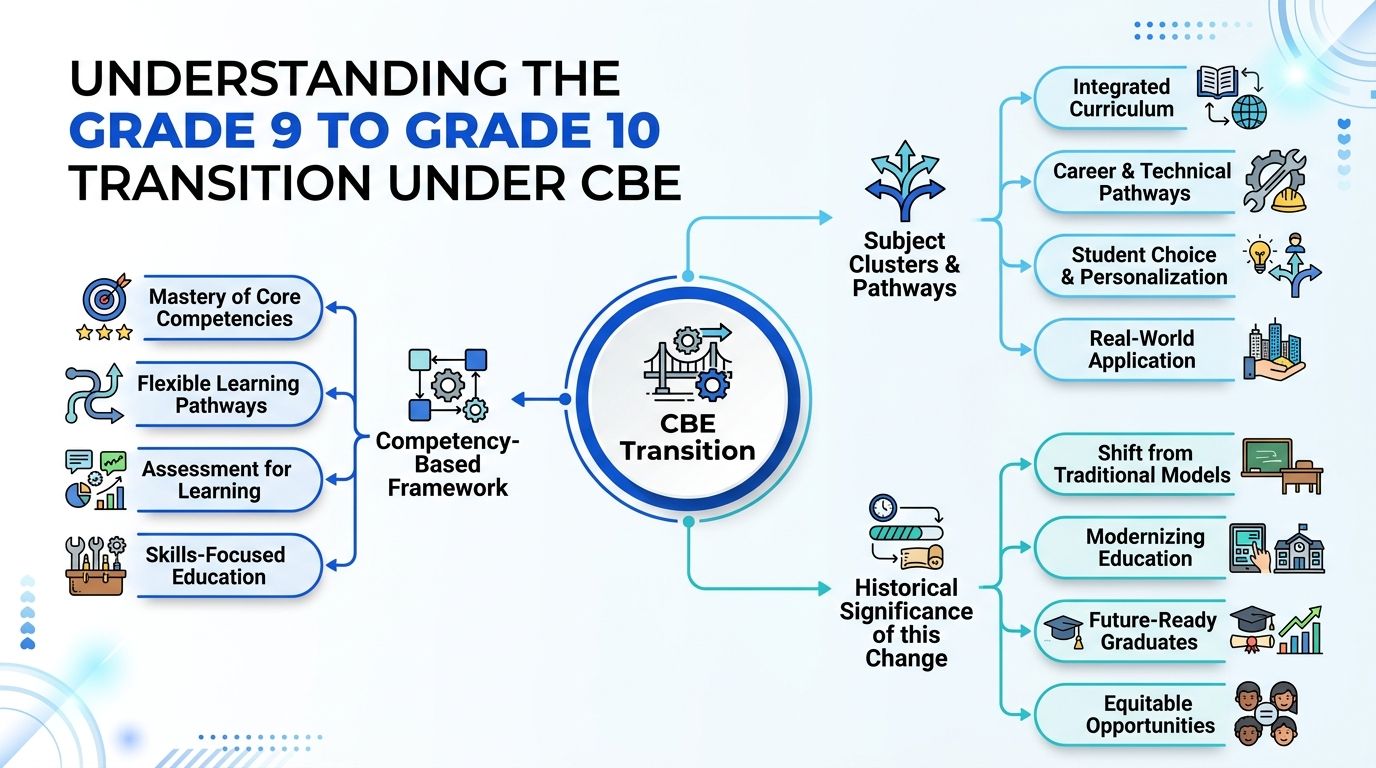
Under the old KCPE-style model, families understood transition largely as an examination result followed by secondary school admission. The CBE model changes the decision. Grade 9 learners move from Junior Secondary into Senior School through a national digital selection process that considers school choices and pathway preferences. Grade 10 is the first point where learners are organised into STEM, Social Sciences, or Arts and Sports Science pathways.
That makes the transition both academic and administrative. The learner must understand personal strengths and interests. The parent must verify placement and reporting arrangements. The school must have the teachers, rooms, laboratories, learning materials, and timetable needed to deliver the selected pathway.
What changes for the learner
Junior Secondary provides a broad foundation. Senior School introduces more focused choices within a pathway structure. A learner who has enjoyed practical science, mathematical problem-solving, and technology-related activities may find STEM suitable, while another who communicates strongly, enjoys history or society, or shows interest in business may prefer Social Sciences. Creative performance, visual expression, physical ability, and sustained interest in sport may point towards Arts and Sports Science.
The decision shouldn't be made because one pathway sounds more prestigious. It should be based on evidence from classroom work, assessments, teacher observations, and the learner's own commitment.
Practical rule: Placement is only the beginning. Confirm that the assigned school can actually offer the pathway and subject combination selected.
Why the national figures matter
The rapid movement from partial reporting to near-universal transition shows the size of the exercise. More than one million Grade 10 learners were reported nationwide, representing 92% of candidates who sat the KJSEA, according to Ministry-linked reporting covered by Capital FM's national transition update.
Yet national averages can hide local problems. Mandera reportedly exceeded 95% reporting while Turkana was around 25% during an earlier stage of the process, as covered in the report on the 75% national transition and county disparities. A family in a well-connected urban centre and one in a remote or marginalised area won't experience the same transition. County education offices and schools must treat non-reporting as a case requiring follow-up, not as a missing name on a spreadsheet.
Choosing the Right Senior School Pathway
Pathway selection should answer one question: where is this learner most likely to develop real competence and remain engaged? It shouldn't answer the parent's status concerns or follow the choice made by a neighbour.
Start with the learner's evidence. Review classroom assignments, CEA results, practical work, teacher comments, and the strands where the learner works confidently without constant prompting. Then compare that evidence with the learner's interests and possible career direction. A career ambition matters, but it shouldn't override persistent difficulty in the foundational skills that the pathway demands.
Use a four-part decision conversation
Ask what the learner enjoys doing. Does the learner like investigating, calculating, designing, debating, writing, performing, creating, or training? Interest doesn't guarantee success, but a complete lack of interest creates a difficult foundation.
Check demonstrated competence. Look for patterns across assessments rather than one impressive test. A learner may struggle with written work but show strong practical reasoning. Teachers should explain that distinction clearly.
Test the school's actual offer. A pathway choice is meaningful only if the assigned school has the relevant teachers, rooms, equipment, and subject combination. Don't assume that every school offers every option.
Discuss flexibility. If the learner is uncertain, choose the pathway that best matches current evidence and keep monitoring performance. A later request to change may involve school capacity, subject availability, and administrative approval, so changing direction shouldn't be treated as automatic.
Use this framework with the Grade 10 pathway selection guide for Kenya before submitting or confirming choices.
| Pathway | Best Suited For | Key Subjects | CEA Indicators to Check |
|---|---|---|---|
| STEM | Learners who enjoy scientific investigation, mathematics, technology, and practical problem-solving | Science, mathematics, technical and applied learning options | Numeracy, scientific reasoning, interpretation of data, practical task performance |
| Social Sciences | Learners drawn to people, society, communication, history, languages, and enterprise | Humanities, languages, business-related options | Reading comprehension, written communication, research, interpretation, discussion |
| Arts and Sports Science | Learners with sustained creative, performing, visual, or physical interests | Creative arts, performing arts, sports and related options | Originality, technique, performance consistency, collaboration, physical or artistic development |
Parents should ask the school for a clear explanation of available combinations. If a learner's first choice isn't available, request alternatives that preserve the learner's strengths rather than accepting a random combination.
Administrative Steps for Enrolment and Placement
Families should handle placement like a practical file, not a rumour network. Keep the learner's assessment information, selection details, school contacts, reporting instructions, and any correspondence together. A WhatsApp message from another parent isn't confirmation.
For parents and learners
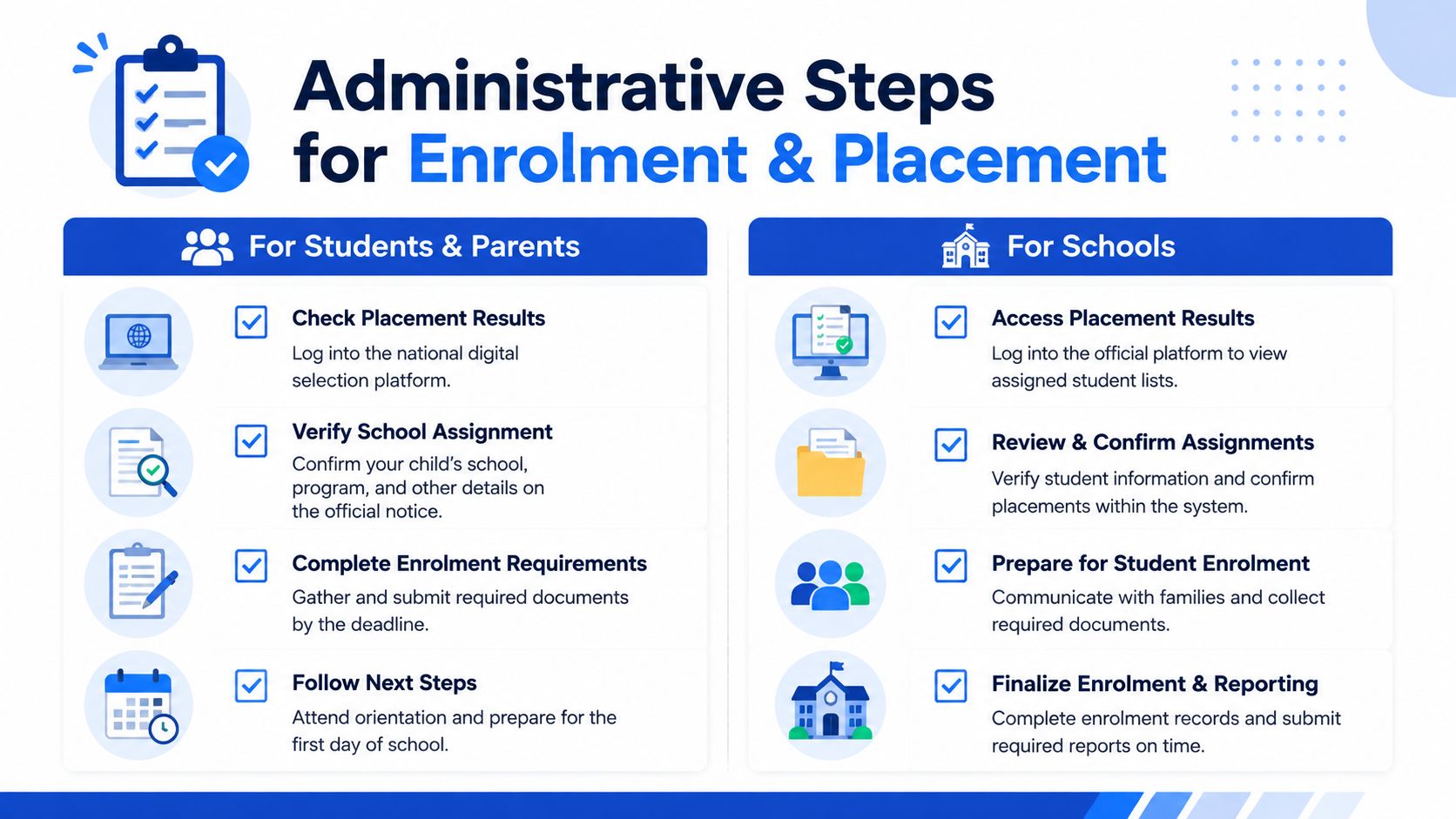
First, check the placement result on the national digital selection platform. Confirm the learner's name, assigned school, pathway, and subject combination. Save the official notice or write down the reference details.
Next, contact the assigned school directly. Ask about reporting requirements, boarding or day arrangements, uniform, documents, fees, available pathway facilities, and the process for correcting an error. Confirm that the school recognises the placement before travelling.
Then, report or escalate quickly. If the learner hasn't reported, identify the reason immediately. Financial difficulty, distance, child labour, teenage pregnancy, early marriage, absenteeism, and placement delays require different responses. The head teacher, principal, local education office, and relevant county officers should know when a learner is at risk of dropping out.
Finally, verify enrolment in person or through the school's official channel. Obtain confirmation that the learner is on the admission register and that the selected pathway has been recorded correctly.
County follow-up must be targeted
The reporting gap has been uneven across counties. Mandera's reported uptake above 95% and Turkana's reported uptake around 25% show why a national announcement can't replace local case management. The county disparity reporting provides this operational warning.
Schools should create a list of learners who haven't reported, assign each case to a staff member, and record the action taken. A phone call may solve a misunderstanding. A home visit may uncover transport or financial problems. A county office may need to resolve a placement issue. The point is to replace passive waiting with documented follow-up.
At one stage, reporting moved through 61%, 75%, and 85%, with about 280,000 learners still not reported. The Interior Ministry's account of the mop-up process describes this gap. Schools that wait for families to solve every barrier alone will lose learners who were technically placed but practically excluded.
Preparing Teachers and Schools for Senior School Intake
A school can receive a learner without being ready to teach that learner well. That is the central readiness risk in this transition.
Government preparations included hiring 76,000 teachers, allocating Sh980 million for teacher retooling, and constructing 1,600 laboratories in schools lacking science facilities. The government's readiness report details these measures. These actions matter, but a national allocation doesn't guarantee that every school has the right teacher, room, equipment, or timetable on the first day.
Conduct a pathway capacity audit
A principal should ask each department to produce a short, honest audit:
- Teachers: Which subjects can current teachers deliver, and where are the gaps?
- Rooms: Are classrooms, studios, workshops, fields, and laboratories available for the selected combinations?
- Materials: Can learners perform the practical, creative, and investigative activities required?
- Timetable: Does the schedule protect pathway learning instead of squeezing it around more familiar subjects?
- Assessment: Can teachers record projects, practical work, and written tasks consistently?
- Learner support: Who will follow up learners who arrive late or show serious gaps?
A school that offers a STEM combination without usable science facilities has created a placement-to-capacity mismatch. The learner may be admitted but denied the learning experience attached to the pathway.
Start with diagnosis, not assumptions
Consider a school receiving learners from several Junior Secondary settings. One group may be confident in basic concepts, while another may have gaps in measurement, reading instructions, or laboratory safety. A teacher who begins with advanced content immediately may mistake unfamiliarity for inability. The better response is a short diagnostic sequence, followed by grouped support and clear reteaching.
Teachers can use the 5E lesson planner to organise the first weeks around Engage, Explore, Explain, Elaborate, and Evaluate. The structure helps a department connect the incoming learner's evidence to practical classroom activity instead of relying on a generic opening scheme of work.
The former Junior Secondary staffing shortfall was reported at 42,117 teachers, a warning that school readiness must be checked locally rather than assumed from policy plans. UKFIET's discussion of the shift to Senior Secondary covers staffing and wider readiness barriers.
School leadership advice: Don't report “ready” until the department can name the teacher, room, materials, timetable slot, and assessment method for every pathway option.
Using Digital Tools to Build Academic Readiness
Digital tools help when they answer a specific question. A mastery dashboard should show which strand needs attention. A CEA should reveal whether the learner can apply the skill. A revision queue should turn that information into the next sensible task.
Parents don't need to supervise every exercise. They need a reliable weekly routine for checking evidence and agreeing on the next action. On a shared family phone, a parent can review the learner's weak-strand briefing, while the learner completes a short adaptive queue during the weekend. The parent should ask the learner to explain one corrected mistake, not merely report that the task was finished.
A practical weekly loop
Review: Check the weekly briefing and identify the weakest strand, not a random topic.
Practise: Let the adaptive queue select revision that responds to the learner's recent performance.
Assess: Use a CEA to check whether the learner can now work independently.
Adjust: If the gap remains, schedule another explanation or ask the teacher for targeted support.
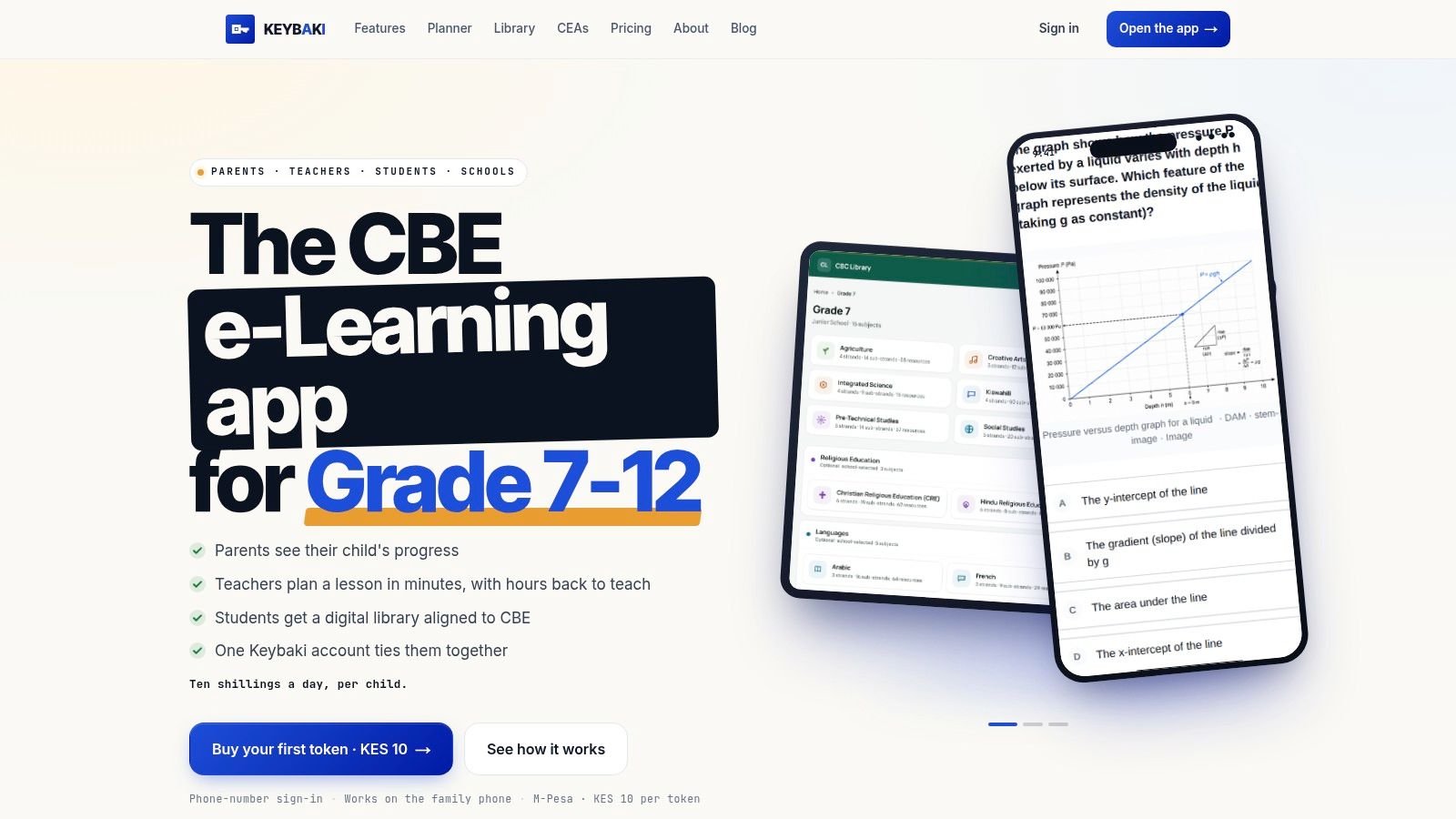
Keybaki provides CBE-mapped lessons and CEAs, weekly weak-strand briefings, adaptive weekend revision queues, mastery reporting, and teacher planning tools for Grades 7 to 12. Its 5E lesson planner can connect CEA outcomes to the next week's plan, while offline caching and shared-phone access support families working with limited devices. Families comparing options can also review this guide to CBE e-learning in Kenya.
Make the data useful to a teacher
A student shouldn't hide weak results. The value of a CEA is that it gives the teacher a starting point for reteaching. A teacher can group learners by a common weak strand, change the example used in class, provide a practical activity, and check understanding again.
Streaks and badges may help a learner maintain a revision habit, but they aren't proof of mastery. The true test is whether the learner can explain the method, apply it in a new question, and improve after feedback. Use digital tools to support judgement, not replace it.
Managing the Social and Emotional Shift
A learner may understand the academic pathway and still feel unsettled. Senior School can mean a new uniform, unfamiliar teachers, different classmates, longer travel, hostel life, or separation from friends. A placement that looks acceptable on paper may feel frightening to a child who has never travelled far from home.
Parents should listen before they advise. If a learner is disappointed by placement, don't dismiss the feeling with “you should be grateful”. Ask what specifically worries them, then separate the solvable problem from the emotional reaction. Transport, reporting dates, uniform, and accommodation can be investigated. Fear of starting somewhere new needs reassurance, preparation, and a trusted adult at school.
Support the first month deliberately
- Build a contact plan: Agree when the learner will call home and identify the school staff member to contact if a problem arises.
- Practise help-seeking: Teach the learner how to approach a class teacher, house parent, counsellor, or deputy principal.
- Avoid pathway labels: A STEM learner can struggle at first, and an Arts and Sports Science learner can excel academically. Neither result defines the child.
- Watch for withdrawal: Persistent silence, unexplained absence, loss of interest, or fear of attending school deserves prompt attention.
Teachers set the tone quickly. Greet new learners by name, explain routines plainly, mix learners during collaborative work, and correct mistakes without public humiliation. A learner who feels safe is more likely to ask questions and reveal gaps.
Imposter syndrome often appears when a learner enters a demanding pathway with classmates who seem more prepared. The solution isn't empty praise. Give the learner a manageable task, provide feedback on the exact skill demonstrated, and show the next step. Confidence grows from visible progress and supportive relationships.
A successful transition protects the learner's dignity while building academic responsibility.
Your Transition Timeline and Action Checklist
Use a simple timeline and assign responsibility. Families should save the official Kenya school calendar and term dates guide, then confirm school-specific instructions because reporting arrangements can differ.
During the final Grade 9 preparation period
Learner: Complete CEAs seriously, review weak strands, and discuss pathway interests with a teacher.
Parent: Review assessment evidence, ask about realistic pathway options, and confirm the preferred school choices.
Teacher: Complete learner records, flag support needs, and provide evidence-based pathway guidance.
After selection results are released
Parent: Check the national digital placement result, verify the school and pathway, and contact the school through an official channel.
Learner: Read the reporting instructions and ask questions about the assigned combination.
School: Prepare an admission list, identify non-reporting learners, and begin follow-up instead of waiting for the first term to settle.
Before reporting
Organise documents, transport, uniform, learning materials, and any required medical or boarding information. If cost, distance, pregnancy, disability, family duties, or another barrier threatens attendance, contact the school and local education office early.
The first month of Grade 10
Teachers should use early classroom evidence to group support, adjust lesson plans, and check that pathway facilities are functioning. Parents should ask what the learner is learning and where support is needed, not only whether marks are high. Learners should attend consistently, keep up with projects and practical work, and report placement or safety problems promptly.
The Grade 9 to Grade 10 transition works when every stakeholder treats it as a live process. Placement, reporting, teaching, assessment, and emotional support must connect.
Keybaki gives Kenyan families, learners, and teachers a shared way to monitor weak strands, run CBE-mapped CEAs, plan lessons, and organise adaptive revision before and after Grade 10 placement. Visit Keybaki to see how the platform can support your learner's transition from Junior Secondary into Senior School.
Comments
Loading…