
· KJSEA
KJSEA Assessment Format: Multiple-Choice and Structured Questions Explained
16 min read
KJSEA assesses learning across Grades 7, 8 and 9 using multiple-choice and structured questions, although English Language and Kiswahili Lugha are MCQ-only papers. You'll therefore need to practise both choosing answers and writing your own, depending on the paper.
Perhaps you've opened a mock paper, recognised the topic, then wondered whether to shade a letter or write an explanation. That uncertainty is manageable. Understanding the KJSEA assessment format starts with knowing what each question asks you to do, where your answer belongs and how much detail is enough.
Table of Contents
- What the KJSEA Assessment Format Looks Like in 2026
- KJSEA Multiple-Choice Questions and How to Handle Them
- KJSEA Structured Questions and How Marks Are Awarded
- MCQ-Only, Structured-Only and Combined Papers at a Glance
- Decoding Command Words and Avoiding Common Mistakes
- Mixed-Format Practice Test with Answer Key
- Why MCQ and Structured Marks Are Not the Whole KJSEA Story
- FAQs and Where to Keep Practising
What the KJSEA Assessment Format Looks Like in 2026
You turn over a mock paper and see answer options on one page, then blank lines on another. Before answering, pause and read the instructions. Don't assume every learning area uses the same arrangement.
The official KNEC assessment management guide identifies Grades 7–9 coverage and the use of both MCQs and structured questions. The purpose is broader than remembering facts. Learners must also demonstrate knowledge, skills, values and competencies developed during junior school.
Picture the answer journey
A multiple-choice item gives you possible answers. You select the correct one and record it as instructed. A structured item asks you to produce the answer yourself, perhaps by naming something, explaining a reason or showing a calculation.
These formats provide different evidence of understanding:
- MCQs allow broad coverage of curriculum content through recognition, interpretation and application.
- Structured responses make your reasoning, working and explanations visible.
For the paper arrangements described in the examination briefing, MCQ responses go on a separate Optical Mark Recognition sheet, usually called an OMR sheet. Structured responses belong in the personalised question paper or designated answer space.
Before you begin: Find the instructions for each section and the place where each answer must go.
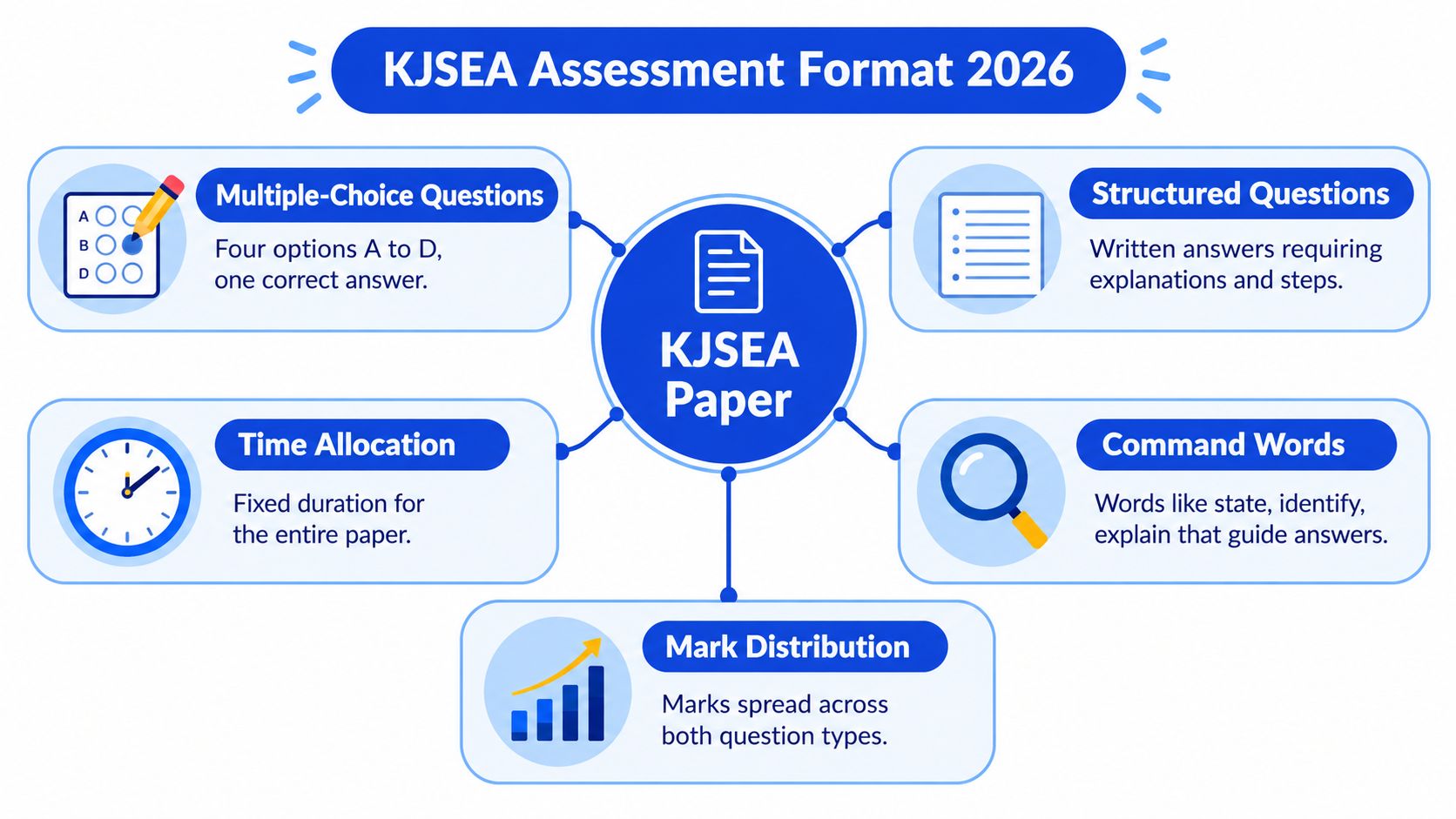
Treat this diagram as an overview, not a universal paper template. The actual paper determines its sections, answer requirements and mark allocations.
For families who want the wider classroom context, this guide to CBE assessment methods provides a useful companion. For the KJSEA exam format 2026, however, always let the current examination instructions settle paper-specific questions.
KJSEA Multiple-Choice Questions and How to Handle Them
Original practice examples, not official KNEC examination questions. The explanations below are teaching guidance, not official marking schemes.
Work through the options
Example A
Which sentence uses the past tense correctly?
A. Yesterday, Amina walks home.
B. Yesterday, Amina walked home.
C. Yesterday, Amina walking home.
D. Yesterday, Amina walk home.
Answer: B. “Yesterday” places the action in the past, so “walked” fits. A uses the present tense, C lacks a complete verb phrase and D uses the wrong verb form.
Example B
Which item is most suitable for measuring the length of an exercise book?
A. Thermometer
B. Measuring cylinder
C. Ruler
D. Balance
Answer: C. The question asks about length. The other instruments measure different quantities.
Example C
Which action best demonstrates cooperation during a group task?
A. Listening to others and sharing responsibilities
B. Keeping all the materials
C. Refusing to discuss ideas
D. Leaving the work to someone else
Answer: A. Cooperation involves working with others. Each distractor describes behaviour that prevents shared participation.
Use a repeatable routine
Read the question before examining the options. Decide what it's asking, then reject choices that don't meet that requirement.
A distractor is an incorrect option. In the examples above, distractors expose particular misunderstandings, such as confusing the quantity being measured or overlooking a time word.
- Choose deliberately: Check that your answer satisfies the whole question.
- Match the number: Confirm the question number before recording the answer on the OMR sheet.
- Keep entries clear: Follow the sheet's instructions and avoid stray marks or ambiguous selections.
- Return if needed: Make your best reasoned selection when uncertain, subject to the actual paper's rules.

Don't assume general writing instructions automatically specify how to complete an OMR sheet. Follow its own directions. Also, the absence of a stated penalty in a briefing isn't enough to establish an official negative-marking policy.
KJSEA Structured Questions and How Marks Are Awarded
A structured question isn't necessarily an essay. It may need a name, a sentence, a labelled diagram or a calculation with working.
The KNEC Integrated Science sample paper illustrates the distinction clearly: Section A contains 30 MCQs numbered 1–30, while Section B contains 10 short structured questions numbered 31–40. That's a documented sample arrangement, not permission to assume identical counts in every paper.
Make your reasoning visible
Consider this original calculation example, not an official examination item:
Calculate the area of a rectangular garden measuring 8 m by 3 m. Show your working.
A clear response is:
Area = length × width
= 8 × 3
= 24 m²
The formula shows your method. The substitution shows how you used the information. The final line gives the result and its unit.
Compare that with writing only “24”. A teacher can see the numerical answer, but not your method or whether you understand the unit of area.
Separate practice feedback from official marks
For this original example, a teacher could check the formula, substitution, arithmetic and unit separately. That is a suggested feedback checklist, not a KNEC mark allocation.
Whether an examination response earns method credit, partial credit or separate explanation marks depends on the item-specific marking scheme. Don't assume every calculation awards marks in the same way, or that a wrong final answer always receives method marks.
Show enough working for someone else to follow your thinking, without burying the answer in unrelated material.
When reviewing KJSEA structured questions at home, ask: Did I answer the command? Is my reasoning understandable? Have I included the required unit or explanation?
For a comparison with another examination system, Magna Education's guide to what to expect on AP free response offers additional reading about constructed responses. It isn't a source of KJSEA marking rules.
MCQ-Only, Structured-Only and Combined Papers at a Glance
Check the paper, not just the subject name. Preparing for English Language doesn't remove the need to practise writing for the separate composition and literary analysis paper.
The following breakdown follows the KJSEA supervisors' and invigilators' briefing reproduced by Education Board. This is a secondary reproduction of examination information, so confirm operational details against current KNEC instructions.
KJSEA Question Formats by Learning Area
| Learning Area | Paper Format | What to Practise |
|---|---|---|
| English Language, 901/1 | MCQ-only | Careful reading, option selection and answer transfer |
| Kiswahili Lugha, 902/1 | MCQ-only | Language interpretation and accurate selection |
| English composition and literary analysis | Structured-only | Organised writing and supported responses |
| Kiswahili composition and literature | Structured-only | Focused written answers and composition |
| Mathematics | Combined | Calculations, option selection and working |
| Integrated Science | Combined | Interpretation, explanations and calculations |
| Agriculture and Nutrition | Combined | Applied choices and contextual responses |
| Religious Education | Combined | Interpretation and clear explanations |
| Creative Arts and Sports theory | Combined | Knowledge application and written responses |
| Pre-Technical Studies theory | Combined | Technical understanding and short constructed answers |
For combined papers, don't spend all your revision time choosing letters. Practise producing an answer without options too.
For structured-only papers, concentrate on planning and expressing responses. For MCQ-only papers, prioritise accuracy and interpretation, but remember that recognising a familiar word isn't the same as understanding the whole question.
Decoding Command Words and Avoiding Common Mistakes
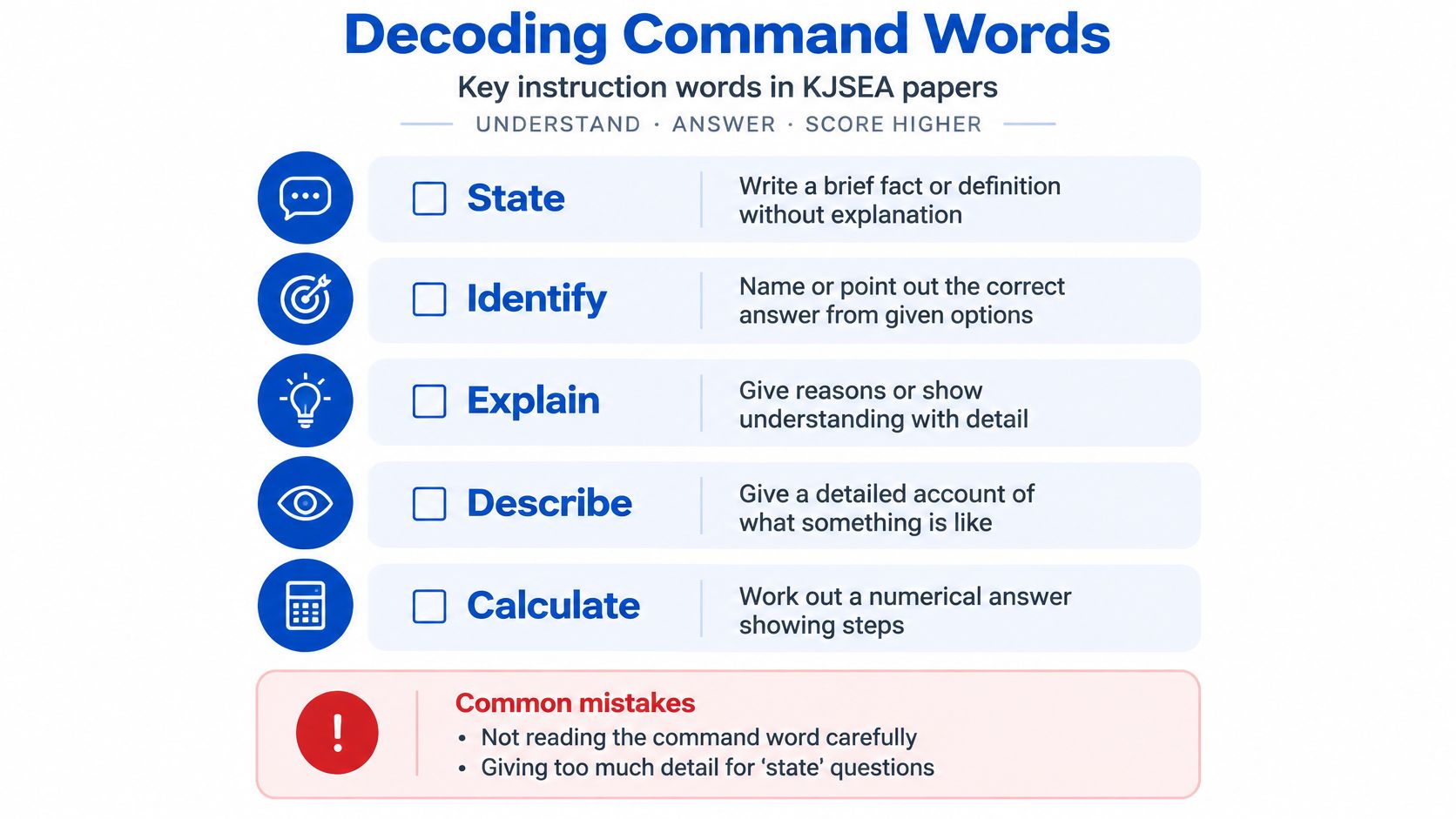
The command word tells you what kind of answer to produce. A correct fact can still be an incomplete response if the question asks you to explain it.
These are original structured-question examples, not official KNEC items. Their answer notes illustrate what the command requires; they don't reproduce official marking schemes.
Match the verb to the response
| Command | Original example | Model answer and explanation |
|---|---|---|
| State | State a tool used to measure length. | A ruler. A brief fact answers the request. |
| Identify | A learner measures classroom temperature. Identify the instrument needed. | A thermometer. Name the instrument that fits the situation. |
| Describe | Describe a rectangular exercise-book cover. | It has opposite sides equal and parallel, with right-angled corners. Give its relevant features. |
| Explain | Explain why group members should share responsibilities. | Sharing responsibilities allows members to contribute and prevents the task from falling on one person. Give the reason, not merely the action. |
| Calculate | Calculate 18 + 27. | 18 + 27 = 45. Show the operation as well as the answer. |
A useful memory aid is: state a fact, identify the item, describe its features, explain the reason, calculate with working.
Avoid presentation mistakes you can control
The published KNEC candidate instructions require written responses in black or blue ink, prohibit erasable pens and reserve pencil for diagrams. They also warn that information not requested earns no marks.
- Read the scope: If a paper limits how many questions to answer, obey that direction.
- Watch your time: Don't spend too long on a difficult item while other questions remain.
- Answer the actual request: More writing doesn't automatically mean a stronger response.
- Check completeness: Look for missed questions and unclear answer-sheet entries before finishing.
A useful final check: Underline the command word in your mind, then ask whether your answer does what it says.
Mixed-Format Practice Test with Answer Key
All questions below are original practice items, not official KNEC examination questions. The answer key provides teaching explanations rather than an official marking scheme.
Try this as a 30-minute home practice activity. That's a suggested study session, not an examination duration. Keep the answers covered until you've finished.
Practice questions
1. Which sentence is a complete statement?
A. Because the rain.
B. Walking towards school.
C. The learners cleaned the classroom.
D. Under the desk.
2. A rectangle measures 6 cm by 4 cm. What is its perimeter?
A. 10 cm
B. 20 cm
C. 24 cm
D. 48 cm
3. Which tool would you select to measure the mass of an object?
A. Ruler
B. Thermometer
C. Balance
D. Clock
4. Identify the instrument used to measure temperature.
Answer space: ........................................................
5. State what is meant by cooperation.
Answer space: ........................................................
6. Describe a square.
Answer space: ........................................................
7. Explain why a group should agree on responsibilities before beginning a shared task.
Answer space: ........................................................
8. Calculate the area of a rectangle measuring 7 cm by 5 cm. Show your working.
Working space: ......................................................
Final answer: ........................................................
Separate answer key
1. C. It expresses a complete thought. The other options are fragments rather than complete statements.
2. B. Perimeter = 6 + 4 + 6 + 4 = 20 cm. A adds only adjacent sides; C calculates area; D doesn't apply the perimeter rule correctly.
3. C. A balance measures mass. The distractors refer to length, temperature and time.
4. Thermometer. Naming the correct instrument satisfies “identify”.
5. Working together towards a shared goal. Accept equivalent wording that clearly conveys joint effort.
6. A shape with equal sides and right-angled corners. The response describes defining features rather than merely naming another shape.
7. Agreeing on responsibilities helps members understand their tasks and reduces confusion or duplicated effort. The response connects the action with its benefit.
8. Area = length × width = 7 × 5 = 35 cm². Check the method, multiplication and unit separately during self-review.
Use secondary-school revision materials to follow up the topic behind an error, rather than repeating the same question.
Why MCQ and Structured Marks Are Not the Whole KJSEA Story
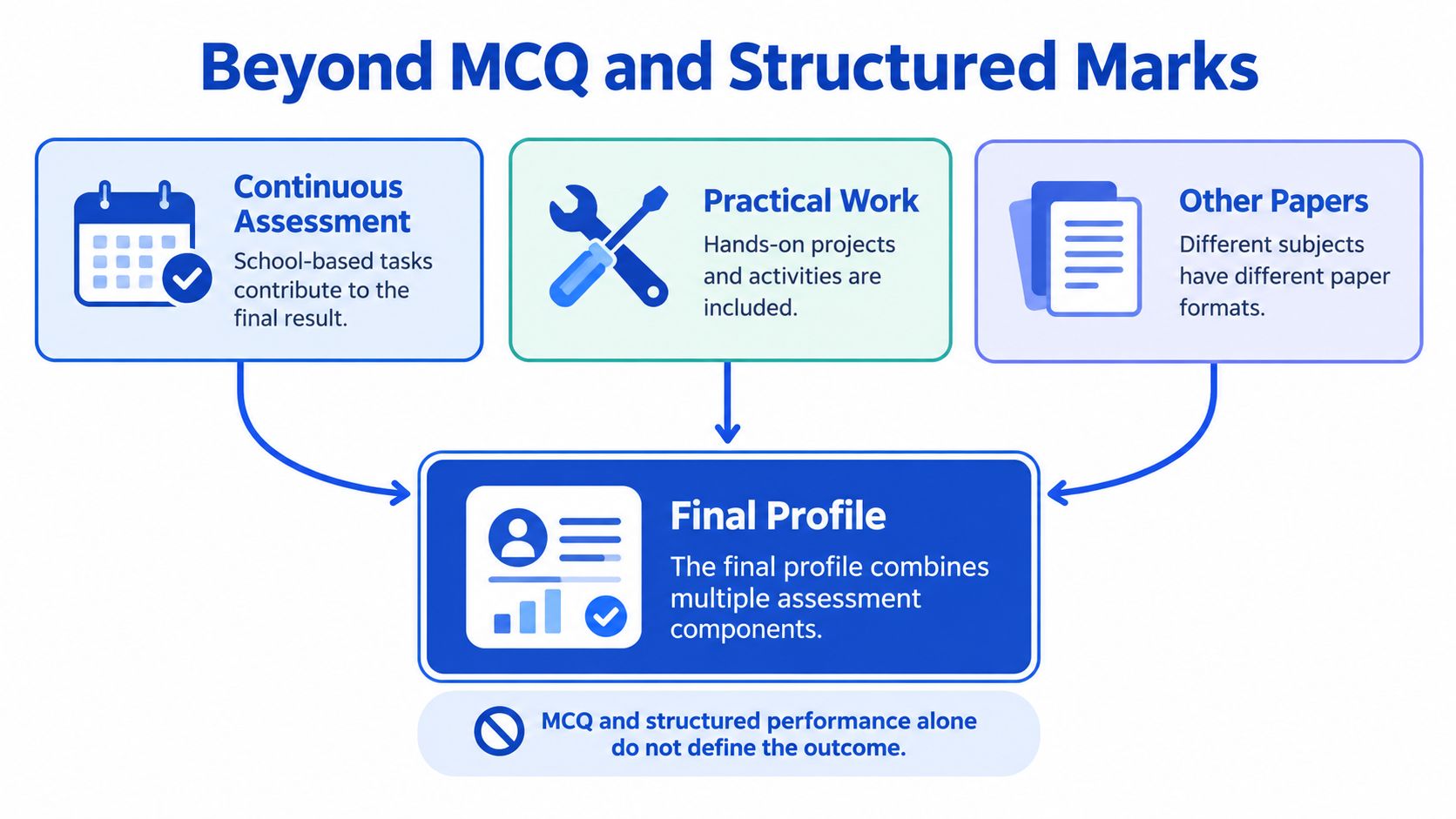
A mock score tells you where you struggled on that paper. The eventual KJSEA profile draws on far more evidence, so treat the mark as a torch that lights one room of a much larger house.
The Star's report on KNEC's assessment reporting describes four performance bands, each split into two points on an eight-point scale, giving up to eight points in each of nine assessed learning areas for a possible 72 in total, and records that 75% of learners reached Approaching Expectations or above across the tested subjects.
Understand the broader profile
The four bands run from Exceeding Expectations through Meeting Expectations and Approaching Expectations down to Below Expectations. The same reporting describes a wider profile that incorporates KPSEA performance, Grade 7 school-based assessment, three Grade 9 projects and the summative assessment.
Here is where families often stumble. No published formula converts a practice MCQ total into a final result, and the possible points total does not work as a conventional aggregate percentage. Read a mock the way a marker reads your script: it shows what you demonstrated on that day, on those questions.
Turn errors into useful next steps
After marking a practice paper, classify the problem. Did you misunderstand the topic, misread the command, omit working or transfer an answer incorrectly?
Each cause wants a different remedy. Relearning the topic cannot fix a question-number mismatch, and extra answer-sheet practice will not repair a shaky grasp of area. Match the cure to the actual fault.
For a fuller explanation, consult the KJSEA grading system guide. Keep the practical objective simple: demonstrate what you understand, then use feedback to improve what remains uncertain.
FAQs and Where to Keep Practising
Does every paper have the same duration?
No. The official 2026 KJSEA timetable allocates 1 hour 40 minutes to English Language and 2 hours to Mathematics. Reading time is included unless special instructions say otherwise.
Is there negative marking?
The material cited here doesn't establish that policy. Follow the actual paper's instructions rather than relying on an assumption.
How should I balance revision?
Practise both formats where your paper combines them. Spend extra time on whichever skill your marked work shows needs attention.
What should I check on assessment morning?
Confirm your paper, reporting arrangements and permitted materials. Use the KJSEA timetable and assessment instructions guide alongside official school directions.
Publication and sharing assets
SEO title: KJSEA Assessment Format: MCQs and Structured Questions
Suggested slug: kjsea-assessment-format-multiple-choice-structured-questions
Meta description: Understand the KJSEA assessment format, multiple-choice and structured questions, answering techniques, common mistakes and revision tips.
Alternative headlines
- Learner-focused: KJSEA Questions Explained Without the Confusion
- Parent-focused: Help Your Grade 9 Learner Tackle MCQs and Written Answers
- Revision-focused: Read the Command, Build the Answer and Revise for KJSEA
Social preview: Unsure when to choose a letter or show your working? Explore paper formats, command words and original practice questions with explained answers.
Facebook post A: A correct fact isn't always a complete answer. Help your learner understand the difference between state, describe and explain, then try the original practice questions together.
Facebook post B: Revision shouldn't stop at choosing letters. This KJSEA guide covers written responses, answer-sheet checks and practical ways to learn from mock-paper mistakes.
WhatsApp message A: Revising for KJSEA? Try this guide's original mixed-format questions before checking the separate answer key. Focus on understanding each mistake.
WhatsApp message B: Parents and teachers: use the command-word examples for a short revision conversation. Ask the learner to explain what the question requires before answering.
Short social post: Read the command before writing the answer. KJSEA preparation needs careful choices, clear explanations and visible working.
Video concept: A 20–30 second desk demonstration opens with a learner hesitating between answer options and a written response. The teacher highlights “explain”, demonstrates a reason-based answer, then invites viewers to attempt the practice set.
Seven-day distribution plan, targeting 1,000 genuine views, not guaranteeing them
| Day | Proposed action |
|---|---|
| Monday | Publish after editorial checks and share with existing subscribers. |
| Tuesday | Post the learner-focused Facebook message. |
| Wednesday | Ask teachers to share in relevant, permission-based WhatsApp groups. |
| Thursday | Publish the short command-word video. |
| Friday | Share the parent-focused Facebook message. |
| Saturday | Host a practice discussion and answer genuine questions. |
| Sunday | Review actual traffic and share the most useful example again without spamming. |
Cover and publication status: This article hasn't been published, and no cover file has been attached. Image upload and mobile optimisation aren't available in this response; the supplied study photograph is an existing visual option, subject to permission and suitability checks.
Ready-to-use cover prompt: Create a professional, welcoming 16:9 photograph of a Kenyan junior-school learner preparing at a tidy desk, with an exercise book, pencil, blue pen, a multiple-choice practice sheet and a written-answer exercise. Use natural daylight, restrained blue accents and uncluttered composition. Include no logos, watermarks or prominent embedded text. Export a mobile-friendly compressed image and retain a high-quality master.
Cover alt text: Grade 9 learner preparing for KJSEA with multiple-choice and structured question examples.
Editorial check: Practice answers have been checked. Live link availability, an official KICD cross-check, image rights, mobile rendering and social-preview attachment still require verification before publication.
For practice alongside your exercise book and teacher feedback, Keybaki offers a CBE-mapped digital library, lesson planner and Continuous Evaluation Assessments. Visit the platform, choose the strand you found difficult and use your next revision session to practise both selecting an answer and explaining your thinking.
Comments
Loading…