
· CBE assessment Kenya
KJSEA Grading System Explained for Teachers and Parents
16 min read

A Grade 9 parent opens a KJSEA report and immediately asks, “What does this result mean for my child's future?” A teacher may be looking at codes such as EE1, ME2 or AE1, while the family is still expecting the old language of total marks and class position. That confusion is understandable because the KJSEA grading system changes how achievement is reported, discussed and used for senior school placement.
KJSEA is not meant to reduce a learner to one rank. It provides a structured profile of competency across learning areas, then contributes to a wider placement calculation alongside earlier assessment evidence and school-based records. The useful question is therefore not only, “How many points did my child get?” but also, “Which competencies are secure, which need support, and what does the complete profile suggest about the next learning environment?”
Table of Contents
- What the KJSEA Grading System Actually Measures
- Understanding the Eight Point Bands and Performance Levels
- How KJSEA Feeds Into Senior School Placement
- Linking KJSEA Results to CBE Mastery Strands
- Using KJSEA Data to Plan Reteaching and Revision
- Common Misinterpretations and Frequently Asked Questions
- Does Band 8 mean my child is the top learner nationally?
- Does a low band mean the learner has failed?
- Does KJSEA alone determine senior school placement?
- Should parents add all subject points and treat the total as the final placement score?
- Can a learner appeal or re-sit KJSEA?
- How are private school candidates assessed?
- How Keybaki Supports KJSEA Workflows for Schools and Families
What the KJSEA Grading System Actually Measures
The Kenya Junior Secondary Education Assessment, or KJSEA, is used at the end of Grade 9 within Kenya's Competency-Based Education pathway. Official reporting describes achievement through descriptive performance levels, rather than a single aggregate score based on the former KCPE-style model. The shift is explained in reporting on the new KJSEA grading structure.
That difference matters in a parent-teacher meeting. A family may see a collection of subject results and try to turn them into one verdict. The teacher's responsibility is to read each learning area as evidence of what the learner can do, where performance is consistent, and where application remains difficult.
From recall to demonstrated competence
Under a competency-based approach, assessment is concerned with more than whether a learner can repeat a definition. Tasks may require the learner to apply knowledge, analyse information, solve a problem, communicate an idea or create a suitable response. The report therefore works best as a readiness profile, not as a label attached to the learner.
KJSEA should also be distinguished from KPSEA, which is the national assessment associated with the end of Grade 6. KPSEA provides earlier evidence in the broader pathway, while KJSEA assesses achievement at the end of junior secondary. School-based evidence adds another view of the learner's development over time.
Why the report may look unfamiliar
The official structure uses four top-level categories:
- Exceeding Expectations, abbreviated as EE.
- Meeting Expectations, abbreviated as ME.
- Approaching Expectations, abbreviated as AE.
- Below Expectations, abbreviated as BE.
Each category is divided into two sub-levels, creating eight achievement bands. Subjects are reported independently, so a learner may demonstrate stronger achievement in one learning area and need more support in another. That variation is not a flaw in the report. It is one of the reasons the system moves away from a single total-mark judgement.
Practical rule: Read the subject profile before discussing placement. A total can hide the learning areas that should guide pathway conversations and support plans.
The KJSEA reporting explanation from The Star describes the model as a criterion-referenced mastery scale. In plain language, a band reflects performance against expected competency standards, not a learner's position in a national race. Teachers and parents should use the result to ask what the learner has mastered and what needs deliberate practice next.
Understanding the Eight Point Bands and Performance Levels
The eight-point structure becomes easier to interpret when the four broad levels are placed beside their two sub-levels. EE1 and EE2 sit within Exceeding Expectations, ME1 and ME2 within Meeting Expectations, AE1 and AE2 within Approaching Expectations, and BE1 and BE2 within Below Expectations.
The score ranges and points are set out below.
| Band | Score Range | Performance Level | Competency Indicator |
|---|---|---|---|
| EE1 | 90–100% | Exceeding Expectations | Strong, consistent demonstration of the expected competency |
| EE2 | 75–89% | Exceeding Expectations | High achievement with the ability to perform expected tasks well |
| ME1 | 58–74% | Meeting Expectations | Secure achievement of the expected competency |
| ME2 | 41–57% | Meeting Expectations | Basic expected achievement, with areas that may benefit from refinement |
| AE1 | 31–40% | Approaching Expectations | Partial and inconsistent demonstration of the competency |
| AE2 | 21–30% | Approaching Expectations | Developing understanding requiring focused support |
| BE1 | 11–20% | Below Expectations | Significant gaps in the expected competency |
| BE2 | 1–10% | Below Expectations | Limited evidence of the expected competency |
These ranges and their corresponding points are reported in the KJSEA grading breakdown published by The Kenya Times. EE1 earns 8 points, while BE2 earns 1 point.
How to read a band in practice
Suppose a learner records 72% in Mathematics on the relevant assessment. That mark falls within ME1, which earns 6 points, not Band 5. The learner is therefore demonstrating Meeting Expectations at the higher sub-level. A mark of 41% to 57% falls within ME2 and earns 5 points.
This distinction is important because informal explanations can easily attach the wrong meaning to a band. Parents should look at both the code and the score range shown in the official report, rather than relying on a remembered example or an old grading habit.
Why the scale isn't a class ranking
The bands are intended to describe achievement against competency criteria. They aren't designed to show whether a learner is first, tenth or last in a class. A learner's EE1 in one learning area says that the expected competency was demonstrated at the highest reported level for that range. It doesn't, by itself, mean the learner is the top performer nationally.
Assessment evidence may also come from tasks with different purposes and weighting arrangements. Two learners can have similar marks in one activity but receive different overall subject interpretations when the full set of assessed evidence is considered. The report should therefore be read as a structured judgement, not as a simple conversion of one classroom test.
A band is useful when it leads to a teaching decision. “ME2 in algebra” should prompt targeted practice, not a vague conclusion that the learner is either safe or weak.
The practical conversation is straightforward. EE suggests extension and deeper application, ME suggests consolidation and progression, AE calls for focused reteaching, and BE signals that foundational support should be prioritised. Those responses are educational decisions, not permanent descriptions of a child's ability.
How KJSEA Feeds Into Senior School Placement
KJSEA is an important part of senior school placement, but it isn't the complete placement result. Current reporting describes the composite as 60% KJSEA, 20% KPSEA and 20% School-Based Assessment, giving a total contribution of 100% across the three components. The placement criteria explanation highlights why a learner's earlier record still matters after the Grade 9 assessment.
The calculation can be represented:
- KJSEA provides the largest component through Grade 9 summative performance.
- KPSEA contributes evidence carried forward from Grade 6.
- SBA contributes school-based evidence from the learner's assessed work.
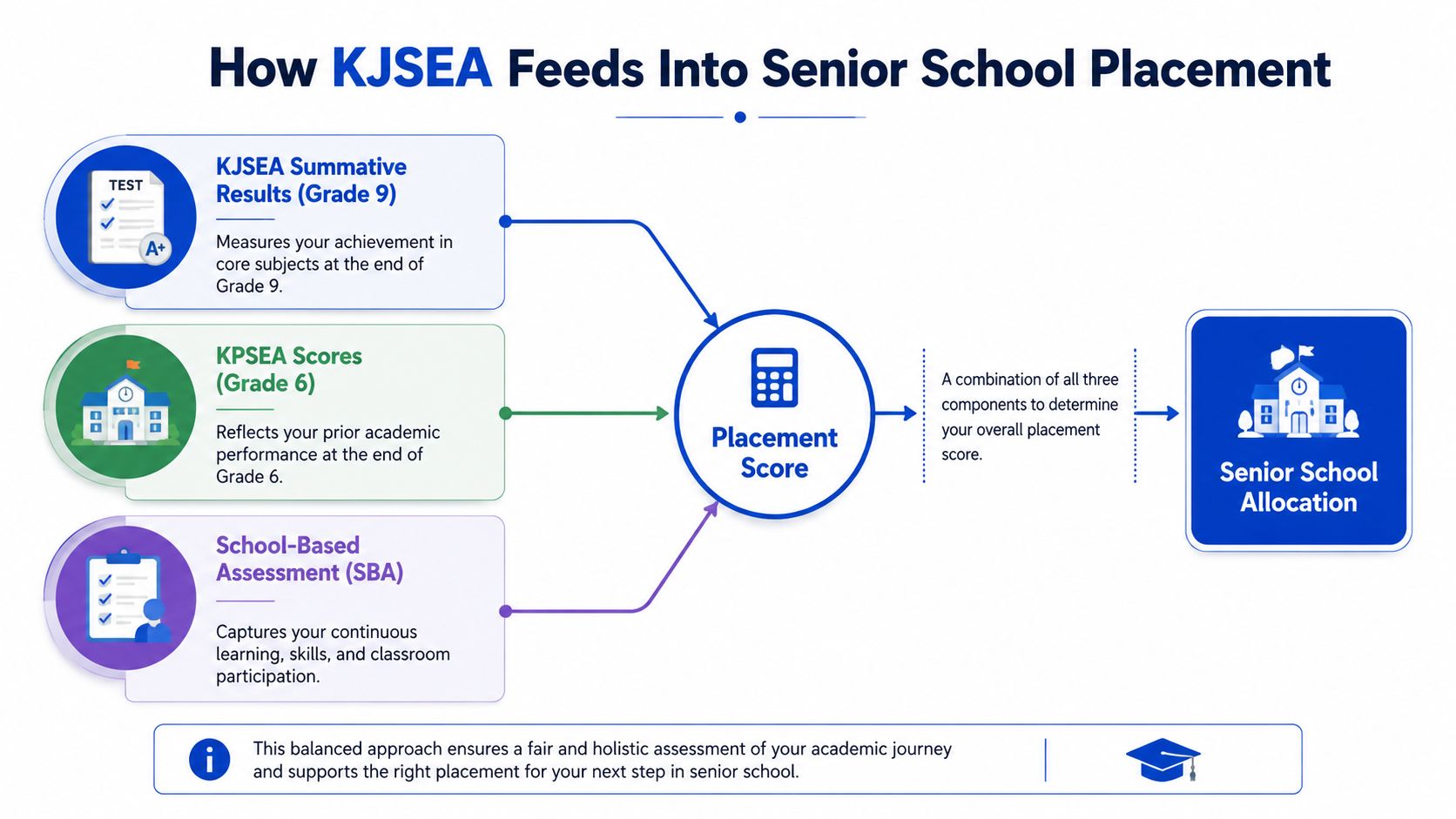
A safe way to explain the composite
Avoid inventing a learner's final placement mark from a report that doesn't provide comparable component scores. Instead, explain the logic using symbols:
Placement composite = KJSEA contribution + KPSEA contribution + SBA contribution
The KJSEA component carries the greatest weight, but it cannot erase the other evidence. A learner who has shown steady development in school-based work and earlier national assessment enters the placement process with a fuller record than a learner whose profile is based mainly on one examination period.
The published framework also connects the KJSEA point scale to a possible maximum of 72 points when nine learning areas are considered. That point total helps the system organise achievement levels, but it shouldn't be confused with the complete placement composite. The composite brings together different assessment sources.
Placement is more than a calculation
Senior school placement decisions also involve the learner's pathway interests and the available school options. Families should discuss whether the learner's strengths and interests align with STEM, Social Sciences, or Arts and Sports Science, while recognising that allocation depends on the national placement process and available capacity.
The most useful conversation is therefore based on evidence. A parent can ask:
- Which learning areas show the strongest achievement?
- Which competencies need support before senior school?
- What pathway interests the learner?
- What does the complete profile indicate, beyond the KJSEA component?
For a practical discussion of pathway choices, families and teachers can also use this guide to understand Grade 10 pathways in Kenya.
For teachers: Keep SBA records organised and interpretable. A missing or unclear record doesn't just create an administrative problem. It makes it harder to represent the learner's development accurately.
Linking KJSEA Results to CBE Mastery Strands
A subject-level band is useful, but teachers need a more detailed view to plan instruction. The central question is, which strand or sub-strand produced the result? A learner may appear secure in Mathematics overall while still struggling with a particular area such as algebraic reasoning.
For example, a Grade 9 learner may receive a higher ME result in Mathematics, yet show AE-level performance in algebraic reasoning tasks. That profile tells the teacher something a subject total cannot: the learner has broad achievement, but a specific competency remains inconsistent when the task requires symbolic manipulation, explanation or application in a new context.
Reading the report as a learning profile
A practical mastery report can be read in layers:
- Learning area: Identify the subject or broader area being reported.
- Strand: Locate the major curriculum domain connected to the evidence.
- Sub-strand: Find the more specific knowledge, skill or application area.
- Achievement level: Note whether the evidence is EE, ME, AE or BE, including the relevant sub-level where provided.
- Teaching response: Decide whether the learner needs extension, consolidation, reteaching or foundational intervention.
This reading changes the purpose of the report. Instead of asking which learner has the highest total, the department can ask which strands are secure across the class and which require a shared response. Parents can also support a specific learning need at home rather than asking a child to revise every subject without direction.
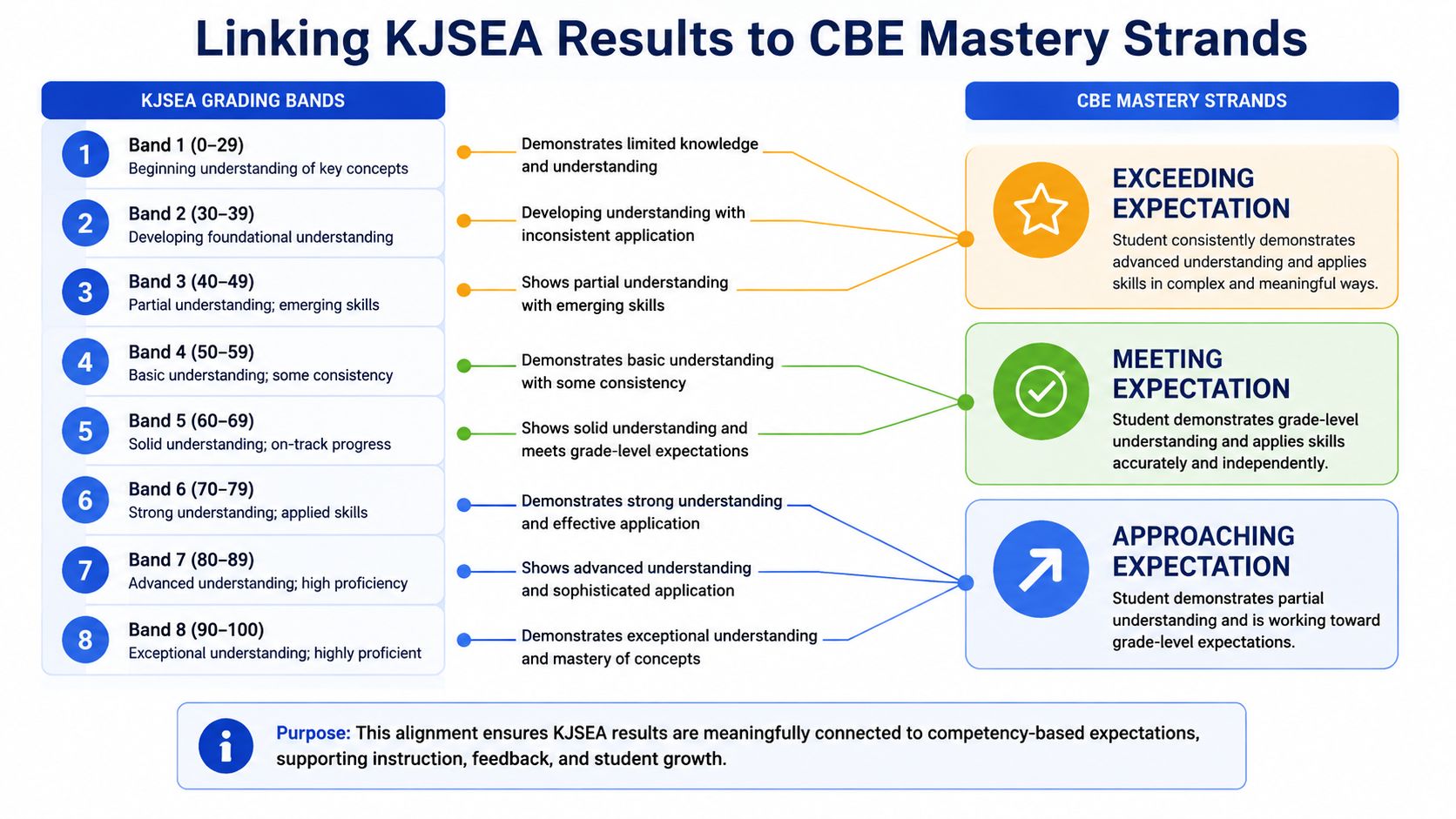
Why strand evidence matters for pathways
Pathway conversations need more than broad labels. A learner interested in STEM may need support in a particular Mathematics strand, while another learner may show strong communication or creative performance that deserves recognition in a different direction. The band doesn't make the decision alone, but strand evidence helps adults make a more informed judgement.
Schools can strengthen this work with CBE assessment tools for teachers, provided that the tools remain aligned with the curriculum and the teacher's professional interpretation. Digital reporting should make evidence easier to use, not replace the classroom conversation.
The shift from rank-order summaries to competency profiles is the educational value of the KJSEA model. Once teachers identify the precise gap, they can reteach it. Once families understand the precise strength, they can encourage it.
Using KJSEA Data to Plan Reteaching and Revision
A KJSEA report becomes useful only when it changes what happens in the next lesson. Teachers can turn the data into a weekly reteaching cycle by moving from class-level patterns to learner-level actions.
Start with the class pattern
First, list the strands and sub-strands assessed. Mark the achievement level for each learner, then identify the areas where AE and BE results are concentrated. The aim isn't to punish a class for weak performance. It is to find the content that deserves a shared teaching response.
Next, group learners according to the gap. One group may need a concrete explanation and guided examples. Another may understand the concept but struggle with application. Learners in ME or EE can receive extension tasks while the teacher gives focused support to those who need it most.
A teacher might discover that many learners need help with health and disease prevention in Integrated Science. The response could include a short reteaching lesson, a practical classification activity, a discussion of prevention choices, and a brief check for transfer to a new scenario.
Turn the finding into a weekly plan
Use a simple cycle:
- Identify the priority. Select the sub-strand with the clearest concentration of AE or BE evidence.
- Diagnose the error. Review learner responses to distinguish misconception, forgotten knowledge and weak application.
- Plan the reteach. Choose an explanation, activity and differentiated practice task.
- Check understanding. Use a short formative assessment before moving on.
- Record the response. Note who improved, who remains stuck and what should happen next.
- Feed the result forward. Use the new evidence in the next Classroom-Based Assessment and lesson plan.
| Sub-Strand | Mastery Level | Learners Affected | Reteaching Action | Timeline |
|---|---|---|---|---|
| Algebraic reasoning | AE | Learners with inconsistent symbolic application | Model worked examples, then use guided and independent problems | Early in the week |
| Health and disease prevention | AE or BE | Learners needing clearer links between causes and prevention | Use scenarios, group explanation and differentiated practice | Two focused sessions |
| Measurement | ME with recurring errors | Learners who understand terms but misapply procedures | Revisit units and estimation through practical tasks | Short consolidation block |
| Data interpretation | AE | Learners struggling to explain evidence from tables or charts | Use annotated examples and verbal reasoning before written responses | End-of-week check |
Teachers can use formative assessment practices to make the check-ins part of normal instruction rather than an extra examination burden.
Keep parents informed
A useful parent brief is concrete: “This week we're revisiting interpreting graphs. Please ask your child to explain what the highest and lowest values show.” Avoid sending only a code such as AE1. Families need the learning action, the expected practice and a simple way to help.
The cycle should continue after the first improvement. A learner who moves from BE to AE has made progress, but may still need structured support. Teachers should celebrate the movement while keeping the next target visible.
Common Misinterpretations and Frequently Asked Questions
Parents often bring familiar 8-4-4 assumptions to a new assessment language. A short, direct answer can prevent unnecessary anxiety and help the learner focus on improvement.
Does Band 8 mean my child is the top learner nationally?
No. Band 8 corresponds to EE1, the highest reported achievement band for that learning area. It indicates performance within the strongest range, but it isn't a national position or proof that the learner is ranked first.
Does a low band mean the learner has failed?
No. AE and BE identify the level of demonstrated competency and the need for support. A BE result should lead to diagnosis, foundational teaching and follow-up evidence. It shouldn't become a permanent judgement about the learner's ability.
Does KJSEA alone determine senior school placement?
No. The placement framework combines KJSEA, KPSEA and SBA. KJSEA has the largest share, but the final picture includes evidence from the other components as well.
Should parents add all subject points and treat the total as the final placement score?
Not automatically. The point bands help report achievement, and the system may consider points across learning areas. The senior school placement outcome uses the composite formula, so a subject-point total shouldn't be treated as the whole algorithm.
Can a learner appeal or re-sit KJSEA?
Families should follow the official communication from the Kenya National Examinations Council and the school regarding any review, query or assessment procedure. Don't assume that an appeal or re-sit is available just because a parent disagrees with a result. Ask the school to confirm the current process and required evidence.
How are private school candidates assessed?
The reporting principles remain centred on the applicable national assessment requirements. A private school should provide parents with clear information on registration, assessment administration and how school-based evidence is maintained for the learner. The school's assessment office is the right place to confirm candidate-specific procedures.
For families: Ask the teacher to translate every unfamiliar code into three things, the demonstrated strength, the learning gap and the next support action.
The official explanation of how KJSEA results were calculated is useful when families need to distinguish achievement bands from placement questions. A calm reading of the report protects the learner from comparisons that the system wasn't designed to make.
How Keybaki Supports KJSEA Workflows for Schools and Families
Schools need an assessment workflow that connects evidence to action. Keybaki provides a CBE-mapped digital library, lesson planning tools and continuous assessments organised around curriculum strands and sub-strands. Teachers can record weekly evidence, review mastery patterns and use the results when planning reteaching.
The workflow is practical:
- Continuous Education Assessments: Teachers gather regular evidence linked to the intended competency.
- Data aggregation: Results are organised by learner, class, learning area and strand.
- Result analysis: Mastery views help staff identify recurring AE and BE patterns.
- Action planning: Teachers use the findings to prepare targeted lessons, practice tasks and parent updates.
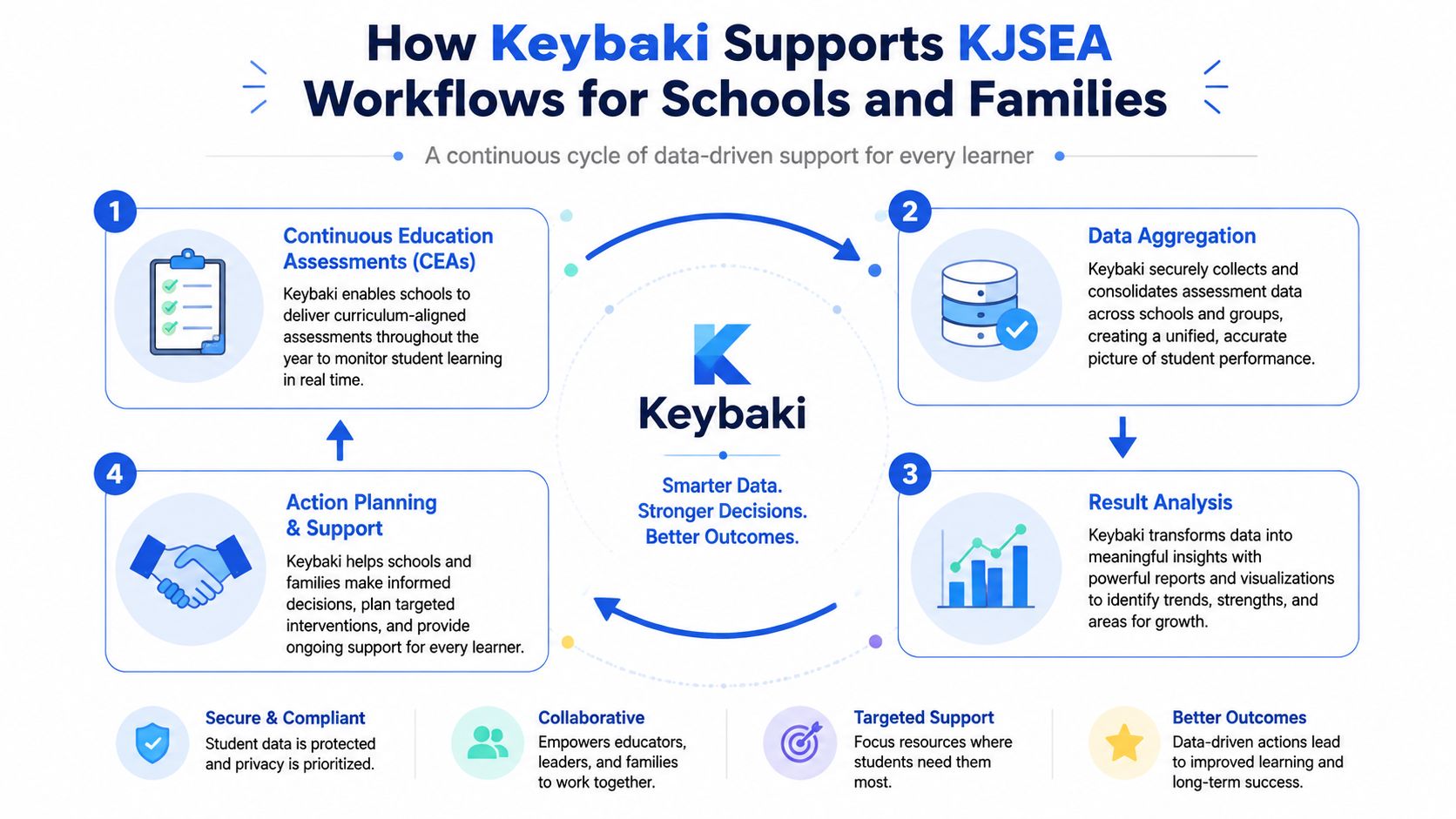
For families, the value lies in receiving a clearer explanation of what the learner should practise next. For school leaders, organised records make it easier to discuss progress, support teachers and prepare learners for senior school pathway conversations. The platform can support the workflow, but teachers still interpret evidence and choose the appropriate instructional response.
Keybaki helps schools connect CBE-aligned planning, continuous assessment, strand-level mastery and family communication in one workflow. Visit Keybaki to explore the platform and consider piloting its KJSEA support tools for one term, then review how your school manages reteaching plans, assessment records and parent briefs.
Comments
Loading…