
· school project sources
How to Find a Source You Can Trust for School Projects
17 min read
The computer lab has twenty minutes left and your Grade 8 project is due on Friday. You type your topic into the search box, scan the first page of results, click the third link because the heading matches your question, and copy three sentences into your notebook.
Nothing in that sequence was wrong, exactly. But nothing in it asked whether the page deserved to be believed. When your teacher says "Who wrote this?", that isn't a trick question. It's the whole skill.
Table of Contents
- Why Trust Matters More Than Finding Something
- Search Words That Find Better Sources
- Four Questions to Ask Any Source
- Spotting Ads, Opinion and Official Addresses
- Compare Sources and Settle Disagreements
- Record Sources and Check AI Answers Before Citing
- Practise Finding Trusted Sources Before Your Project Is Due
Why Trust Matters More Than Finding Something
Your search returns a page whose address ends in .go.ke. The heading matches the project question, and the sentences sound sure of themselves. A classmate's AI answer names the same fact in an even smoother voice. Both still have to pass a check. A neat address is only the front door. A confident sentence is only a tone.
Trust is the decision you make after the search. You look at who stands behind the page, when they wrote it, what evidence they show, and why the page exists. If those answers are thin, the official-looking name does not rescue the fact. The fluent AI line does not rescue it either.
CBC projects ask you to research, and the marks sit in that second skill. Finding a page and deciding it deserves to be believed are separate jobs. Searching more, or opening the first result that sounds like the teacher's notes, does not teach the second job by itself.
A study of information-literacy skills in secondary-school libraries in Nairobi and Tharaka Nithi shows how many learners feel that gap. 85.9% of surveyed learners in Nairobi and 90.8% in Tharaka Nithi reported challenges with information-literacy activities, according to the Kenyan study of secondary-school libraries. The same study used the Big6 research model, which treats judging a source as its own stage. You first identify possible sources. Then you decide which ones are suitable before you use them to build an answer.
Kenya's digital-skills policy treats information literacy as a core skill. That fits the library findings. Learners can collect ten results in under a minute and still hold a page with no author, no date, and no clue where its numbers came from. The speed of the search is not the same thing as proof.
The rule this guide builds on: a source earns a place in your project only when you can say who wrote it, when, what their evidence is, and why it exists.
Search Words That Find Better Sources
You type deforestation. The screen fills with a world encyclopedia, a charity campaign, and a news story from another continent. You type deforestation effects Kenya Grade 9. Now the results name the place, the level, and the angle your strand covers.
The words you type choose the shelf. Broad words put you on the world shelf. Specific words put you on the shelf your teacher set.
A neat address or a sure-sounding answer is not trust. Trust is a decision you make after the search, once the page is open. A name that looks official can still be the wrong year, the wrong county, or a page that only borrowed the word "ministry". An AI reply can sound certain and still fail the same checks a weak website fails.
Work the search in four small moves.
Name the topic, not the theme. "deforestation effects on rainfall Mau Forest" beats "environment" every time.
Add Kenya, your county, or your grade. Kenya, Kakamega, or Grade 9 pulls results toward the CBC work you are writing.
Put a phrase in quotation marks when the words must stay together, such as "forest cover Kenya". The search looks for that exact wording instead of splitting the words apart.
Add an institution word such as government, ministry, county government, or university. Treat it as a starting filter, not as proof. Anyone can type "ministry" on a page.
Precision matters more on a phone, and that is where most of this searching happens. More than 90% of internet users in Kenya access the internet through mobile phones, according to the Communications Authority of Kenya analysis of ICT uptake. Internet use also differs between males and females, so classmates may not be seeing the same pages you see. On a small screen the first few results fill the whole page. It is easy to stop before the better ones appear. Results also shift with your location, your language, and how strong your connection is at that moment.
Need school figures rather than a guess from your own class? Search the same way you search a strand: name the county, the level, and the measure, then open verified school and learning figures and decide whether that page earns a place in the project.
The second search nobody does
When the first page is thin, rewrite the question instead of quitting. Swap in a synonym. Use the exact term in your textbook, even if it sounds formal. Try the Kiswahili word your teacher used in class next to the English one, then compare what comes back.
Scan past anything labelled Sponsored or Ad. Do not stop at the first page. Pick the three most promising results. A good domain name still has to pass. So does a tidy AI summary with no author and no date.
Four Questions to Ask Any Source
Before you read a page in detail, run four questions over it. Who wrote it? When was it written or updated? How do they know what they claim? Why was it written? The answers take about a minute, and they save you from building a whole project on a page that was never going to hold up. Authorship and dates are the fast ones: skim for a name, an organisation and a year before you read a word of the argument.
| Question | What to look for | Red flag |
|---|---|---|
| Who wrote it? | Named author or organisation with relevant expertise and contact details | No author, no organisation, or an unclear about page |
| When was it written or updated? | Publication or update date shown, recent enough for the topic | No date, or old figures used for a fast-changing topic |
| How do they know? | Cited references, named data source, survey year, sample size and method | Claims with no source, or a statistic with no denominator |
| Why was it written? | Aim to inform, with balanced wording and clear labelling of any sales or opinion | Product pushing, emotional language, or a sales page presented as neutral information |
Two checks learners skip most
How do they know is where most school projects fall apart. A page that says "many learners" or "most households" without a survey year, a sample size or a link to the report has given you a mood, not a fact. Look for the data source by name. If a percentage appears, look for the number it was calculated from. Three out of four of something is meaningless until you know whether the four was four people or four thousand.
Why was it written is the check learners find strangest, because it feels like guessing at motives. It isn't. A revision-notes shop can sell you useful practice questions and still be a poor source for a claim about exam trends, because its job is to sell. Read the page as a piece of work with a purpose. Is it trying to inform you, sell you something, or win an argument?
The ICT Authority's strategic plan makes the point that access and skill are different things. It reports that 39% of Kenya's population uses the internet and warns that internet use does not automatically mean people have the skills to benefit from online information or avoid its dangers, according to the ICT Authority strategic plan. Being online is not the same as being able to check what you find there, which is why the four questions have to be done on purpose.
The two-strike rule: if a source fails two of the four questions, set it aside and search again. You don't need to prove it wrong. You just need a better source.
These four checks are the same ones universities teach first-year students, and a guide to evaluating information for research papers from Model Diplomat walks through the same reasoning at greater length. Learn the pattern once here and it will serve you in Form 4 and beyond.
Spotting Ads, Opinion and Official Addresses
Three kinds of page will waste your time: the sponsored result, the opinion piece, and the official-looking page that isn't official. Label each one before you read it, because the label changes how much of the page you can safely cite.
The difference between a page that argues and a page that reports is usually visible within ten seconds.
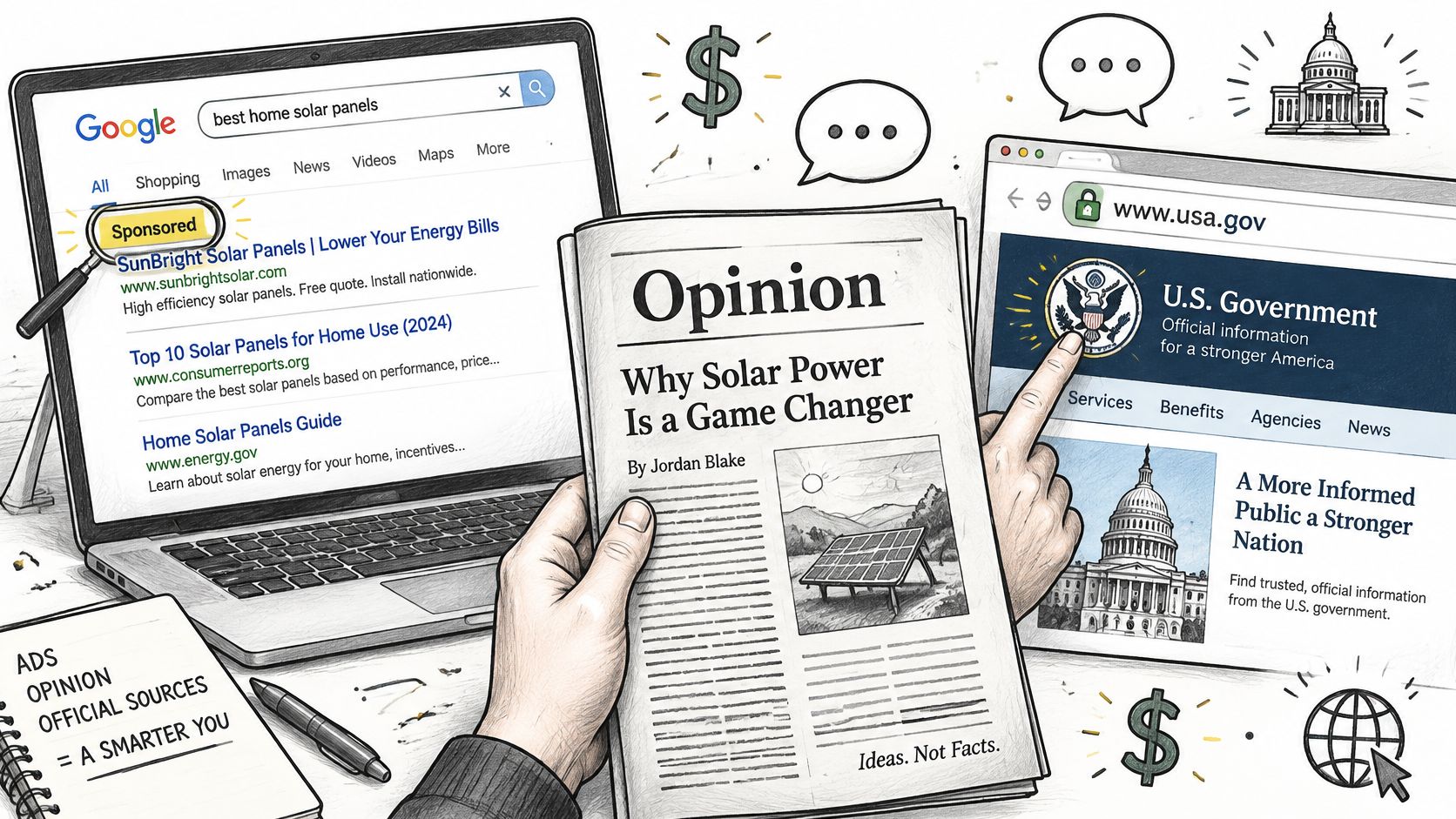
Sponsored results carry a small label, usually the word Sponsored or Ad. The label tells you someone paid for the position. It says nothing at all about accuracy, and the page behind it may be an advert written to read like an article.
Opinion pieces, columns and blog posts argue. They can be useful for understanding how people think about a topic, and they often point you towards the reports worth reading. Just don't build a factual claim on one. The facts in your project should come from a source that shows its evidence.
The web address is a useful first signal. Government bodies, universities, and well-known national or international organisations publish under addresses you can recognise, they answer for what they publish, and their documents can be checked and quoted. A page from a ministry, a public university or a body like the Kenya National Library Service is a sensible place to start.
It is not the only test, though. A government page can be years out of date. A student's blog on a university address is a student's blog, not a study. And an official-looking page can borrow authority with a crest, a serious font and a confident tone.
The numbers show why you can't assume one page speaks for everyone. The Communications Authority's analysis of the 2023–2024 Kenya Housing Survey found national internet usage of 35.0%, against 56.6% in urban areas and 25.0% in rural areas, with Nairobi at 83.1% and West Pokot at 17.9%, according to the ICT analytical report based on the Kenya Housing Survey.
| Area or measure | Internet use or access |
|---|---|
| National internet usage | 35.0% |
| Urban areas | 56.6% |
| Rural areas | 25.0% |
| Nairobi | 83.1% |
| West Pokot | 17.9% |
| Household internet access | 36.3% |
| Mobile internet | 34.9% |
A popular page, a sponsored result or an English-only source may therefore describe a very different Kenya from the one your reader lives in. Check the figures in your fake admission and placement messages against the same instinct: a familiar logo is a design choice, not a credential. The order to check is label, purpose, address, then evidence. That order is a fast first pass only. The four questions still decide whether the source goes in your project.
Compare Sources and Settle Disagreements
Two pages can disagree because they describe different places, years or groups of people. Before deciding which figure to use, compare what each one measures.
Start with the number, then check the population, location and date. One source may count households while another counts people. One may describe Nairobi, while another covers the whole country. Both figures could be accurate, but only one may support the point in your project.
For example, if two pages give different figures for household access to electricity, trace each number to the report and table it came from. Use the figure whose year and scope match your claim. If you cannot tell what a number measures, leave it out.
Then check how the source supports its claim. Set aside pages that give no method, hide the author, repeat a claim without naming its origin, or present opinion as evidence.
When they still disagree
Look for another source with relevant expertise, such as a textbook, a Ministry of Education or KICD document, an official statistics publication, or a university study. Choose according to the question: a curriculum document can explain what is taught, while a research paper may describe how a study was conducted.
| Source type | Good for | Check before using |
|---|---|---|
| Approved textbook | Core definitions, concepts and CBC content | Edition, publisher and year |
| Ministry of Education or KICD document | Curriculum requirements and official policy | Document title, date and whether it is current |
| KNBS or other official statistics | National and county figures | Survey year, scope and whether the figure is urban, rural or national |
| University or research publication | Evidence, studies and detailed methods | Author, methods, sample and references |
| Established news outlet | Recent events and reporting | Publication date and whether it names its own sources |
| Blog, forum or social-media post | Opinions, personal experience and leads to follow | Treat claims as leads, then trace them to a reliable source |
Add a scope label beside every figure you use, such as national, county, urban, rural or age-specific. A Nairobi result does not automatically describe all Kenyan learners.
A written checklist helps you compare sources without relying on memory. For each figure, note its date, location, population and what it measures. Easy access to information does not, by itself, show that the information is reliable.
For context on education topics in Kenya, browse the Keybaki education news and analysis, then check any factual claim against a source suited to your project.
Before citing a claim, ask whether the source is authoritative, current, relevant, supported by evidence and confirmed by another suitable source. A confident tone or a familiar domain name cannot replace those checks.
Record Sources and Check AI Answers Before Citing
Write the record while you research, not the night before submission. By then you'll be reconstructing half of it from memory, and memory is generous.
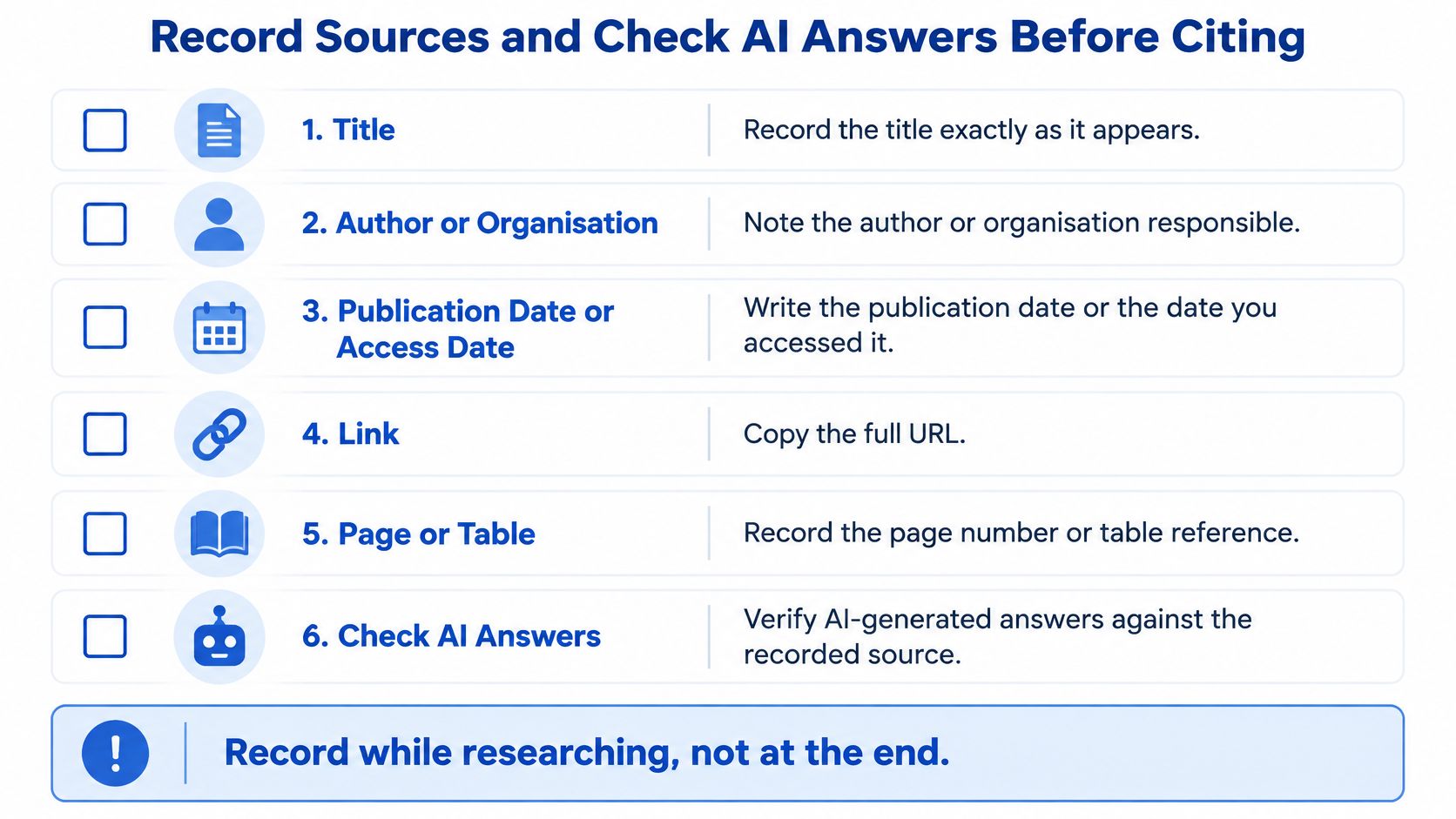
For each source, note the title, the author or organisation, the publication date or the date you accessed it, the link, the page or table number, and one sentence explaining why it supports your claim. That last sentence feels fussy until a teacher asks why a source is in your bibliography and you already have the answer written down.
Example entry: Grade 8 Integrated Science learner book, chapter 4, page 62, edition and year noted, plus one line saying the page defines the term used in my second paragraph.
Six fields per source is all it takes, and they turn directly into a reference list at the back of the project.
AI answers are not sources
An AI chatbot can hand you a confident paragraph in seconds. The Kenyan Government's draft National Artificial Intelligence Strategy warns that generative AI systems can produce deepfakes and help create or spread false narratives, undermining trust in media and public institutions, according to the draft National AI Strategy for public validation%20for%20Public%20Validation%20%20%5B14-01-2025%5D.pdf). That's the official Kenyan position, and it explains why an AI answer is a starting point rather than something you can cite.
- Name the claim. Pull out the exact sentence or statistic you want to use.
- Find it in a trustworthy source. A textbook, a government publication, a university page or a KNBS report.
- Record that source, not the AI. Title, author or organisation, date, link, page number.
- When they disagree, check a third and more authoritative source. Never let confident phrasing decide it.
The same discipline applies to any AI answer you plan to use, and our guide to using AI for homework safely and checking an AI answer walks through the routine step by step. When a source turns out to be a long PDF report, analysing PDF documents for research covers how to find the right page, table and figure inside it instead of guessing.
Finally, ask your teacher how the class wants AI use acknowledged. A short line saying which tool helped and which claims you verified yourself is usually enough, and it keeps the work honest.
Practise Finding Trusted Sources Before Your Project Is Due
It is a Thursday afternoon, and your Grade 8 project is not due until next week. You have time. Open a search on something that will not be marked, such as the history of a sport or how a local crop is grown. Run the checks now, while nobody is waiting for the answer.
A footballer does not learn a new pass in the last minute of a match. You learn it in training, then use it when the whistle is already going. Source checks work the same way. If the first time you ask who wrote a page is the night before you hand the work in, you will skip a step.
Do it on a throwaway topic first. Nobody learns a new skill for the first time under deadline pressure with marks attached.
There is a good reason to practise rather than wait to be taught. In 2025, only 24.6% of Kenyan secondary-school teachers had received some form of digital-literacy training, according to Business Daily's report on an Usawa Agenda survey. A teacher who has not had that training can still guide you well. You may still be the first person in the room who knows these checks.
Try this on your throwaway topic. Search for one claim, then open the top result and the page that looks most official. A neat domain name is only an address, not a decision you have already made. Read who wrote each page, when it was updated, what evidence it shows, and why it was written. If the two pages disagree, do not keep the one that sounds more sure of itself. A confident sentence, including one from an AI tool, can still fail those checks. Keep the page a textbook or a government site also supports, and write down the title, organisation, date and link before you close the tab.
Then do one thing today. Pick the claim from your real project that you were about to copy without checking, and give it the same treatment before you write a sentence.
Keybaki is a CBE e-learning app for Grade 7 to 10 students in Kenya, with Grades 11 and 12 coming soon, and a digital library aligned to the CBE curriculum. Every CEA and lesson cites the competency it advances. Students study in three taps: pick weak spots from the latest CEAs, work through a queued list of lessons and activities, and prove progress with a 10-minute CEA. The Students Basic plan is free forever at KES 0 per student and includes two subjects with no time limit: English and Social Studies for JSS, and English and ICT for SSS. Visit Keybaki to start, then bring one checked source to class this week.
Comments
Loading…