
· M-PESA payment scam
Fake Admission and Placement Messages: How Students Can Check Before Paying
11 min read
You're waiting for news about a place, checking your phone more than usual, when a message arrives. It names a real institution, says your place is almost ready, and asks you to pay today to secure it. Don't pay yet. Around every intake, families receive messages like this, and the safest habit is simple. Confirm the placement, the institution and the payment destination as three separate checks before you send money or personal details.
Table of Contents
- Spot the Warning Signs in Admission Messages
- Confirm the Placement Through Official Channels
- Verify the Institution, Course and Contacts
- Before You Pay, Run the Payment Safety Check
- What to Do If You Already Paid or Shared Details
- Practise Spotting Scams Before the Next Offer
Spot the Warning Signs in Admission Messages
Around every intake, families receive messages asking them to pay to secure a place, confirm an admission or change a course. Some offer help with a transfer or a replacement letter. Others promise that a quick payment will protect a place that's about to be given to someone else.
Real placement and admission processes run through official portals and official channels, not personal WhatsApp numbers. A message can look polished, use a familiar institution name and still be fake. Learning the general patterns helps you judge the shape of a message, not just one sender. Similar warning signs appear with helpers who pressure families or make promises they can't prove, which is why recognizing unreliable admissions counselors is a useful skill alongside checking the official record.
Red Flags in Admission and Placement Messages
| Red flag | What it looks like | What to do |
|---|---|---|
| Deadline pressure | Pay today or lose the slot | Pause. Real placements are confirmed on official records, not by a deadline |
| Personal payment number | M-PESA to an individual's phone or an agent | Don't pay. Find official payment details on the institution's own website |
| Unofficial link | Shortened or look-alike web address | Type the official address yourself instead of tapping the link |
| Request for index number or ID | Asked to send ID, KCSE details or admission number to verify | Share details only through official portals and verified contacts |
| Request for PIN or OTP | Asked to read out a code or hand over a phone | Never share. No genuine process needs it |
| Guaranteed placement | Promise of admission in a course never applied for | Check the application and placement record first |
| Personal WhatsApp channel | Admission or course changes handled by a personal WhatsApp number | Use the institution's official social accounts and listed contacts |
One red flag is enough to pause. You don't need to prove a message is fake before you check it, and you don't need to reply quickly to protect a genuine place. A sender who becomes angry, evasive or more urgent when you ask for time is giving you useful information.
Any message that asks for money or personal data first earns a check before any reply.
Keep the message, but don't act inside it. Leave the chat, find official channels yourself and start again from a source you chose.
Confirm the Placement Through Official Channels
A placement is confirmed by the official record, not by a message, screenshot, PDF or phone call. Work through these checks in order and stop if one fails.
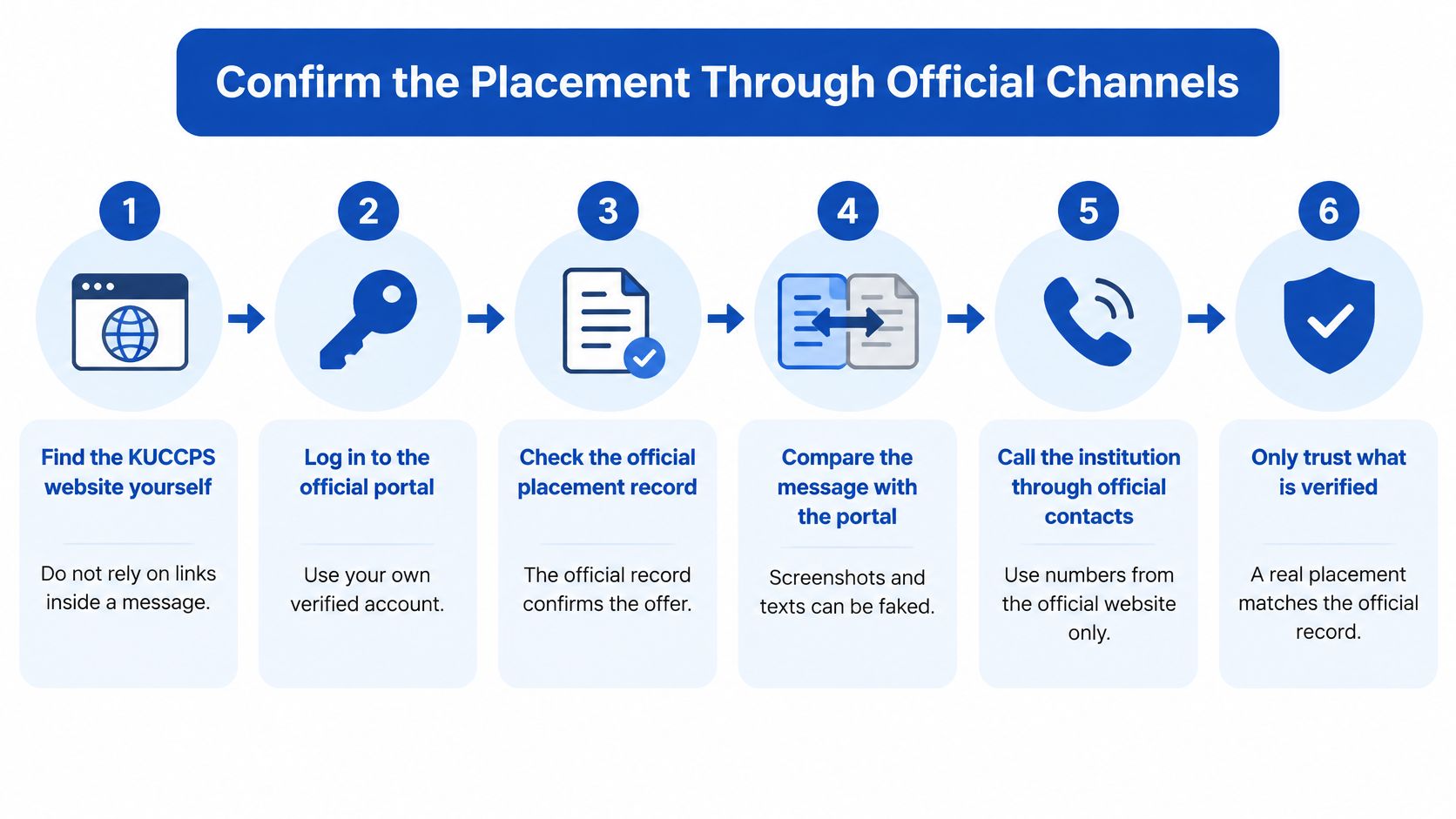
Six Checks in Order
- Find the KUCCPS website yourself. Type the address or go from the government's main site. Don't use a link in the message, because look-alike addresses can copy a real page closely.
- Log in to the official KUCCPS Student's Portal. A legitimate allocation should be confirmed there, where the candidate's institution and programme are displayed. Check the official site for current dates rather than trusting dates in a message.
- Match the details. Compare the candidate's name, index details, programme, institution and intake with what the message claims. Any mismatch needs an explanation from an official contact, not from the sender.
- Compare any SMS carefully. Placement information may also be sent to the contact supplied during application, but a text still has to agree with the portal record.
- Treat screenshots and PDFs as unverified. Images and documents can be edited, logos can be copied and a neat letter doesn't create a placement.
- Accept what the record says. If no record exists, you don't have a confirmed placement, whatever the message promises.
The official figures show why guaranteed slots don't fit the formal process. In the 2024 KCSE cycle, the KUCCPS placement announcement recorded 244,563 Kenyan citizens qualifying for degree programmes, 201,695 of them, or 83%, applied through KUCCPS, and 194,372, or 80% of degree-eligible candidates, were placed. Placement depends on results, eligibility, application and published outcomes. It isn't a slot an agent can sell in a chat.
If you're also weighing options outside Kenya, it helps to compare international medical school application routes through published programme pages in the same careful way, starting from official sources rather than messages from intermediaries. For local context, our guide to placements and education choices in Kenya can help families plan the next step.
At the end of this stage, hold one clear answer. Either the official record confirms the placement, or it doesn't.
Verify the Institution, Course and Contacts
A real institution name isn't enough. Scammers borrow names precisely because families recognise them, so verify the institution and the exact course separately.
Use the Three-Part Test
- Is the institution listed? Confirm it appears on the Commission for University Education's approved list.
- Is this course authorised? Check the exact programme and level. Institutional accreditation doesn't automatically cover every course it advertises.
- Is a partnership approved? Where a message claims a collaboration or foreign affiliation, check that the regulator authorised that collaboration before enrolment.
This caution is grounded in recent enforcement. University World News reporting on the Commission for University Education warning says the regulator identified 15 institutions in March 2025 as operating illegally or offering unapproved degree and postgraduate programmes, and warned that qualifications from institutions not on its approved list wouldn't be recognised in Kenya. A professional website, branded letter or certificate proves nothing on its own.
A Real Name Can Still Be Misused
Africa Check has flagged fake WhatsApp messages about Kenya Medical Training College admissions and course transfers. The Africa Check fact-check on the fake KMTC notice reported that KMTC doesn't process admission-letter replacements, course changes, campus transfers or deferments through WhatsApp or other informal channels, and KMTC advised applicants to rely only on official KMTC and KUCCPS communication channels. That's the pattern to remember, whatever institution a future message names.
Practical rule: Reach the institution through contact details you found yourself, never through details supplied by the message you're checking.
Open the institution's official website or official social accounts yourself. Use a phone number or email published there and ask whether the admission reference exists in its student-record system. If you're unsure, ask your school or a trusted adult to sit with you while you check. Families comparing schools can also read our background on Kenya High School in Nairobi as an example of starting with the institution itself.
Before replying to any sender, answer three questions. Is the institution listed? Is this course authorised? Did I reach the office through its official domain?
Before You Pay, Run the Payment Safety Check
Checking happens before paying, not after. A genuine placement can still come with a fake payment request. The institution and course may be real while the paybill, till, bank account or phone number belongs to someone else.
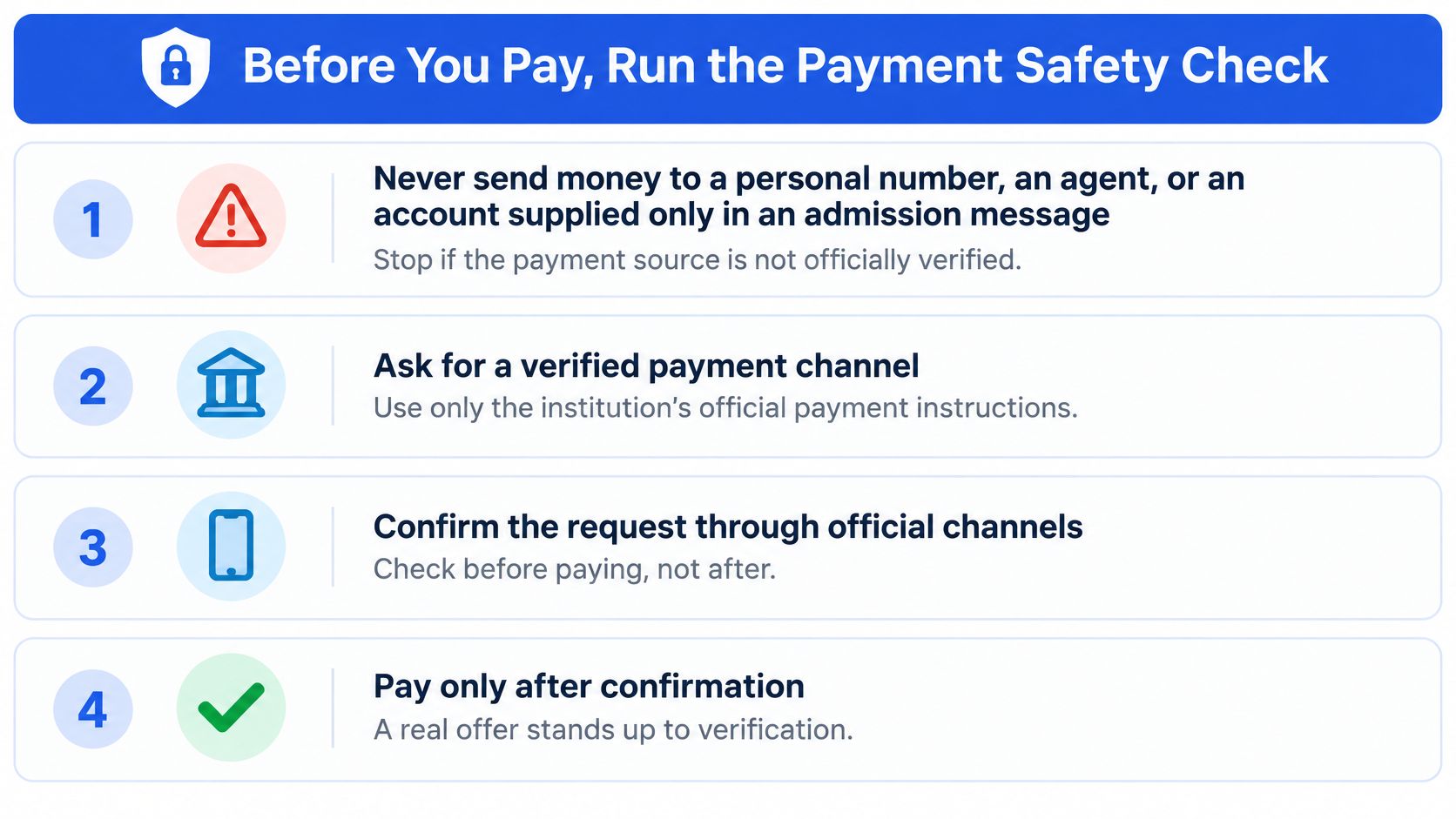
Run the Protocol in Order
- Never pay a personal number. Don't send money to an individual's phone, an agent or an account supplied only in an admission message. Fraudsters often ask for a small "verification" amount first to build trust, so no transfer is safe until every detail checks out.
- Ask for formal documents. Request a fee structure and invoice from the admissions office or the institution's independently verified domain.
- Compare every payment detail. Check the payee name, till or paybill, account or reference format and stated fees against the institution's published instructions.
- Keep the evidence. Save the SMS sender, full message text, phone number, payment prompt, screenshots and transaction ID.
The scale of the system makes impersonation plausible. The KUCCPS application announcement reported 980,444 eligible candidates in the 2025 cycle, with 268,700 qualifying for degree placement, while its 2025 process placed 310,502 students across universities and colleges. High numbers explain why fake messages circulate. They don't prove that any individual message is genuine.
Apply the Three-Source Match
Don't pay until three sources agree. The KUCCPS placement record, the institution's verified admissions details and the finance office's payment details must all point to the same student, programme and payee.
Say the course and institution check out, but the paybill in the message differs from the one on the official invoice. Stop. Ask the institution, through contacts on its own website, to confirm the exact account. I wouldn't send even a small amount while that difference is unexplained. Our article on how to spot a fake M-PESA message shows similar tricks used outside admissions.
At the end, you should hold a verified payee, an official invoice and a saved record. If you hold only a chat and a phone number, you're not ready to pay.
What to Do If You Already Paid or Shared Details
If you've already paid, you've been targeted. You haven't failed. These messages are built to create urgency at a stressful moment, and the next hour matters most.
Contain It First
- Stop further transfers. Don't pay a second release, refund or clearance fee to anyone who offers to recover the first payment.
- Save everything. Keep the message, sender number, PDF, URLs, transaction ID and screenshots before deleting anything.
- Contact your mobile-money provider promptly. Use its official customer-care channel, found independently, and give staff the transaction details.
- Change your portal password. Don't share your login or index number with anyone offering help.
- Notify the institution and KUCCPS. Use official contacts if placement or admission is involved.
- Report the suspected fraud. Contact the police or the relevant cybercrime authorities and share the saved evidence.
Institutions have had to issue warnings in similar situations. Nairobi Leo's report on the University of Nairobi scam website warning described a fraudulent site targeting first-year students and parents, while the university directed users to its official SMIS registration system. Following the institution back to its real system is the safe move.
A reversed or refunded M-PESA transaction doesn't prove an admission was legitimate. It only concerns the payment, not the authenticity of the offer.
Don't send an ID, KCSE details or admission number to someone who says they need them to verify you. Verification happens through official portals and institutional contacts, with unnecessary data withheld.
Make the first call today. Start with your mobile-money provider through its official channel, then notify the institution.
Practise Spotting Scams Before the Next Offer
Build one habit. Treat placement, institution and payment destination as three separate checks, because a real offer can still arrive with a fake till number or a borrowed logo.
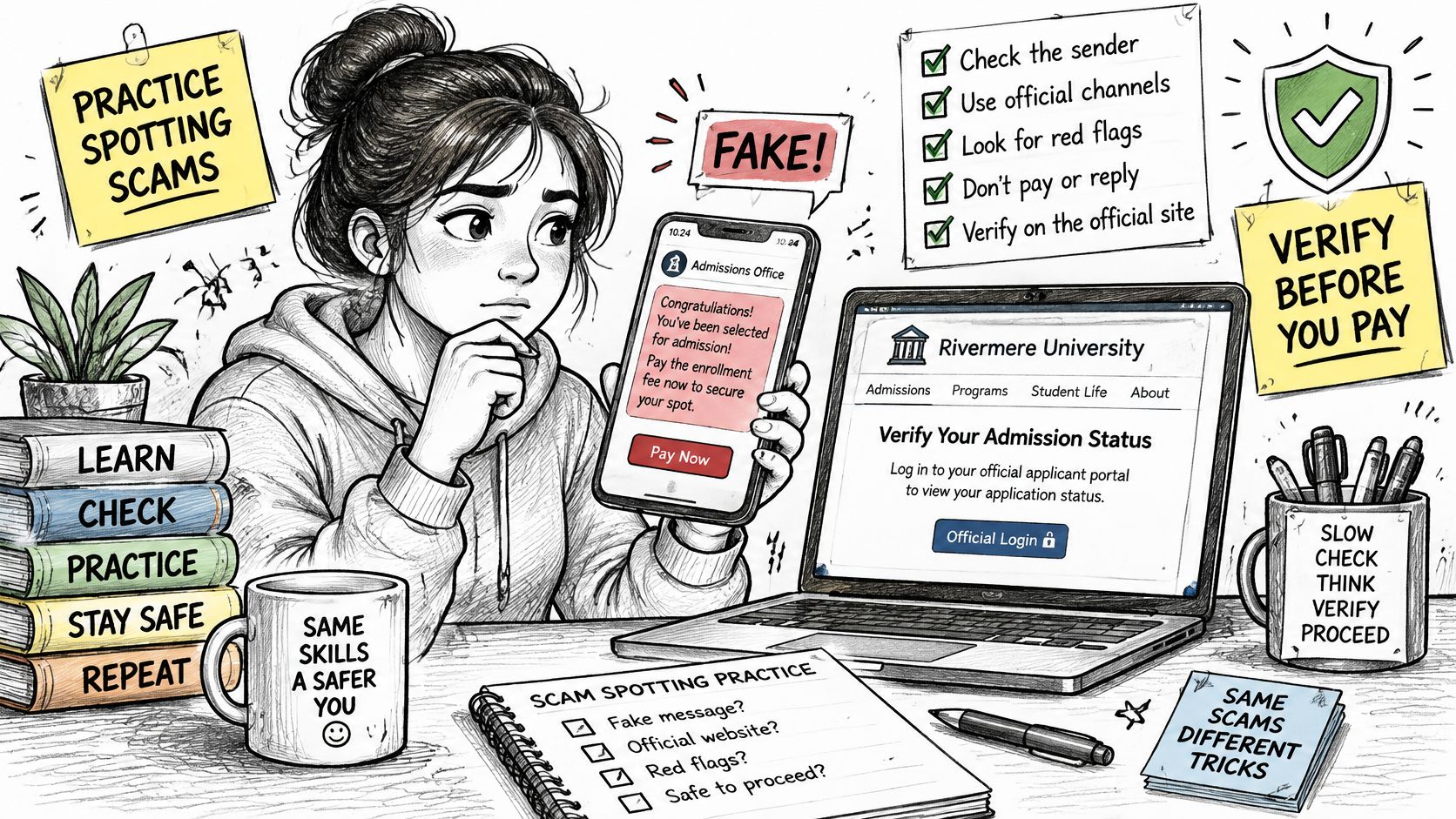
Run the drill whenever a message appears. First confirm the offer inside KUCCPS or the institution's own portal. Then match the course, contacts and fee instructions to the same official source. Only then look at payment details, and pay nothing until the destination is verified from those channels.
For practice at home, Keybaki fits the family phone: students sign in with a PIN rather than email, take CEAs, and see weak strands shrink while parents review reports on the same device. That routine makes "check first" easier to repeat.
This week, share this checklist with a classmate or sibling who's waiting for news. A ten-minute conversation now can prevent a rushed payment later.
Keybaki helps Kenyan learners, parents and teachers build digital safety, study skills and curriculum confidence through guided practice you can use on a family phone. Use the checks in this guide for real admission messages, then build the habit safely with practice lessons. Visit Keybaki to explore learning support for your family.
Comments
Loading…