· core competencies in cbc
Core Competencies in CBC Explained for Grades 7 to 12
16 min read
You can see it in a Grade 8 lesson almost immediately. The teacher asks a group to explain a science idea, one learner takes the lead, another checks notes on a phone, and a third helps the group agree on one answer. At home, a parent hears the same child talking through a task instead of just saying, “I memorised it.” That is core competencies in CBC showing up in real life, not as a slogan but as behaviour you can notice.
For many teachers and parents, the confusing part is simple, what exactly should I look for? The names sound familiar, but day-to-day evidence often feels fuzzy. This guide gives you a practical map for Grades 7 to 12, with plain definitions, classroom examples, assessment clues, and a weekly routine that links planning, teaching, and reteaching through a closed loop. If you want a platform view of that planning-to-assessment cycle, this CBC-aligned learning platform overview shows how the pieces fit together in practice.
Table of Contents
- Introduction to Core Competencies in CBC for Busy Teachers and Parents
- What Core Competencies Mean in Kenya's Competency Based Curriculum
- The Seven Core Competencies Explained with Classroom Examples
- How Competencies Look Different Across Subjects and Grades
- How Core Competencies Are Assessed and Tracked Through CEAs
- Practical Actions for Teachers and Parents Plus How Keybaki Supports Each Competency
- Bringing Core Competencies to Life in Your School and Home
Introduction to Core Competencies in CBC for Busy Teachers and Parents
A teacher marks attendance, opens a textbook, and asks the class to work in pairs. One learner explains an idea clearly, another listens and improves the answer, and a third tries again after making a mistake. That small moment tells you more than a copied paragraph ever could, because it shows how the learner thinks, speaks, collaborates, and recovers.
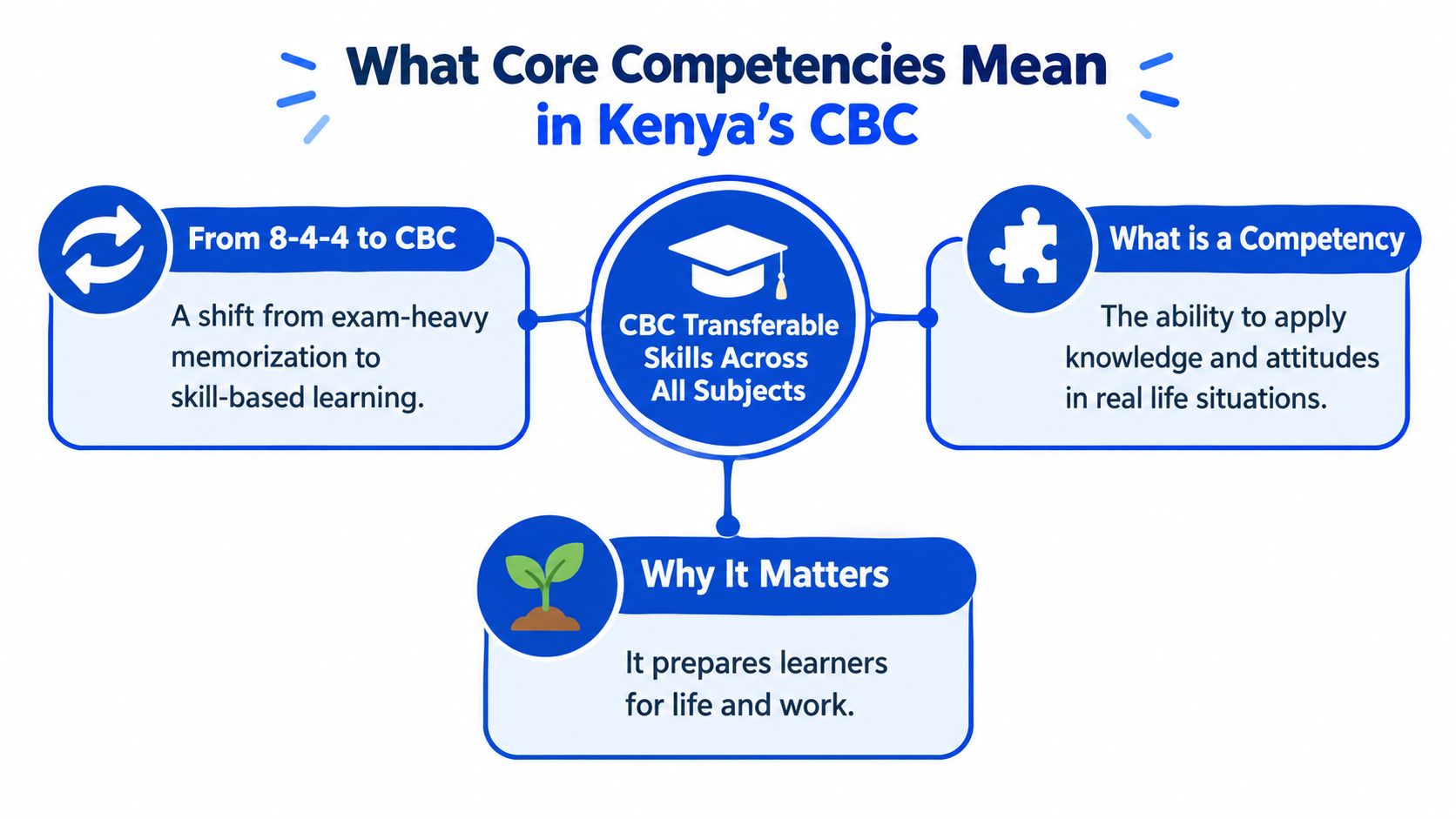
That is why core competencies in CBC matter so much in Grades 7 to 12. Kenya's curriculum reform moved away from an exam-heavy model because the aim is not just to finish content, but to build transferable skills that learners carry across subjects and into life. In Kenya, the framework settled on seven core competencies, and KICD's curriculum framework, published in 2017, made that shift a formal milestone in the rollout of CBC, with the competencies developed across subjects rather than taught as separate lessons KICD curriculum framework.
What makes this different in the classroom
A parent may look at a report and ask why a child who writes neat notes still struggles in class discussion. A teacher may ask why a learner who scores well in a test hesitates during group work. CBC answers both questions by paying attention to how the learner applies knowledge, not only what they can repeat.
Practical rule: if you cannot observe it in a lesson, a discussion, a project, or a reflection, you probably need a clearer indicator.
That is why this topic is easier to handle when you treat it as a weekly teaching habit, not a policy speech. The focus is on what learners do, what evidence teachers collect, and how weak areas get reteached before they become bigger gaps. The examples below stay close to the Kenyan classroom, because that's where the framework either works or gets lost.
What Core Competencies Mean in Kenya's Competency Based Curriculum
A learner may finish a lesson with neat notes and still not know how to use the ideas in a real task. CBC asks a simpler, more useful question. Can the learner apply what was learned in class? That is why understanding what competency-based curriculum actually means matters before teachers and parents try to track the seven competencies.
Competencies are built across subjects
KICD explains that these competencies are not separate subjects. They grow through pedagogy, learning areas, curriculum designs, schemes of work, lesson plans, and teaching-learning materials KICD curriculum framework. So when a learner practises communication in English, collaboration in science, or digital literacy in humanities research, the school is building the same transferable skill in different lessons.
That makes the competencies easier to spot in ordinary classroom moments. A learner who asks a clear question, listens to a partner, or uses a tablet to gather information is showing more than subject knowledge. The teacher is seeing behaviour that can be observed, recorded, and discussed in assessment notes. A parent can see it too, for example when a child explains a homework answer in their own words instead of reciting a memorised line.
The same logic fits the weekly teaching cycle. A lesson plan names the competency, the classroom activity brings it out, the teacher looks for evidence, and the next lesson can reteach where the class struggled. That rhythm is close to the way Kenyan schools already plan work, mark tasks, and adjust after class. CBC only makes the skill more visible.
Why the model fits Kenya's reform goals
The seven competencies came from a Kenya-based needs assessment, so the framework is rooted in local classroom realities rather than copied from somewhere else CBC curriculum design Kenya. Kenyan learners need more than memorised answers. They need confidence, judgment, teamwork, and the habit of trying again when a task changes.
In practice, the subject carries the lesson content, while the competency shows the habit the learner is building. A math lesson can still teach equations, and at the same time show how a learner reasons and persists. A CRE lesson can still teach content, and also reveal reflection and citizenship. Seen that way, core competencies in CBC are not extra work on top of the timetable. They are the skill layer that runs through it.
The Seven Core Competencies Explained with Classroom Examples
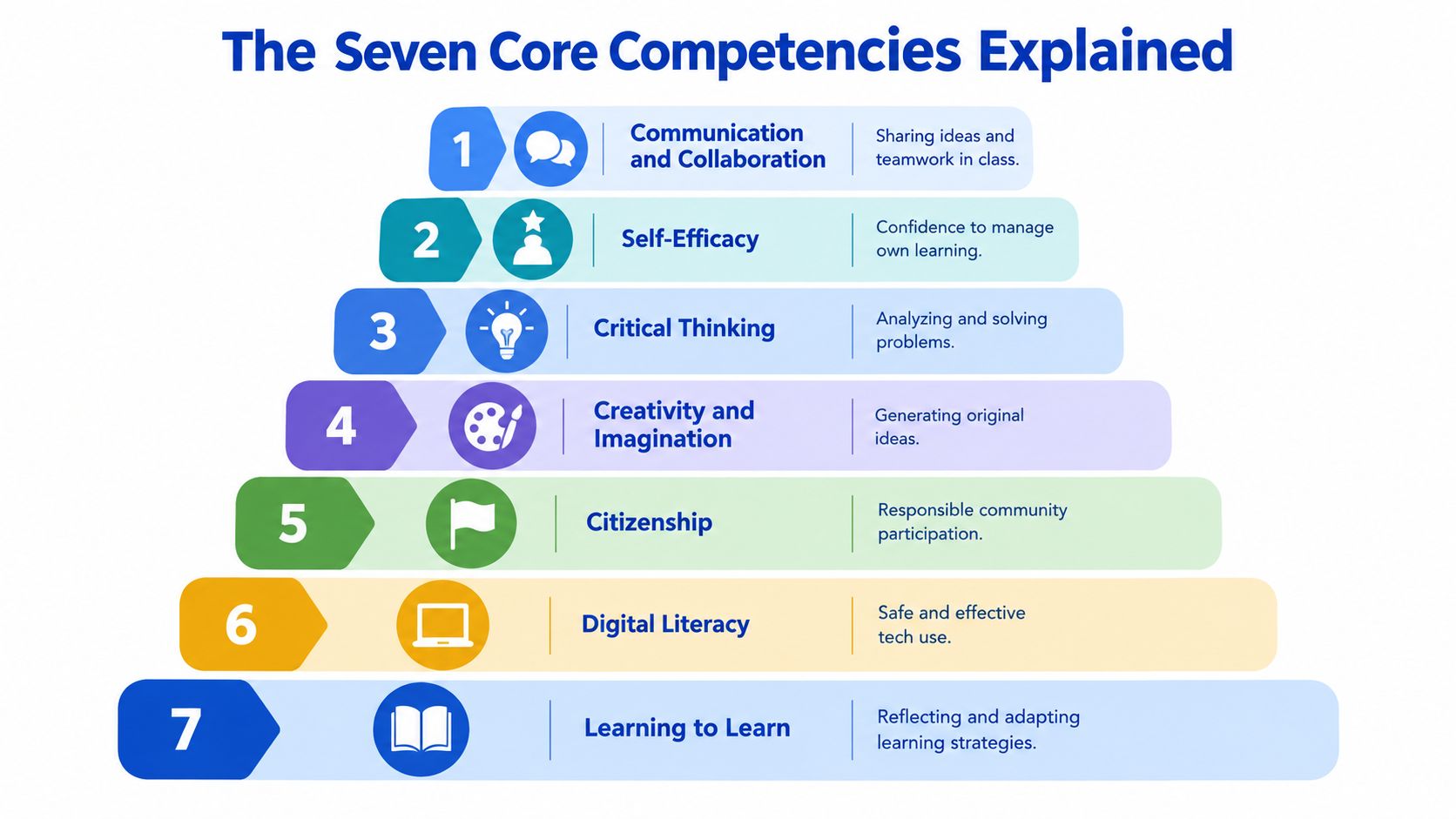
A teacher asks a group to solve one task, and the room quickly shows who can speak clearly, who keeps trying after feedback, who reasons through a problem, and who works well with others. That is the easiest way to understand the seven core competencies in CBC. Look at what learners do, not just what they say about themselves. A learner's speech, written work, choices, and response to correction all give evidence.
Communication and collaboration
A learner explains ideas clearly, listens to others, and helps the group reach one shared answer.
In Grades 7 to 12, this shows up when a learner joins group work with a clear contribution, asks a useful question, or adds to a classmate's point instead of cutting in. During a science investigation, one learner may summarise the group's findings while another checks whether everyone agrees. A teacher can watch for a simple sign, the learner shares information, listens, and helps the group move forward without taking over or withdrawing.
Self-efficacy
A learner believes, “I can handle this task, and I can improve if I keep at it.”
You can see this when a student starts work without waiting for repeated rescue, returns to a task after feedback, or manages revision with less prompting. In a Grade 9 maths class, a learner may spot an error in their own working and correct it before the teacher steps in. At home, it may be the child who opens a revision book before being reminded twice.
Critical thinking and problem solving
A learner can look at a problem, compare options, and choose a sensible next step.
This often appears in questions with more than one possible approach. In lower secondary, a learner may sort evidence before giving an answer. In senior secondary, they may explain why one solution works better than another. The clearest sign is simple, the learner does more than repeat a memorised answer, they explain the reason behind it.
Creativity and imagination
A learner produces original ideas, adapts existing ideas, or finds a new way to present work.
This is easy to notice in creative writing, project work, design tasks, and presentations. A learner might turn a normal summary into a poster, a skit, or a short model that makes the idea clearer to others. The point is not artistic flair alone. It is the ability to produce something fresh that still serves the lesson.
Citizenship
A learner acts responsibly toward people, rules, and the shared life of the school and community.
KICD states that this competency runs through pedagogy, learning areas, and lesson plans. In the classroom, it can show up when a learner waits their turn, uses respectful language, and helps maintain a safe learning space. In wider school life, it may appear during community service or group decision-making. Citizenship is seen in behaviour that protects others and supports common rules.
Digital literacy
A learner uses digital tools safely, effectively, and for a clear learning purpose.
In Grades 7 to 12, this can appear in online research, typed assignments, or handling a shared device responsibly. A learner may search for information, compare sources, or present work using a simple digital format. The clearest sign is whether the learner uses technology to support learning instead of letting the device distract from it.
Learning to learn
A learner reflects on what works, changes strategy, and keeps improving.
This competency is visible when a learner reviews mistakes, asks what method helped most, or adjusts study habits after feedback. In a revision session, they may switch from rereading notes to practising questions because the first method was not enough. That habit of self-correction is one of the strongest signs that CBC is taking root.
| Competency | Classroom clue | What a teacher or parent can notice |
|---|---|---|
| Communication and collaboration | Group task, discussion, shared presentation | The learner contributes and helps the group move forward |
| Self-efficacy | Independent start, persistence after feedback | The learner keeps working without giving up quickly |
| Critical thinking and problem solving | Case study, investigation, multi-step task | The learner explains why an answer makes sense |
| Creativity and imagination | Poster, story, model, design task | The learner offers a fresh and useful idea |
| Citizenship | Class routines, community activity, group norms | The learner shows respect and responsibility |
| Digital literacy | Online search, typed task, shared device use | The learner uses digital tools safely and purposefully |
| Learning to learn | Reflection, revision, correction after feedback | The learner changes strategy and improves |
How Competencies Look Different Across Subjects and Grades
A learner may show critical thinking in mathematics, citizenship in history, and digital literacy while researching a language task. The same competency travels across subjects, but the evidence changes with the lesson. A teacher who only waits for a special “competency lesson” will miss it in ordinary class work.
A good example is communication and collaboration. In an English group presentation or a science practical discussion, a Grade 7 to 9 learner might share a simple idea and listen carefully. A Grade 10 to 12 learner should go further, present a clearer argument, and help the group refine its answer.
Critical thinking and problem solving also shift with grade level. In a mathematics word problem or a geography interpretation task, younger learners may choose a workable method and explain their steps. Older learners should compare methods and defend the one that fits best. The subject may change, but the teacher is still watching the learner's reasoning.
| Core Competency | Example Activity by Subject | Observable Indicator Grades 7-9 vs 10-12 |
|---|---|---|
| Communication and collaboration | English group presentation, science practical discussion | Grades 7-9, the learner shares a simple idea and listens. Grades 10-12, the learner argues a point clearly and helps the group refine its answer. |
| Critical thinking and problem solving | Mathematics word problem, geography interpretation task | Grades 7-9, the learner chooses a workable method. Grades 10-12, the learner compares methods and defends the best one. |
| Digital literacy | Research task in humanities, typed report in business studies | Grades 7-9, the learner can search and organise information. Grades 10-12, the learner can use digital tools more independently and judge whether the source helps the task. |
Digital literacy follows the same pattern. A younger learner may search and organise information with guidance. An older learner should use digital tools more independently and judge whether a source is useful for the task. That is why the planned guide on what core competencies mean in Kenya's competency based curriculum helps parents and teachers see the bigger picture before they compare grade levels.
A senior secondary learner should usually show more independence and better judgement than a Grade 7 learner, but the competency itself stays the same. That progression matters because it stops teachers from expecting the same level of performance at every stage. It also stops parents from assuming a younger learner has failed when they are at an earlier stage of development.
Useful check: if the task changes but the learner's behaviour stays flat, the competency probably needs more deliberate practice.
Subjects give different windows into the same learner. A learner who speaks shyly in English may still show strong problem solving in science. Another learner may be confident in art but need more support in digital literacy. CBC works best when teachers look across subjects and note the pattern in everyday classroom behaviour.
How Core Competencies Are Assessed and Tracked Through CEAs
CBC assessment works best when teachers treat evidence as something collected over time, not something discovered at the end of the term. Kenya's assessment framework ties competency-based assessment to the learner's acquisition of the competencies, which means the teacher needs regular proof from classwork, projects, observation, and feedback cycles ITPD assessment guidance. That is also where many teachers still feel the strain, because the evidence is spread across lessons, and the workload can feel heavy.
What counts as evidence
A quiz can help, but it is not the whole story. So can a group project, a notebook check, a class discussion, a practical task, or a portfolio of work samples. The useful question is not only “Did the learner finish?” but “What did the learner show while finishing it?”
How CEAs fit into the week
Continuous Evaluation Assessments, or CEAs, give the teacher a structured way to capture progress during teaching, rather than waiting for a final exam. A weekly pattern might look like this, the teacher introduces a task, observes how learners respond, records weak strands, and then uses that information to reteach. Parents then see the same pattern in the learner's feedback, not as a surprise, but as a visible learning trail.
Assessment rule: if the evidence cannot guide the next lesson, it probably isn't helping enough.
The challenge in Kenya is not the idea of assessment, it is the consistency of practice. Reviews of CBC implementation keep pointing to teacher preparedness, limited resources, heavy assessment workload, and unclear classroom routines as the main bottlenecks, which is why the quality of assessment can vary from one school to another Brookings on Kenya learning. In a well-run classroom, weak strands get identified early and reteaching happens quickly. In a stretched classroom, the teacher may know the gap but still struggle to close it in time.
For practical planning, this guide to CBE assessment methods can help teachers connect classroom evidence to a more organised weekly routine.
Practical Actions for Teachers and Parents Plus How Keybaki Supports Each Competency
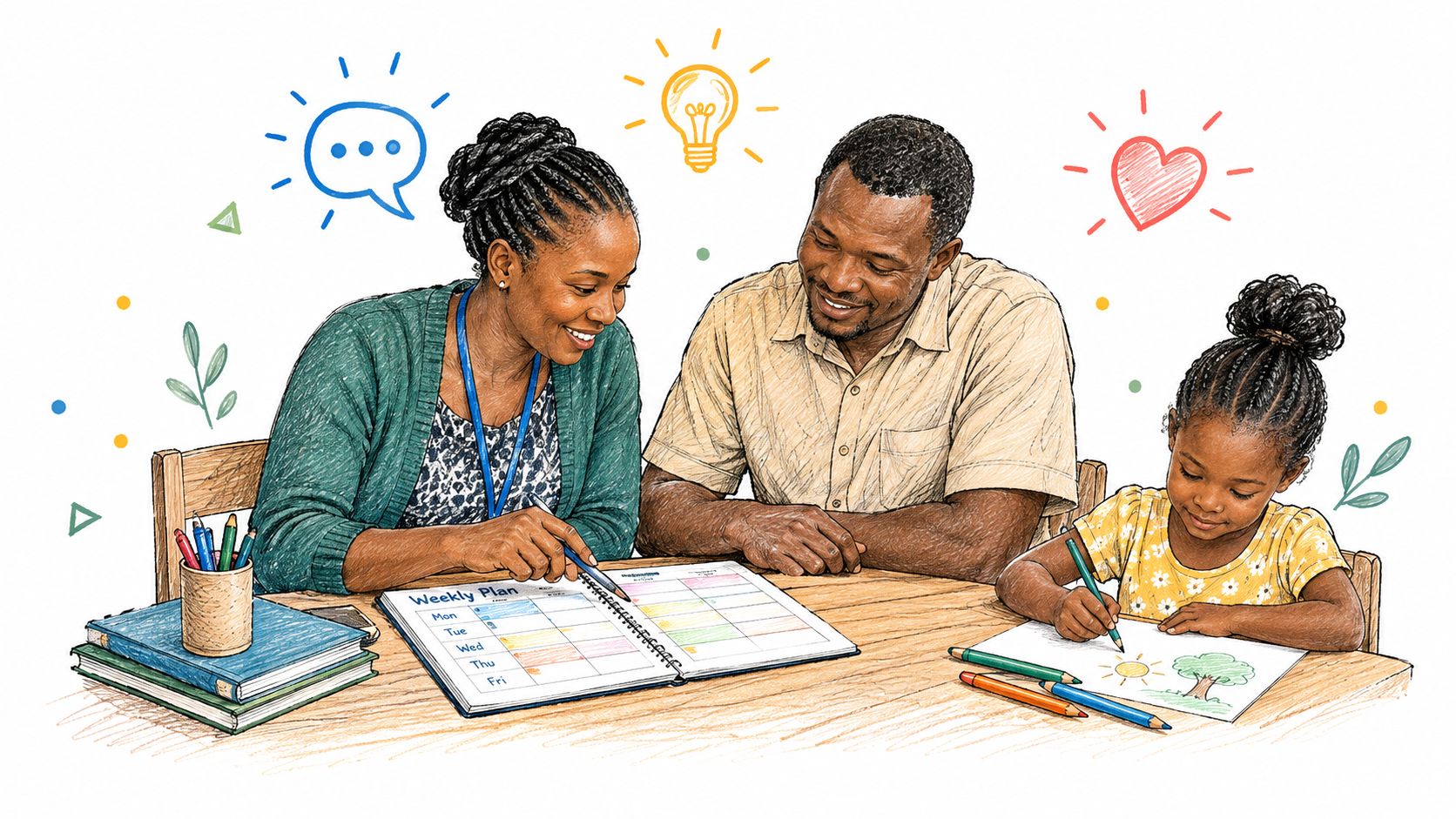
A good CBC week is not complicated. The teacher plans one competency focus, the lesson includes a visible activity, and the assessment gives one clear signal about what needs reteaching. The parent then reinforces the same habit at home, even if it is just through a quick conversation, a shared phone, or a short revision check.
What teachers can do
- Tag one competency in the plan: Choose the main competency you want to watch in that lesson, then build a task that makes it visible.
- Watch for evidence, not perfection: A learner who starts well but struggles later still gives you useful information.
- Reteach the weak strand fast: Don't wait for the term to end before correcting a misunderstanding.
- Use a closed loop: Let the assessment shape the next lesson instead of sitting in a file.
What parents can do
- Read the weekly note carefully: Look for the competency and the weak strand, not just the mark.
- Ask one simple question: “What did you learn, and how did you know you had understood it?”
- Support regular revision: A short, calm routine beats a long, stressful cram session.
- Use the home device well: If several children share one phone, keep learning time short, focused, and supervised.
A platform like Keybaki links CBE-mapped lesson planning with CEAs, weak-strand feedback, and parent and student views, so the planning, assessment, and reteaching cycle stays in one place. That kind of setup matters most where devices are shared and time is tight, because the weekly loop is easier to follow when the evidence is already organised.
Bringing Core Competencies to Life in Your School and Home
Core competencies stop feeling vague when you watch them in action. A learner speaks more clearly, solves problems with more confidence, or changes study habits after feedback. That is growth you can see, support, and repeat.
Keep the weekly routine simple. One competency focus, one observable indicator, one CEA check, one reteach step. Teachers, parents, and school heads who keep that rhythm make CBC easier for learners to understand and easier for adults to manage.
If you want a practical way to plan, assess, and reteach CBC lessons without losing the thread between school and home, visit Keybaki and see how it organises Grades 7 to 12 work around strands, weekly assessment, and learner feedback. It gives teachers and parents a shared view of what learners need next, which makes the seven competencies easier to track in real life.
Comments
Loading…