
· CBE timetable
2027 School Timetable Kenya: A Week-by-Week Planning Guide
14 min read
You're arranging school transport when a message arrives from another parent: their child's school closes earlier than yours. At the same time, a teacher is trying to fit practical work, revision and assessments into a weekly grid that already looks full. Both problems start with the same assumption, that every Kenyan learner follows an identical school timetable.
For anyone planning a 2027 school timetable in Kenya, the starting point is the learner's school level, not an empty lesson grid. Use the published calendar as a planning baseline, then confirm the school's own reporting arrangements, assessment notices and activities before making firm bookings.
Table of Contents
- 2027 Term Dates for Every School Level
- Breaks and Exam Windows to Block First
- How a School Timetable Is Built Day by Day
- Senior School Pathways and Practical Time
- Planning Around Siblings and Shorter Terms
- Build and Check Your Weekly Timetable
2027 Term Dates for Every School Level
| School level | Term 1 | Term 2 | Term 3 |
|---|---|---|---|
| Pre-primary, primary and junior schools | 4 Jan to 9 Apr (14 weeks) | 3 May to 30 Jul (13 weeks) | 30 Aug to 5 Nov (10 weeks) |
| Senior and secondary schools | 4 Jan to 2 Apr (13 weeks) | 3 May to 30 Jul (13 weeks) | 30 Aug to 5 Nov (10 weeks) |
These are the planned 2027 term dates and week counts in Arena's account of the Ministry of Education school calendar. Treat them as the baseline for planning, while checking subsequent Ministry and school communications for changes.
The difference that matters most is the earlier first-term closure for senior and secondary schools. The opening dates align, but the closing dates don't. A teacher who copies the junior-school row into a senior-school planner could place lessons after learners have already gone home.
Think of the calendar as a printed map with separate route lines for different school levels. Everyone may start at the same point, but not everyone reaches the next stop together. A single national calendar therefore doesn't produce an identical teaching schedule for every school.
Term weeks aren't a list of available lessons
The week counts describe the calendar's term structure. They aren't permission to fill every weekday with ordinary instruction. Schools still need to account for breaks, assessments, organised activities and their own approved events.
For a department head, that means checking available teaching periods before dividing curriculum content across a term. For a parent, it means distinguishing a closing date from the date a particular child must travel, report for an examination or attend an organised school activity.
Planning rule: Choose the learner's level before choosing lesson dates. A neat timetable built from the wrong calendar row is still wrong.
A useful planning sheet should have separate fields for school level, term opening, term closing and school-confirmed arrangements. Don't put a boarding reporting time into the national opening-date field, for example. Keeping those details separate makes later changes easier to understand.
Begin by finding the correct row for your child or class. Copy its term boundaries into your calendar, label the school clearly, and leave room for the school's notices before you start placing lessons or booking transport.
Breaks and Exam Windows to Block First
| Event | Planned 2027 dates | Timetable rule |
|---|---|---|
| February half-term | 19 to 28 February | Block all lessons and CEAs |
| June mid-term break | 9 to 20 June | Block all lessons and CEAs |
| August holiday | 31 July to 29 August | No ordinary lessons; school confirms any separate revision arrangements |
| Junior-level national assessments | 1 to 5 November | Assessment mode; no new instruction for affected learners |
| KCSE | 8 to 26 November | Examination window for candidates only |
The break dates follow the published calendar baseline. For the November windows, Education News's account of the Ministry calendar reports planned junior-level national assessments for 1–5 November 2027 and KCSE for 8–26 November 2027.
The important distinction is between a school being open and a class being available for new learning. Learners may be on site for assessment, revision or examination arrangements rather than an ordinary lesson sequence. Don't count that time twice.
Give each period a clear purpose
Tag timetable blocks as instructional, revision, assessment or examination. Each needs different arrangements: instruction needs learning materials, revision needs selected retrieval tasks, assessment needs appropriate conditions, and examinations need protected candidate time.
A declared break should remain blocked for ordinary lessons and Continuous Evaluation Assessments, or CEAs. If a school communicates separate holiday revision arrangements, show them separately rather than converting holiday dates into compulsory teaching capacity.
The late-term squeeze needs particular care. A sensible planning benchmark is to finish new strand instruction before the final teaching fortnight, leaving a buffer for retrieval practice, remediation, portfolio completion and examination logistics. That's a planning recommendation, not a replacement for the school's assessment instructions.
Consider a class that can explain a scientific idea orally but struggles to apply it in a written task. A short check before the break can identify that gap. The next available instructional block should address the weak sub-strand before the teacher adds enrichment work.
For choosing suitable checks, our guide to CBE assessment methods helps connect classroom evidence with the next teaching decision.
Protect assessment time before the timetable becomes crowded. Moving unfinished teaching into an assessment window only hides the planning gap.
Mark every relevant row in the table on the school calendar. Then check which learners, rooms and teachers each assessment affects, rather than blocking the whole school automatically.
How a School Timetable Is Built Day by Day
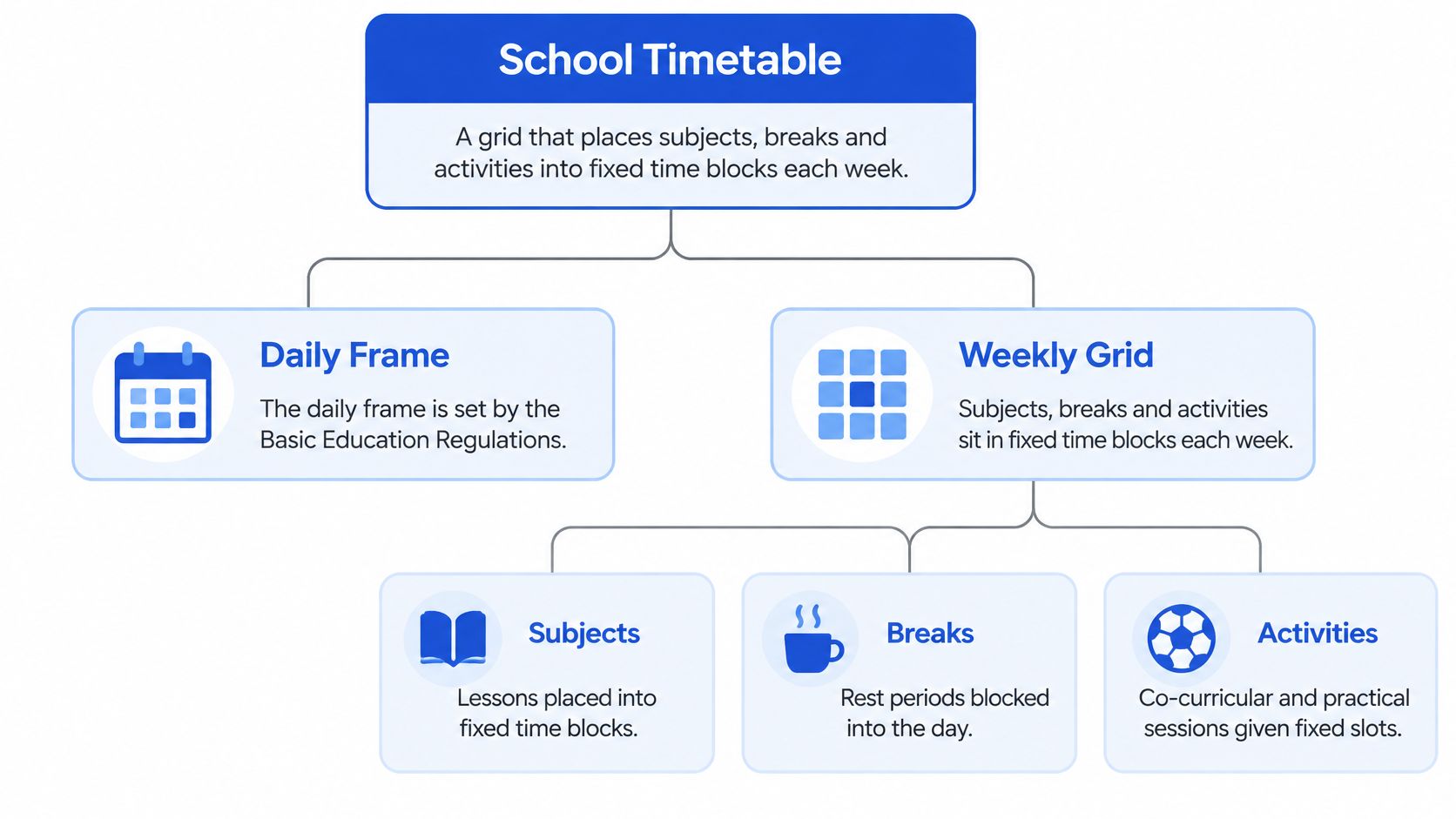
A school timetable is a grid that places subjects, breaks and activities into fixed weekly time blocks. The Ministry of Education's junior-school implementation guidelines specify an operating frame of 8:00 a.m. to 3:30 p.m., Monday to Friday, under the Basic Education Regulations of 2015.
That junior-school guidance is a useful starting point for planning, not a reason to assume every school phase has an identical subject grid. Its prototype includes English, Mathematics, Kiswahili, Religious Education, Social Studies, Integrated Science, Business Studies, Agriculture, Health Education, Pre-technical Studies, Physical Education and Sports, and optional subjects.
The diagram separates the daily frame from the activities placed inside it.
Protect the whole school day
Assembly, class meetings, clubs, games, career guidance and lunch also belong in the timetable. They aren't spare spaces to remove whenever a subject falls behind. A workable plan recognises rest, movement and organised activities alongside classroom instruction.
Practical sessions need preparation and clearing-up time within their allocated blocks. For example, an Agriculture activity shouldn't depend on learners reaching the practical area instantly or leaving equipment behind when the bell rings.
School planning guidance also calls for routine, master and class-specific timetables, displayed in line with Ministry guidance, with schemes of work prepared before each term.
- Routine timetable: Makes recurring school activities and daily arrangements visible.
- Master timetable: Brings classes, teachers and shared facilities into a whole-school view.
- Class timetable: Shows the programme a particular class should follow.
The master timetable is like a station departure board showing every route; the class timetable is a passenger's ticket showing the relevant journey. They should agree, even though they serve different readers.
Connect the grid to the teaching plan
A timetable says when learning happens. A scheme of work explains what the teacher intends learners to cover and how that learning will progress. Use a scheme of work template to connect those decisions before the term begins.
Check the master timetable against fixed activities and shared resources. If a teacher or laboratory appears in conflicting places, resolve that clash before distributing class copies.
Senior School Pathways and Practical Time
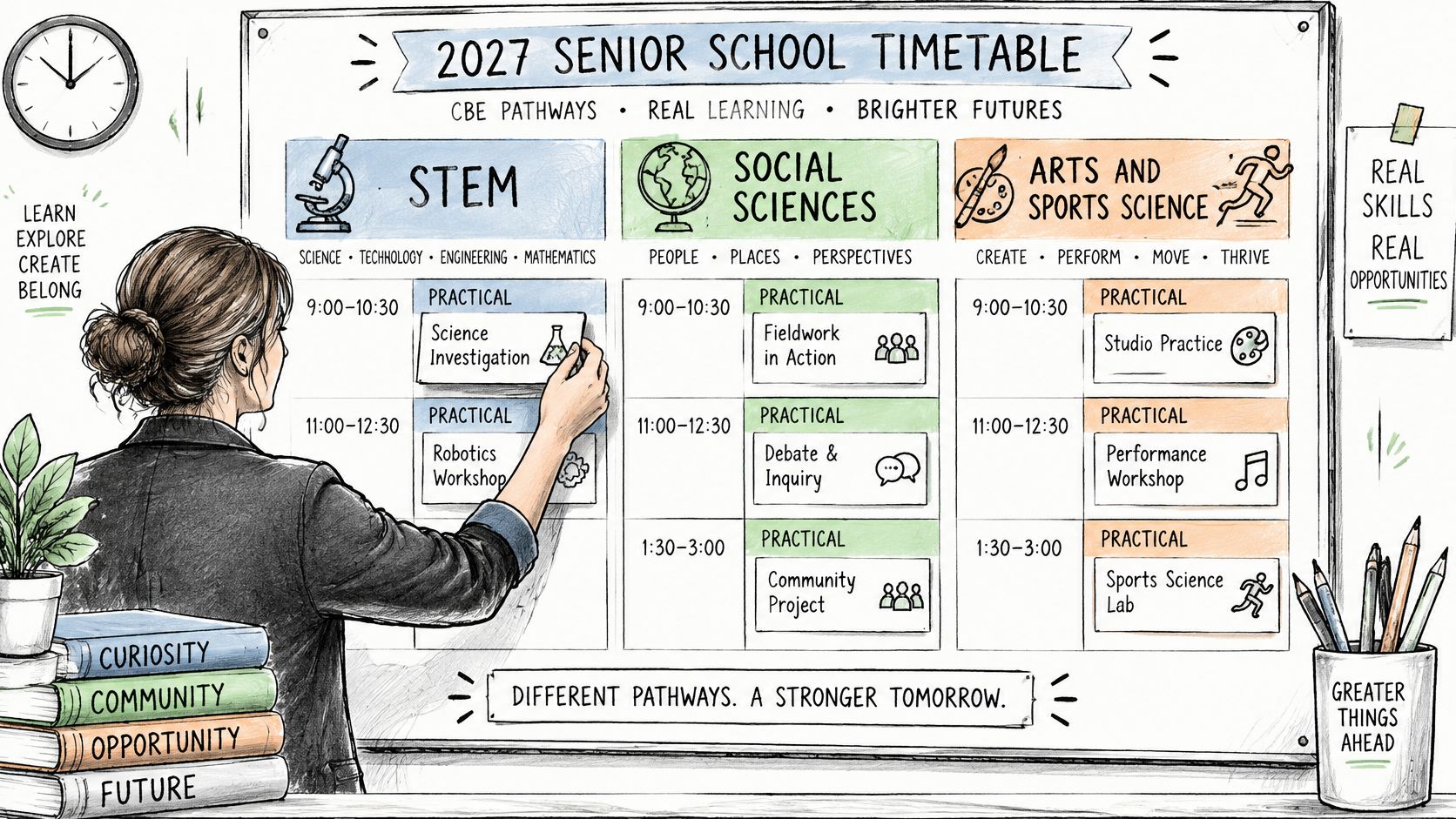
Senior-school planning needs more than a subject list copied from the former examination-focused model. The Ministry of Education's CBC implementation documentation identifies STEM, Social Sciences, and Arts and Sports Science as the senior-school pathways, with Grade 10–12 curriculum designs scheduled for development and rollout across 2026–2028.
That planned rollout makes 2027 an implementation year in which schools need to accommodate pathway learning, practical work and continuous school-based assessment. The same documentation places this work within the 2-6-3-3 CBE structure, covering pre-primary, primary, junior and senior schooling respectively.
Pathway choices need to be visible in the timetable, not just on admission paperwork.
Match the block to the task
Different activities call for different scheduling decisions. Plan from the actual subjects the school offers and the tasks in their curriculum designs.
- STEM: Protect laboratory access, equipment preparation and practical investigation time.
- Social Sciences: Allow suitable space for projects, source analysis, presentations and fieldwork where relevant.
- Arts and Sports Science: Give performance, rehearsal and training enough continuity to be useful.
A practical activity can become ineffective when a teacher has to stop immediately after distributing materials. Equally, a long block isn't automatically better if the task only needs a short explanation and independent practice.
Keep compulsory learning visible
Place compulsory learning areas first, using the applicable curriculum allocations. Then fit pathway electives around teacher availability, specialist spaces and assessment needs. Our guide to Grade 10 pathways in Kenya can help families understand the choices before discussing the school's offer.
For a deliberately simplified example, suppose a school sketches a day with six blocks: four for compulsory areas, one for a pathway subject and one for a project or CEA. This isn't an official allocation. It illustrates how a planner can protect core learning while making applied work visible.
The final grid must follow curriculum requirements, not that example. Before approving it, list the pathway subjects offered, identify their resource needs and check whether their blocks are long enough for the intended work.
Planning Around Siblings and Shorter Terms
There's no single national timetable template that every family can copy unchanged. A household with children in different phases needs a shared calendar with separate entries for each learner, not a single label saying school holidays.
| Family situation | What changes | Practical response |
|---|---|---|
| Children attend different school levels | Closing arrangements may differ | Label travel and collection by child |
| A learner is an examination candidate | Attendance may follow examination instructions | Keep candidate dates separate from sibling holidays |
| A child boards | Reporting, collection and luggage arrangements need confirmation | Record the school's travel notice |
| A learner joins a new school or pathway | Induction and subject confirmation may add tasks | Track school-issued deadlines separately |
| Children have competing activities | Transport and adult availability can clash | Name the adult responsible for each journey |
For a concrete example, Kenyans.co.ke's account of the planned calendar places primary-school first-term closure on 9 April 2027, while senior and secondary schools are scheduled to close on 2 April 2027. A family with children in those phases therefore needs different collection and home-care arrangements.
The older learner may already be home while the younger child still needs the school run, packed meals and an evening homework routine. Don't cancel shared transport until you've checked which child still needs it.
Separate national dates from school decisions
Use distinct calendar colours or labels for national dates, school-specific events and family arrangements. A parent meeting belongs to the school layer; a collection booking belongs to the family layer. Neither should be mistaken for a Ministry-wide requirement.
Keep the learner's level, school type, assessment commitments and transition tasks visible. Add fee-related reminders, co-curricular programmes and meetings only when the school communicates them, rather than guessing dates from another school's pattern.
For households also coordinating training and matches, Vanta Sports' approach to one calendar for every child's season offers a useful way to organise shared responsibilities alongside school commitments.
For families: A date isn't fully planned until someone knows who's collecting the child, where they're going and what happens afterwards.
Plan the shorter term by available teaching time
Teachers shouldn't distribute the same volume of new work into every term because each has a separate reporting cycle. Put prerequisite learning early enough for learners to use it, and retain space for targeted support later.
Department heads can compare planned strand coverage against available instructional weeks, rather than comparing raw term totals. Parents can apply the same principle at home: a busy assessment period needs focused support, not a larger pile of revision tasks.
Share the dated family calendar with every adult who manages collection, meals, boarding travel or study support. Agree who updates it when a school notice changes the plan.
Build and Check Your Weekly Timetable
Start with the correct school-level calendar row, then remove unavailable time before adding lessons. Before planning, ask the head teacher to confirm the school's closing arrangements, assessment windows and school-specific dates for meetings, activities and fee-related notices.
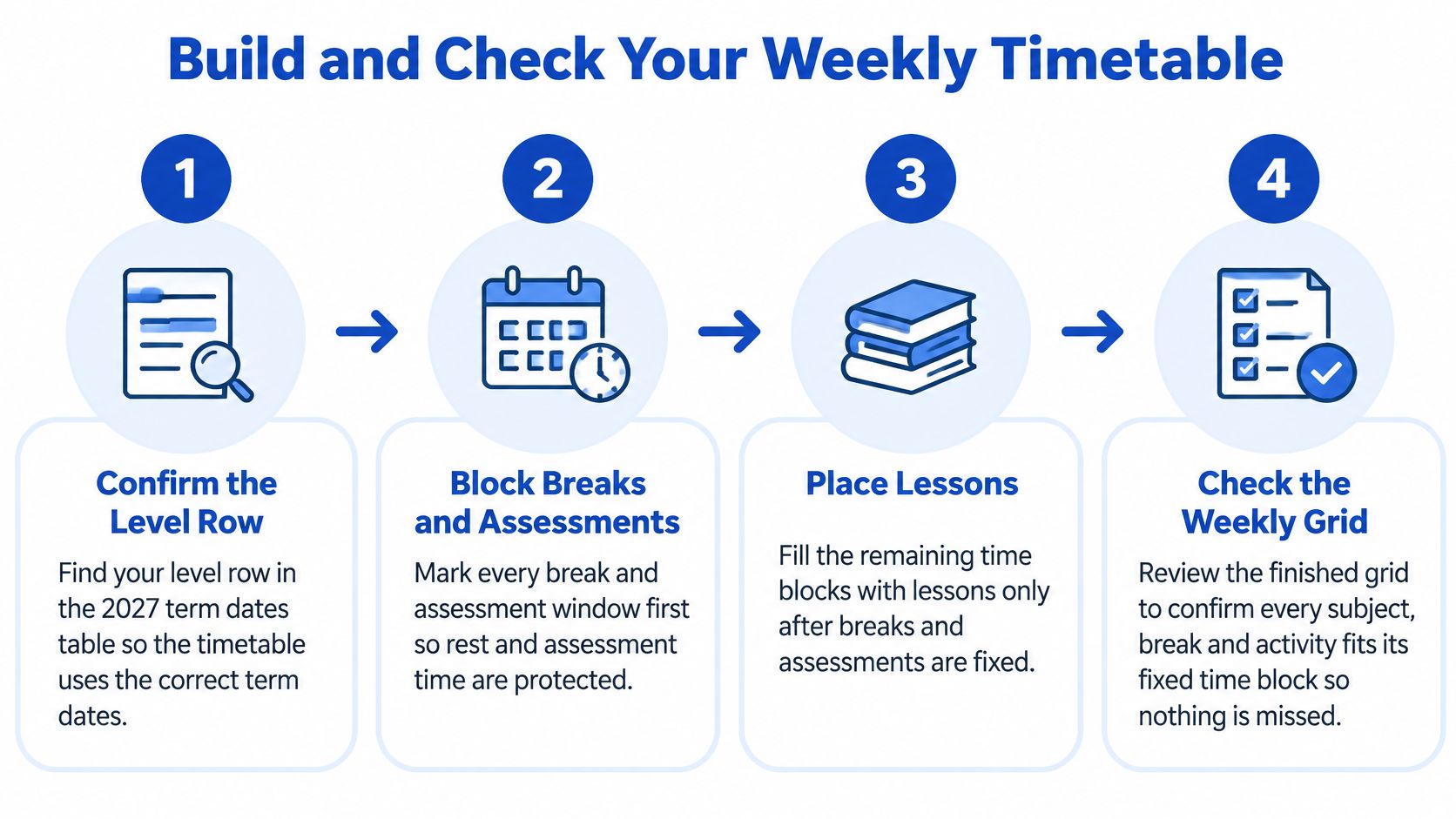
The planning sequence is simple, but the checks matter.
Build from fixed commitments
Confirm the level row. Put the appropriate term boundaries into the working calendar. Check the class and stream labels too, so a correct plan doesn't get issued to the wrong group.
Block breaks and assessments. Transfer the relevant windows into the planner and mark affected classes. Keep examination restrictions separate from ordinary whole-school closures.
Place fixed events. Add assembly, lunch, games, clubs and other confirmed activities before subject lessons. This makes the remaining teaching capacity visible instead of hiding clashes until the week begins.
Assign subject periods. Follow the school's approved allocations and applicable curriculum guidance. Where practical work requires continuity, use adjacent periods when permitted, and check the room, teacher and equipment together.
A room check deserves more than a glance at whether the space is empty. Confirm that the equipment is available, materials can be prepared and another class won't need the same resources at the same time.
Make learning traceable
Map lessons and CEAs to strands and sub-strands. Give each entry a clear learning focus. A label such as revision is too broad to tell a colleague what learners will practise or how the teacher will judge understanding.
Place checks before breaks where appropriate. Use manageable strand checks to identify what needs attention, then put reteaching into the next available instructional block. Don't turn every check into a lengthy formal test or schedule one before learners have had enough practice.
Build lessons through the 5E sequence. Use Engage, Explore, Explain, Elaborate and Evaluate to organise learning. For example, begin with a familiar local problem, let learners investigate, clarify the concept, apply it in a fresh situation and check understanding.
Review the week against what remains. Compare planned work with available periods and learner progress. If a practical session overruns or a check reveals misunderstanding, adjust the next plan rather than squeezing extra tasks into protected time.
At Keybaki, teachers can plan a whole week in three steps: browse the library, attach resources to create lesson plans, then schedule and present them on the timetable. Teachers can assign a week's lessons in under an hour, while still checking that the selected content fits their class.
Check school and home together
Parents don't need to reproduce the classroom grid at home. They need a workable routine for getting ready, travelling, eating, resting and preparing materials; Family Xchange's morning and bedtime routine checklist can help organise those bookends without filling every evening with schoolwork.
A finished weekly plan should pass clear conflict tests: no lesson occupies a blocked slot, no teacher or room is double-booked, and planned pre-break CEAs leave time to interpret the results. Every assessment should have a learning purpose and an available instructional follow-up.
Before the opening week begins, compare the master timetable with the school-confirmed calendar and raise any mismatch with the head teacher. Aim for a conflict-free, teachable week, not merely a full grid.
Our Teachers plan is free forever at KES 0 per teacher, with up to 3 subjects, unlimited lesson planning, unlimited CEAs on those subjects and a classroom presenter. Visit Keybaki to organise curriculum-aligned lessons around your school's confirmed calendar and turn assessment results into the next week's teaching plan.
Comments
Loading…