· junior secondary
What Is CBC in Kenya: A Plain English Guide
15 min read
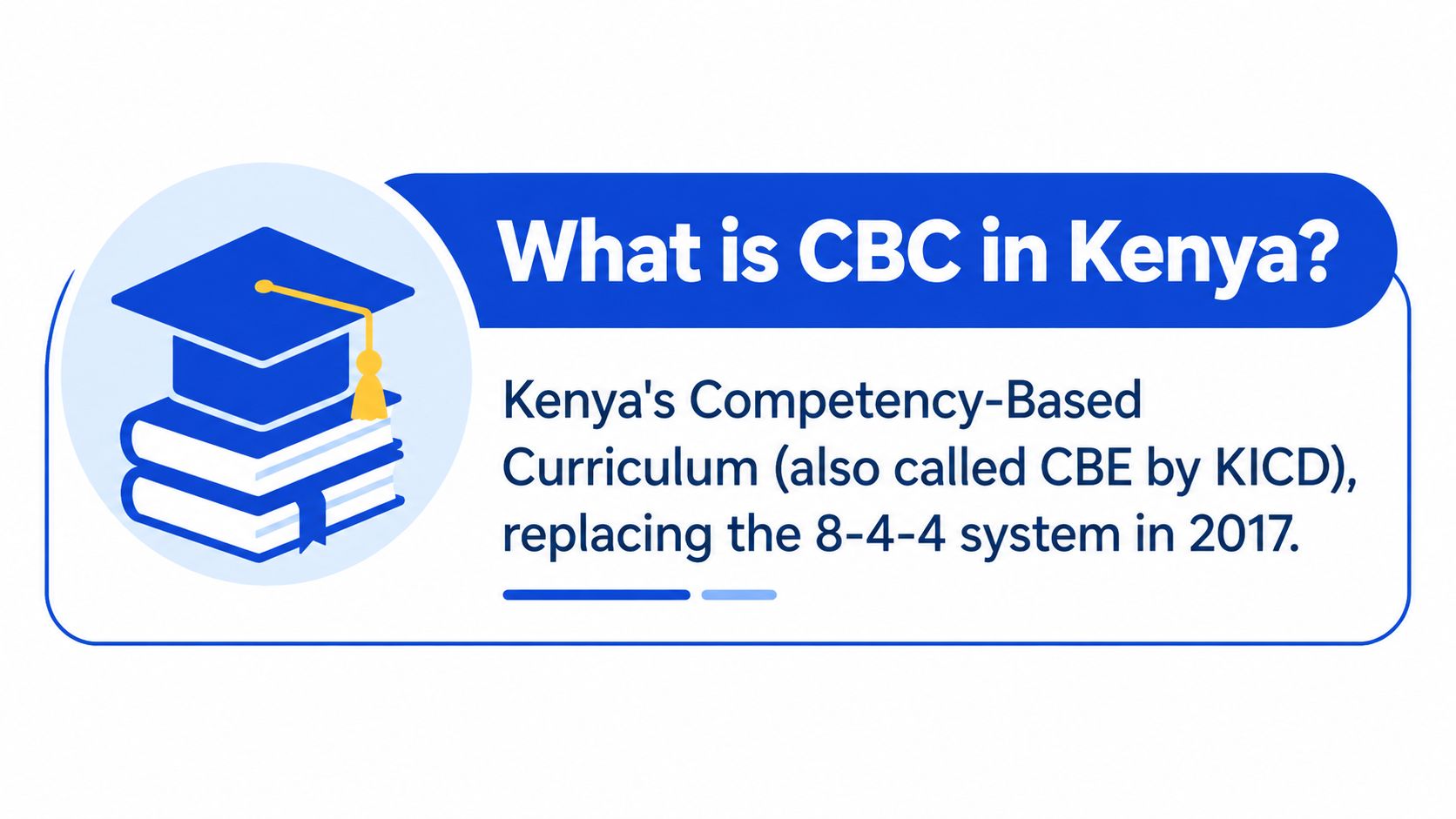
Kenya's Competency-Based Curriculum, also called CBE, replaced the 8-4-4 system in 2017 and follows a 2-6-6-3 pathway from pre-primary through senior secondary. In simple terms, CBC focuses on what a learner can do with knowledge, not only what they can remember for an examination.
You may be asking this after hearing about Grade 9 pathway choices, seeing a new assessment report, or trying to understand why your child's homework looks different from the revision exercises you knew. Perhaps the school has asked for a project, portfolio evidence, or materials for a practical activity, and you're wondering what CBC requires from your family.
The short answer is that CBC has moved Kenya from one familiar examination route into a staged education system. It changes how schools organise learning, how teachers assess progress, and how learners prepare for senior school.
Table of Contents
- A Quick Answer to What CBC in Kenya Really Is
- Where CBC Came From and How the 2-6-6-3 Path Works
- Inside Junior Secondary, the Stage Most Parents Ask About
- How Competencies, Strands and Assessment Actually Work
- What a Real CBC Week Looks Like for Teachers, Parents and Students
- Common Misconceptions About CBC in Kenya
- Using Keybaki to Plan, Teach and Assess the CBE Way
- Key Dates, Next Steps and What to Do Now
A Quick Answer to What CBC in Kenya Really Is
CBC means Kenya's Competency-Based Curriculum. The Kenya Institute of Curriculum Development also uses the term Competency-Based Education, or CBE, for the national curriculum materials and framework. Kenya unveiled CBC in 2017 as the replacement for 8-4-4, with a phased rollout that started in early learning and expanded through primary and secondary education, as described by the BBC's report on Kenya's curriculum reform.
The key change is simple to understand. Under a content-heavy system, success often appeared to depend mainly on how much information a learner could recall in a major examination. Under CBC, the teacher also looks for practical ability: Can the learner explain an idea, solve a problem, work with others, communicate clearly, create something, or apply knowledge outside the exercise book?
That doesn't mean knowledge has disappeared. A learner still needs facts, vocabulary, procedures, and subject understanding. CBC asks the learner to use those foundations, rather than leaving them as memorised answers.
A parent can understand the system by asking seven practical questions:
- Where did CBC come from? The 8-4-4 system was replaced by a new pathway.
- How does 2-6-6-3 work? Each stage has a different purpose.
- What happens in junior secondary? Grade 7 to Grade 9 is the bridge to senior school.
- How are competencies assessed? Daily work matters alongside national assessments.
- What does a normal week look like? Teachers, learners, and parents all have new responsibilities.
- Which myths are misleading? CBC hasn't abolished examinations or become a private-school programme.
- What happens in 2026? Grade 9 assessment, placement, and senior-school preparation become central concerns.
Where CBC Came From and How the 2-6-6-3 Path Works
Kenya moved towards CBC because the education system needed to do more than prepare learners to reproduce content under examination conditions. The reform was designed around a broader question: how can schools develop communication, problem-solving, creativity, citizenship, and other abilities that learners need in further education, work, and daily life?
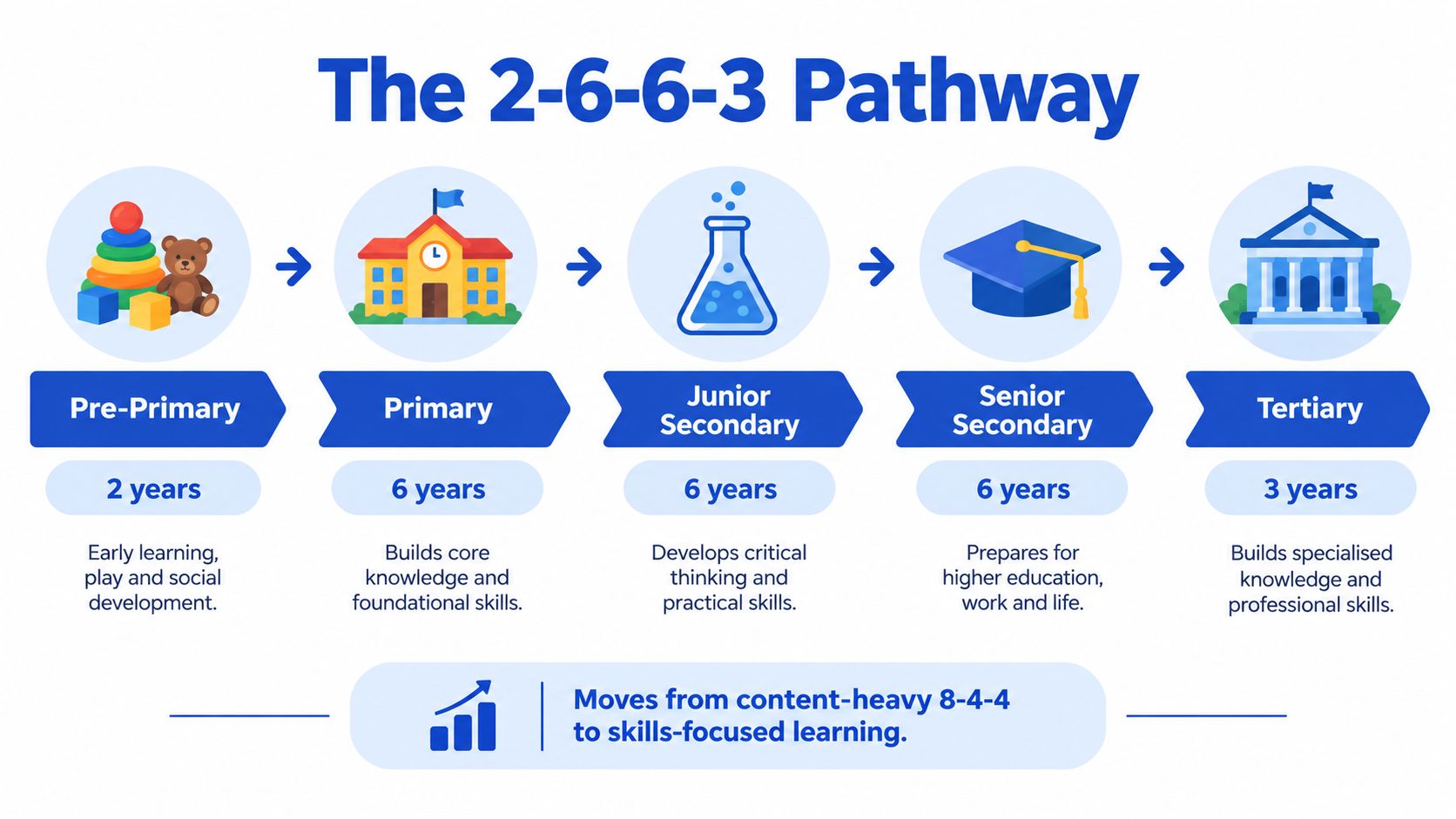
The pathway is commonly described as 2-6-6-3:
| Stage | What it means |
|---|---|
| Early learning | 2 years of pre-primary education |
| Primary | 6 years |
| Junior secondary | 6 years in the commonly described full pathway, split between 3 years of junior secondary and 3 years of senior secondary |
| University | At least 3 years of university education |
For a parent following a child's journey, that means PP1 and PP2, followed by Grade 1 to Grade 6, then Grade 7 to Grade 9 in junior secondary. Senior secondary covers Grade 10 to Grade 12, where learners move towards subject pathways. The three broad pathway areas are STEM, Social Sciences, and Arts and Sports, although the exact subject choices and national designs continue to develop.
The main institutions have different responsibilities. KICD develops curriculum designs and materials, the Ministry of Education leads policy and implementation, and the Teachers Service Commission supports teacher deployment. KICD's official materials cover pre-primary, primary, junior school, senior school, teacher education, and special needs education, confirming that CBC is a national content framework rather than a syllabus created separately by each school. You can browse the official KICD CBC materials for the published curriculum resources.
The transition is staged, not finished in one movement. The Ministry's 2024 planning documents place the development and rollout of Grade 10 to Grade 12 CBC between 2026 and 2028, so schools must keep aligning teaching resources, assessment plans, and teacher preparation with updated national designs.
Inside Junior Secondary, the Stage Most Parents Ask About
Junior secondary is where many families feel the reform most directly. At this level, the official structure provides 9 lessons each day for 5 days, which totals 45 lessons each week, with each lesson lasting 40 minutes. The Ministry of Education's junior secondary implementation guidelines also state that English is the medium of instruction, except for Kiswahili, Kenyan Sign Language, and foreign languages.
English and Kiswahili remain central. Depending on staffing and the school's capacity, learners may also encounter languages such as Kenyan Sign Language, Arabic, French, German, or Mandarin. The practical limitation is clear: an optional language can only run properly when a school has the teacher, timetable space, and learning materials.
The junior-secondary learning areas include English, Kiswahili, Mathematics, Integrated Science, Health Education, Pre-Technical and Pre-Career Studies, Social Studies, Religious Education, Creative Arts, Agriculture and Nutrition, and Physical Education and Sports. The weekly allocation gives Mathematics 5 lessons, English 5 lessons, and Integrated Science 4 lessons, which shows why a teacher can't treat planning as an informal exercise. Every strand needs space within a tightly controlled timetable.
| Learning Area | Grade 7 lessons/week | Grade 8 lessons/week | Grade 9 lessons/week |
|---|---|---|---|
| Mathematics | 5 | 5 | 5 |
| English | 5 | 5 | 5 |
| Integrated Science | 4 | 4 | 4 |
| Other learning areas | Based on the official timetable | Based on the official timetable | Based on the official timetable |
The Grade 9 decision is especially important. Learners select among STEM, Social Sciences, and Arts and Sports for senior school, while their Grade 9 performance contributes to placement. The Kenya Junior School Education Assessment, or KJSEA, is the exit assessment for junior secondary. Parents who want to follow the practical transition issues can read this guide to the Grade 9 to Grade 10 transition.
Practical rule: Ask the school which pathway information is official, which choices are provisional, and how the learner's interests and evidence will be considered.
Schools still face difficult realities. Some have limited laboratory facilities, some lack teachers for optional languages, and teachers must manage heavy content and assessment demands. Parents shouldn't interpret every implementation gap as a problem with the idea of competencies, but they're right to ask how the school will deliver the required learning with the resources available.
How Competencies, Strands and Assessment Actually Work
The vocabulary sounds complicated until you connect it to one ordinary lesson. A competency is an ability the learner develops and demonstrates, such as communicating, thinking critically, collaborating, showing citizenship, using digital tools, learning independently, or building self-confidence.
A strand is a broad topic area within a subject. A sub-strand narrows that topic into a more specific group of learning objectives. The teacher uses the curriculum design to identify what learners should understand, practise, and demonstrate during the lesson.
One activity can serve several purposes
Suppose a Grade 7 English teacher gives learners a motion for a classroom debate. Learners must understand the topic, organise points, listen to opposing views, and speak clearly. The activity belongs to an English strand, but it also provides evidence of communication and collaboration, critical thinking, and self-efficacy.
That's the point of CBC lesson design. The teacher doesn't add a random game and call it competency-based learning. The activity must connect to the intended learning outcome, the relevant sub-strand, and the competency being developed.
Teachers then gather evidence in different ways:
- Observation checklists record what a learner can do during an activity.
- Rubrics describe the quality of performance against clear criteria.
- Portfolios collect selected work over time.
- Peer assessment helps learners evaluate one another constructively.
- Self-assessment asks learners to identify strengths and areas needing practice.
- Classroom tasks show whether a learner can apply knowledge rather than repeat it.
The national assessment hasn't vanished. CBC combines school-based evidence with national assessment arrangements, including KJSEA at the end of junior secondary and other Kenya National Examinations Council assessments at the relevant stages. The important difference is that one examination is no longer the only picture of a learner's development.
Parents who want to decode the terminology can use this strand and sub-strand guide alongside the school's curriculum designs.
What a Real CBC Week Looks Like for Teachers, Parents and Students
On Monday morning, a Grade 5 teacher in Nakuru reviews the week's learning outcomes before class begins. The teacher selects an activity, prepares questions, and decides what evidence will show that learners understand the concept. In Kisumu, a Grade 8 teacher does a similar review, but must also fit the lesson into the junior-secondary timetable and record progress across several learning areas.
The classroom activity might involve measuring, sorting, discussing, drawing, presenting, or solving a local problem. Homework may ask a learner to interview a family member, observe something at home, revise a concept, or complete a practical task. That work isn't meant to become an expensive competition between families. A good teacher designs it so the learner can demonstrate understanding with ordinary materials wherever possible.
By Wednesday, the parent in Nairobi may be negotiating a different set of constraints. The child needs time to complete an assignment, but the family shares one phone. Charging the device, paying for transport, finding lunch money, and deciding which parent can attend a co-curricular session all affect whether the learner can participate fully.
What teachers carry
Teachers must plan lessons, facilitate activities, observe learners, give feedback, update records, and communicate with families. Overcrowded classrooms, limited digital access in rural schools, and teachers handling several learning areas can make that workload difficult.
What parents can do
Parents don't need to write the teacher's lesson plan. They can ask the child to explain the task, provide a quiet place where possible, check that work is complete, and communicate openly when time, money, devices, or materials are unavailable.
At home, support means asking “What did you learn and what can you demonstrate?” rather than only asking “What mark did you get?”
Good CBC practice doesn't require a family to buy every item mentioned in a project. It requires coordination. A school should explain the purpose of an activity, offer reasonable alternatives, and avoid turning household income into an invisible assessment criterion.
Kenyan research has reported that parents weren't adequately prepared for their CBC role and faced financial and time constraints, while teachers described unrealistic assignments and socioeconomic inequalities. Another Kenya-focused study identified limited materials, weak cooperation, and limited CBC knowledge among parents and teachers as serious challenges, with public schools facing greater pressure. The Kenya-focused study on CBC implementation challenges reflects why school-home communication matters as much as classroom method.
Common Misconceptions About CBC in Kenya
A parent hears that CBC has removed exams, while a teacher explains a classroom project and a learner prepares for Grade 9 pathway choices. The confusion comes from mixing the curriculum design with how schools implement it. CBC has real pressures, but several common claims are inaccurate.
| Common Myth | What CBC Does |
|---|---|
| CBC abolished all examinations | CBC includes school-based assessment and national assessments, including KJSEA at the end of Grade 9. |
| CBC is only for private schools | CBC is a national framework used across public and private education. |
| CBC only renamed the old subjects | It changes learning outcomes, classroom activities, assessment, and progression, even where subject names look familiar. |
| CBC will automatically be reversed | CBC remains national education policy, while the Ministry continues staged development and adjustment. |
The first myth is especially damaging. A learner may complete practical tasks, portfolios, and classroom assessments, while national assessment still forms part of the system. For the 2026 cohort, KJSEA is scheduled for 26 to 30 October 2026, according to the published KJSEA 2026 parents' guide. Because this is a scheduled future window, schools and families should follow official updates as preparations continue.
The second myth treats unequal resources as proof that schools follow separate curricula. A well-resourced private school may have more devices, rooms, or materials than a public school, but the framework is national. The practical question is how schools can make implementation fair when facilities, staffing, and household support differ.
The third myth begins with a small truth. Learners still study familiar areas such as Mathematics, English, Kiswahili, science, social studies, creative work, and physical education. CBC changes what happens around that content: learners are expected to apply knowledge, demonstrate competencies, and receive feedback throughout learning.
Finally, saying that CBC is “failing” can hide two different questions. Schools may struggle with teachers, materials, communication, and facilities, and those concerns deserve direct attention. That does not make CBC a temporary pilot with no national direction. Families need clear support for assessment and pathway planning, rather than rumours that make Grade 9 decisions harder.
Using Keybaki to Plan, Teach and Assess the CBE Way
A teacher using a digital CBE platform can begin with the official strand and sub-strand rather than searching randomly for an activity. In Keybaki, the 5E lesson planner organises a lesson around Engage, Explore, Explain, Elaborate, and Evaluate. The teacher can edit the generated blocks, add differentiation, specify materials, and prepare a presenter view for classroom delivery.
The practical sequence is straightforward:
- Select the curriculum location. Choose the relevant grade, subject, strand, and sub-strand.
- Draft the learning experience. Use the 5E flow to move learners from an opening question into exploration, explanation, application, and evaluation.
- Adapt for the class. Add local examples, group arrangements, support for learners who need it, and extension work.
- Teach and observe. Record the evidence learners produce during discussion, written work, practical activity, or presentation.
- Evaluate and respond. Use a CEA or another classroom check to identify which part of the strand needs more teaching.
That creates the closed loop CBC requires. The teacher plans from the curriculum design, teaches through an activity, evaluates learner performance, and uses the evidence to adjust the next lesson. The Keybaki lesson planner is one tool built around that workflow.
Keybaki also provides a CBE-mapped digital library for Grades 7 to 12, with learning resources organised by strands and sub-strands. Its Continuous Evaluation Assessments can support on-demand quizzes, teacher-scheduled checks, and competency reporting, while parent and student views can make learning gaps easier to discuss at home.
Offline access and phone-friendly use matter in Kenya because not every learner has a personal computer or reliable connectivity. Multi-grade support can also help schools serving mixed classes. Still, the platform doesn't replace the teacher. It handles parts of planning, resource organisation, and paperwork so the teacher can spend more time facilitating learning and giving useful feedback.
Key Dates, Next Steps and What to Do Now
The 2026 calendar turns CBC into a practical planning matter for junior-secondary families. The national assessment window for CBC-linked assessments is scheduled to run from 26 October to 20 November 2026, covering KJSEA, KPSEA, KSSEA, and KPLEA. KJSEA itself is scheduled for 26 to 30 October 2026, subject to the published assessment arrangements.
The nationwide Grade 9 senior-school selection window is scheduled for 24 August to 11 September 2026, ahead of the planned January 2027 transition for the second Grade 9 cohort. Pathway preferences and placement decisions will shape the learner's next stage, so families should discuss choices before the selection period begins. The wider Grade 10 to Grade 12 rollout is planned as a staged process covering 2026 to 2028, as indicated in the Ministry's 2024 terms of reference.
What each group should do
- Teachers: Download the Grade 7 to Grade 9 designs, connect schemes of work to strands and sub-strands, and decide what assessment evidence the lesson should produce.
- Parents: Discuss STEM, Social Sciences, and Arts and Sports with the learner. Use interests, demonstrated strengths, and future direction as guides rather than pressure from friends.
- School heads: Check textbooks, practical facilities, optional-language staffing, devices, and timetable space against junior-secondary requirements.
- Students: Keep useful portfolio evidence, ask for feedback, practise explaining ideas, and treat classroom tasks as preparation for deeper learning rather than disposable homework.
Dates may be adjusted as implementation continues. Families do not need to memorise every policy term. They need to know the child's current grade, the next assessment or pathway decision, and the questions to raise with the school.
Keybaki brings together CBE-mapped lesson planning, strand-based resources, and continuous assessment tools for Grades 7 to 12. Visit Keybaki to see how weekly planning can connect with classroom evidence and next-step support.
Comments
Loading…