
· KJSEA preparation
KJSEA Subjects Explained: What Grade 9 Learners Need to Know
14 min read

KJSEA covers English, Kiswahili or Kenya Sign Language, Mathematics, Religious Education, Social Studies, Integrated Science, Pre-Technical Studies, Agriculture and Nutrition, and Creative Arts and Sports, with each learning area carrying a maximum of 8 points for a possible aggregate of 72. That spread is why KJSEA subjects explained for what Grade 9 learners need to know can't start and end with a subject list. Your child isn't preparing for one kind of test repeated nine times. They're building evidence across papers, practicals, projects, and school work.
Table of Contents
- A Grade 9 Evening and the New Shape of Assessment
- The Nine Learning Areas and What Each One Asks of a Learner
- How Continuous Marks Build the Final Profile
- Theory Papers, Practicals, Projects, and School Evidence Compared
- Reading the Strands and Sub-Strands Beneath Subject Marks
- Closing the Loop With CBE-Mapped Continuous Assessment
- From Learning Areas to Grade 10 Pathway Choices
- A Weekly Rotation Plan Families Can Start Tomorrow
A Grade 9 Evening and the New Shape of Assessment
It's homework time. The exercise books are open, a parent is looking at a timetable that seems longer than the one they remember, and the learner asks a fair question. If KJSEA is the big assessment, why does a garden project, a science practical, or a piece of artwork matter as much as a written test?
That question makes sense if you grew up with the old examination mindset. Under that model, success often looked like remembering notes and reproducing them on one important day. Kenya's Competency-Based Curriculum asks for something broader. Learners are expected to show what they can do, not only what they can recall.
Learning to ride a bicycle works the same way. Reading about balance helps a little. Staying upright, steering, braking, and judging the road prove the skill. KJSEA keeps the reading part, then asks for the riding part in the subjects where doing is part of learning.
Why the list feels so wide
Kenya's Junior School curriculum covers Grades 7, 8, and 9 and combines academic foundations with practical, creative, technical, agricultural, and citizenship oriented learning, as set out in Kenya's basic education organisation of Junior School learning areas. That's deliberate. A Grade 9 learner is being prepared to communicate, reason with numbers, investigate, make things, understand society, and look after health and food production.
- Languages build communication. Reading, writing, listening, and speaking support every other area.
- Mathematics and Integrated Science build reasoning. Learners solve problems, observe, measure, and explain results.
- Making and performing count too. Pre-Technical Studies, Agriculture and Nutrition, and Creative Arts and Sports connect knowledge to real tasks.
Calm preparation doesn't mean doing everything every day. It means giving each learning area a regular turn before pressure builds.
The honest starting point is this. KJSEA is broad, and last minute cramming fits it poorly. Steady evidence building fits it well.
The Nine Learning Areas and What Each One Asks of a Learner
Start with a simple question for each area. What will my child produce? A written answer, a spoken response, an investigation, a made item, a performance, or a project record? Once you know the product, revision stops being vague.
The visual below groups the nine areas so you can see the spread at a glance before working through each one.
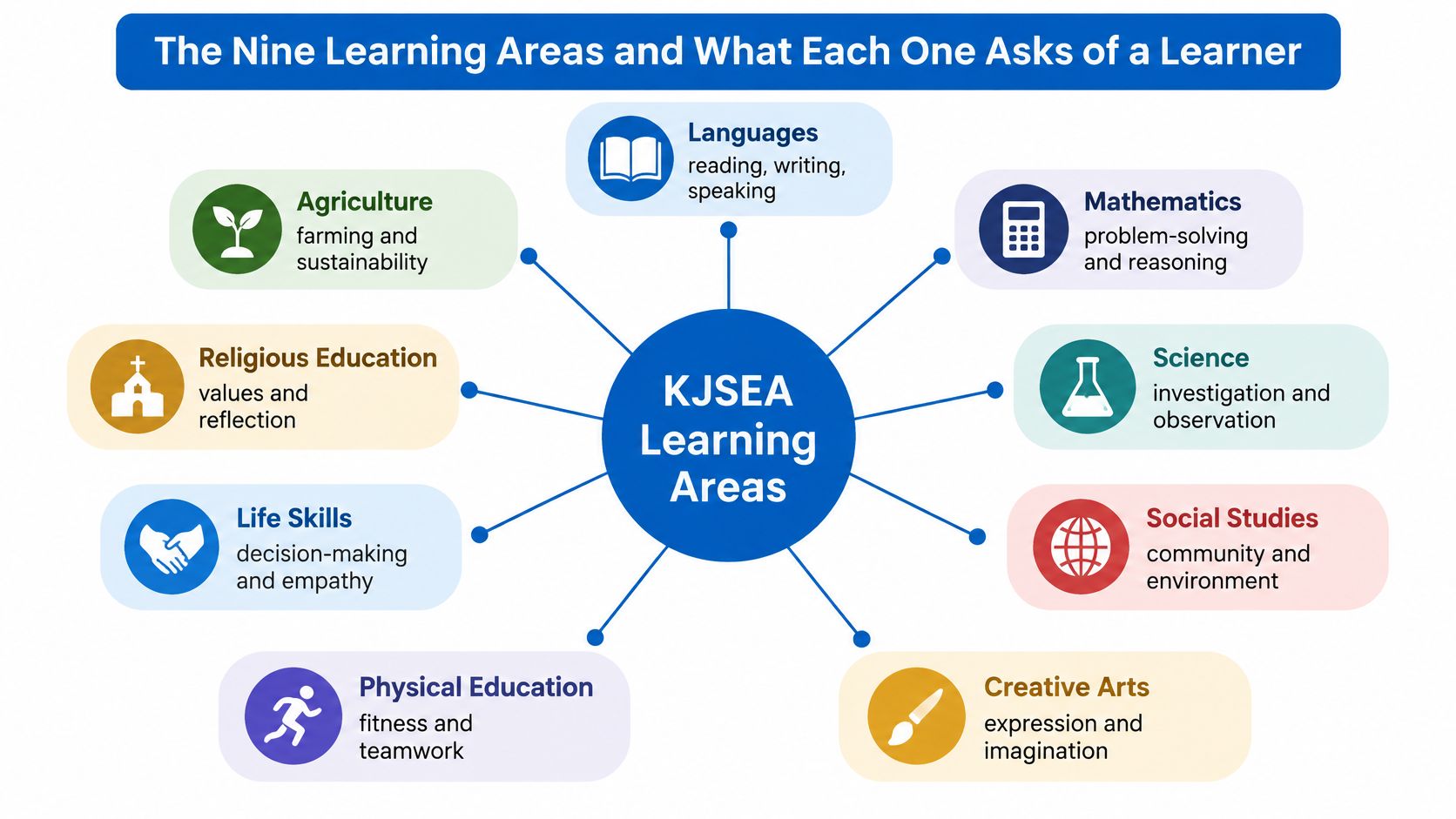
Communication, values, and society
English and Kiswahili or Kenya Sign Language ask learners to understand texts, express ideas clearly, listen carefully, and respond in fitting language. A learner might read an unfamiliar passage, answer questions about meaning, then write or sign a structured response. Good revision therefore includes reading aloud, discussing meaning, and practising clear sentences, not just memorising definitions.
Religious Education may be taken as CRE, IRE, or HRE depending on the school and learner. It asks learners to understand teachings, values, and moral choices, then apply them to everyday situations. Social Studies connects Kenya's people, environment, governance, history, geography, and resources. Learners interpret information about communities and places and explain how citizens use and protect resources.
Reasoning, investigating, and making
Mathematics asks for quantitative reasoning. Learners calculate, measure, spot patterns, work with shapes and data, and show their method. A correct answer with no working may hide shaky understanding, so practice should make thinking visible.
Integrated Science asks learners to observe, investigate, record findings, and reason from evidence. Reading about an experiment isn't the same as planning one, handling materials safely, and explaining what changed.
The remaining three areas are where families most often underestimate preparation time.
- Pre-Technical Studies asks learners to design and make. They apply practical and business related skills to tasks that develop over time.
- Agriculture and Nutrition asks learners to produce and care. Garden work, animal or crop related tasks, food knowledge, and project records all take weeks, not one evening.
- Creative Arts and Sports asks learners to perform and create. Artwork, music, drama, movement, fitness, and teamwork need rehearsal and feedback.
The decision rule is simple. Give every learning area its own revision lane, and protect time for the practical lanes early. You can't rehearse a performance, grow a crop, or complete a well documented project the night before.
How Continuous Marks Build the Final Profile
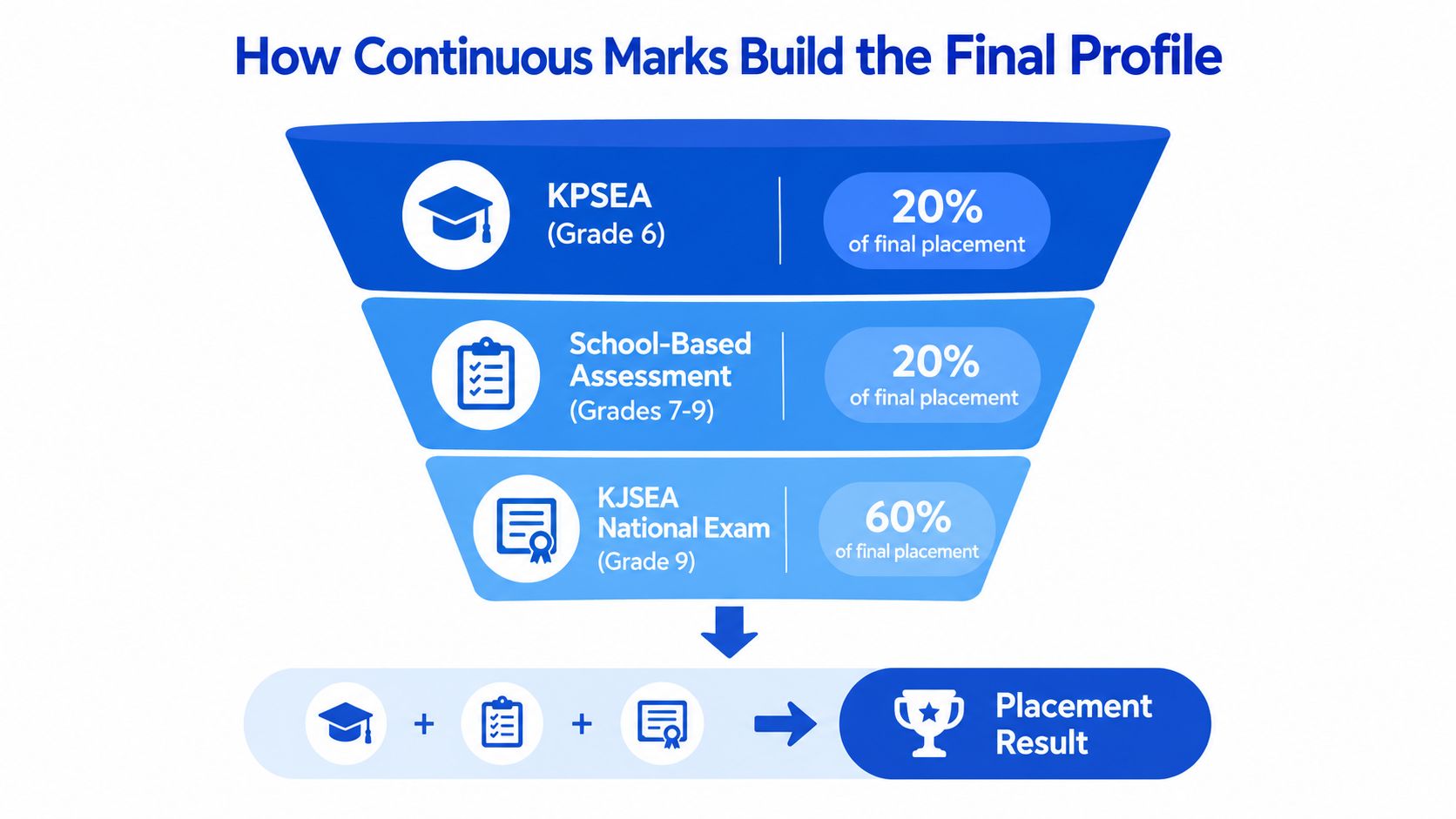
Many parents picture Grade 9 as one high stakes morning that decides everything. It isn't built that way. Published summaries describe the final placement result as combining 20% from KPSEA, 20% from school-based assessment, and 60% from the Grade 9 KJSEA summative assessment in the KJSEA grading structure summary.
Use a cooking analogy. The final Grade 9 assessment is the largest ingredient, but it isn't the whole meal. Work from earlier years is already in the pot. A strong final push helps, yet it can't completely replace ingredients that were missing earlier.
The funnel below shows how those three parts combine into one placement profile.
What families should keep and track
School-based assessment can include assignments, projects, practical work, tests, and teacher recorded continuous evaluations. Keep project drafts, marked work, and teacher feedback in one folder per learning area. When a teacher says a task will be assessed, treat the record as part of the work, not as paperwork afterwards.
For a fuller walkthrough of points and bands, read how the KJSEA grading system turns learning area scores into a final profile alongside your child's school reports. Then compare what the report says with the actual work in the folder. Gaps become easier to spot.
Practical rule: Use weekly retrieval for new work, a cumulative quiz every two weeks, and a timed mock each term so no format feels new in Grade 9.
Keep two simple records as you go. One tracks written concepts. The other tracks projects and practical tasks. If either record shows repeated weakness, schedule reteaching early while the topic is still fresh and the teacher can help.
Theory Papers, Practicals, Projects, and School Evidence Compared
Knowing the names of the subjects doesn't mean a learner is ready for how each one is assessed. This is the gap that catches many families. A child can have neat notes in every book and still be unprepared for a practical demonstration or a project deadline.
Available guidance on the assessment structure shows that English and Kiswahili have two papers, while several other areas combine theory with practical or project components, as summarised in KNEC related guidance on the Grade 9 KJSEA structure. The table below turns that structure into a planning view.
KJSEA Components by Learning Area
| Learning Area | Main Components |
|---|---|
| English | Two papers covering comprehension, language use, and writing |
| Kiswahili or Kenya Sign Language | Two papers covering comprehension, language use, and composition or signed communication |
| Mathematics | Written problem solving with worked methods |
| Religious Education | Written responses in CRE, IRE, or HRE |
| Social Studies | Written responses using source, map, and scenario material |
| Integrated Science | Theory plus practical investigation |
| Pre-Technical Studies | Theory plus project work |
| Agriculture and Nutrition | Theory plus project work |
| Creative Arts and Sports | Theory plus practical or performance work |
What changes at home
A theory paper mainly needs a quiet space, past questions, and timed practice. A practical needs materials, safe handling, observation, and accurate recording. A project needs planning, stages, evidence, and reflection over time. School evidence needs consistency, because the teacher sees the process as well as the final product.
If your home has limited space or materials, plan around school and community resources early. Ask when the laboratory, workshop, garden, art room, or field will be available. Borrow safe household substitutes for practice where a teacher approves them. Photograph stages of project work if the school allows it, so progress is easy to show.
To compare how these formats develop different skills, see the main CBE assessment methods and what each one measures before you buy more revision books. Sometimes the missing item isn't another textbook. It's rehearsal time, seeds, drawing materials, or a supervised chance to repeat a practical task.
Reading the Strands and Sub-Strands Beneath Subject Marks
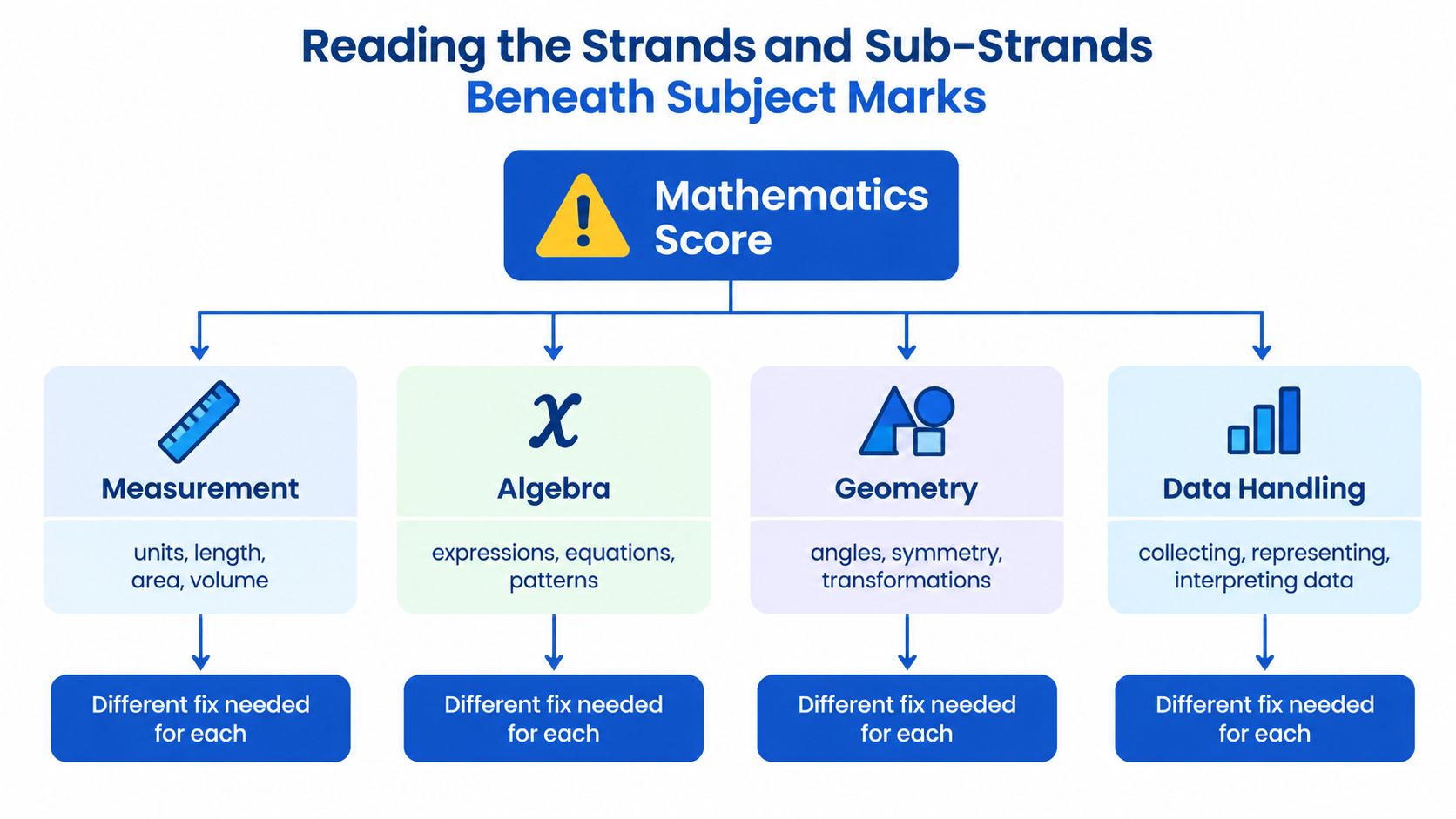
A single subject mark can hide a deeper issue. Suppose a report shows weak Mathematics. That label doesn't tell you what to practise on Monday. The weakness could sit in measurement, algebra, geometry, or data handling, and each one needs a different fix.
Kenya's Grade 9 learning areas are organised through designs issued by the Kenya Institute of Curriculum Development, with content arranged into strands and sub-strands in the official KICD Grade 9 curriculum designs. A strand is a broad thread within a subject. A sub-strand is a smaller topic inside that thread.
The diagram below breaks one Mathematics score into four possible problem areas.
A worked example at the kitchen table
Imagine your learner handles algebra confidently. They can simplify expressions and solve simple equations. Measurement tells a different story. They mix up units, rush conversions, and lose marks on area questions.
Sending that child to redo a whole Mathematics paper wastes time and patience. Target the measurement sub-strand instead. Practise reading scales, converting units step by step, and estimating before calculating. Then test measurement again and check whether the same errors appear.
Use the same logic elsewhere. In Integrated Science, a learner may describe concepts well but record observations poorly. In English, comprehension may be strong while summary writing is weak. Name the smaller skill, practise it, then reassess it.
For help labelling gaps consistently, use a plain guide to strands and sub-strands for parents and teachers when you review marked work. Write the strand name beside each repeated error in a notebook. After a few weeks, patterns appear that a single subject mark would never reveal.
Closing the Loop With CBE-Mapped Continuous Assessment
A useful weekly system has four steps. Teach a sub-strand, check understanding, reteach the weak part, and check again. Problems start when step two lives in a mark book, step three depends on memory, and parents only hear about both at the end of term.
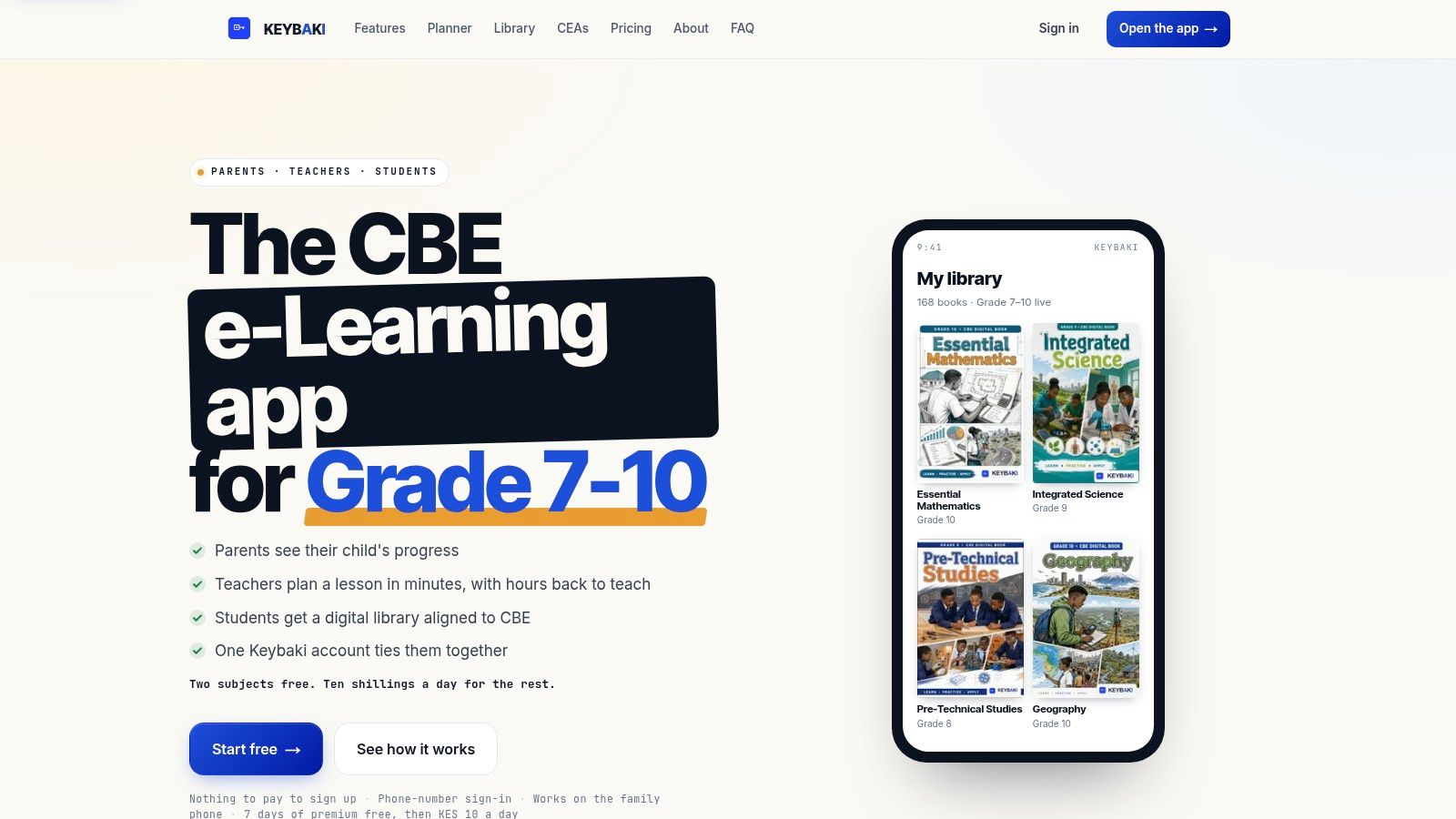
The screenshot below shows the kind of shared view that helps teachers, learners, and parents work from the same strand level information.
What a closed loop looks like in practice
A teacher sets a short check on a taught sub-strand. Results show which learners grasped it and which specific ideas caused trouble. The next lesson plan then starts with those weak ideas instead of repeating the whole topic for everyone. Learners who are secure move to harder application questions.
Keybaki is one example of a CBE-mapped platform built around this loop, with a strand organised library, a 5E lesson planner, Continuous Evaluation Assessments, national format mocks, and parent briefings on weak strands. Other tools or school systems can serve the same purpose if they keep planning, assessment, and reteaching connected without retyping the same information.
When you judge any system, ask practical questions.
- Is every question tagged to a strand? Untagged scores can't guide precise reteaching.
- Can parents see weak areas weekly? Termly surprises leave too little time to act.
- Does the result change next week's plan? A dashboard that nobody uses for planning is only decoration.
- Can learners retry similar questions? One correction rarely builds secure mastery.
The short video below is useful if you want to see how continuous checks can sit inside normal weekly teaching rather than becoming extra examination pressure.
Keep the human judgement in charge. A quiz can flag weak measurement, but a teacher decides whether the cause is unit conversion, careless reading, or a missing earlier concept. Technology should shorten the path to that decision, not replace it.
From Learning Areas to Grade 10 Pathway Choices
After Grade 9, learners choose among STEM, Social Sciences, and Arts and Sports, and families make preferred school choices as part of placement, as described in the Ministry of Education update on Grade 9 learner placement.pdf). The hard part isn't naming the three pathways. It's matching a real child's mixed strengths to a school, a track, and a subject combination.
Two common decision puzzles
Consider a learner who is strong in Integrated Science and Pre-Technical Studies but average in Mathematics. STEM may still fit, especially where technical interests are clear, but the family should ask how much Mathematics support the senior school offers. They should also check whether workshops, laboratories, and subject combinations match the learner's interests.
Now consider a learner who shines in Creative Arts and Sports and writes well in both languages. Arts and Sports may be an obvious conversation starter, yet Social Sciences could also fit if the learner enjoys debate, media, community issues, or languages. Visit the question from several sides before deciding.
- Look at evidence across areas. Projects, performances, investigations, and written work all tell part of the story.
- Check the school, not only the pathway name. Facilities, teachers, tracks, and available subject combinations shape daily learning.
- Ask the learner what work holds their attention. Interest doesn't replace achievement, but it affects effort over the next stage.
A pathway choice isn't a permanent career verdict. It is a serious choice about the subjects, facilities, and daily experience that will shape the next stage of learning.
Avoid choosing by prestige alone. A pathway that fits a learner's demonstrated strengths, curiosity, and available support gives them a better chance to keep growing.
A Weekly Rotation Plan Families Can Start Tomorrow
You don't need a complicated timetable. You need a repeatable week that touches all nine areas, gives practical work enough lead time, and leaves space when school plans change. Short, focused sessions are easier to protect than one long weekend marathon.
A simple five day rotation
- Monday pairs Mathematics with English. Practise one weak sub-strand, then read or write for a short session.
- Tuesday pairs Integrated Science with Kiswahili or Kenya Sign Language. Review an investigation record, then practise comprehension or composition.
- Wednesday covers Social Studies and Religious Education. Use scenarios and short written answers rather than rereading notes only.
- Thursday is project time. Move Pre-Technical Studies or Agriculture and Nutrition forward by one clear stage and record evidence.
- Friday or Saturday is creation and movement. Rehearse, draw, compose, train, or review Creative Arts and Sports feedback.
Keep a one page mastery record with three columns. Write the learning area and sub-strand, the latest evidence, and the next action. Separate written concepts from assessed projects so a good test score doesn't hide a stalled project.
School weeks rarely run perfectly. A sports event, a teacher's absence, or a moved assessment can knock your plan sideways. When that happens, borrow simple schedule disruption fixes from Teacher Planner, then return to the next unfinished slot instead of scrapping the whole week. Consistency after a disruption matters more than a perfect chart.
End each week with one question. Which weak sub-strand will we reteach first next week? That single decision turns revision from a pile of books into a calm, repeating loop.
Start this week by mapping your child's nine learning areas to their weakest strands, then use that map to plan short checks and targeted reteaching instead of generic revision. Keybaki brings CBE-mapped lessons, strand level Continuous Evaluation Assessments, national format mocks, and weekly parent briefings into one shared view for teachers, learners, and families. Visit today to turn this week's KJSEA preparation into a clear plan you can follow.
Comments
Loading…