
· kiswahili notes
Kiswahili Notes for CBE Learners: 10 Sources by Grade
17 min read
It's Sunday evening, a Grade 10 learner needs Kiswahili notes on listening and speaking, and your search results show different grades, prices and file types. One page offers a complete pack, another sells a single topic, and a third opens an older secondary-school archive. You need the right lesson, not another folder of uncertain downloads.
Start with the grade, then the strand and sub-strand. A resource labelled Kiswahili might contain detailed learner explanations, teacher planning notes, revision questions or only curriculum headings. Those formats serve different purposes, even when their titles look similar.
For listening and speaking, check what the learner will do in practice. Reading a definition of attentive listening isn't the same as listening to a dialogue, identifying its main message and responding appropriately. If you're making a short demonstration to accompany written notes, the ClipCreator.ai educational video guide offers a starting point for planning educational videos.
Before downloading: Open the contents or preview and find the exact sub-strand your learner is studying. A familiar subject name isn't enough.
The sources below range from curriculum-mapped libraries to downloadable packs and topic outlines. Free doesn't automatically mean complete, and paid doesn't automatically mean reviewed. Where a listing covers a particular grade, has unclear access requirements or still awaits academic review, that distinction matters more than the size of the download.
Table of Contents
- 1. Digital Library
- 2. Teachers Kenya Hub
- 3. Masomotele
- 4. Shupavu Resources
- 5. CBC Edu Kenya
- 6. Elimu Planner
- 7. Teacher.co.ke
- 8. Elimu Cloud
- 9. MwalimuFocus
- 10. ElimuKit
- How the Kiswahili notes sources compare by grade, cost and format
- Building a Weekly Kiswahili Study Routine That Sticks
1. Digital Library
Keybaki's Digital Library is the strongest starting point here if your main problem is organising learning around grade, strand and sub-strand, rather than collecting unrelated files. Its curriculum-mapped structure lets teachers and learners connect the material they're reading with the competency they're practising.
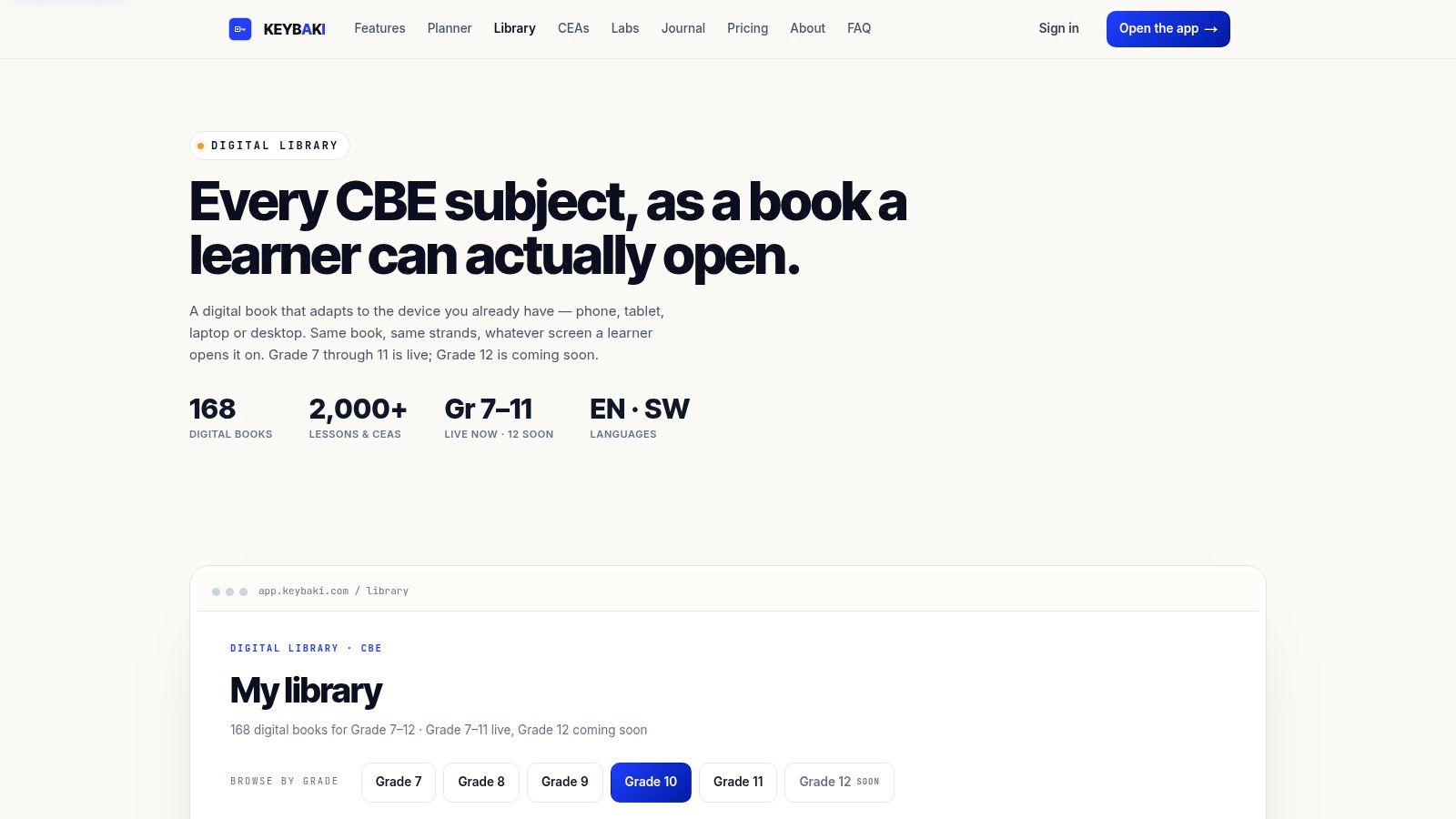
Our library is designed across Grades 7–12 and 14 subjects, with dedicated English and Kiswahili content. Our Learn stage provides grade-specific explanations, worked examples and vocabulary, while lessons connect with competency assessments and mastery reporting. For families choosing access, our student Basic plan covers selected subjects, not all Kiswahili content; Premium costs KES 10 per day after a free seven-day trial.
Where the structure helps
Say a learner can explain a language rule but struggles to apply it in a conversation. A sub-strand-based route lets you move from explanation to a practical task, then use the assessment result to decide whether to revisit the skill.
- Best fit: Teachers and families who want learning materials and assessment connected within a CBE workflow.
- Coverage check: Inspect the actual Kiswahili lesson for your grade and sub-strand. Platform-wide breadth doesn't guarantee equal depth in every topic.
- Main trade-off: Curriculum-specific organisation is useful for Kenyan CBE learners but less suitable for someone following another national curriculum.
For an overview of how curriculum mapping differs from a folder of downloads, see our guide to a CBE digital library in Kenya.
I'd choose this format when the learner needs a clear next step after revision. A downloadable pack may be simpler when the immediate requirement is a printable handout, so compare the lesson itself rather than choosing by platform features alone.
2. Teachers Kenya Hub
If you need a printable classroom resource, Teachers Kenya Hub's Grade 9 Kiswahili lesson-notes page is a focused place to begin. The site describes the PDF as free to preview and download without signing up.
The important distinction is lesson notes versus a complete independent course. A teacher can use notes to prepare an explanation or exercise, but a learner may still need instructions, oral practice and feedback that aren't obvious from the file title.
Inspect the teaching sequence
Open the preview and check whether headings follow the current curriculum design. Then examine a sample explanation: does it include a worked example, a learner activity and an answer or success criterion?
- Grade coverage: The linked resource is grade-specific, not evidence of complete coverage throughout junior and senior school.
- Strand coverage: Confirm the contents inside the PDF rather than assuming the title means every sub-strand is included.
- Format and cost: The site describes free PDF access, alongside teaching resources such as schemes and lesson plans.
The provider's KICD-alignment description isn't a KICD endorsement. Its own advice to compare resources with the latest official curriculum design is sensible.
For oral skills, supplement the document with purposeful language-learning activities, such as a paired conversation with clear listening criteria. Don't turn a speaking lesson into silent copying just because the notes are printable.
3. Masomotele
A learner who gets stuck in a long PDF may prefer Masomotele's Grade 10 Kiswahili lessons. The provider combines topic-based interactive lessons with printable notes and revision papers, and describes its lessons as free, phone-compatible and available without sign-up.
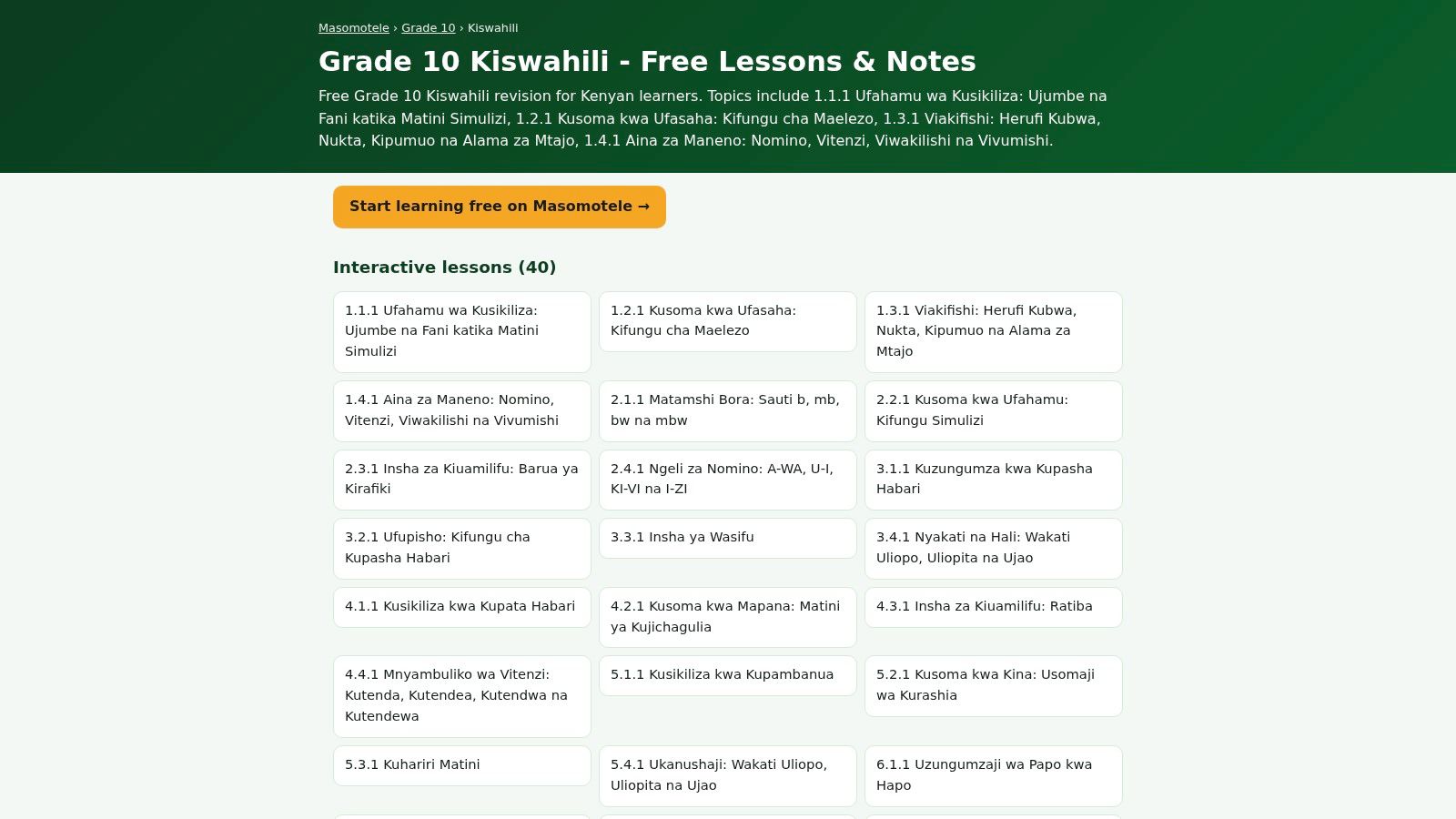
Topic selection is its practical advantage. Instead of downloading a broad pack, the learner can look for the skill currently causing difficulty, such as reading, writing, language use or listening and speaking.
Use the interaction deliberately
An interactive page is only useful if the learner does more than tap through it. Ask them to explain an answer, rewrite an incorrect sentence or give an oral response before checking the model.
- Coverage: The provider also has selected junior-school pages, but available pages don't establish a complete junior-to-senior Kiswahili course.
- Format: Interactive topic lessons suit focused screen-based study; printable PDFs suit annotation and offline revision.
- Limitation: Topic depth and the amount of available material vary by grade. Independent review evidence hasn't been established here.
For a learner preparing a broader revision plan, pair a targeted lesson with the organisation principles in this guide to secondary-school revision materials.
I'd use Masomotele for a clearly identified gap, then check the learner's work against the teacher's expectations. Don't assume completing an online activity proves competence in an unfamiliar task.
4. Shupavu Resources
Shupavu Resources' Kiswahili catalogue brings notes, examinations, marking schemes and schemes of work into a paid-download catalogue. Listings are organised by grade and document type, with some identified by term or year.
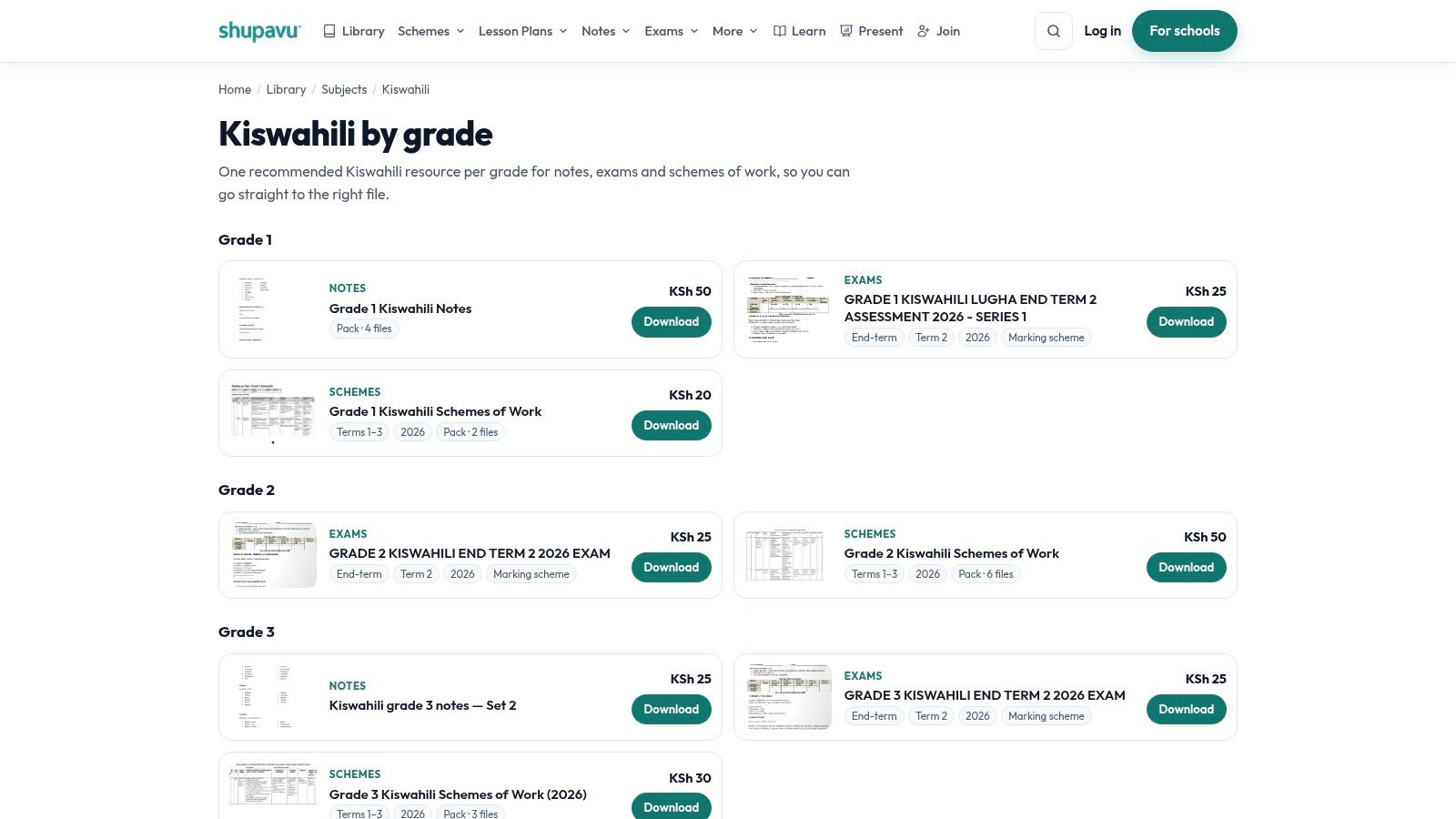
This format suits a teacher who already knows which document is missing. It's less helpful for a parent who needs guidance on what to teach next, because a catalogue doesn't necessarily provide a learning sequence.
Check the pack before payment
The product pages describe M-Pesa payment and downloadable files. Before paying, establish whether the purchase contains learner notes, teacher guidance, questions, answers or a combination.
- Grade and strand: Match the selected listing to the learner's grade, then inspect its contents for the required sub-strand.
- Cost: Treat the current product-page price as the checkout reference. Don't assume similarly named packs contain equivalent material.
- Format: Downloadable documents can support printing and offline study, but confirm the file type and delivery instructions.
A complete pack should be complete for a stated scope. It might cover a term, a strand or a grade, and those aren't interchangeable.
The catalogue's breadth isn't independent evidence of academic quality. I'd favour a listing with a useful preview and clear contents over one that relies on a large catalogue claim or an impressive-sounding title.
5. CBC Edu Kenya
The academic-review warning is the deciding detail here. CBC Edu Kenya's Grade 7 Kiswahili bundle offers a printable revision pack with worked examples, questions and answers, tests and a detachable answer booklet, but its page says the Kiswahili material is awaiting academic review.
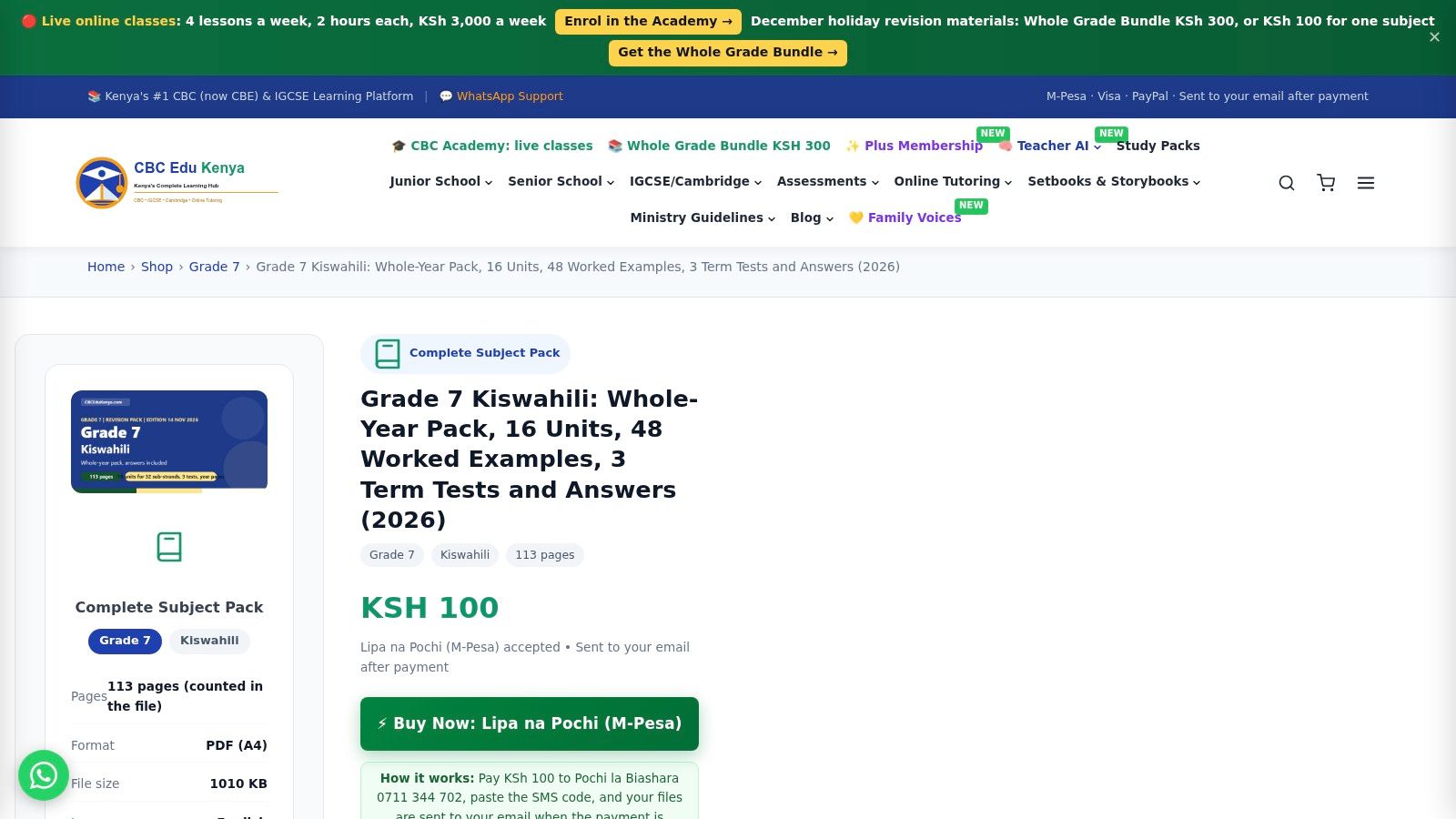
That doesn't mean every explanation is wrong. It does mean a teacher should inspect the language, answer key and curriculum match before assigning it as an authoritative revision source.
A revision aid, not the final authority
Worked examples and answers can help parents support homework without inventing explanations. However, an answer booklet is most useful after the learner has attempted the task and explained their reasoning.
- Coverage: The cited bundle is for a specific grade. Check its unit headings against the school's current teaching sequence.
- Format and cost: It's a paid PDF pack with a free preview, so inspect the sample before purchasing.
- Main gap: Pending academic review warrants closer checking, especially where a learner would otherwise memorise model answers.
For writing tasks, compare the suggested response with the actual prompt. A polished model composition won't help much if the learner doesn't understand audience, purpose or organisation.
I'd use this pack as supplementary practice under teacher guidance, not as the sole source for settling disputed grammar or marking decisions. Its transparency about review status is useful, but the checking still needs to happen.
6. Elimu Planner
Elimu Planner's lesson-notes library lists free Kiswahili resources for Grades 7 and 9, with online-viewing and download options. Its broader mixed-subject library may suit teachers gathering material for several classes.
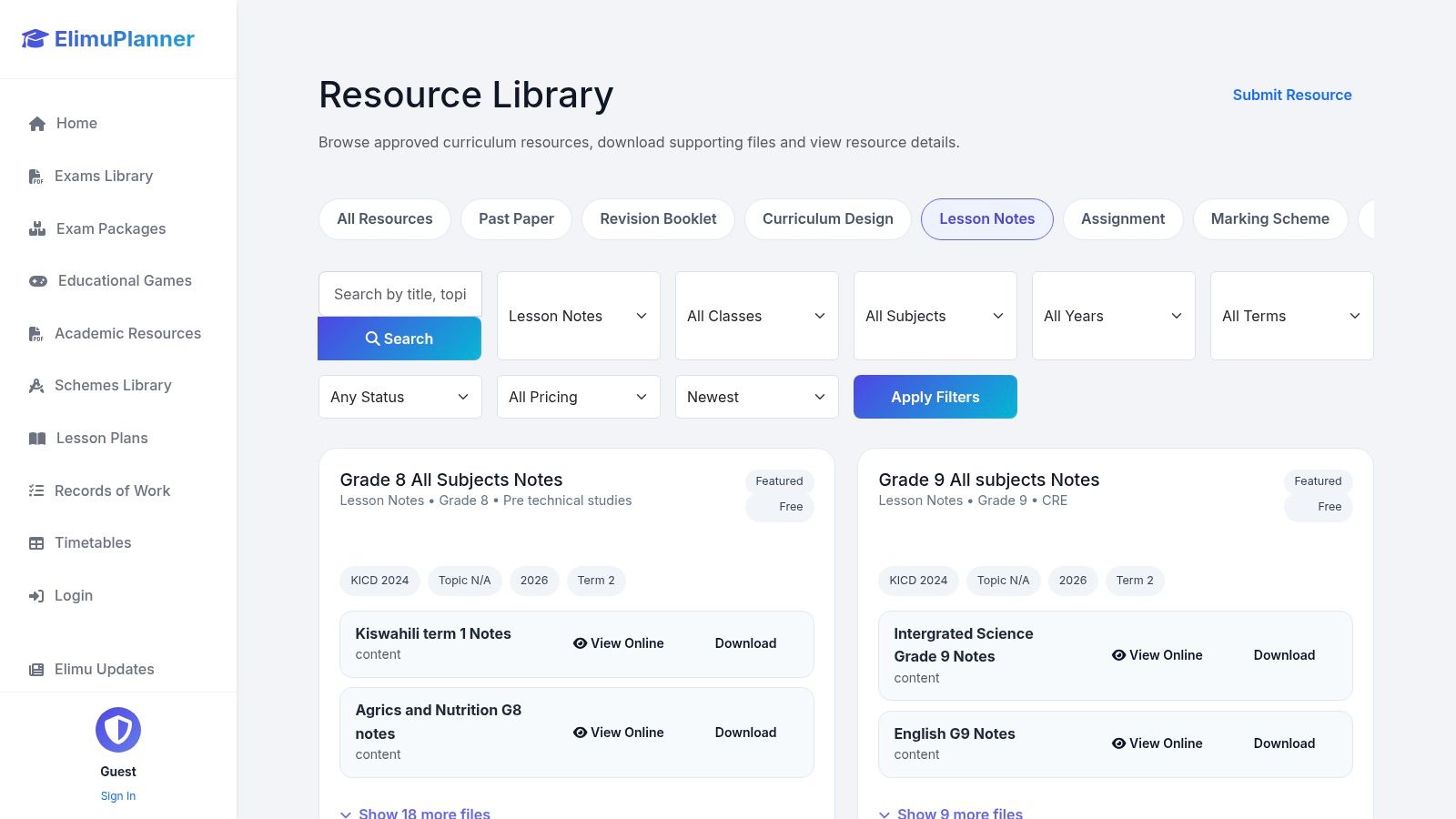
Online viewing is the feature to use first. It lets you inspect the document before adding another file to a phone or printing something unsuitable.
Let the document settle the question
Some library metadata appears incomplete or generic, so read the title page, contents and sample activities inside the resource. Check whether its curriculum and year labels agree with what the document contains.
- Best use: Finding supplementary teaching notes alongside resources for other subjects.
- Coverage limit: The listed Kiswahili documents don't demonstrate a complete course across junior and senior school.
- Strand check: Look for actual sub-strand headings and tasks, not just a broad subject label.
A practical test is to choose an upcoming lesson and locate both an explanation and something the learner must produce. If the file supplies only definitions, prepare the application activity separately.
For department use, record the exact document title and curriculum match before circulating it. That prevents a broadly labelled library entry from becoming an assumed departmental recommendation.
Free access is helpful, but it doesn't remove the need for subject review. Independent user-review evidence hasn't been established for these listings.
7. Teacher.co.ke
Teacher.co.ke's Kiswahili archive contains Form 1–4 resources covering language use, composition, poetry, oral literature and set-book guides, alongside separate CBE resource sections. The site describes its listed Kiswahili downloads as free.
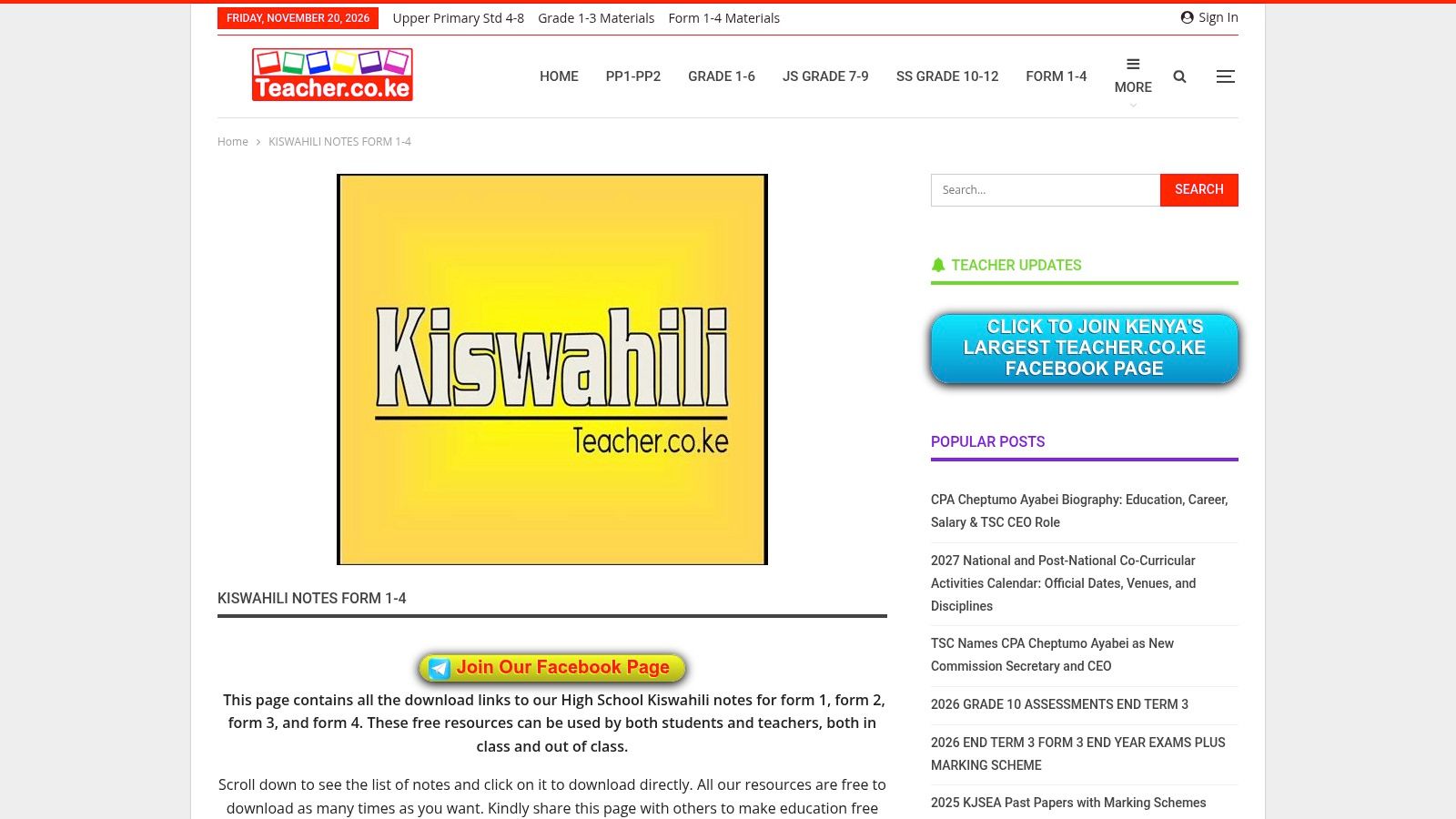
The archive can be useful when you know the topic you want. Its main weakness for CBE learners is the risk of confusing legacy material with current grade-specific coverage.
Borrow the explanation, check the task
An older grammar explanation may support a current lesson, but the teacher still needs to check terminology, depth and expected application. Literature resources need particular care because a guide's usefulness depends on the text being studied.
- Grade fit: Don't translate a Form label directly into a CBE grade.
- Strand fit: Match the specific skill or literary concept, then check the expected learner performance.
- Format: Treat the archive as a collection of files, not a structured interactive course.
Curriculum safeguard: A resource can be accurate in isolation and still be the wrong assignment for the learner in front of you.
I'd use this archive selectively for explanations and extra practice. I wouldn't give a learner an entire legacy folder and ask them to decide which pages belong to the current syllabus.
Keep the teacher's selected extract separate from the full download. That makes the intended task clearer and reduces unnecessary revision.
8. Elimu Cloud
Need a particular skill area rather than a broad pack? Elimu Cloud's secondary-school catalogue lists Grade 10 and Grade 11 Kiswahili resources, including individual topic files and broader sets.
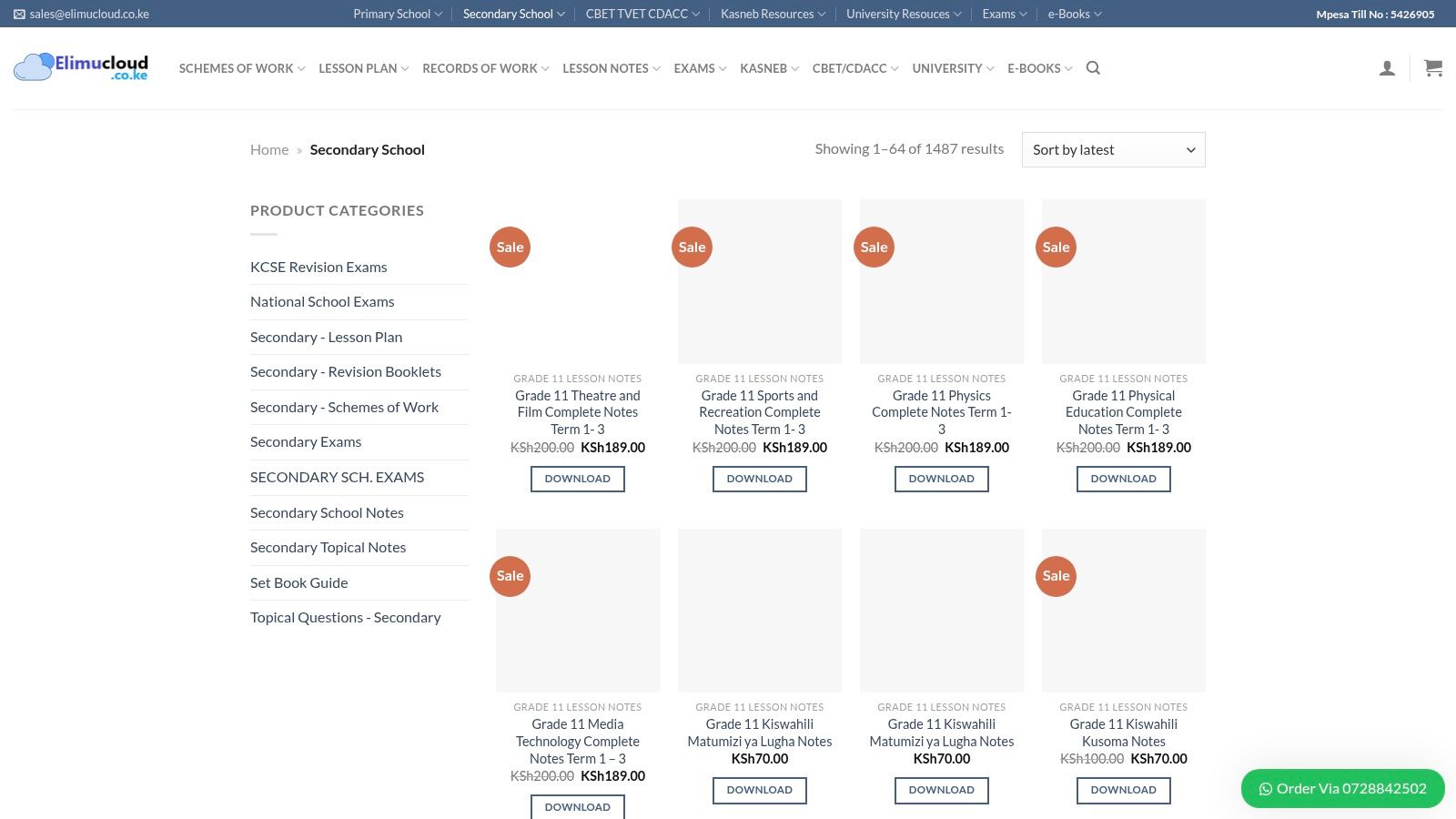
The listed areas include listening and speaking, reading, writing and language use. Buying narrowly can make sense when you've already identified the gap, but it requires more careful comparison than choosing a clearly scoped course.
Watch for overlapping purchases
A topic file, term set and complete pack may contain overlapping material. Similar titles aren't enough to tell you whether you're buying a new resource or a different packaging of the same content.
- Cost: This is a paid-download store. Compare the current listed price with the scope of the file, not just its title.
- Coverage: Confirm the grade, strand and included sub-strands before checkout.
- Format: Establish the file type, preview availability and download process on the selected product page.
Related assessment and planning resources may help teachers supplement notes. They don't automatically show that a learner-facing explanation includes suitable practice or feedback.
For listening and speaking, inspect the activity instructions especially closely. A document can guide a dialogue or listening task, but the teacher or family must still supply the spoken input if no audio is included.
I'd choose a specific file only after checking that its contents address the actual difficulty, rather than buying a broad set just in case.
9. MwalimuFocus
MwalimuFocus's Grade 11 Kiswahili page offers a complete set alongside separate files for listening and speaking, reading, writing and language use. Its listings include document details such as page counts or file sizes.
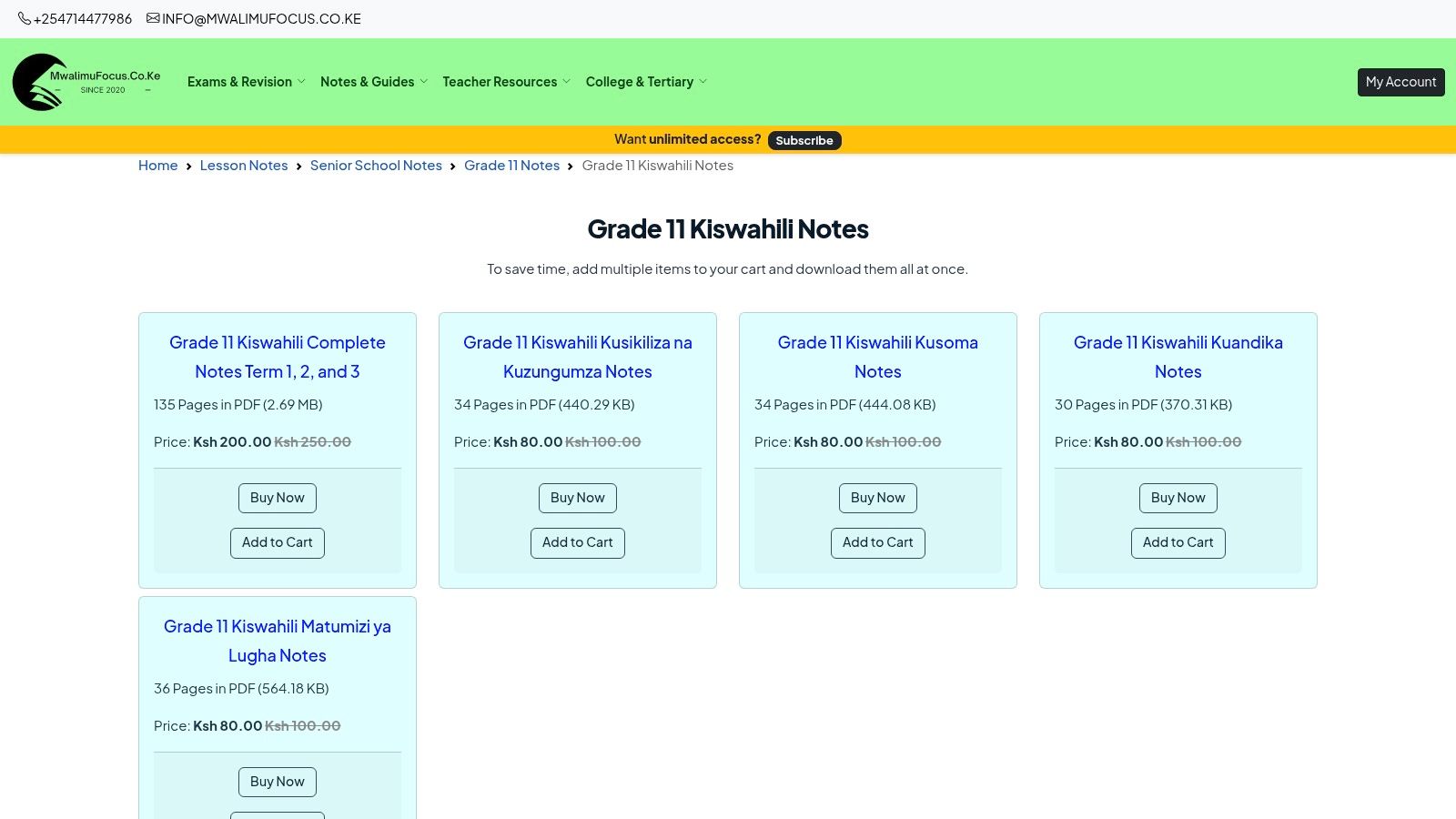
The choice between a complete set and a skill-area file is useful. A teacher planning across the year may prefer broader coverage; a learner struggling with writing may need a much narrower resource.
Choose by task, not thickness
A page count tells you the document's length, not how well it teaches. Read a sample for the balance between explanation, worked examples, independent tasks and feedback.
- Grade boundary: The linked Kiswahili page is grade-specific. It doesn't establish availability or quality for other grades.
- Cost and format: These are paid PDF resources; confirm the selected listing's current price and included files.
- Strand detail: Separate skill-area titles help navigation, but inspect the sub-strands inside each document.
For writing revision, look for guidance on planning, drafting and improving a response. A collection of model answers alone won't show the learner how to repair their own weak paragraph.
The site also sells examinations, schemes and other teaching materials, which may be convenient for classroom preparation. Keep those functions separate: planning documents aren't substitutes for learner-ready notes.
Independent user-review evidence hasn't been established here, so a sample and a curriculum check should carry more weight than the size of the pack.
10. ElimuKit
ElimuKit's notes pages provide grade-organised curriculum summaries and study prompts across Grades 1–12, including junior and senior Kiswahili. Its strength is helping users locate strands and sub-strands rather than supplying a conventional full set of lesson notes.
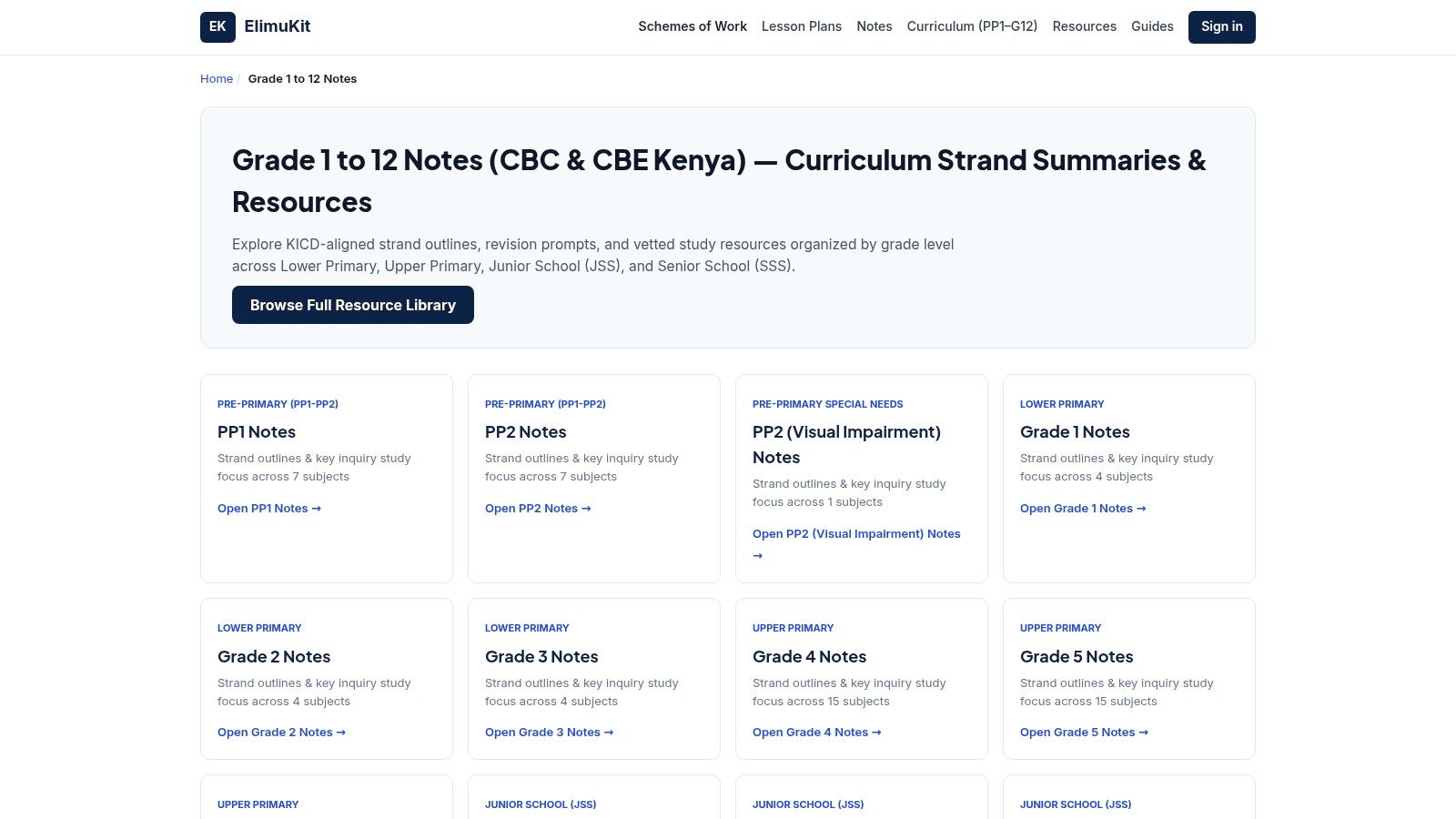
Use it as a revision map. A learner can identify a topic, turn a study prompt into a question, and then find a fuller explanation in class notes or another suitable source.
An outline needs supporting material
A heading for listening and speaking doesn't itself provide a listening passage, model response or assessment criteria. Likewise, a writing summary may identify the topic without teaching the full drafting process.
- Coverage: Grade-based outlines help with navigation, but outline breadth isn't the same as detailed lesson coverage.
- Strand use: Compare the listed sub-strands with the teacher's current sequence before building a revision plan.
- Access and cost: Check requirements on the individual resource page rather than assuming every outline includes a free downloadable pack.
The provider's description of summaries as based on KICD records isn't an independent endorsement. Teachers should still verify topic sequencing and the expected depth.
I'd use ElimuKit before choosing supplementary notes, particularly when a learner knows the subject but can't name the topic they need. It's less suitable as the only resource for someone who needs explicit explanations, worked examples and corrective feedback.
How the Kiswahili notes sources compare by grade, cost and format
| Item | Grades Covered | Cost | Format | Best For |
|---|---|---|---|---|
| Digital Library | Grades 7–12 | Not specified | Curriculum-mapped digital resource library | CBE learners seeking resources across subjects, including Kiswahili |
| Teachers Kenya Hub | Grade 9 Kiswahili notes; other resources vary | Free listed notes | Downloadable PDFs and teaching resources | Grade 9 revision and classroom preparation |
| Masomotele | Grades 7–9 and 10; coverage varies | Free, according to the site | Interactive lessons, PDF notes, and revision papers | Topic-based study with interactive lessons |
| Shupavu Resources | Multiple grades, including 7, 8, 10, and 11 | Paid; listed examples KSh 50–130 | Downloadable notes, exams, and schemes of work | Learners seeking grade-specific materials and assessments |
| CBC Edu Kenya | Grade 7 | KSh 100 | 113-page PDF revision pack with preview | Grade 7 revision with worked examples and tests |
| Elimu Planner | Listed Kiswahili resources for Grades 7 and 9 | Free listed resources | Online-viewable and downloadable notes | Teachers and learners seeking free notes across subjects |
| Teacher.co.ke | Form 1–4; separate CBE resources include Grades 7–12 sections | Free, according to the site | Downloadable archive of notes and guides | Learners seeking legacy secondary materials or literature guides |
| Elimu Cloud | Grade 10 and Grade 11 | Paid; examples range from KSh 50 to KSh 200 | Downloadable topic files and term sets | Buyers seeking specific topics or broader note sets |
| MwalimuFocus | Grade 11 cited; other grades may be available | KSh 200 for the cited complete set | Downloadable complete notes and skill-area files | Grade 11 learners seeking complete or targeted notes |
| ElimuKit | Grades 1–12 | Not specified | Curriculum strand summaries and study prompts | Learners and teachers using curriculum-guided revision references |
Building a Weekly Kiswahili Study Routine That Sticks
Choose a primary source for the grade and strand, then give it a clear job. Use a curriculum-mapped library for sequencing, a checked PDF for annotation or a topic page for targeted practice. Don't ask the learner to move between several explanations of the same concept before they've attempted anything independently.
Before paying or downloading, check the grade, year, term and contents. Use free previews to confirm that the resource matches the school's current curriculum sequence, and save files with descriptive names so they're easy to find again.
Turn revision into visible performance
Begin with the difficult skill, not the longest chapter. Ask the learner to attempt a short task before opening the notes, then use the explanation to correct a specific misunderstanding.
For listening and speaking, include spoken practice rather than relying entirely on reading. In a Kenyan instructional-resource study, 93% of respondents fully utilised audio materials, compared with 48% who fully utilised ICT resources, according to the African Journal of Educational Management, Teaching and Entrepreneurship Studies paper. For a practical home routine, a clear recorded dialogue with a transcript may be more manageable than a complex online activity.
- Read with a purpose: Find the explanation that answers the learner's actual question.
- Practise without copying: Complete a fresh response, conversation, paragraph or comprehension task.
- Check the evidence: Identify what improved and what still needs correction.
- Return later: Revisit the weak skill with a different task rather than rereading the same answer.
Keep a short record of difficult topics and review it weekly. Quotabl's forgetting curve tool can help you think about spacing revision, but use the learner's actual performance to decide what needs another attempt.
Make the routine work offline
Download permitted files while connected, print only the pages you need and prepare activities that don't depend on continuous internet. A family interview, oral summary or paired dialogue can support active practice when the resource provides clear instructions.
This matters in a shared-device household. The Communications Authority and KNBS survey reported internet use by about 35% of Kenyans, so continuous online access shouldn't be assumed.
End the week with a concrete decision: move on, practise again or ask the teacher for clarification. The best Kiswahili notes are the ones that help the learner produce better work, not just accumulate more pages.
Keybaki offers CBE-mapped Kiswahili learning materials organised by grade, strand and sub-strand, with assessments that help identify what to practise next. Visit Keybaki to explore the library and choose a lesson that matches your learner's current topic.
Comments
Loading…