
· track math progress
Grade 8 Mathematics in Kenya: Strands, Skills and Progress
15 min read
It's Thursday evening, and the exercise book is open between the plates. Your Grade 8 child has a neat tick beside x = 5. Ask why they subtracted 4 first, and the room goes quiet. Last week's shirt discount came out in the right shillings, yet they still can't say what 15% means at the shop counter, or why an M-Pesa charge isn't “just a small fee”. A copied method can look like success. Grade 8 mathematics under Kenya's Competency-Based Curriculum asks for something you can hear: a reason, a check, and a skill that still works when the numbers change.
Table of Contents
- Grade 8 Mathematics Strands and Sub-Strands at a Glance
- How the Official Grade 8 Design Guides Your Teaching
- Why a Correct Answer Is Not Enough and How to Track Real Understanding
- How to Solve a Grade 8 Problem Step by Step
- A Weekly Practice Routine That Builds Real Skills
- Choose Your Next Step for This Term
Grade 8 Mathematics Strands and Sub-Strands at a Glance
Start with the map, not a pile of past papers. Grade 8 mathematics is organised into strands, and each strand breaks into sub-strands in the official design. The table below is a working map for class and home: five strands, the sub-strands a learner typically meets, the skill to master, and one task you can set tonight.
| Strand | Key sub-strands | Core skill | Sample task |
|---|---|---|---|
| Numbers | Fractions, decimals, percentages, ratio and proportion | Convert between fractions, decimals and percentages | Write 3/8 as a decimal and as a percentage |
| Algebra | Algebraic expressions, simultaneous equations | Simplify expressions and solve for two unknowns | Solve x + y = 10 and 2x - y = 5 |
| Geometry | Polygons, angle properties, constructions | Classify polygons and construct with ruler and compass | Construct the perpendicular bisector of a line |
| Measurement | Area, perimeter, volume, time, money | Calculate with correct units | Find the floor area of a classroom that is 6 m by 4 m |
| Data and Probability | Collecting and reading data, averages, chance | Read tables and graphs and find the mean | Find the mean of five test scores |
Check the exact strand names against the current KICD listing before you lock a scheme of work. Titles shift in small ways between printouts, and a homework label that doesn't match the design makes later tracking messy.
How one weak strand shows up in another
These strands are not separate subjects. A fraction skill is reused the moment percentages and ratio appear. 3/8 is 0.375, which is 37.5%. That same conversion sits inside a shop discount and inside “3 parts out of 8”. Algebra borrows the same balance idea: what you do to one side, you do to the other. Measurement borrows units from number work. A classroom 6 m by 4 m has a floor area of 24 square metres only if the learner multiplies length by width and keeps the unit. Drop the unit and the number is no longer a measurement.
Data work leans on all of that. A mean is an addition and a division, often of awkward decimals. Chance language (“likely”, “even chance”) only makes sense if the learner can read a table first.
Practical rule: When a learner is weak in one strand, look for the shared skill, not a new topic name. A percentages mistake is often a fractions mistake wearing different clothes.
Parents get confused when the exercise book jumps from polygons to money in one week. That jump is normal. The question to ask is which sub-strand is being practised, and whether the learner can do the sample task without copying the line above it.
How the Official Grade 8 Design Guides Your Teaching
The authority for this work is the Kenya Institute of Curriculum Development. KICD's Grade Eight designs include a dedicated Grade Eight Mathematics curriculum design, published alongside designs for English, Kiswahili, Integrated Science, Social Studies, Creative Arts, Agriculture, and Pre-Technical Studies. Mathematics is its own learning area in junior school, not a warm-up for a later exam. Plan from that design's strands and learning outcomes. Don't plan from a separate exam-prep syllabus written outside the CBC.
KICD's materials are meant for learners, teachers, school administrators, parents, and other stakeholders, so the design is a shared reference, not a staff-room secret. Parents can ask the school for it and check that homework matches a named outcome. A fuller walk-through of how those documents fit together sits in our guide to KICD curriculum designs.
A four-step check before you set work
- Find the strand. Locate it in the design, not in last year's revision booklet.
- Read the full learning outcome. The title is a label. The outcome says what the learner should explain, apply, or justify.
- Match the task. If the question only asks for a final number, it may miss an outcome that asks for a reason.
- Note the gaps. Any outcome with no practice yet goes on next week's list.
Outcomes describe what a learner can do. “Covered algebraic expressions” is not the same as “can simplify an expression and say which term was combined”. Grade 8 is a stage in its own right. Treating it as revision for Grade 9 pushes learners to memorise methods they can't yet defend.
The Kenya National Examinations Council's 2024 Grade 7 and 8 School-Based Assessments guidance confirms that Grade 8 learners were included in the national school-based assessment cycle. Marks from class work are part of that cycle, so a Friday quiz is not a private drill that disappears on Monday.
During a lesson, real-time student response tools let you see who can state the reason before you move on, instead of waiting for the exercise book to come in. Use them to sample one outcome, not to race through every sub-strand in a period.
Why a Correct Answer Is Not Enough and How to Track Real Understanding
A driving test checks manoeuvres in a set route. Real driving means reading traffic and explaining a choice. Grade 8 mathematics works the same way. A final answer can be right while the thinking is borrowed.
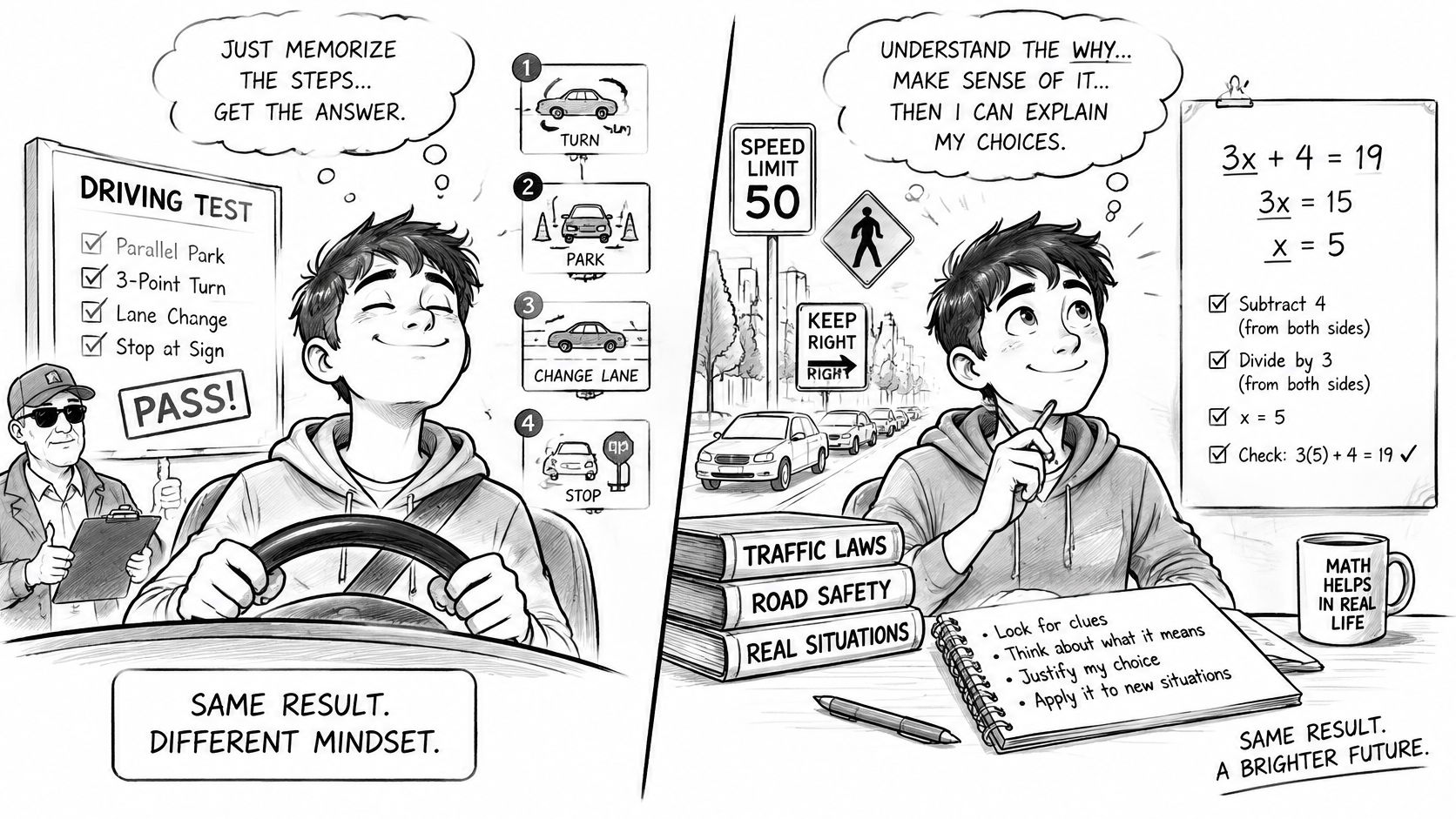
Take 3x + 4 = 19.
A procedure-only learner writes x = 5 and stops. A competent learner shows three moves. Subtract 4 from both sides to get 3x = 15. Divide both sides by 3 to get x = 5. Check by substituting: 3 × 5 + 4 = 19. The answer didn't change. The evidence did.
The Basic Education Curriculum Framework treats mathematics as a foundation for later STEM learning, because it builds numeracy for number sense, quantitative reasoning, spatial understanding, and everyday use. The same framework names reasoning, manipulation, presentation, value judgment, and application of knowledge as signs of generic competency. A high score built only from final answers can misrepresent mastery. In class, the four competencies to watch are reasoning, communication, problem solving, and application.
The Star's report on the first junior-school assessment notes that the assessment was built around written, structured, and practical tasks, not mainly multiple-choice recall. Classroom assessment in Grades 7 and 8 contributes 40% of the junior-school result, and the Grade 9 KJSEA contributes 60%. Much public Grade 8 material still lists fractions, algebraic expressions, simultaneous equations, constructions, and polygons, without showing how a learner should explain a method or move it into an unfamiliar situation. More solved exercises, on their own, don't close that gap.
Four kinds of evidence
A strand-level check should record at least four evidence types: a correct answer, logical reasoning, method selection, and application to an unfamiliar situation. Each weak type needs a different reteach. Short computation plus a structured response, where the learner shows the method and explains the conclusion, is a sound mix. For question design that forces that explanation, see how to write effective quiz questions. Our notes on formative assessment show how to use those checks before a score is final.
| Evidence | What it shows | How to record it | Reteach action if weak |
|---|---|---|---|
| Correct final answer | Calculation accuracy | Tick per sub-strand in a log | Short drill on the same sub-strand |
| Method written with working | Method selection and procedure | Note whether the method fits the question | Redo two examples, comparing two methods |
| One-sentence reason given | Conceptual understanding | Mark the reason as sound, partly sound or missing | Reteach with a diagram or physical model |
| Unfamiliar real-life problem solved | Transfer to new situations | Score 0 to 2 for independence | Practise problems in new contexts such as budgeting |
A tick shows calculation accuracy. Written working shows whether the method fits. One sentence (“I subtracted 4 because it was added to 3x”) shows concept. A new context, such as splitting a household budget, shows transfer. If the cause is a slip in arithmetic, drill the operation. If the strategy is clumsy, compare two methods. If the idea is missing, use a diagram or counters. If transfer fails, change the story, not the numbers.
Keep a two-week log with four columns: date, sub-strand, evidence type, and a one-word cause (concept, calculation, strategy, or transfer). Every fortnight, teach the sub-strand that appears most often. That is more honest than another mixed test.
This short clip shows why talking through a method beats silent copying. Watch it with a learner, then pause and ask them to finish one line of working out loud.
How to Solve a Grade 8 Problem Step by Step
Use the same routine every time, whether the topic is money, area, or equations. The point of each step is to stop a rush to the answer.
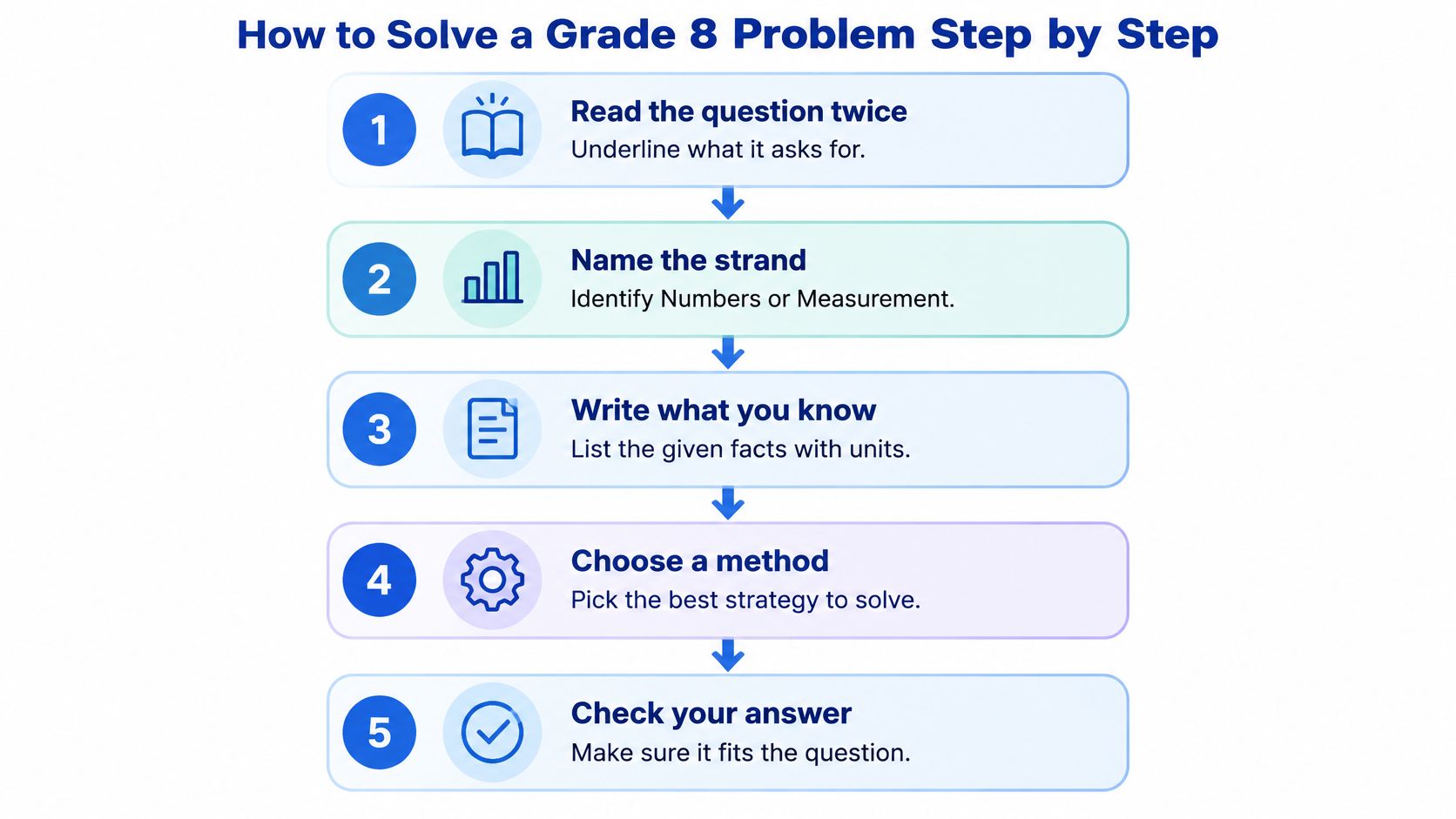
- Read the question twice and underline what it asks for. The first reading finds the story. The second finds the actual demand, such as “new price” rather than “discount”.
- Name the strand, for example Numbers or Measurement. Naming it tells you which tools are legal. A money question that needs a percentage is still a Numbers skill.
- Write what you know, with units. Bare numbers drift. KES 800 and 15% can't be added to each other.
- Choose a method and say in one line why it fits. “I'll find 15% of 800, then subtract, because the question wants the price after the discount.”
- Solve with working on separate lines. One operation per line makes a wrong step visible.
- Check by substituting back, or by estimating. A wild answer fails a rough test even when the arithmetic looks tidy.
- Write a one-sentence answer with units. The sentence must match the underlined demand.
A shirt at KES 800 with 15% off
Method A, building from 10%. Ten percent of 800 is 80. Five percent is half of that, 40. The discount is 80 + 40 = 120. The price is 800 − 120 = KES 680.
Method B, a single multiplication. 0.15 × 800 = 120, and 800 − 120 = 680. Same destination, different path. A learner who can do both isn't tied to one layout in the textbook.
The check. Fifteen percent is a little over one seventh. One seventh of 800 is about 115, so a discount near 120 is reasonable. An answer of KES 15, or of KES 785, fails that test.
The answer sentence: the shirt costs KES 680 after the discount.
Two slips that look like carelessness
Taking 15% as KES 15. Percent means “out of 100”, so 15% of 800 is not 15 shillings. If a learner does this, they haven't connected percent to a fraction of the price. Go back to “15 out of every 100”, using KES 100 first, then scale to 800.
Writing the discount and forgetting to subtract. The working shows 120, and the learner stops. Underline “after the discount” again. The question never asked for the discount alone.
If two methods disagree, don't average them. Re-do the line where the numbers first differ, then estimate again.
Say the same routine on a simpler check: a notebook at KES 200 with 10% off should land at KES 180. If that one fails, don't move to 15% yet. The routine is only useful when the learner can say why the method fits, not when they recite the seven steps from a poster.
A Weekly Practice Routine That Builds Real Skills
Long Saturday cramming fades by Monday. A better pattern is 20 to 30 minutes on five days, one job per day, always with working you can hear. Our notes on mathematics teaching strategies sit well beside this rhythm, and teachers running part of the week online can explore better online teaching methods so a short session stays interactive instead of becoming a silent worksheet.
What each day is for
- Day one, one sub-strand. Set three questions at the level of the sample tasks, plus one explained aloud with the word because. “I converted 3/8 to a decimal because the next line asks for a percentage.”
- Day two, a Kenyan context. Check an M-Pesa charge against the table, work a shop discount, or scale a recipe from 4 people to 6. The learner must say which fact came from the story and which came from a calculation.
- Day three, the wrong one. Redo a single mistake with a different method. If Method A failed, try Method B, then compare the lines.
- Day four, data from life. Use a newspaper graph or a family spending record. Find one mean, and say what the mean hides (one large shop trip can pull it up).
- Day five, mixed review. Four short items from different strands, then a self-check: right answer, sound reason, units present. Stop when the time is up, even if a sixth question is tempting.
When the regular design is not the right one
Kenya's Grade 8 mathematics is an inclusive entitlement, not one uniform course. KICD's hearing-impairment Grade 8 designs include Grade 8 Mathematics for learners with hearing impairment, and the institute also provides Grade 8 designs for other special-needs contexts. That pathway is not “the same work, made easier”. It calls for accessible communication, differentiated activities, and a clear presentation of the ideas.
For a learner using that design, keep diagrams, written instructions, sign-supported or written explanations, and hands-on objects such as counters or a metre rule. Check any worksheet against the relevant KICD design and the learner's needs before you use it for teaching or assessment. Inclusion sits with the school, not as an optional extra for one teacher. A resource that can't be traced to the right design shouldn't be the basis of a mark.
Choose Your Next Step for This Term
You don't need a new textbook to change the next fortnight. You need the log, the official design, and four moves.
- Pick the weakest sub-strand from the last two weeks. If “percentages” appears more than “polygons”, percentages win, even if polygons feel harder to teach.
- Find its learning outcome in the official design. Copy the outcome in the learner's words at the top of the page.
- Practise five questions in that sub-strand with working shown. At least one should be a shop, budget, or charge story.
- Take a 10-minute check on the same sub-strand. Compare it with the log, not with a class average.
Repeat the cycle each fortnight until that sub-strand stops appearing as the main cause. A notebook and the design are enough.
If you want a platform beside that routine, Keybaki is one option, not a requirement. Our CEAs let a learner test one sub-strand, a whole strand, or a full subject, with questions drawn at random so the same set never repeats. Show-your-working items give partial credit against the strand the child got partly right, which matches the evidence log better than a bare tick. Students can study in three taps: pick weak spots from the latest CEAs, work a queued list of lessons and activities, and prove progress with a 10-minute CEA. Use that only for step 4 if it helps. The four moves still stand if you never open an app.
Keybaki is a competency-based platform built in Nairobi for Kenya's CBE, with Grade 8 mathematics organised by strand and sub-strand, lessons you can revisit, and checks that ask learners to show working rather than only a final number. Use it to turn this term's weakest sub-strand into a short practice queue and a 10-minute proof of progress. Visit Keybaki when you are ready to put the next fortnight's log on a shared map for teacher, parent, and learner.
Comments
Loading…