· lesson planning kenya
KICD Curriculum Designs: A Practical Guide for Teachers
18 min read
On Sunday evening, a Grade 7 Mathematics teacher sits at the kitchen table with the official KICD design, two different photocopies and a half-finished scheme of work. The strand names don't match, the assessment column is blank, and the teacher isn't sure which version should guide Monday's lesson.
That situation is common because KICD curriculum designs are detailed working documents, not quick topic lists. Used properly, they connect what a teacher plans, what learners do, what evidence the teacher collects and what happens next when some learners haven't mastered the outcome.
The official KICD curriculum designs are organised as grade-by-grade documents. Each learning area is mapped into strands and sub-strands, with learning outcomes, learning experiences and assessment guidance placed at the sub-strand level. That structure makes weekly planning and mastery tracking auditable because a teacher can trace an activity to a named curriculum unit instead of a generic topic.
Table of Contents
- What a KICD Curriculum Design Actually Is
- Inside the Document Strands, Sub-Strands and Outcomes
- The Four Assessment Approaches in CBE
- Mapping a 5E Lesson Plan to a Named Sub-Strand
- Closing the Planning Assessment Loop Each Week
- Finding the Right Design Version and Avoiding Old PDFs
- Senior School Readiness and the Grade 9 to 10 Transition
- Practical Checklists for Teachers Parents and School Leaders
What a KICD Curriculum Design Actually Is
A KICD curriculum design is the official planning reference for a learning area and grade. It sits above the textbook, scheme of work and lesson plan. The design tells the teacher what learners should achieve, while the scheme of work distributes that content across the term and the lesson plan turns one part of it into classroom activity.
The document isn't a textbook. It won't replace teacher explanation, learner notes, examples or locally available resources. It also isn't a scheme of work, because it doesn't record the teacher's exact weekly timetable, class context or adjustments. Its value is that every one of those working documents can be checked against the same curriculum source.
Practical rule: Start with the named sub-strand and learning outcome, not with the textbook chapter.
The official designs include strands, sub-strands, specific learning outcomes, suggested learning experiences, resources and assessment guidance. A teacher can therefore move through a clear sequence:
- Identify the learning area and grade.
- Locate the relevant strand and sub-strand.
- Read the learning outcomes carefully.
- Select activities that produce visible evidence.
- Record assessment against the outcome.
- Use the evidence to adjust the next lesson.
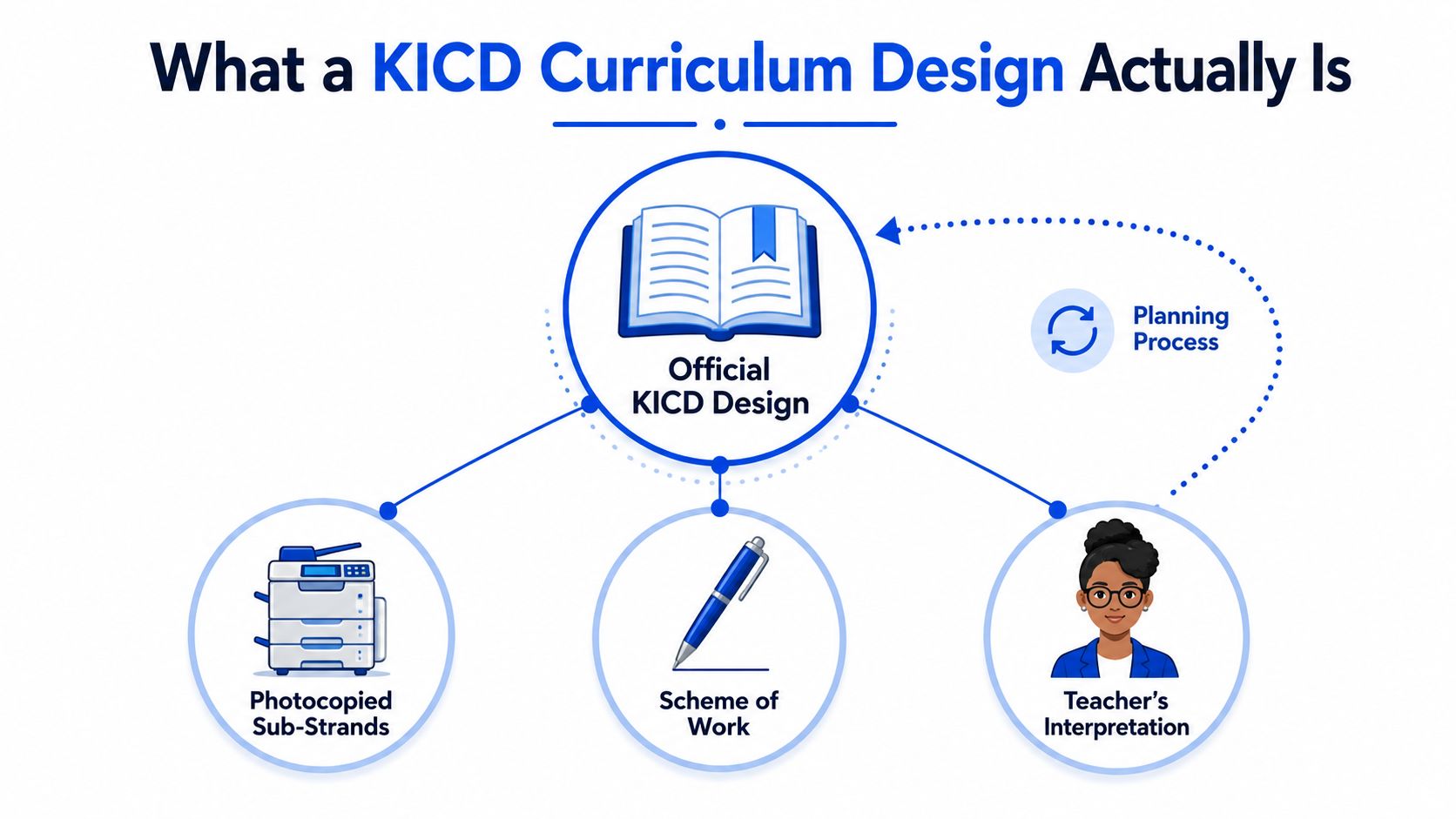
This is what makes the design more than a compliance document. A parent report, lesson plan or continuous assessment record should point back to the same curriculum language. When that chain is intact, a teacher can explain not only what was taught, but also why a particular task was used and which outcome it measured.
The rest of the work depends on reading the document accurately. You need to distinguish a broad strand from a teachable sub-strand, interpret the outcome as evidence to collect, select an appropriate assessment approach and confirm that the PDF is the current edition before building a term plan.
Inside the Document Strands, Sub-Strands and Outcomes
Read a KICD design from the outside in. At the top is the learning area, such as Science and Technology or English. Inside it are broad strands, which group related knowledge and skills. Each strand contains sub-strands, the more focused units that a teacher can plan, teach and assess.
A Grade 7 Science lesson might be organised like this:
- Learning Area: Science
- Strand: Energy and Motion
- Sub-Strand: Forms of Energy
- Learning Outcome: An observable statement describing what the learner should demonstrate
The exact wording must come from the design being used. Don't turn the outcome into a broad intention such as “learners will understand energy”. A useful outcome helps you decide what learners should say, identify, compare, make, demonstrate or explain, and therefore what evidence belongs in the assessment record.
The design also places suggested learning experiences, resources, inquiry questions and assessment guidance alongside the sub-strand. Those details help the teacher choose an activity that fits the intended competency instead of forcing every outcome into a written exercise.
| Curriculum Level | Example: Grade 7 Science | Purpose |
|---|---|---|
| Learning Area | Science | Defines the subject context |
| Strand | Energy and Motion | Groups connected concepts and skills |
| Sub-Strand | Forms of Energy | Identifies the teachable planning unit |
| Learning Outcome | Observable learner performance | Defines the evidence to collect |
| Suggested Experience | Investigation, discussion or demonstration | Shows possible routes to learning |
| Assessment Guidance | Task, observation or rubric evidence | Supports a defensible judgement |
A strand can span several weeks or approximately half a term, while a sub-strand is usually the smaller unit used for focused teaching. Kenya-focused curriculum guidance describes sub-strands as commonly covered within one to three weeks, and notes that many Grade 7 and Grade 9 learning areas contain roughly 14 to 22 sub-strands. The strand and sub-strand guide offers a further explanation of how this hierarchy works in classroom planning.
The seven core competencies should not be added as decoration after the lesson is written. Select the competency that the activity develops. A group investigation may create evidence of communication and collaboration, while a learner's explanation of a surprising result may reveal critical thinking. The suggested pedagogical approach helps you create that opportunity.
Once the hierarchy is clear, mapping becomes straightforward. You can place the strand and sub-strand in the planner, copy the specific outcome, choose the evidence, and then identify the competency demonstrated through the activity.
The Four Assessment Approaches in CBE
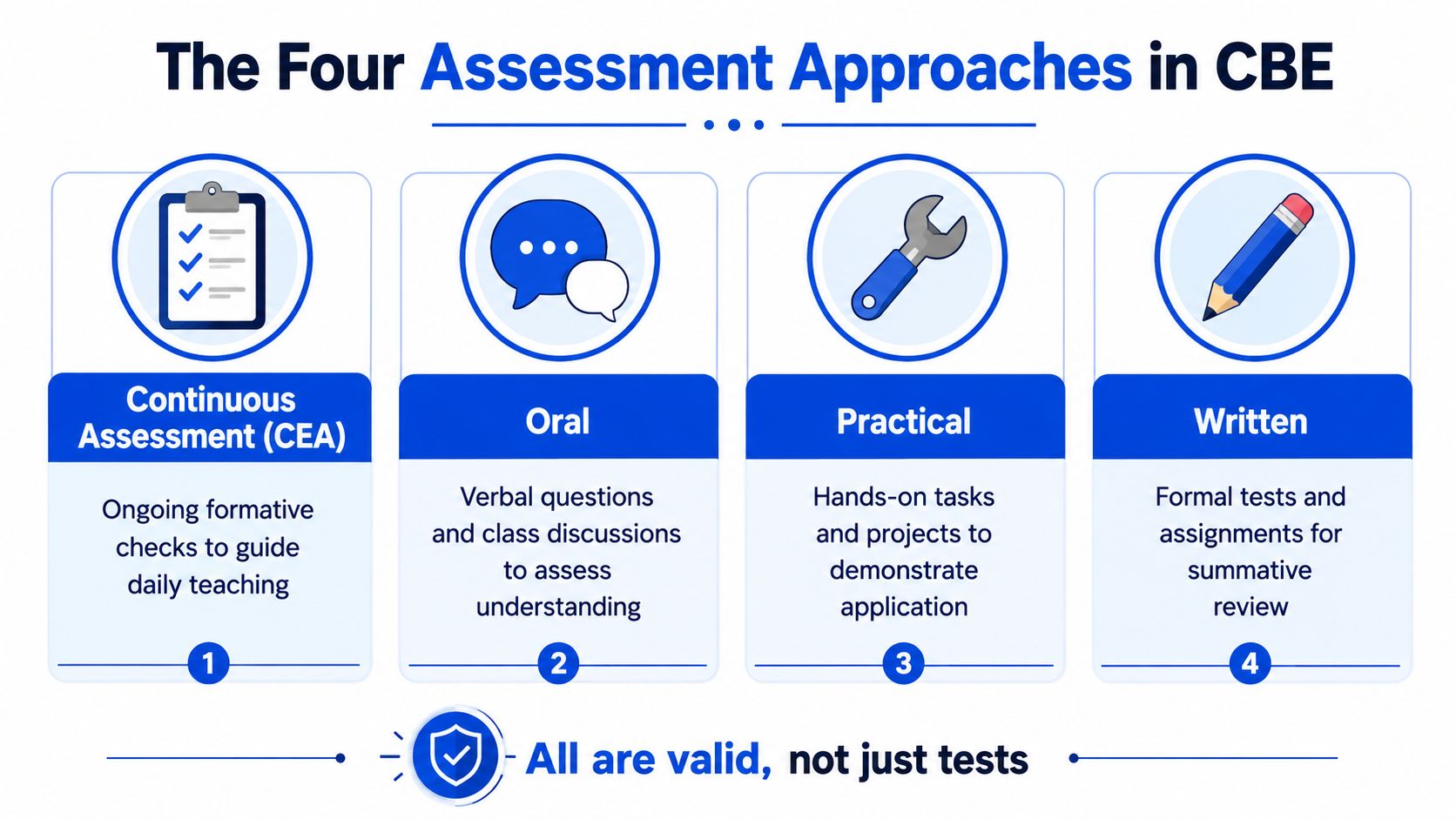
Assessment in CBE isn't a separate event that happens after teaching. It is the process of collecting evidence against a learning outcome. The four commonly used approaches, continuous assessment, oral, practical and written, give the teacher different ways to see what a learner can do.
A Grade 7 English teacher might use oral assessment during a Speaking and Listening activity. A written comprehension response can provide evidence for a Comprehension sub-strand. A practical performance can suit a Creative Writing task where learners produce and present work, while a written exercise may be appropriate for a Grammar outcome.
The approach must follow the outcome. If the outcome asks learners to communicate ideas orally, a silent written test alone won't provide sufficient evidence. If it asks learners to apply a process, observation of the process matters as much as the final answer.
Continuous assessment is broader than tests
CEA includes the ongoing checks a teacher makes during instruction. These may include questioning, observation, short tasks, learner demonstrations, peer responses and written work. The point is not to create a test for every lesson. The point is to gather enough relevant evidence to decide whether the learner is approaching the intended outcome.
The provided planning guidance describes a weighting logic of approximately 60 percent teacher observation and 40 percent written work. That proportion should be applied only where it fits the approved assessment guidance for the learning area and task. A teacher shouldn't convert every observation into an arbitrary mark. Instead, record evidence against the specific learning outcome and use the rubric descriptors consistently.
Record evidence at the right level
A useful CEA record answers three questions:
- Which sub-strand was assessed?
- Which learning outcome was measured?
- What did the learner demonstrate?
That record can sit in a portfolio with the task, rubric, observation note or learner product. It gives the teacher a basis for feedback and makes the next planning decision more precise.
Written work has a place, but it can't show every competency. Oral questioning can reveal immediate understanding, while practical work can show application. A balanced assessment record mirrors the curriculum structure rather than treating “assessment” as a single test column.
Mapping a 5E Lesson Plan to a Named Sub-Strand
A reliable lesson plan begins with a precise outcome. Consider a Grade 8 English lesson under the Listening and Speaking sub-strand, using learning outcome LO8.1.1, identifying the main ideas in oral narratives.
The teacher should keep the curriculum wording visible while planning. The activity, question, resource and assessment evidence must all help learners demonstrate that outcome. Communication and Collaboration is a natural core competency where learners listen, discuss and justify the main idea they have identified.
| 5E Phase | Learning Activity | Sub-Strand Outcome | Core Competency | CEA Evidence Collected |
|---|---|---|---|---|
| Engage | Ask learners what helps them remember a story heard aloud | Identifying main ideas in oral narratives | Communication and Collaboration | Initial oral responses |
| Explore | Play or read an oral narrative while pairs note important points | Identifying main ideas in oral narratives | Communication and Collaboration | Pair listening notes |
| Explain | Groups state the main idea and explain which details support it | Identifying main ideas in oral narratives | Communication and Collaboration | Group explanation |
| Elaborate | Learners compare the main idea with a second narrative or change of viewpoint | Identifying main ideas in oral narratives | Communication and Collaboration | Individual or paired application |
| Evaluate | Each learner states or writes the main idea and one supporting detail | Identifying main ideas in oral narratives | Communication and Collaboration | Short CEA rubric |
The lesson plan resource can help teachers think about the relationship between lesson phases and curriculum evidence, but the design remains the authority for the outcome and assessment expectations.
Fill the planner before writing activities
Your planning sheet should include at least these columns:
- Strand
- Sub-strand
- Specific learning outcome
- Learning activity
- Resources
- Core competency
- Assessment evidence
- Learners requiring follow-up
For the example above, resources might include a teacher-read narrative, an audio recording where available, paper for listening notes and a simple rubric. The teacher isn't assessing whether learners copied a definition of “main idea”. The teacher is checking whether they can identify the central message from something they heard and support that choice with relevant detail.
The final CEA can be brief, but it must be visible and traceable. One learner may identify the correct main idea but struggle to explain it. Another may offer several details without distinguishing the central message. Those differences should guide feedback and the following lesson.
A mapped lesson therefore becomes more than a daily preparation record. It becomes a unit of evidence for the learner portfolio, because the teacher can connect the activity, outcome, competency and judgement without reconstructing the lesson weeks later.
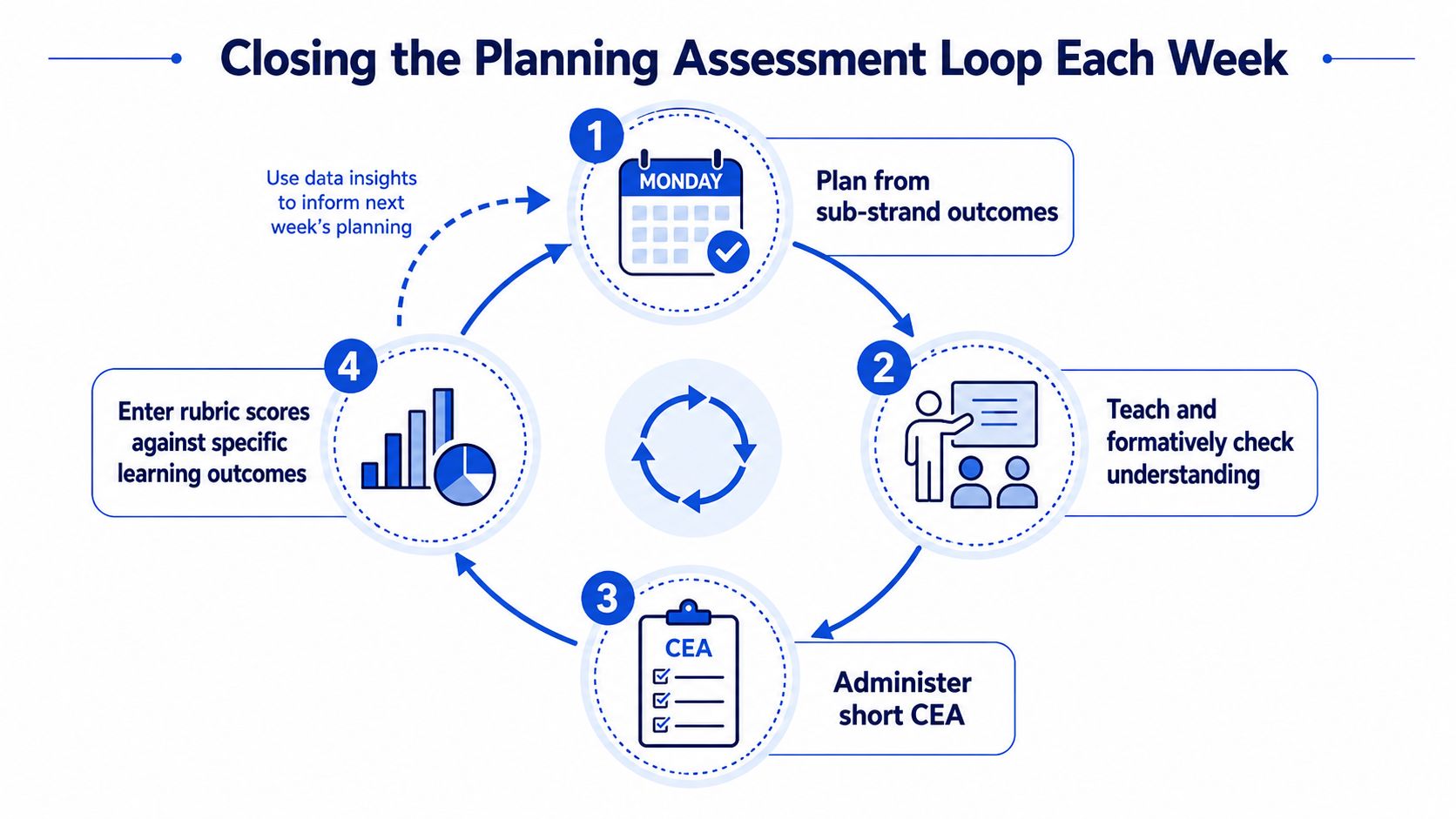
Closing the Planning Assessment Loop Each Week
The most useful weekly routine is a loop, not a straight line. On Monday, plan from the sub-strand outcome. During the week, teach and check understanding. On Friday, administer a short CEA, record the rubric evidence and use the pattern of missed outcomes to decide what needs reteaching before new content takes over.
The manual version often looks like this: a printed design, handwritten observation notes, a mark book, a spreadsheet and a scheme of work that must be updated separately. Teachers then copy the same learner information into several places, usually after a demanding week.
The assessment record should change the next plan. If it doesn't, it is only filing.
A closed-loop workflow can be organised in four actions:
- Plan from the named outcome. Select the sub-strand and decide what successful performance will look like.
- Check during instruction. Use questions, observation and short learner tasks before Friday.
- Record the CEA. Enter evidence against each specific outcome, not only a general subject mark.
- Reteach deliberately. Group learners by the gap and adjust the next week's activity, examples or support.
A digital platform such as Keybaki can automate the repetitive part of this process by keeping outcomes organised by strand and sub-strand, supporting 5E lesson planning, accepting scheduled CEA entries and showing mastery patterns that help identify reteaching priorities. The teacher still decides whether a learner needs another example, a peer explanation, a practical task or individual support. The tool reduces transcription, it doesn't replace professional judgement.
The formative assessment guide provides useful context for using small checks during teaching rather than waiting for a major test.
This matters especially in classes where learners progress at different speeds. A teacher who sees a weak outcome early can revisit it while the learning is still active. A teacher who records only a final subject score loses the detail needed to choose the next instructional move.
The weekly cycle is simple enough to run on paper, but digital support can keep the evidence, planner and follow-up action connected. The measure of success is not a colourful dashboard. It is a clearer answer to the question, “What will I do next week because of what learners showed me this week?”
Finding the Right Design Version and Avoiding Old PDFs
A PDF may look official yet still be unsuitable for current planning. KICD design files circulate in several versions, so teachers need a quick way to confirm the document before building a scheme of work around it.
For Grades 1 to 9, use the rationalised 2024 designs identified in the current Kenya curriculum guidance. Older 2022 and early CBC files may still appear in searches or staffroom folders. They can differ in learning-area structure and weekly load, which then affects strand coverage, lesson allocation and assessment planning. Confirm the file through the official KICD curriculum designs page before downloading or printing.
Run this one-minute check
- Source: Is the PDF on the official KICD website or in an authorised school record?
- Cover: Does it show the rationalised 2024 edition where that edition applies?
- Grade: Does the grade match the learners you teach?
- Learning area: Does the title name the correct subject?
- Structure: Do the strands and sub-strands follow the approved scope?
- Assessment: Does the file include learning outcomes and assessment guidance?
- Completeness: Are the core competencies and planning terms visible, with no missing pages?
Treat a file labelled “KICD 2019 draft” as a warning. Missing core competencies, unexplained page gaps and strand lists that differ from the current design are further signs to stop and verify. A practical school routine is to keep one confirmed master copy, record its edition wording, and compare photocopies against it before sharing them with teachers.
This check also protects the planning and assessment loop. If a teacher maps a lesson to an old sub-strand, the weekly evidence may be recorded against the wrong outcome, making reteaching decisions less useful. Version control therefore belongs in curriculum planning, not only in office filing.
Senior School Readiness and the Grade 9 to 10 Transition
The move from Grade 9 into Grade 10 creates a different planning question. Teachers aren't only asking what to teach next. They're asking how Grade 9 evidence, learner interests, optional subjects and career conversations should inform senior school pathway decisions.
Recent Kenya-focused reporting states that KICD has completed curriculum designs for Grade 10, Grade 11 and Grade 12, while teacher training is being coordinated with TSC as CBE expands into senior school. The senior school curriculum update also highlights the practical gap teachers are facing. Materials and guidance are moving through the system, while schools still need to support real learner and parent decisions.
| Pathway | Rollout Status | Core Subjects | Grade 9 Prep Action |
|---|---|---|---|
| STEM | Being phased in under KICD and Ministry guidance | Confirm from current senior school guidance | Use Grade 9 evidence to discuss strengths and interests |
| Social Sciences | Being phased in under KICD and Ministry guidance | Confirm from current senior school guidance | Connect subject performance with learner goals |
| Arts and Sports Science | Being phased in under KICD and Ministry guidance | Confirm from current senior school guidance | Keep practical and performance evidence organised |
| Technical and Engineering | Being phased in under KICD and Ministry guidance | Confirm from current senior school guidance | Discuss applied skills and available school options |
| Business and Entrepreneurship | Being phased in under KICD and Ministry guidance | Confirm from current senior school guidance | Include enterprise interests in guidance conversations |
Teachers should avoid presenting pathway advice as a single mark-based decision. A learner's portfolio can show patterns across written, oral and practical work, alongside personal development and career guidance conversations. It gives the school a stronger basis for discussing options without pretending that one assessment captures the whole learner.
School leaders should publish a written pathway briefing for parents before the Grade 9 selection deadline. The briefing should state which guidance is confirmed, which details remain subject to official communication, what subjects are available locally and how the school will support learner choice.
The practical priority is continuity. Keep Grade 9 records clearly tied to named outcomes, maintain accessible portfolios and avoid last-minute reconstruction of evidence. That preparation helps the next teacher understand what the learner has demonstrated and where support may still be required.
Practical Checklists for Teachers Parents and School Leaders
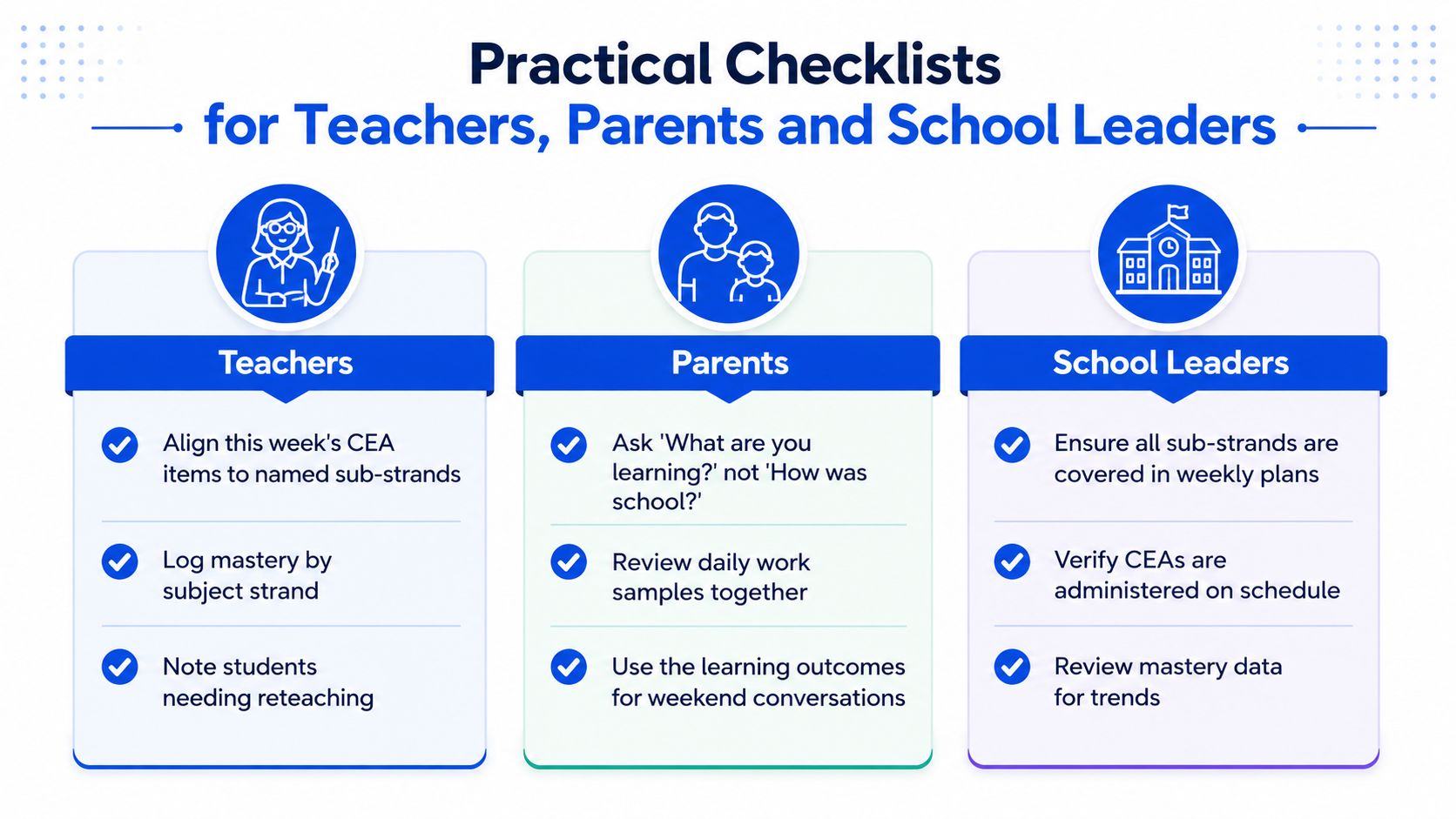
At the end of a busy week, a teacher may have lesson plans in one file, CEA notes in another and learner work elsewhere. The checklist below brings those pieces together. Each role has a clear action, and the weekly reteaching decision can follow the evidence rather than a general subject mark.
Teacher checklist
- Name the unit: Write the strand and sub-strand on the weekly plan.
- Map the CEA: Link each task to a named learning outcome. For example, a task under a science sub-strand should show which outcome the learner is demonstrating.
- Record the evidence: Mark whether the evidence came from oral response, observation, practical performance or written work.
- Locate the gap: Identify the missed outcome for each learner, rather than relying only on an overall mark.
- Reteach deliberately: Add a worked example, guided practice, peer task or short demonstration to the next plan.
- Keep the trail: Store the task, rubric and learner evidence together in the portfolio.
A digital planner can reduce repeated copying. When the teacher records the strand, outcome and evidence once, a connected CEA workflow can flag learners needing reteaching, group them by missed outcome and place the follow-up activity in the next weekly plan. The teacher still checks the judgement, but no longer reconstructs the cycle by hand.
Parent checklist
- Ask for the edition: Confirm that the school is using the current rationalised design for the learner's grade and learning area.
- Ask about strands: Request progress by strand or sub-strand, not only a general grade.
- Review evidence: Look at a work sample and ask which outcome it demonstrates.
- Support choice: Discuss the optional subject selected at Grade 9 alongside the learner's interests and future plans.
- Use ordinary conversations: Ask what the learner is learning and how they know they have succeeded.
Parents do not need to interpret every curriculum term. A useful question is, “Show me what you can do now that you could not do before.” The answer should connect classroom work with a named outcome and, where needed, the support planned next.
School leader checklist
- Audit alignment: Sample plans and check that CEA evidence points to named sub-strands and outcomes.
- Moderate judgements: Hold moderation meetings so teachers compare how they interpret rubric evidence.
- Verify digital records: Check that planners and assessment tools use the rationalised design edition.
- Publish guidance: Give parents a written explanation of pathway planning and the information currently confirmed.
- Protect teacher time: Use one shared evidence trail instead of duplicate registers and repeated transcription.
Quick FAQs
Do teachers need a separate design for every learning area?
Yes. KICD designs are organised by grade and learning area, so use the document matching the class and subject.
How often should a CEA be given?
CEA is ongoing. Use short, purposeful checks during and after learning, following the relevant design and recording evidence against outcomes.
Should every learner repeat a sub-strand when some struggle?
No. Identify the missed outcome, provide targeted reteaching and give other learners suitable extension or practice.
Where should authentic designs be downloaded?
Begin with the KICD curriculum designs page and verify the grade, learning area and edition before planning.
Keybaki provides Kenyan schools with a shared CBE library, 5E lesson planner and CEA workflow organised around strands, sub-strands and learning outcomes. Visit Keybaki to keep weekly planning, assessment evidence and reteaching decisions connected in one teacher-controlled workflow.
Comments
Loading…