
· Keybaki CBE platform
Core Values in CBC Explained for Grades 7 to 12 Success
17 min read

On Monday morning, a Grade 8 learner hands in a group task with neat work, but you can still tell who carried the group and who kept quiet. A parent sees the same pattern at home, one child does the chores without being reminded, another keeps promising to start. That is where core values in CBC stop being theory and start becoming the story of learning, because the values show up in how learners speak, share, finish tasks, and handle the truth.
Kenya's CBC treats values as part of the whole curriculum, not as an extra lesson on the side. The official framework reduced the core values from 13 to 8 and tied them to wider national values, so schools are expected to grow both competence and character together Basic Education Curriculum Framework. That matters for teachers, parents, and school leaders who want more than a list on a wall.

By the end, you should be able to name the official values, explain them in plain language, teach them in class and at home, and record evidence without turning every lesson into paperwork. You'll also see how a weekly planner and dashboard approach can make values visible in Grades 7 to 12 in a way that feels manageable for real schools.
Table of Contents
- Introduction to Core Values in CBC for Kenyan Classrooms
- What Core Values Mean Inside Competency Based Curriculum
- The Eight Official CBC Core Values and Their Simple Meanings
- Why Core Values Matter for Teaching Learning and Assessment
- How to Teach Core Values in Class and at Home for Grades 7 to 12
- Sample Learning Activities and CEAs Mapped to Core Values
- Operationalize Core Values Weekly With Keybaki Tools
Introduction to Core Values in CBC for Kenyan Classrooms
A teacher asks a group to present their science project, and one learner keeps interrupting while another writes down the team's ideas. No one has given a sermon on values, but you can already see respect, responsibility, and integrity playing out in real time. That is how CBC works best, through behaviour that can be noticed, guided, and later assessed.
Parents know the same thing happens at home. A child who returns a borrowed book, admits a mistake, or helps a younger sibling without being pushed is already practising the values schools are trying to build. The point is not to turn every moment into a lecture, it is to notice that values are lived in ordinary routines.
Kenya's curriculum framework makes this practical link clear. It says education should promote national values and produce a self-disciplined, ethical citizen, while the curriculum policy says learners should gain relevant knowledge, national values, social competencies, and 21st-century skills aligned to the Constitution and Vision 2030 National Curriculum Policy. So when a teacher asks, “How do I teach values in Grade 7, 8, 9, 10, 11, or 12?”, the answer is not a separate subject. It is the way the subject is taught.
Practical rule: if you can only describe the value, you are still at the idea stage. If you can point to what the learner said, did, or completed, you are already in teaching and assessment territory.
The official list comes later, but the main idea is simple. CBC values are not there to decorate schemes of work, they are there to shape how learners work, think, and relate. In the sections below, the meaning of each value is broken down in plain English, then linked to class routines, home habits, and weekly evidence so that teachers and parents can work from the same understanding.
What Core Values Mean Inside Competency Based Curriculum
A Grade 8 learner submits a project on time, shares the work fairly in a group task, and speaks politely while disagreeing. That learner is not only showing competence, they are showing CBC values in action. Values function as the layer that shapes how learning happens, not just what gets learned.
Kenya's curriculum framework ties CBC to national values and principles of governance, including patriotism, unity, democracy and participation, human dignity, equity, social justice, inclusiveness, equality, human rights, non-discrimination, integrity, transparency, accountability, and sustainable development. The curriculum policy also makes the same point in teacher language, it expects education to produce citizens with relevant knowledge, national values, social competencies, and 21st-century skills National Curriculum Policy.
National values, core values, and competencies
The three ideas are related, but they are not the same. National values give the civic and constitutional direction. Core values are the behaviours schools want learners to live out day by day. Competencies are the skills and abilities learners show in tasks, projects, and assessments. In CBC, these work together in one classroom, one club, one assignment, and one school routine.
A learner may explain integrity well in a written exercise and still fail to show it when handling shared materials, correcting homework, or working in a group. That is why teachers should look beyond the definition. The question is simple, can the value be seen again and again in what the learner says, does, and completes?
Learn how core competencies connect to CBC planning
Why CBC treats values as part of whole-school life
CBC expects values to appear across subjects, learner support, clubs, and daily routines. A teacher of Agriculture, CRE, Social Studies, Mathematics, or English all has a part to play. A school that treats values as only one lesson a week misses the point.
What matters is repeated evidence. A learner who shows responsibility in practical science, honesty in a correction task, and respect during debate gives teachers clearer proof than a learner who only recites a definition in class. Parents can see the same pattern at home when children complete chores, speak respectfully, and admit mistakes without being pushed.
That is also where weekly planning helps. A lesson plan, a CEA activity, and a short note in a planner can show how a value was taught and observed. Over time, this creates a simple audit trail for Grades 7 to 12, and it helps teachers move from broad CBC language to visible classroom practice. For colleagues who want a practical way to map values to planning and evidence, CBC planning with core competencies gives a useful starting point.
Values in CBC are not just statements learners repeat. They are habits teachers can observe, parents can reinforce, and schools can record with confidence.
The Eight Official CBC Core Values and Their Simple Meanings
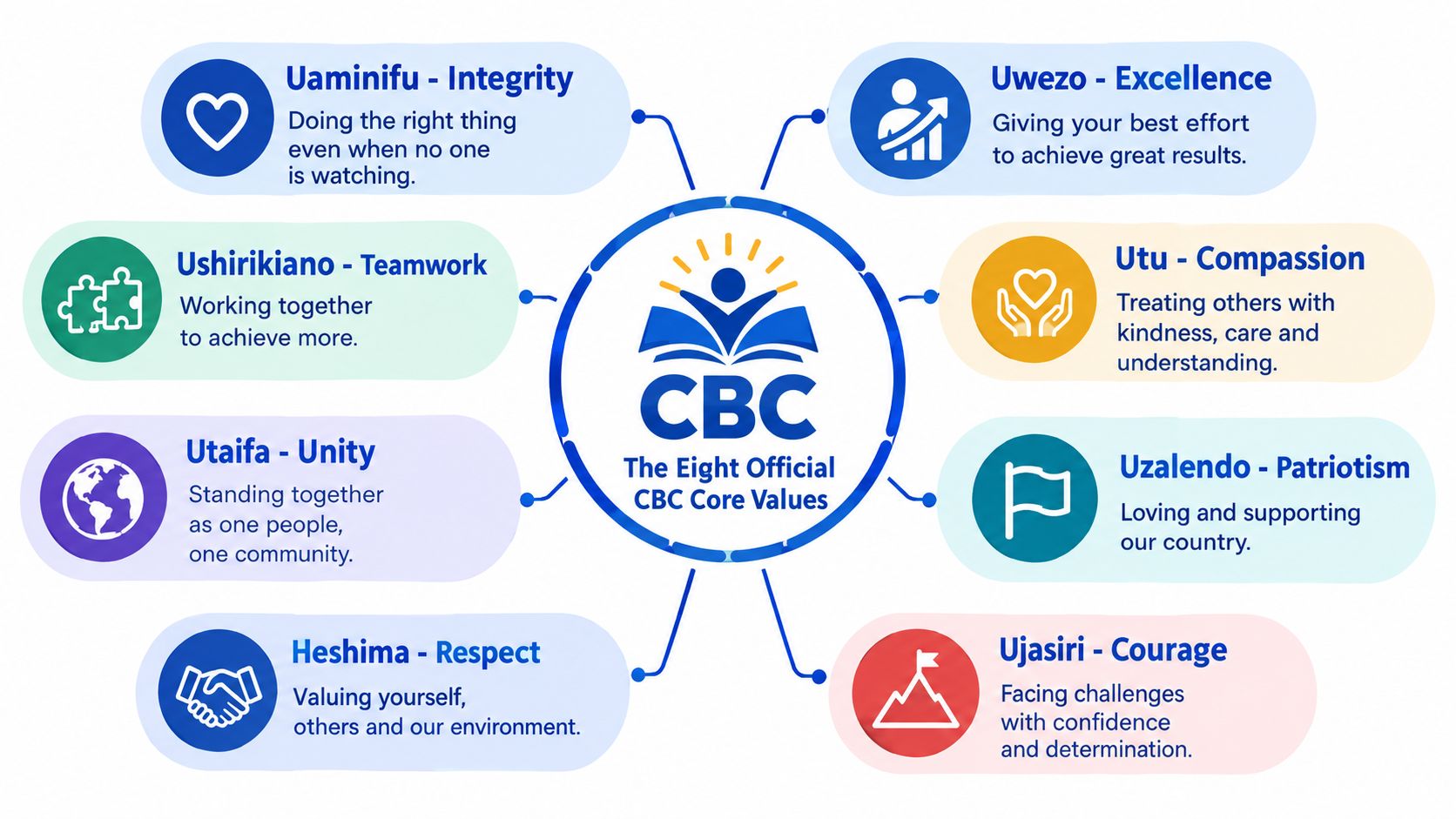
A class can talk about CBC values all morning, yet the true test comes at break time, during group work, and in the way learners handle books, tools, and one another. Kenya's Basic Education Curriculum Framework reduced the core values from 13 to 8 after a stakeholder review in 2017. The eight are love, responsibility, respect, unity, peace, patriotism, social justice, and integrity. The diagram below gives the official set at a glance.
A plain reading of each value
Love means caring for self, others, and the school community. In class, a learner shows it by helping a classmate who is stuck, speaking kindly, and avoiding cruel jokes or hurtful online messages.
Responsibility means owning duties without waiting to be pushed. A responsible learner comes with materials, meets deadlines, and completes chores at home or school.
Respect means valuing people, property, time, and rules. It shows in polite speech, careful handling of borrowed items, and listening without mocking others.
Unity means working with others toward a shared goal. In group tasks, learners divide roles fairly, include quieter members, and finish the work together.
Peace means settling disagreement without violence or humiliation. A peaceful learner can disagree, apologise, and return to work without turning a small issue into a fight.
Patriotism means valuing the country and protecting the common good. In school life, that may show in caring for public property, singing the anthem properly, and taking civic duties seriously.
Social justice means treating people fairly and noticing when someone is left out. Learners show it when they share resources fairly, defend the excluded, and reject discrimination.
Integrity means doing what is right even when no one is watching. It appears when a learner submits honest work, admits a mistake, and avoids copying.
What teachers and parents can actually look for
The cleanest way to judge these values is to ask what they look like in real work. A learner may recite the words well and still not show them in a workbook, a project, a class discussion, or a home task. So the check is simple, does the learner show the value in what they say, do, and complete?
- Love: helps another learner without being told, speaks without cruelty, shows care in small duties.
- Responsibility: arrives prepared, finishes assigned work, returns borrowed items on time.
- Respect: listens, waits for a turn, uses language that does not shame others.
- Unity: takes part in team roles, includes others, supports shared outcomes.
- Peace: handles conflict calmly, seeks help appropriately, stops gossip that fuels tension.
- Patriotism: protects school resources, takes civic tasks seriously, shows interest in national identity.
- Social justice: notices unfairness, shares opportunities, avoids bias in group selection.
- Integrity: tells the truth, works independently when required, owns errors.
A teacher in Grades 7 to 12 can record these signs while learning is still fresh, for example after practical work, peer marking, or a class duty roster. A parent can do the same at home, during chores, family conversations, or shared decision-making. That gives the school and home a simple trail of evidence, not just a memory of good intentions. As the curriculum framework shows, the values are meant to be part of daily learning, so the key question is not whether a learner can name them, but whether the same value shows up again in class, at home, and in the way tasks are completed.
Why Core Values Matter for Teaching Learning and Assessment
A Grade 8 learner may finish a worksheet neatly and still interrupt a classmate, ignore borrowed tools, or copy answers from a friend. CBC asks teachers and parents to notice both sides of learning, the academic work and the value shown in the work. That is why core values sit beside knowledge, skills, and attitudes in Kenya's curriculum direction.
Values matter because they shape how learners use what they know. A learner who understands a topic but cannot work with integrity, listen well, or cooperate with others is still not ready for the wider demands of school and life. The curriculum policy links education with relevant knowledge, national values, social competencies, and 21st-century skills National Curriculum Policy.
Values change what good teaching looks like
Once values are taken seriously, a good lesson is judged by more than coverage. Teachers also watch how learners treat one another, how they handle materials, and whether they complete tasks with integrity. A simple classroom example makes this clear. During group work, the strongest answer may come from a learner who also waits for a turn, shares tools, and admits a mistake without argument.
That is why the values approach in Kenya is more than a character list. The framework expects values to run through classroom learning and whole-school life, so the same value should appear in different subjects and settings Basic Education Curriculum Framework. A learner should not meet integrity only in a moral lesson and then lose it in Physics or Business Studies.
Assessment changes as well. One record is too thin to guide improvement. A learner may be careless in one week and dependable the next, so teachers need repeated evidence from class discussion, practical work, club participation, home tasks, and reflection notes.
Teacher's test: if the evidence cannot be tied to a real lesson, task, or interaction, it is too vague to help anyone improve.
The common mistake schools make
Many schools still place values in pastoral time, assembly, or a brief talk before exams. That keeps values outside the core work of learning, where learners spend most of their time. Subject teaching gives the clearest chance to observe them in action.
The challenge lies in making values visible without adding paperwork. Schools need a simple, low-friction way to collect strand-linked evidence, especially in Grades 7 to 12 where teachers already carry heavy workloads. A weekly routine, supported by clear indicators and a basic audit trail, works better than long speeches.
How to Teach Core Values in Class and at Home for Grades 7 to 12
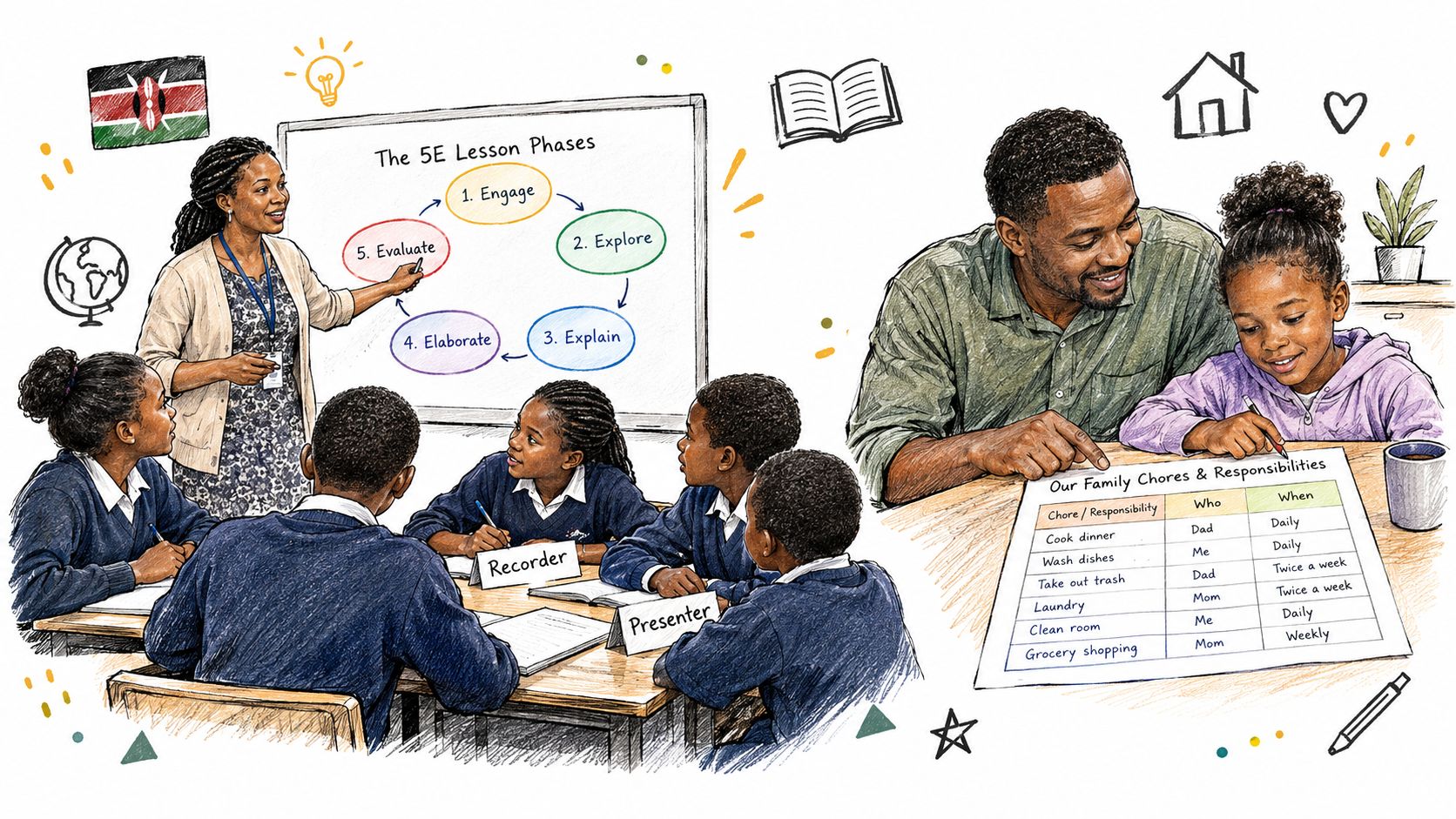
Start with routines, not speeches. A teacher can build values into the 5E lesson flow, group roles, exit reflections, and practical tasks without adding a separate “values period”. A parent can do the same at home through chores, conversations, and shared decisions.
In class, make the value visible
If the lesson is group-based, assign roles that surface a value. One learner leads, one records, one reports, and one checks time. That simple structure gives you a chance to observe responsibility, respect, and unity instead of hoping they appear on their own.
Use short prompts at the end of a lesson. Ask, “Who showed honesty in the task?”, “Who helped the group stay calm?”, or “What did the team do when someone made a mistake?” These questions help learners connect behaviour to the value, which makes the value easier to remember later.
A school can also link subject moments to specific values. In Agriculture, responsibility shows when a learner cares for seedlings and returns tools properly. In CRE, love and peace can be explored through forgiveness, care, and reconciliation. In Social Studies, patriotism appears when learners discuss public service, national identity, and care for common resources.
For a fuller classroom routine, some teachers use platforms such as Keybaki to organise plans and activities around learner behaviour and support. The tool matters less than the habit, the teacher still needs to notice the behaviour, name it, and record it cleanly.
At home, keep it ordinary and consistent
Parents do not need a big programme. Responsibility can be built through chores that are done properly and on time. Respect can be built through how children speak to elders, siblings, and visitors. Unity can be built when family members handle small disagreements without shouting or insults.
A learner who practises one value at home and sees the same value at school learns faster than a learner who hears the word only during exams.
Large classes need simple adaptations. If you have many learners, rotate who gets observed each lesson. If devices are shared, use one quick checklist instead of a long digital form. If time is tight, focus on one value per week and collect evidence from one subject, one club activity, and one home task.
The point is steady practice. A teacher or parent does not need a dramatic lesson to teach values. The learner's daily habits are already the lesson.
Sample Learning Activities and CEAs Mapped to Core Values
The cleanest way to assess values is to attach them to a real task. A learner who writes the definition of responsibility is not yet the same as a learner who completes a task on time, helps the group stay organised, and reflects on the work. That gap matters in Grade 7 through Grade 12, where teachers need evidence that can be traced back to a strand, an activity, and a behaviour.
See how learner portfolios can store evidence over time
Sample activities and CEAs mapped to CBC core values
| Learning Area Example | Activity or CEA Type | Core Value Targeted | Observable Indicator |
|---|---|---|---|
| Agriculture | Practical farm care task | Responsibility | Learner completes the assigned step, handles tools carefully, and returns them properly |
| CRE | Short reflection and pair discussion | Love and Peace | Learner shows empathy, listens respectfully, and responds without hostility |
| Social Studies | Community issues discussion | Patriotism and Social Justice | Learner explains care for public resources and spots unfair treatment |
| English | Group presentation | Respect and Unity | Learner listens, takes turns, and contributes fairly to the shared output |
| Mathematics | Correction of an error in classwork | Integrity | Learner owns a mistake, corrects it openly, and does not copy another answer |
| Science | Laboratory activity | Responsibility and Respect | Learner follows safety rules, handles materials properly, and supports team order |
| Business Studies | Case response task | Responsibility and Integrity | Learner gives honest reasoning and submits work on time |
| Clubs and sports | Team challenge or service activity | Unity and Peace | Learner cooperates, manages conflict calmly, and supports shared goals |
How to read the table in real life
The table works best when you ask one simple question, "What can I see?" If the answer is only a feeling, the evidence is too weak. If the answer is a behaviour, a product, or a response, you can document it.
That is the audit trail schools have been missing. Teachers can keep a short weekly record, such as a note that a learner showed integrity during a quiz correction, responsibility in a practical task, or respect during peer feedback. Over time, those notes become much more useful than a single broad comment like “good morals”.
The strongest assessments do not ask learners to memorise values in isolation. They place the value inside a task, then check whether the learner demonstrates it naturally. That is the difference between knowing and showing.
Operationalize Core Values Weekly With Keybaki Tools
The simplest way to keep values alive is to make them part of weekly planning, weekly teaching, and weekly evidence capture. In practice, that means the planner should already carry the strand, the activity, the CEA, and the targeted value in one place, so the teacher doesn't have to retype the same idea across documents. That is the kind of workflow Keybaki supports for Grades 7 to 12, with CBE-mapped planning, assessments, dashboards, phone sign-in, offline cache, and parent views.
A low-friction weekly routine
A sensible weekly loop looks like this. Plan one value into the week's lesson sequence, teach it through class routines, assess it in a strand-linked task, then save the evidence in a way that can be reviewed later. If the result shows a weak area, feed it into the next week's plan instead of starting from scratch.
That approach is useful because it reduces the gap between learning and documentation. Teachers get a planning trail, learners get clearer feedback, and parents see what was observed rather than vague praise.
What to keep in view
- One value per week: keep the focus narrow enough to notice real behaviour.
- One clear indicator: choose an action you can observe.
- One linked assessment: attach the value to a lesson task or CEA.
- One brief record: write a short note that explains what was seen.
- One follow-up step: carry the evidence into the next plan.
When schools use a structured loop like this, values stop feeling like extra work. They become part of the learning rhythm, which is exactly how CBC was meant to function.
If you want a practical way to plan, teach, assess, and record core values in CBC without creating extra paperwork, visit Keybaki. It helps teachers and parents keep values visible in weekly learning for Grades 7 to 12, with planning and assessment tools built around the CBC workflow.
Comments
Loading…