
· competency based questions
8 Competency Based Questions for CBE Teacher Interviews
18 min read
Three candidates sit outside the interview room. All three talk fluently about competency based education. None can describe a single lesson where a learner changed an answer because of feedback. You end the day with three impressions and no evidence, and the appointment gets made on how well each person spoke.
That's the gap these eight questions close. Each one asks a candidate to describe something they did, with a real class, a real parent, a real deadline. Your job is to score the actions, not the storytelling.
One clarification before the list. This piece is about hiring, not about writing classroom tasks. These are interview questions for teachers applying to teach Grades 7–12 under CBE. They aren't learner assessment items you'd hand to a class. The distinction matters, because a school leader who blurs the two ends up appointing people who can recite the vocabulary of competency based assessment but can't produce a rubric or a reteaching decision when a strand collapses.
Every item below follows the same shape. What the question reveals, what a strong answer sounds like, what a weak one sounds like, and how to score it. Keep answers comparable by listening for situation, task, action and result, the structure set out in this STAR technique guide for certification graduates.
Table of Contents
- 1. Tell me about a time you had to resolve a conflict with a colleague, student, or parent
- 2. Describe a time you had to meet a tight deadline with competing priorities
- 3. Give an example of when you used data to improve an outcome
- 4. Tell me about a time you adapted to a significant change
- 5. Describe a time you showed leadership without formal authority
- 6. Tell me about a mistake you made and what you did about it
- 7. Give an example of when you had to persuade someone to see things your way
- 8. Describe a time you went beyond what was expected to support a learner or client
- What each competency based question tests and how to use it
- Turn Interview Answers Into Scored Evidence
1. Tell me about a time you had to resolve a conflict with a colleague, student, or parent
Conflict answers usually arrive as stories about other people's faults. Listen for the candidate's own moves.
What it reveals: Interpersonal skill, emotional regulation, and whether the candidate can reach an outcome instead of winning an argument. In a CBE school the two live versions are a parent who disputes a competency judgement on a weak strand, and two teachers who disagree over shared CEA materials.
A strong answer has a paper trail
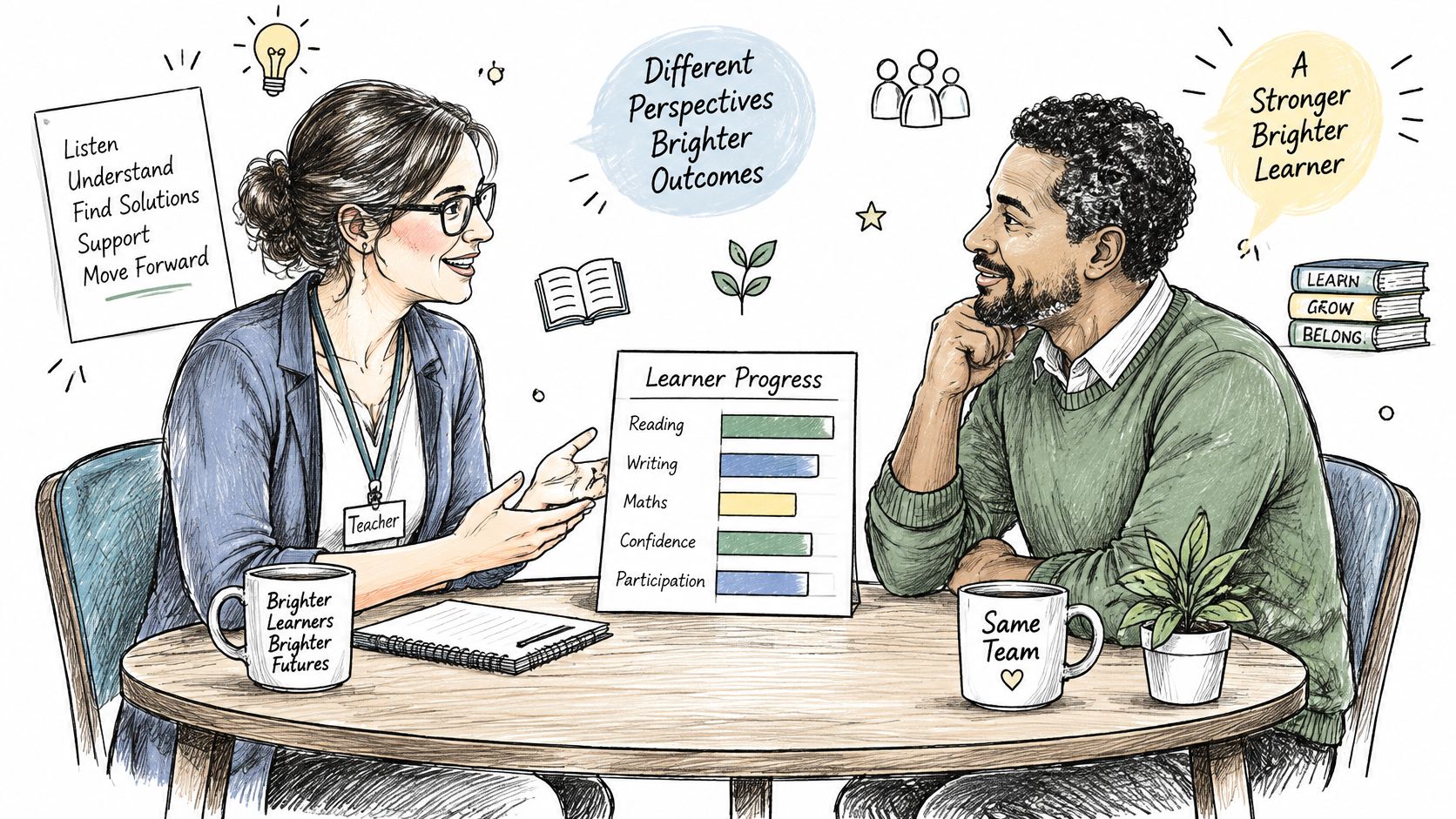
Strong: "A parent came in convinced her son's grade was wrong. I pulled his three most recent sub-strand checks, showed her where the evidence sat, and we agreed on a six-week plan with a weekly check-in." Note the sequence. Evidence first, then a shared action she helped design.
A second strong shape is a department lead who mediated a dispute between two teachers over question sharing by agreeing a common template and a review rota, so the disagreement stopped recurring.
Weak: the candidate describes the other person as unreasonable, or says "I escalated it to the deputy." Both tell you the person doesn't yet own difficult conversations, and in a CBE classroom the difficult conversation is how a parent hears that a child is approaching expectations rather than meeting them.
What to score
Score actions, not drama. A three is a candidate who listened and reached a workable outcome. A four is one who changed a process so the same conflict can't recur. A two is blame without ownership. Probe with "What did you say?" and "What happened next?" until you hear dialogue rather than a summary.
The competency underneath, managing your own reaction while managing someone else's, is the same one learners need, which is why it's worth checking a candidate's grasp of social and emotional learning before you appoint them.
2. Describe a time you had to meet a tight deadline with competing priorities
Prioritisation questions expose planning systems. Anyone can claim to work hard. Few can say what they dropped.
What it reveals: How a candidate sequences work, what they treat as essential, and whether they tell people early when something will slip. Under CBE the pressure is continuous rather than terminal. The World Bank education programme document reports that KNEC trained 1,452 teachers in competency-based assessment, including 120 teachers working in refugee camps, and developed two sets of formative assessment tools covering 29 learning and professional areas. National assessment machinery on that scale means year-round evidence, and year-round evidence means year-round deadlines.
Listen for what they dropped
Strong: "I had CEA results due in the same week as a scheme-of-work review and a parents' evening. I moved my lesson plans into a shared planner so nothing depended on my memory, sent parents the revised assessment dates on Monday, and asked a colleague to second-mark the strand checks." The candidate names the trade-off out loud.
Weak: "I stayed up late and got it all done." That's effort, not judgement, and it predicts collapse in a term where three deadlines collide.
Panel habit: ask "What did you choose not to do?" before you ask how it went. A candidate who can't name the dropped item hasn't prioritised, they've just worked longer hours.
Scoring note
Then ask how they told the affected people. Communication before the miss scores four. Communication after it scores three. Silence scores two. Use the same two probes for every candidate so the comparison holds across the day.
Keep the KNEC CBA portal guide to hand during the panel, so a candidate's account of assessment deadlines can be checked against how the national system runs.
3. Give an example of when you used data to improve an outcome
A candidate who can't describe a pattern in learner work can't reteach from it.
What it reveals: Whether the person collects evidence, reads it, and changes something as a result. That closed loop is scarce. In a study of 58 teachers and 35 administrators in Kenya, only 46.5% of teachers reported being confident or very confident in their understanding of the CBC framework, and the most frequently reported difficulties were designing competency-based assessment tools at 65.5%, interpreting learning outcomes and competencies at 58.6%, and providing individualised continuous feedback at 53.4%, according to the evaluation of teachers' understanding of CBC. Candidates who clear that bar are worth marking up.
Strong: "Our CEA results showed the measurement sub-strand was weak across 19 of my 30 learners, not the three I'd assumed. I reteached it with a practical measuring activity instead of another worksheet and rechecked a week later." The number, the decision, the recheck.
That becomes clear when a candidate walks the panel through their own class record.
Weak: "I use data to inform my teaching." No pattern, no action, no follow-up. That's a slogan, and it scores two.
Score the loop, not the tool
Ask what the data showed before you ask what they did. Then ask how they checked whether the change worked. Four and above requires a before and after. Three is a candidate who spotted a gap and never verified the fix. A tally on the board, a mark book column, a printed sheet of sub-strand scores: simple methods are fine. Don't reward sophistication. Reward the loop.
4. Tell me about a time you adapted to a significant change
Every teacher in Kenya has been asked to change how they teach. The question is what this candidate did when nobody handed them a finished method.
What it reveals: Flexibility, resilience, and whether the candidate adapts alone or with other people. The reform wasn't an exam tweak. Basic education reform began in 2016, with a pilot study before the Competency-Based Curriculum arrived in 2017, and it moved assessment away from memorised content and toward applied knowledge, skills, values and attitudes, as UNESCO's account of the Kenyan curriculum reform sets out. The framework also names four performance levels for judging learner responses: exceeding expectations, meeting expectations, approaching expectations, and below expectations. A candidate should be able to describe moving their own practice onto that footing.
What a real transition sounds like
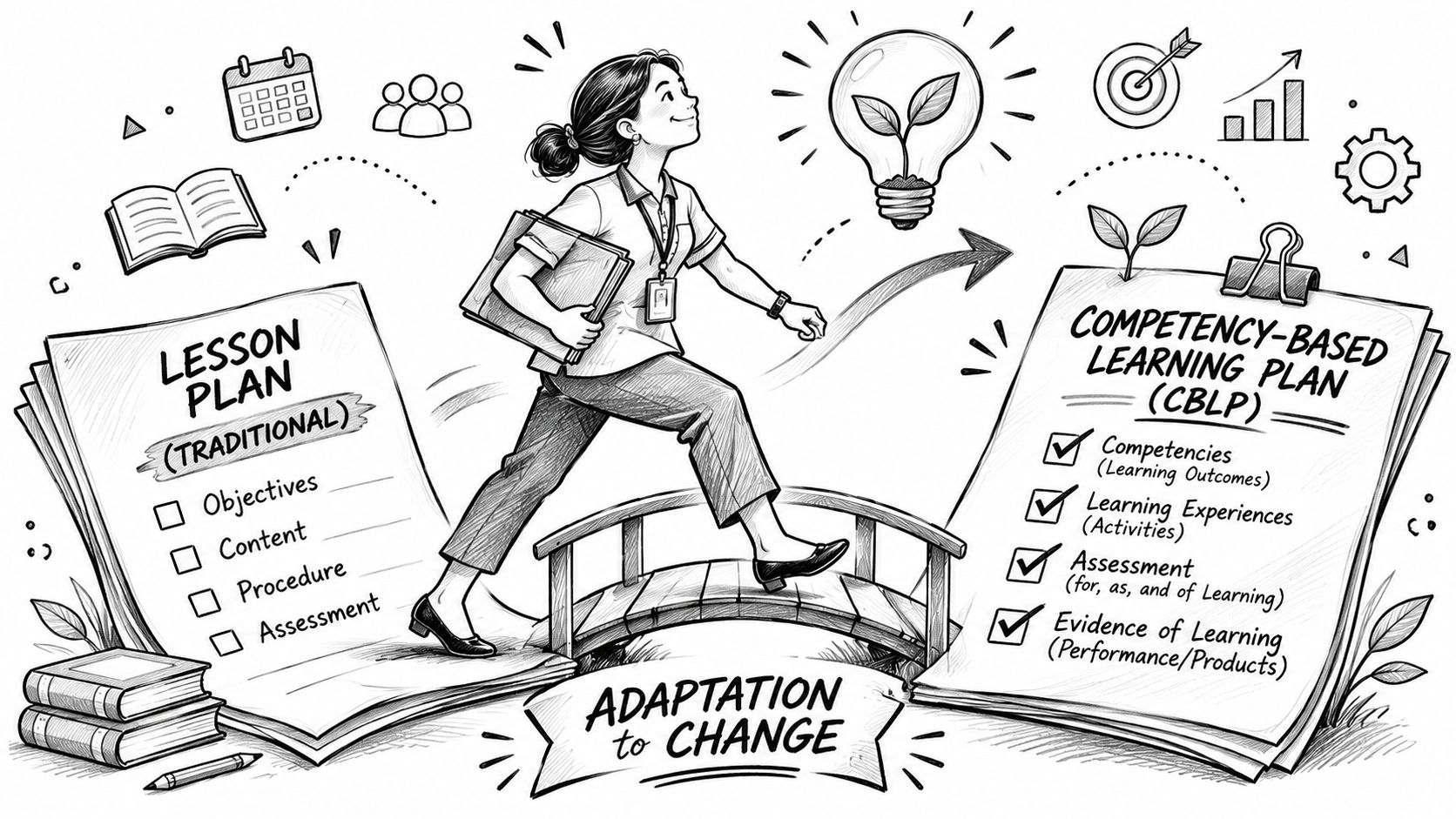
Strong: "Our schemes of work were built around topics. I rebuilt mine around strands and sub-strands with two colleagues during a holiday, and the first term was messy because my assessment tasks were still content questions." That last sentence is the valuable part. It shows a candidate who can see their own half-finished work without being asked.
A second strong shape is a teacher who moved a class onto a shared family-phone workflow when school devices were scarce, and can say what broke in the first fortnight.
Weak: "I'm very adaptable, I always embrace change." No incident, no cost, no learning.
Scoring note
Ask what they found hardest and how they handled it, then ask what changed in their practice permanently. A candidate who describes asking for training or leaning on a colleague scores higher than one who absorbed the change without support, because silent adaptation rarely survives a second change.
5. Describe a time you showed leadership without formal authority
Titles are thin in a school. Influence is what gets a new practice into four classrooms instead of one.
What it reveals: Initiative and the ability to move peers without line authority. This matters more in Kenya than the org chart suggests. A recent East African study reports that limited teacher preparation keeps many classrooms relying on traditional examinations, and that overcrowding plus shortages of learning materials restrict individualised formative feedback. In Kenya, funding and implementation difficulties were associated with only about half of learners meeting expected competency standards, according to the study in the East African Journal of Education and Social Sciences. Practice shifts classroom by classroom, and it shifts because a colleague demonstrated it and stayed to answer questions.
Reading influence from a story
Strong: "I started a Friday peer-review group where four of us swapped CEA items and marked each other's rubrics. Nobody was required to attend. By the second term the whole department used the same template." The candidate names how they recruited people, not just what the group achieved.
A second strong shape is a teacher who ran a short workshop on 5E lesson planning, then collected feedback and fixed the weakest part of the session before running it again.
Weak: "I told my colleagues they had to do it." That's borrowed authority. It collapses the moment the candidate has no title to lean on.
The person who disagreed is the test of the answer, not the interruption.
Scoring note
Ask how they got agreement, then ask about the sceptic. A candidate who changed their approach for the sceptic scores four. A candidate who reports the sceptic as a problem scores two. For a fuller method on reading influence from a story, see this guide to measuring influence when you lack authority.
6. Tell me about a mistake you made and what you did about it
What it reveals: Accountability, and whether reflection changes behaviour. Anyone can name a mistake. Far fewer can describe the system they built afterwards so it doesn't repeat.
The surrounding evidence isn't encouraging. In a Kitui County study covering 93 schools, 403 teachers, 93 head teachers and five curriculum support officers, teachers had only moderately developed knowledge and skills for implementing competency-based assessment, despite familiarity with rubrics, checklists and portfolios, according to the Kitui County CBA preparedness study. The same study reports that teachers have found it difficult to design and use the assessment tools recommended for CBE. Marking errors and badly built tasks are therefore common. The question is what the person did after theirs.
The version you want to hear
Strong: "I marked a CEA item against the wrong rubric level for six learners. I corrected the records, told the parents before they saw the report, and added a two-pass check where I mark once and re-read the rubric before submitting." Owns it, fixes the record, tells the people affected, changes the process.

A second strong shape: a lesson that ran badly over time, and the buffer activity the teacher now builds into every plan as a result.
Weak: a mistake that isn't one ("I care too much"), or an error blamed entirely on someone else's instructions.
Scoring note
Ask what they'd do differently now. Ownership without self-flagellation scores three or four. Penitence with no process change scores two, because you'll be the one managing the repeat next year.
7. Give an example of when you had to persuade someone to see things your way
Persuasion questions separate people who argue from people who move someone.
What it reveals: Whether the candidate listens before pushing, uses evidence rather than seniority, and can accept a fair outcome that isn't a total win. In a school the two live versions are a head of department who won't adopt weekly CEA check-ins, and a parent who won't accept that a Grade 8 learner needs revision support at home.
Two shapes of a strong answer
First: "My head of department thought weekly strand checks would eat lesson time. I showed her eight weeks of my own class's mastery data, including two sub-strands the checks caught early, and offered to run a one-term pilot while she watched the marking load." The candidate brought evidence and reduced the risk to the other person.
Second: a teacher who got a parent to a briefing on a learner's weakest strands by sending a one-page plain-language summary, then following up with a phone call. Attendance is the proof persuasion worked. Words aren't.
Weak: "I explained why I was right until they agreed." That isn't persuasion, and it usually signals a candidate who won't hear a parent's actual concern during a progress meeting.
Probe that separates them: "What was the other person's main worry?" A candidate who can't state the objection in the other person's words wasn't listening, they were waiting.
Scoring note
Ask how their approach changed mid-conversation. Flexibility inside a disagreement scores four. A fair outcome where the candidate gave something up scores four. Total victory with no concession scores three at best, because in a school the person you beat is still on your corridor next term.
8. Describe a time you went beyond what was expected to support a learner or client
What it reveals: Initiative, and whether care turns into action. The trap is the candidate who describes working seventy-hour weeks and calls it commitment. Look for a bounded action with a measurable effect, not exhaustion.
The delivery problem in Kenya is uneven. An EU-supported project had connected 363 schools and reached more than 277,000 learners by December 2025, but only an estimated 30% of Kenya's 23,400 public primary schools were online, according to the European Union delegation's report on the Last Mile Connectivity project, which also names connectivity, teacher training, technical support and maintenance as continuing requirements. Connectivity doesn't stop being a constraint at Grade 7. A teacher who assumes every learner can log on is designing for a minority of the class.
Small, specific and measured
Strong: "Three learners in my class shared one phone at home, so I printed each week's revision items with an answer key and checked their scores every Friday." Constraint, adaptation, check. A second strong shape is a teacher who ran a three-week revision group for learners with weak strands and tracked mastery before and after.
Weak: "I always make time for learners who need help." No decision about who, no limit, no evidence of impact. That answer often hides a candidate heading for burnout in their second term.
Scoring note
Ask how they decided the extra support was appropriate, then how they measured it. Bounded effort with tracked impact scores four. Unbounded effort with no measurement scores three, and comes with a risk flag for the head of department. Our guide to remedial teaching is worth sending to shortlisted candidates before the second round.
What each competency based question tests and how to use it
| Item | Primary Competency | Main Probe | Best For |
|---|---|---|---|
| Tell me about a time you had to resolve a conflict with a colleague, student, or parent | Conflict resolution and emotional intelligence | How did you address the disagreement and reach a constructive outcome? | Assessing relationship skills with parents, learners, and colleagues |
| Describe a time you had to meet a tight deadline with competing priorities | Time management and prioritisation | How did you decide what to prioritise and communicate trade-offs? | Assessing planning and delivery under pressure |
| Give an example of when you used data to improve an outcome | Analytical thinking and evidence-based decision-making | What did the data show, what action did you take, and what changed? | Assessing data-informed teaching and assessment |
| Tell me about a time you adapted to a significant change | Flexibility and resilience | How did you respond to the change and adjust your practice? | Assessing readiness for curriculum or technology changes |
| Describe a time you showed leadership without formal authority | Influence and initiative | How did you gain others' support and handle resistance? | Identifying collaborative leadership potential |
| Tell me about a mistake you made and what you did about it | Accountability and self-reflection | How did you correct the mistake and change your future practice? | Assessing ownership, integrity, and learning from feedback |
| Give an example of when you had to persuade someone to see things your way | Persuasion and communication | What concerns did the other person have, and how did you respond? | Assessing stakeholder communication and influence |
| Describe a time you went beyond what was expected to support a learner or client | Initiative and empathy | What extra support did you provide, and what impact did it have? | Assessing learner-centred commitment and sound judgement |
Turn Interview Answers Into Scored Evidence
Four rules turn the eight questions above into a measurement rather than a conversation. Write the scoring guide before the first candidate sits down. Ask every candidate the same core questions. Score each answer immediately and independently, before the panel compares notes. Then compare scores against the evidence attached.
The fourth rule is the one panels skip. Score actions over fluency. A candidate who tells a tidy story about a parent meeting scores well on delivery. The candidate who names the three sub-strands she showed the parent, and what the parent agreed to, scores well on evidence. When the two conflict, evidence wins.
Panel discipline matters more than question wording. If two interviewers score the same answer differently, the rubric is vague, so fix the rubric between rounds rather than blaming the candidate. Anchors do the work: "listened, reached a workable outcome, no process change" is a defensible three, and "listened, reached an outcome, changed the process so it could not recur" is a defensible four. Any structured scheme runs on this logic, and the mechanics of scoring independently before consensus are laid out in this guide to how panels score competency evidence.
School leaders get a second benefit. Once your interview questions ask for competency evidence, you start noticing which of your current teachers can produce it, and where the professional development gap sits. The discipline you apply to hiring is the same one you apply to assessment inside classrooms. Keybaki applies it to CBE assessment: its Continuous Evaluation Assessments cite the competency each item advances and return a competency score rather than a percentage, so a result traces back to a named strand rather than a raw mark. The platform maps its features to all seven CBE Core Competencies, which lets a head of department check that what is assessed matches what the curriculum expects.
Hold your hiring to that standard. If you can't point to the strand, the evidence, and the decision that followed, you don't yet have a score.
Keybaki is built for the same evidence habit you're hiring for. Its Continuous Evaluation Assessments draw questions at random for a single sub-strand, a whole strand, or an entire subject, so the same set never repeats, then report a competency score with partial credit landing on the strand a learner got partly right. When you're ready to see how that evidence loop looks in practice for Grades 7–10, with Grades 11–12 coming soon, visit Keybaki and look at the CEA reporting before your next round of interviews.
Comments
Loading…