
· Kenya CBE curriculum
2027 Lesson Plan Template for Kenya's CBE Classes
17 min read
It's Sunday evening, and you're preparing a Grade 8 lesson with a blank page beside your timetable. You know the topic, but you're less sure what the school will expect to see: activities, assessment records, differentiation, or proof that learners can apply what you taught.
A useful 2027 lesson plan template brings those expectations together. It records what learners will do, what will count as evidence, and what you'll change when that evidence shows they need another attempt.
Table of Contents
- The Complete Template at a Glance
- How to Write Outcomes Learners Can Show
- How to Plan the 5E Activities Step by Step
- Recording Assessment Evidence and Rubric Levels
- Differentiation for Large and Mixed-Ability Classes
- Pathway and Low-Resource Versions of the Template
- Running the Weekly Cycle From Week One
- Quick Checklist Before You Teach
The Complete Template at a Glance
Start with the curriculum design, your timetable and the previous lesson's assessment notes. Don't begin by searching for an entertaining activity. First decide what learners should demonstrate, then choose an activity that gives them a fair opportunity to demonstrate it.
The KICD Basic Education Curriculum Framework defines competency through successful application of knowledge and skills, and connects learning experiences to real-life situations. That makes learner performance, rather than topic coverage alone, the organising principle of this template.
Template Fields and What to Enter
The example below illustrates how to complete the fields. Check the strand, sub-strand and expected content against the current official curriculum design before using it, rather than treating the illustrative wording as a verified curriculum extract.
| Field | What to enter | Example (Grade 8 Integrated Science) |
|---|---|---|
| Grade and subject | Grade, subject and learning area | Grade 8, Integrated Science |
| Week, lesson and duration | Timetable reference and available teaching time | Current week, scheduled lesson reference and period length |
| Strand and sub-strand | Official CBE strand and sub-strand names, copied from the curriculum design | Illustrative entry to verify: Living Things; Nutrition in Plants |
| Specific learning outcome | An observable outcome with a context and success criterion | Learner explains how a leaf makes food using a labelled diagram showing inputs and products |
| Core competencies | Select competencies that the activity will make observable | Critical thinking and problem solving |
| Values and contemporary issues | Relevant values or issues, linked to an actual learner action | Environmental care through responsible handling of plants |
| Resources | Materials and a workable low-cost alternative | Leaves, torch and chart; use daylight and a board diagram where equipment is unavailable |
| Learner activities | An activity, time allocation and checkpoint for each 5E stage | Engage: ask how plants get food and record learners' predictions |
| Differentiation | Support, core task, extension and reasonable accommodation | Give a developing reader a labelled diagram and allow an oral explanation |
| Assessment evidence | Assessment method, evidence type and rubric level | Individually labelled diagram assessed with a descriptive checklist |
| Teacher comment | The demonstrated strength or specific misconception | Identifies light correctly but confuses water with the food produced |
| Next step | Reteaching action for learners who haven't met the criterion | Repeat the diagram explanation using input and product cards in the next scheduled lesson |
Keep the Page Usable
Use the same headings across junior and senior school, changing the subject content, task complexity and evidence requirements. Add a pathway or subject-choice field when relevant. You don't need a completely different document for every learning area.
Print the blank template and keep the planning sheet on a single page, with detailed rubrics and learner records attached separately. Complete a copy for each lesson. If you use a digital document, retain your edits and give curriculum fields consistent names so another teacher can follow the record.
Don't fill the values field with a list of desirable qualities. Write what learners will do, such as sharing materials fairly or explaining why they shouldn't uproot a plant for observation.
The fields most easily left empty are the outcome, evidence type and next step. Without them, a full-looking page can still leave you unable to explain what learners achieved.
How to Write Outcomes Learners Can Show
| Use this verb | Good for | Avoid this verb | Why it fails |
|---|---|---|---|
| Analyse | Comparing causes or data | Understand | Cannot be observed on its own |
| Design | Making a model, plan or product | Know | Doesn't specify how knowledge will be demonstrated |
| Demonstrate | Performing a skill step by step | Appreciate | Doesn't identify observable evidence on its own |
| Justify | Giving reasons for a choice | Learn about | Describes coverage, not learning |
| Create | Making a product for a real context | Be aware of | Doesn't specify a testable performance |
| Solve | Applying a method to a new problem | Enjoy | Describes a response, not demonstrated competence |
The verb is only the beginning. An outcome also needs content, a context and a success criterion. Analyse soil erosion is incomplete because it doesn't tell you where learners will investigate or what an acceptable response contains.
A hypothetical school-garden outcome could be: Analyse soil erosion on the school plot, identifying three possible causes and proposing one suitable prevention method. Those quantities are example task criteria, not national requirements.
Build the Outcome Deliberately
- Copy the sub-strand accurately. Use the current official curriculum design, not a remembered topic title.
- Choose an observable verb. Match it to the selected competency and the kind of performance learners can reasonably attempt.
- Add a familiar context. A school garden, market purchase or matatu fare problem gives the content somewhere to be applied.
- State what success looks like. Specify a visible feature, accurate explanation, justified choice or completed process.
Keep the lesson focused. A tightly written outcome is more useful than a long collection of intentions you won't have time to assess. Use the guide to CBE learning outcomes when you need help turning broad curriculum language into assessable lesson statements.
Could you see the learner do it, hear them explain it, or hold the product they made?
Kenya's junior school covers Grades 7–9, while senior school covers Grades 10–12, within the structure described by KICD's curriculum FAQs. Use the same outcome-writing method across those phases, but increase the complexity of the context, reasoning and independence where the curriculum requires it.
An outcome should also help you make a teaching decision. If a learner identifies erosion causes but chooses an unsuitable prevention method, the next task should address that choice, not repeat the entire topic.
How to Plan the 5E Activities Step by Step
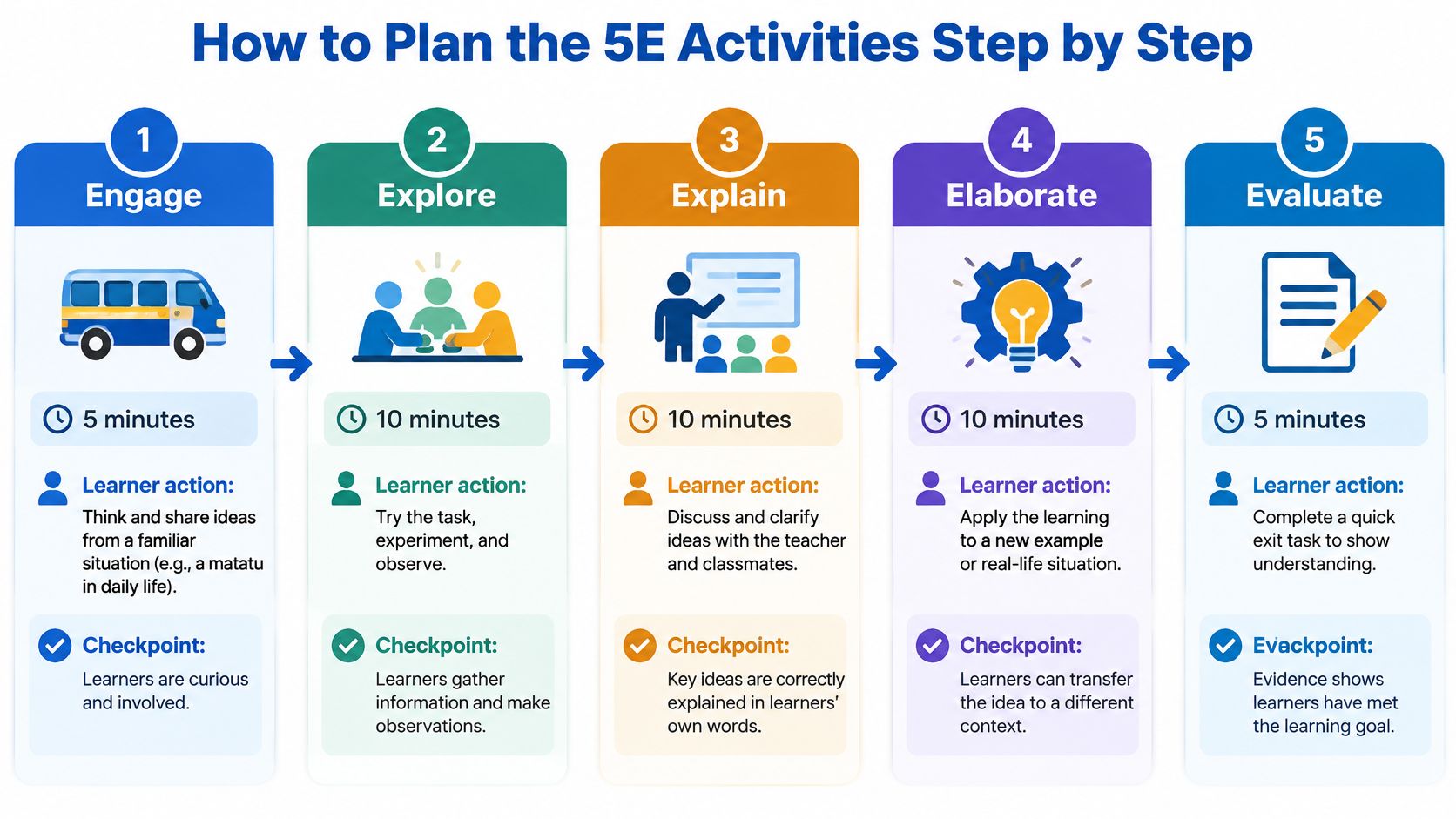
Use the 5E sequence to organise learner actions, not merely to divide your explanation into headings. Each stage needs a task and a checkpoint.
The visual gives a compact overview of the sequence.
A Worked Lesson Sequence
The following is a hypothetical 40-minute allocation, not a prescribed national timetable. It gives extra application time; adjust the balance to the task and your actual period.
Engage, 5 minutes. Show a leaf and ask where the plant gets its food. Learners make individual predictions before discussing them. Your checkpoint is a short record of competing explanations, especially the idea that plants obtain ready-made food from soil.
Explore, 10 minutes. Pairs examine leaves and sort cards representing possible inputs, conditions and products. Listen to their reasons rather than supplying answers immediately. Record which pairs can distinguish an observation from a guess.
Explain, 8 minutes. Learners share their arrangements, then you model an accurate diagram and introduce the necessary vocabulary. Ask them to correct their own work. Check whether they can explain why they moved a card.
Elaborate, 12 minutes. Present a new scenario involving plants growing in different light conditions. Learners predict an effect and justify it using the diagram. Collect a short explanation, not just a group spokesperson's answer.
Evaluate, 5 minutes. Each learner completes an exit task independently. Compare the response with the stated success criterion and identify the misconception that needs attention.
Don't describe card sorting as experimental proof of photosynthesis. It's a reasoning activity that helps you inspect learners' explanations.
Let the Checkpoint Change the Plan
For a hypothetical double period of 80 minutes, doubling those allocations is a starting point, not an obligation. Practical setup, accessibility needs and discussion may justify a different balance.
Planning rule: If learners can complete the activity but can't explain the idea independently, change the next task rather than assuming the outcome is secure.
If your department uses a numerical reteaching trigger, record it as a local planning decision, not a national CBE requirement. Where misunderstanding is widespread, reteach the concept with a different representation before introducing a dependent idea; where it's limited, organise targeted support.
For an additional explanation of the model, use this video alongside your written activity sequence.
Recording Assessment Evidence and Rubric Levels
Record these details against each selected assessment task:
- Evidence type: Oral response, observation, written work, practical performance, project or portfolio.
- Outcome and competency: The exact learning target the task assesses.
- Rubric level: The descriptor that best matches the observed performance.
- Teacher comment: A specific strength, error or misconception.
- Next action: The teaching response and how you'll check improvement.
The KICD curriculum framework on assessment calls for evidence across knowledge and understanding, practical performance, attitudes, values and generic competencies, accumulated through approaches including projects, journals, profiles and portfolios. A quiz can contribute evidence, but it can't stand in for every kind of learning.
Separate Marks From Mastery
A raw mark tells you how a learner performed on the questions you set. Mastery status tells you whether the evidence meets the particular outcome. They aren't interchangeable.
For example, a learner might gain most available marks by naming parts correctly while still giving an incorrect explanation of the process. Record that difference instead of letting the total conceal it.
Also distinguish formative checks from evidence selected for the formal record. A prediction during Explore helps you decide what to explain. An independent explanation after teaching may provide stronger evidence of the learner's achievement.
Use the guide to CBC assessment rubrics to develop descriptors that describe performance rather than relabelling marks.
Four-Level Rubric With the Next Action Recorded
This is an illustrative classroom rubric. Align its labels, timing and descriptors with your school's approved assessment guidance.
| Level | Descriptor | Next action recorded |
|---|---|---|
| 4 Exceeds | Applies the outcome to a new context with no help | Extension task in the next plan |
| 3 Meets | Completes the outcome with minor errors that don't undermine the central criterion | Move on and note an error to watch |
| 2 Approaching | Completes part of the outcome with prompts | Reteach with a worked example |
| 1 Beginning | Cannot yet show the outcome | Individual reteaching and reassessment at a scheduled follow-up |
Write comments that another teacher could act on. Needs improvement is too broad. Confuses the plant's food with water absorbed by roots identifies a teachable gap.
Keep a dated paper or digital folder for each learner, with the outcome, evidence reference and assessment decision together. A practical performance doesn't always require a photograph or video; an appropriately completed observation checklist can record what you saw. The folder should make it possible to follow the learner's progress from a lesson task to the term report.
Differentiation for Large and Mixed-Ability Classes
A Ministry of Education policy paper reports that secondary-school gross enrolment rose from approximately 1.9 million to 3.9 million learners, and records a 29:1 pupil-teacher ratio in public secondary schools. That ratio isn't a measurement of every classroom's size, but it reinforces the need for manageable planning and assessment routines.
You don't need unrelated worksheets for every learner. Keep the intended outcome clear and vary the route learners take towards it.
Write Support, Core and Extension
| Version | What you prepare | Leaf-diagram example |
|---|---|---|
| Support | A worked example, vocabulary aid or sentence starter | Provide labelled input cards and an explanation starter |
| Core | The intended task with normal classroom resources | Learner constructs and explains the diagram |
| Extension | A new case requiring transfer or justification | Learner predicts the effect of reduced light and explains the reasoning |
Support should remove an unnecessary barrier without supplying the whole answer. Extension should deepen the thinking, not merely add more copying.
For group work, assign roles such as reader, materials organiser, recorder and presenter. Rotate them so the confident reader doesn't always explain while everyone else watches. During the activity, ask a learner other than the presenter to explain the group's decision.
Use checkpoints at task transitions: after predictions, after sorting and before the final explanation. This gives you useful information without requiring you to mark every book during teaching.
Record the Accommodation
An accommodation might be a large-print sheet, an uncluttered diagram, suitable seating or additional processing time. An oral response can replace writing when writing isn't the skill being assessed; it shouldn't replace a written task whose outcome specifically requires writing.
The differentiated instruction examples can help you turn broad support intentions into practical classroom actions.
Before teaching: Write a support line and an accommodation line for each activity, then check that the learner can still demonstrate the intended outcome.
Avoid permanent labels such as weak group. A learner may need reading support while showing strong scientific reasoning.
Pathway and Low-Resource Versions of the Template
| Pathway | Competency shown through | Evidence to record | Low-resource alternative |
|---|---|---|---|
| STEM | Science investigation | Practical or field report with rubric | Bottle, sunlight and paper for a suitable task instead of specialist apparatus |
| Social Sciences | Field task or case study | Interview notes or annotated map | Printed map and notebook |
| Arts and Sports Science | Performance or practical drill | Teacher observation checklist or peer review | Paper checklist and group observation |
| Junior school | Core subject task | Written and oral check | Board-based task with oral response |
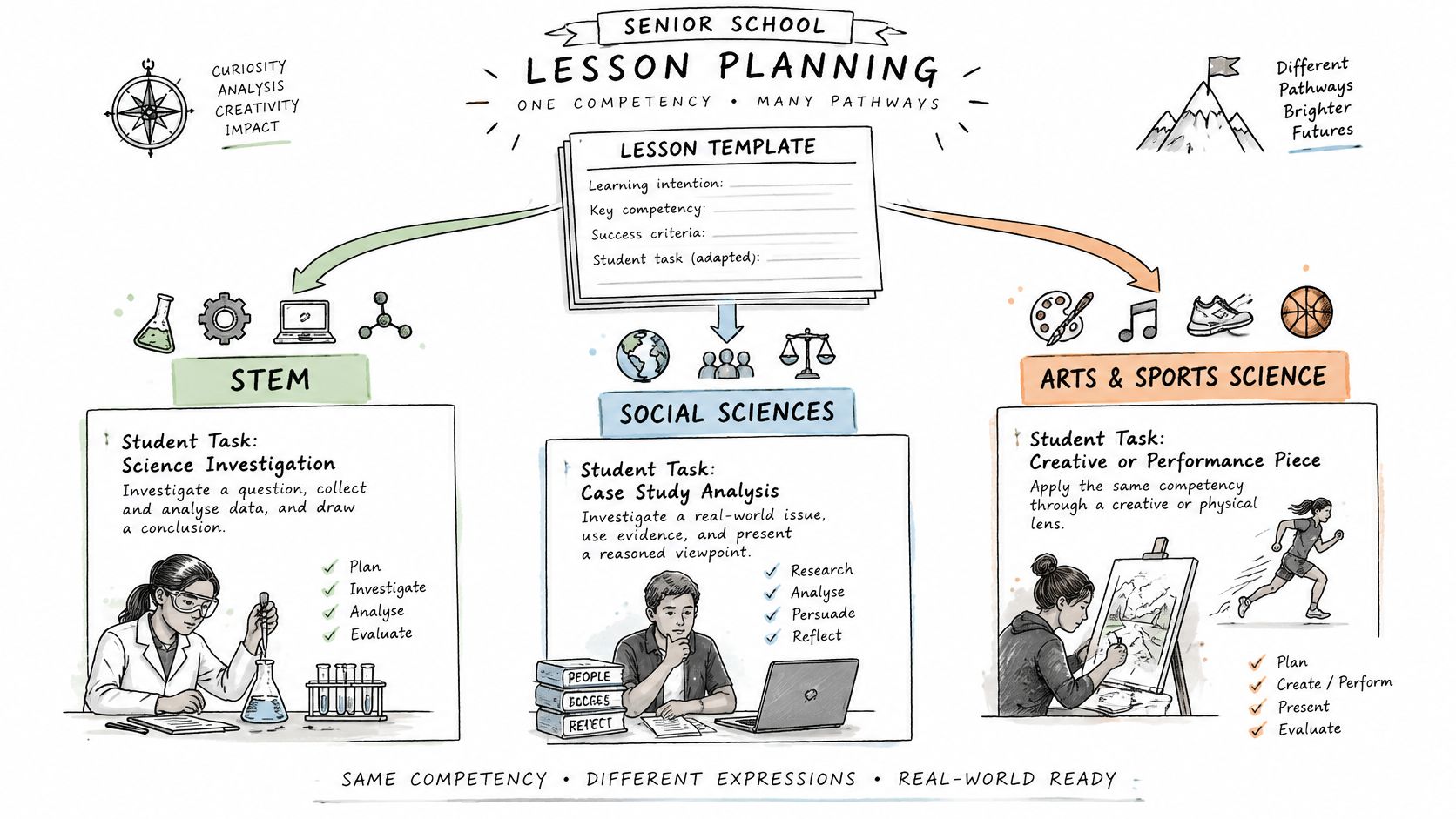
The senior-school pathways described in Teachers Updates' assessment overview are STEM, Social Sciences, and Arts and Sports Science. The planning implication is practical: choose evidence suited to the task rather than forcing every subject into a written quiz.
For critical thinking, a science learner might justify an investigation method, a social-science learner might evaluate an interview response, and an arts learner might explain a performance choice. Those are suggested task designs, not interchangeable subject assessment requirements.
This visual shows how the planning headings can accommodate different pathways.
Make the Offline Version Complete
Prepare a paper-first version with readable headings, brief instructions and space for observations. Keep a digital copy as an addition, not a condition for participation.
- No projector: Draw the diagram on the board and reveal labels gradually.
- Limited materials: Organise safe group stations or choose an observation task using locally available objects.
- Language support: Add Kiswahili explanations for key instructions where helpful, while retaining the required subject terminology.
- No reliable connection: Save resources beforehand and keep a printed alternative.
Don't substitute a bottle-and-sunlight activity for a laboratory procedure unless it addresses the intended outcome. Low cost isn't enough; the alternative must still produce relevant evidence.
If you're adding a live online demonstration or remote guest, consult the AONMeetings bandwidth requirements guide when checking whether the connection can support that choice. Keep a non-live alternative ready.
For performances, a teacher's observation record can be more practical than requiring a video upload. Record the same performance criteria whether the evidence is stored on paper or digitally.
Running the Weekly Cycle From Week One
Copy the template into your planner or a reusable document before teaching begins. Reserve space for follow-up tasks as well as new content. Otherwise, you'll record gaps on Friday and discover on Monday that you've left no time to address them.
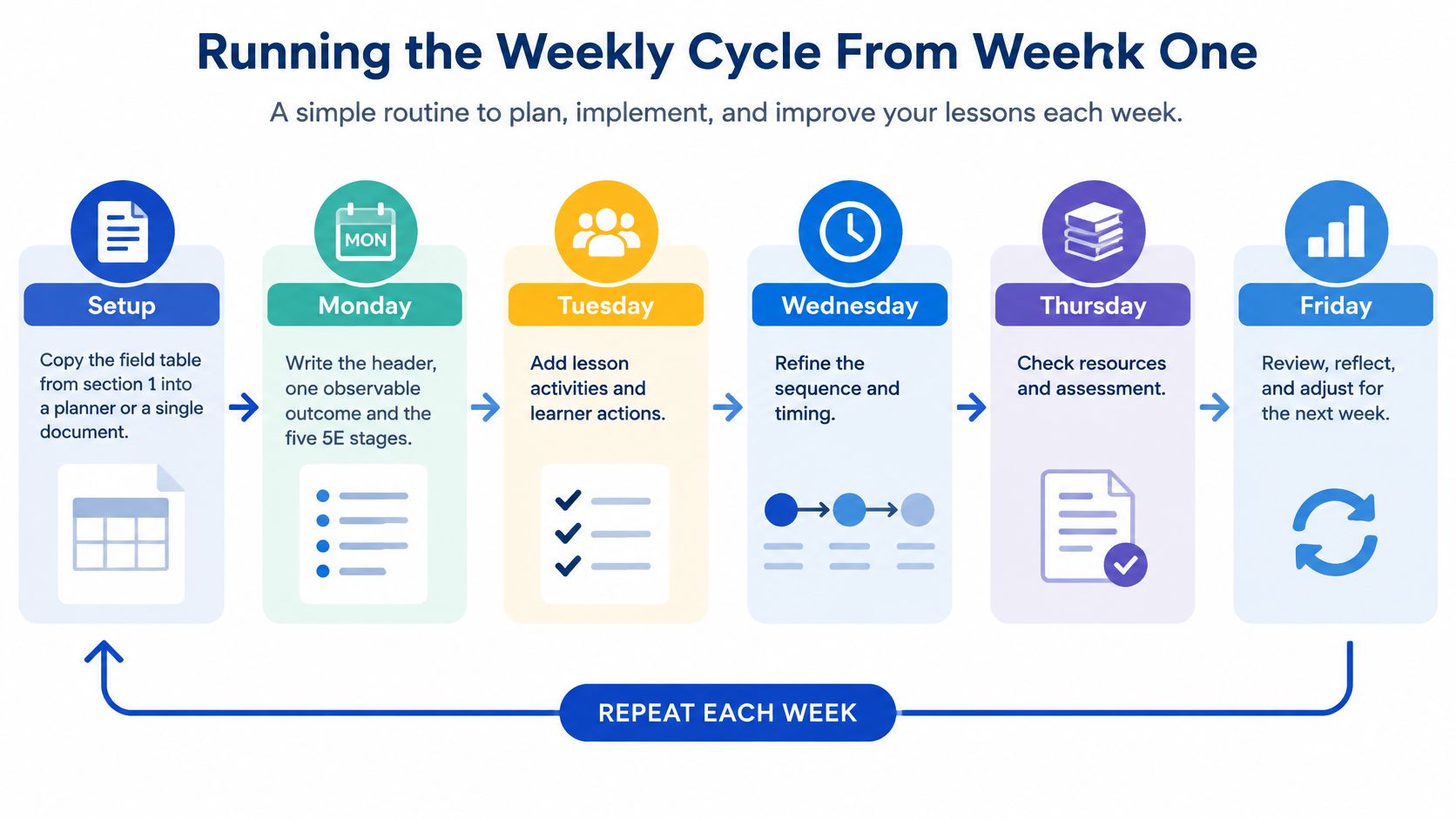
The timeline provides an organising view of the week; adapt the daily preparation tasks around your actual teaching periods.
Use a Teaching and Evidence Timeline
- Monday: Complete the header, observable outcome and planned learner actions. Use the outcome method in section 2 and allocate the stages using section 3.
- Tuesday: Check that learners can access the resources and begin collecting observations during teaching.
- Wednesday: Run a short independent check. Adjust support using the differentiation pattern in section 5 rather than waiting until the end of the week.
- Thursday: Check that your assessment task will produce evidence for the intended outcome, not just a convenient score.
- Friday: Complete outstanding evidence records, apply the rubric from section 4 and identify follow-up groups.
- Next Monday: Put the reteaching task near the top of the plan and schedule reassessment.
For a paper overview of follow-up dates, Dayleaf's printable Monday-first monthly calendar can sit beside the lesson records. Mark the reteaching and reassessment dates without copying sensitive learner details onto a publicly displayed calendar.
Keep Reporting Decisions Separate
A Pulse overview of the proposed KCBE transition reports projected contributions of 15% each for Grade 10 and Grade 11 school-based assessments, and 70% for the Grade 12 summative assessment. Treat these as reported proposals pending confirmation against the latest official KNEC or Ministry circular, not instructions for converting ordinary lesson checks into examination marks.
For term reporting, summarise the demonstrated strength, the specific strand needing attention and the recommended action. Parents need a practical next step, not merely a position in the class.
For digital preparation, our Keybaki workflow is to browse the library, attach resources to create lesson plans, then schedule and present them on the timetable. Teachers can assign a week's lessons in under an hour; our Teachers plan is free forever at KES 0 per teacher, with up to 3 subjects, unlimited lesson planning, unlimited CEAs on those subjects and a classroom presenter.
Keep the next-step field filled even when learners meet the outcome. The next step may be extension or transfer rather than reteaching.
Quick Checklist Before You Teach
Use this check against the actual plan, not against what you intend to remember during the lesson.
- Header complete: Grade, subject, week, lesson reference and duration are recorded, using the fields in section 1.
- Outcome observable: The verb, context and success criterion make achievement visible, following section 2.
- Sequence workable: The 5E allocations total the available teaching time, with checkpoints, as illustrated in section 3.
- Evidence identified: Selected assessment activities name an evidence type and the rubric descriptors you'll use, following section 4.
- Access planned: Support, core and extension tasks are clear, with an accommodation line, using section 5.
- Materials ready: Resources have a suitable low-cost or offline alternative, following section 6.
- Follow-up scheduled: Learners below the criterion have a specific reteaching and reassessment action, using section 7.
- Storage prepared: Each learner's evidence has a dated place in the paper or digital record described in section 4.
A plan missing the outcome, assessment evidence or follow-up action is incomplete, however full it looks, because those entries let the school judge competency development.
Keybaki connects curriculum-mapped lesson planning, classroom resources and continuous assessment so you can use learning evidence to prepare the next lesson. Visit Keybaki to build your weekly plan, review the activities and keep targeted follow-up part of your teaching routine.
Comments
Loading…