· CBC Kenya
CBE Learning Outcomes: A Practical Guide for Kenyan Schools
14 min read
The sharpest warning in Kenya's CBC journey is not about policy language, it's about learning. A national assessment reported that learner performance indices fell from 55.7 in Grade 3 to 39.0 in Grade 9, while 151,691 pioneer CBC learners had dropped out before reaching Grade 10, which tells us that moving learners through a system is not the same thing as helping them master it. The Standard's report on CBC dropout and performance trends forces a simple question that every teacher and parent should ask, what exactly is being measured, and what should children be able to do by the time they move on?
That question sits at the heart of CBE learning outcomes. In Kenya's CBC and CBE model, success is no longer just about finishing a syllabus, it's about whether a learner can demonstrate a competence in a real task, in a real class, with real evidence. UNESCO's review of Kenya's reform path points to six critical milestones, stakeholder participation, piloting, instructional resources, teacher capacity development, assessment policy, and formative or summative evaluation, because curriculum reform only works when all those pieces connect in practice, not just on paper. UNESCO's review of Kenya's curriculum reform journey
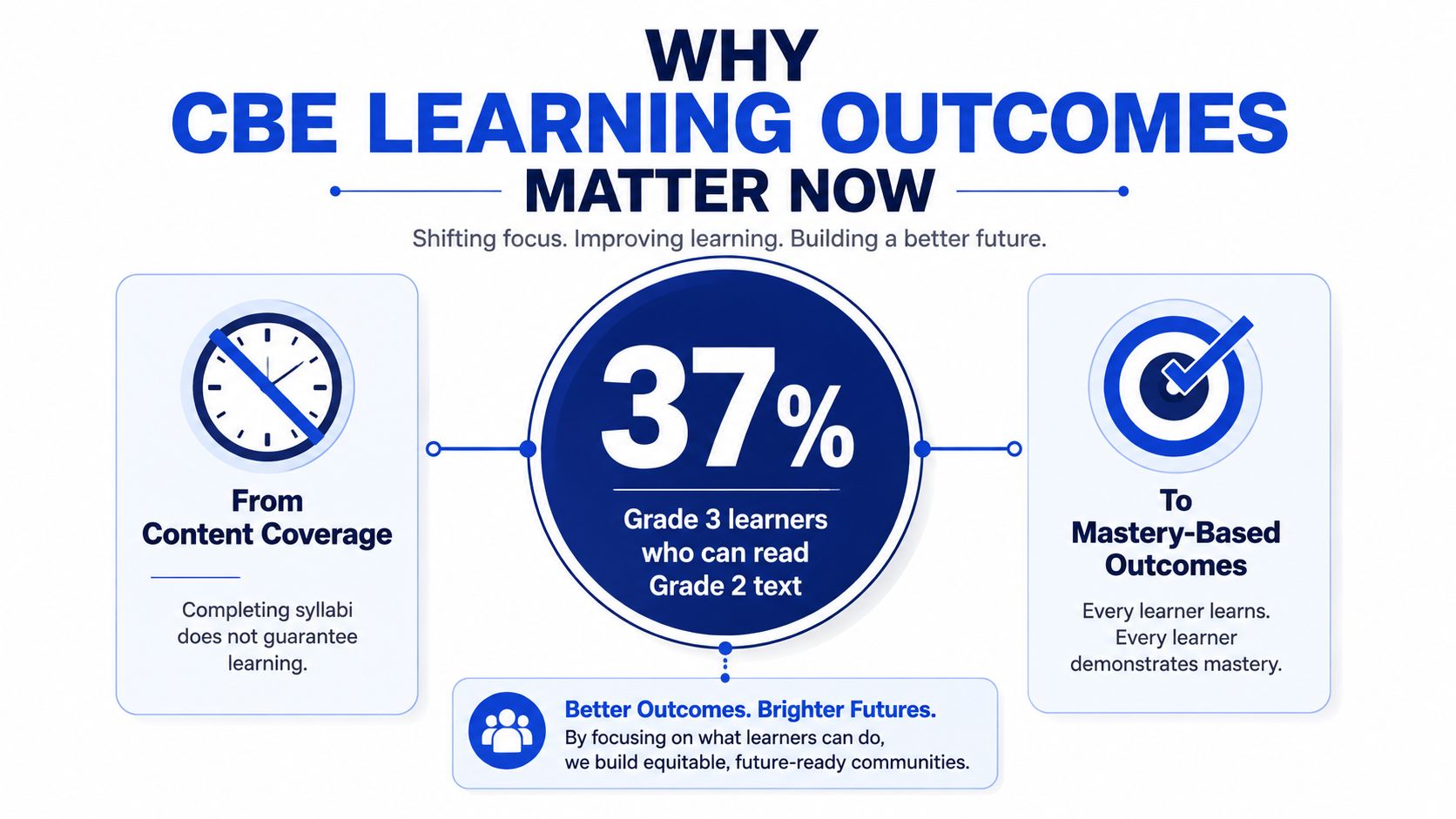
Table of Contents
- Why CBE Learning Outcomes Matter Now
- What CBE Learning Outcomes Actually Are
- Measurable Outcome Examples by Subject and Grade
- How to Write and Map CBE Outcomes to Assessments
- Closing the Loop with Continuous Assessment Data
- How Each Role Uses Outcome Data Differently
- Common Misconceptions About CBE Outcomes
Why CBE Learning Outcomes Matter Now
Kenyan classrooms are carrying two pressures at once, covering the curriculum and helping every learner master the competencies. Teachers still have to plan week by week, assess continuously, and respond to gaps that show up in the same class, sometimes in the same lesson. That is why CBE learning outcomes cannot stay on paper. They have to guide what happens in the room, in the exercise book, and in the next remediation step.
A covered topic is like a box ticked on a scheme of work. Mastery is the learner using the skill without prompting. If a child can repeat a rule but cannot apply it in a reading task, a number exercise, or a practical activity, the lesson is not yet complete in the CBE sense.
The current challenge is uneven learning progress. The Standard's CBC outcome report noted stronger outcomes in practical subjects such as Creative Arts and Agriculture, while theory-heavy areas like Mathematics and languages lagged. That pattern points to a familiar classroom reality. Learners often do better where they can see, touch, draw, build, or act out the task, and they struggle when the work stays abstract.
Kenya's Junior Secondary framework makes the expectation clear. Learners are meant to apply literacy, numeracy, and logical thinking, communicate well, show social, spiritual, and moral values, care for the environment, practise hygiene and nutrition, and act as responsible citizens. The Junior Secondary competency framework on Zenodo places outcomes at the level of visible behaviour, not lesson notes or topic titles.
Practical rule: if you cannot observe it, collect evidence for it, or reteach it after checking it, it is not yet useful for daily teaching.
That rule matters in weekly planning. A teacher may complete the week's activities and move on, yet part of the class still cannot do the actual competency. Without clear outcomes, continuous assessment becomes record keeping. With clear outcomes, it becomes a closed loop. You check the strand, see where learners are stuck, reteach the same skill in a different way, and confirm whether the gap has closed.
That is the value of CBE learning outcomes. They connect the curriculum document to classroom action. They tell teachers what to teach, what evidence to look for, and what to do next when learners are not ready yet. In a system built around mastery, that link is what turns planning into progress.
What CBE Learning Outcomes Actually Are
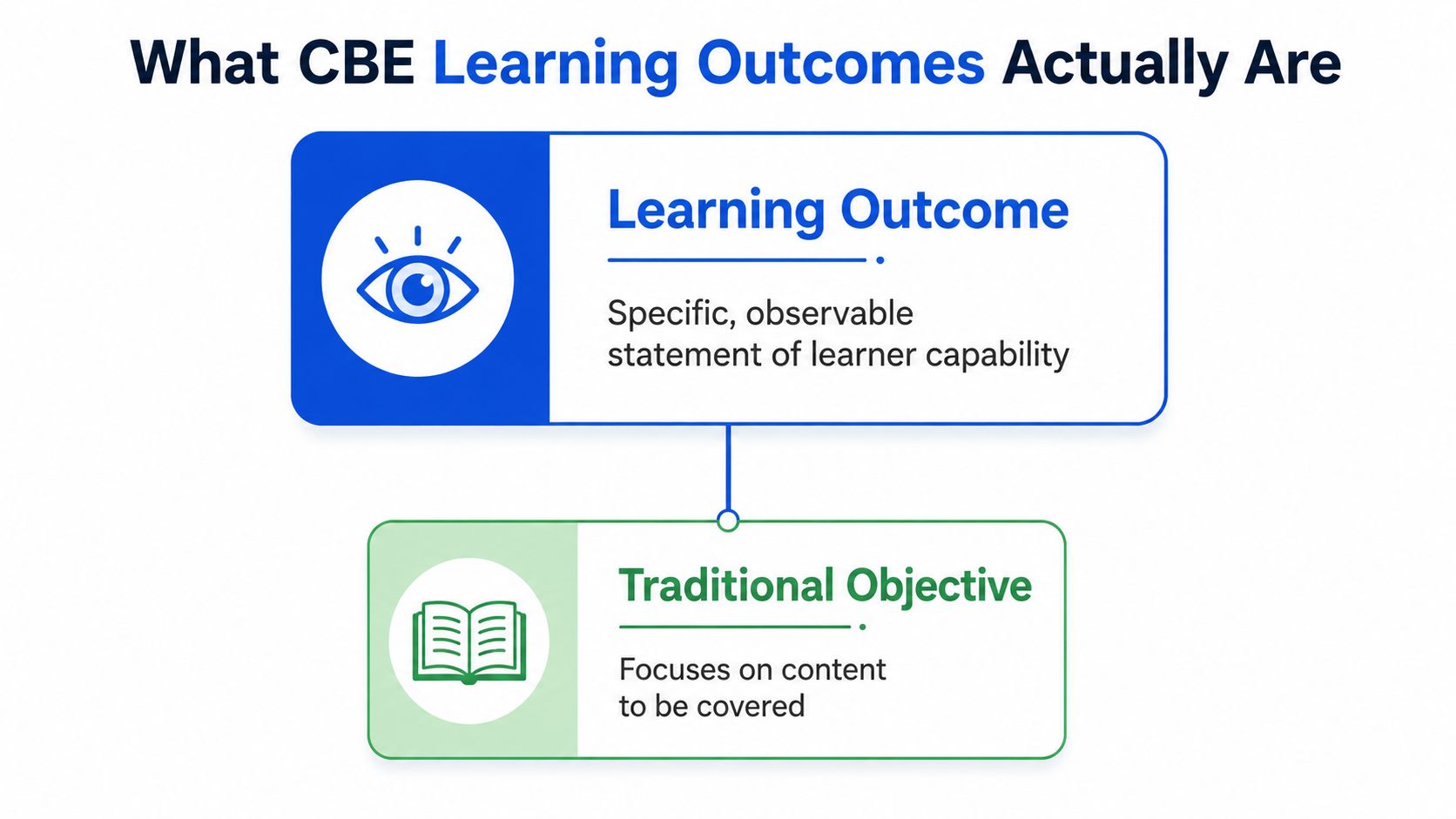
A good CBE learning outcome is a clear statement of what a learner can do after working through a strand or sub-strand. It is not a topic heading, and it is not a teacher activity. It describes learner capability in language that can be observed in class, during an oral task, in a written response, or through a practical demonstration.
The structure behind the statement
CBC is organised by learning area, strand, sub-strand, and then the outcome statements tied to that sub-strand. That structure matters because it keeps planning specific. If the strand is too broad, the teacher cannot tell what evidence counts. If the sub-strand is clear, the teacher can plan one lesson, one assessment, and one remediation step around it.
The three domains also matter. Cognitive outcomes focus on thinking and understanding, psychomotor outcomes focus on doing and using skills, and affective outcomes focus on values, attitudes, and behaviour. CBC does not treat recall as enough, because a learner can know a rule and still fail to apply it properly in a real situation.
Weak wording versus strong wording
A weak outcome sounds like this, “understand fractions.” It is vague, hard to observe, and impossible to score cleanly. A stronger CBC outcome sounds like this, “identify, compare, and order proper fractions up to denominators of 10 using concrete materials.” That version tells the teacher what to look for, what materials to use, and what counts as evidence.
Teacher test: if the outcome can fit on a checklist, a rubric, and a lesson observation note, it is probably written well.
The link between outcomes and classroom work is what makes them practical. They are not the activity itself. They are the mastery target that the activity should produce. If a lesson activity is a group discussion, the outcome is still the learner capability being assessed, not the discussion.
For a plain-language overview of how CBC is organised in practice, the competency-based curriculum guide is a useful companion for teachers who want the big picture before they design daily lessons.
Measurable Outcome Examples by Subject and Grade
The easiest way to understand CBE learning outcomes is to see them in classroom language. The outcome should say what the learner will do, under what conditions, and how the teacher will know the learner has done it well enough. That is what makes the outcome assessable during ordinary teaching, not only at the end of a term.
Outcome examples that teachers can actually use
| Grade & Subject | Strand / Sub-Strand | Learning Outcome Statement | Action Verb & Evidence Type |
|---|---|---|---|
| Grade 1 Literacy | Listening and Speaking / Following Instructions | Listen to and follow two-step oral instructions in familiar contexts | Listen, follow, oral performance, teacher observation |
| Grade 4 Mathematics | Numbers / Multiplication | Multiply single-digit numbers by numbers up to 50 using repeated addition and arrays | Multiply, use of repeated addition, written and manipulatives evidence |
| Grade 7 Integrated Science | Living Things / Classification | Classify local plants into monocots and dicots using observable characteristics and present findings in a labeled chart | Classify, practical observation, charted presentation |
These examples work because each one includes a clear verb and a visible product. A Grade 1 teacher can hear whether a child follows a two-step instruction. A Grade 4 teacher can watch a learner build an array and explain how the answer was reached. A Grade 7 teacher can inspect the chart and see whether the learner used the right traits to classify plants.
What makes the outcomes measurable
The measurable part is not just the verb. It is also the performance condition and the evidence threshold. “Using concrete materials” tells the teacher how the learner should show the skill. “Present findings in a labeled chart” tells the teacher what the product should look like. That is what turns an outcome into a rubric item instead of a general hope.
This is also why weekly formative assessment becomes so useful. The teacher does not need to wait for a big test to know whether a child can do the task. During ordinary class work, the teacher can observe, question, and score the outcome against the agreed criteria.
For a detailed breakdown of how strands and sub-strands are organised, the strand and sub-strand guide can help teachers connect lesson planning language to the curriculum tree.
How to Write and Map CBE Outcomes to Assessments
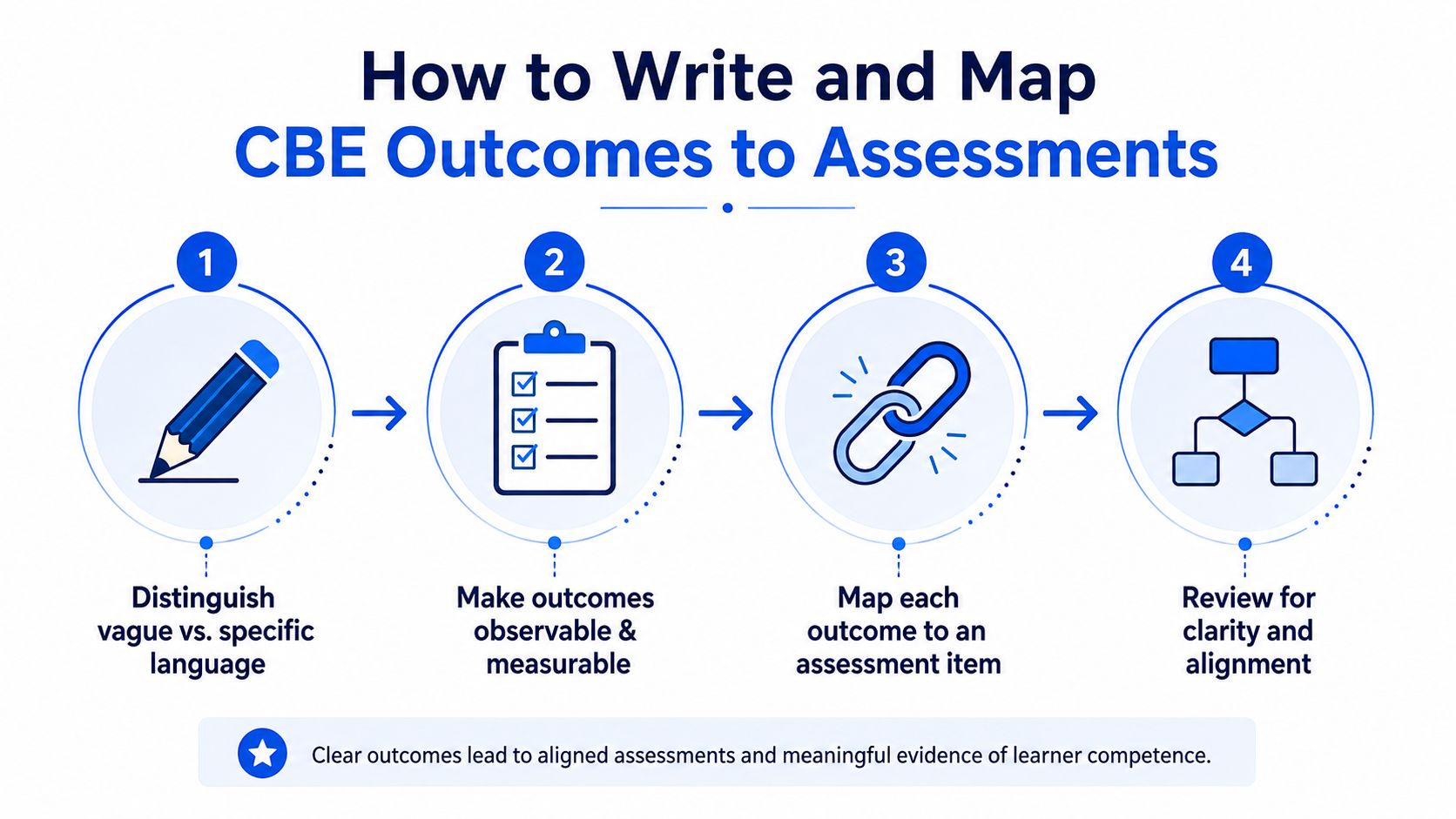
Strong CBE learning outcomes start with the curriculum design, not with a worksheet. The first task is to identify the core competency and the strand from the CBC document. The second is to write the outcome in observable language. The third is to attach it to an assessment task that produces evidence.
A simple writing method
Start by removing vague words. “Know,” “appreciate,” and “understand” often sound neat, but they do not tell the teacher what to watch for. Replace them with verbs that show action, such as identify, compare, classify, construct, explain, demonstrate, or apply.
Then add the condition. If the learner should work with visual models, say so. If the learner should solve a problem in pairs, say so. If the learner should present findings orally, that also belongs in the outcome or in the assessment brief.
Finally, decide what proof counts. A correct answer alone may not be enough in some strands. A diagram, a chart, a short explanation, or a practical demonstration may be the better indicator.
Backward design in lesson planning
Useful planning rule: write the assessment first, then the lesson, then the activity. If the evidence is unclear, the lesson will drift.
That sequence keeps weekly planning tight. Suppose the outcome is that learners compare fractions using visual models. The assessment can be a short task where they arrange fraction cards or shade equivalent parts on paper. The lesson then needs materials, guided practice, and examples that prepare learners for that exact task.
The mapping works best when each lesson cycle stays aligned to one visible outcome. A class activity may be lively, but if it does not produce evidence for the outcome, it is decoration. Teachers should be able to point to the outcome, the activity, and the assessment, and show how they belong together.
A practical rubric framework for this kind of alignment is easier to build once the outcome is fixed. The CBC assessment rubrics guide can support teachers who want to turn outcome language into clear scoring criteria.
Closing the Loop with Continuous Assessment Data
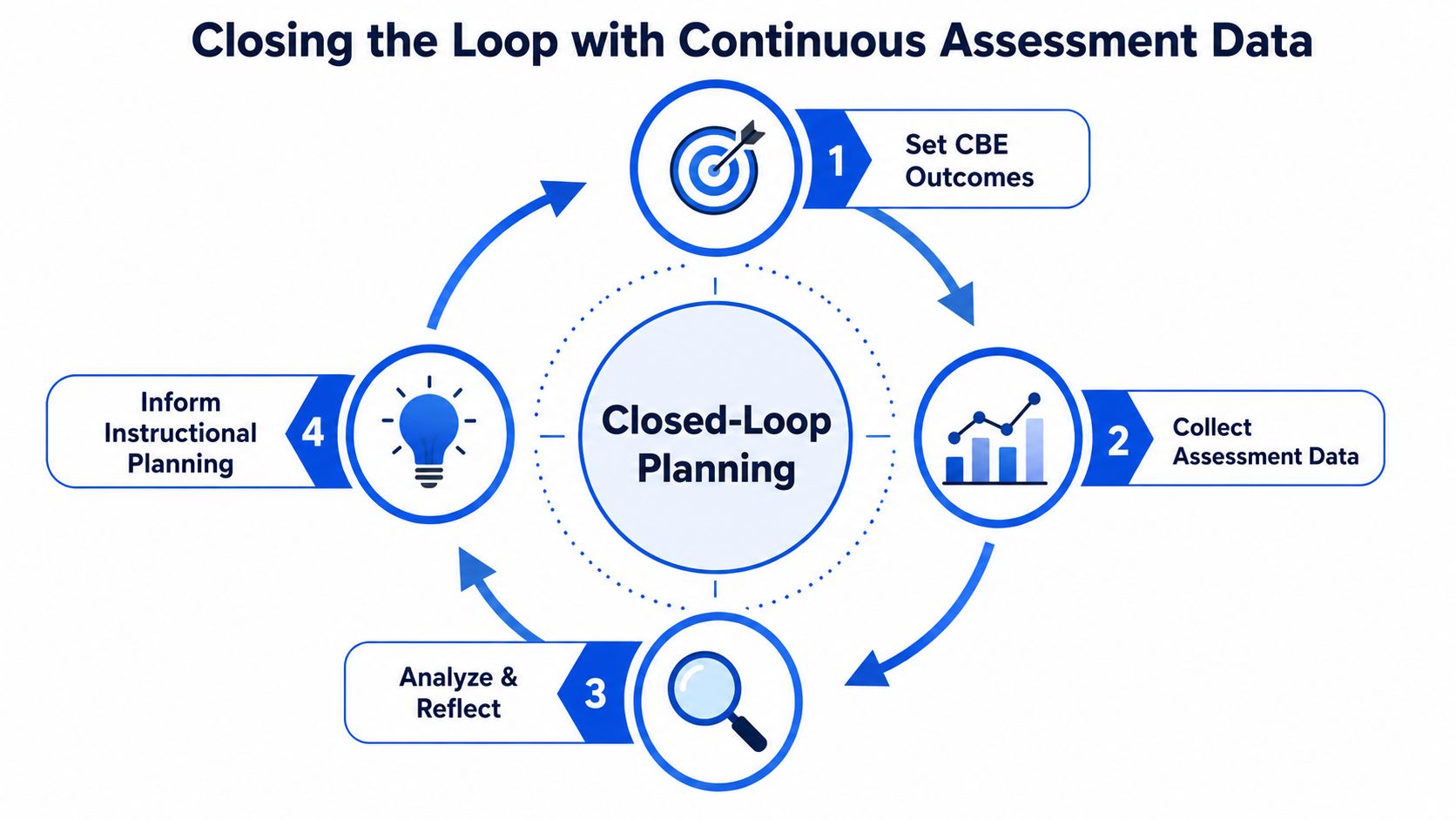
A CBE lesson is only complete when the result of the assessment changes the next lesson. That is the meaning of closed-loop planning. Teachers set the outcome, collect evidence, analyse what learners did, and then adjust the next week's teaching based on that evidence.
What the loop looks like in practice
The standard linear habit in many schools is simple. Teach the topic, mark the task, move to the next topic. The problem is that some learners move on before they have mastered the strand, and the gaps get wider when the work becomes harder.
Closed-loop planning works differently. If a learner misses the target in a sub-strand, the teacher does not just record the score and continue. The teacher identifies the weak strand, reteaches the part that failed, and uses a new task to check whether the learner now meets the outcome.
That approach is already visible in tools that organise learning by strand and sub-strand. Keybaki is one option that links planning, assessment, and remediation in a weekly loop, with Continuous Evaluation Assessments tied to CBE curriculum strands and weak areas routed into the next week's plan. The important idea is not the tool name, it is the workflow: the assessment result has to influence the next lesson, or the assessment is just a record.
Why weekly data matters more than end-term surprise
Weekly data gives teachers something usable. A teacher can see which learners need support before the class moves into a new sub-strand. That is much better than discovering a gap after several weeks of new content have piled on top of an old weakness.
The strongest schools do not wait for learners to fail repeatedly. They use the previous week's evidence to group learners, reteach the hard part, and set a shorter check before the class advances. This is how CBE learning outcomes stay alive in real classrooms, instead of sitting in a scheme of work as tidy but unused statements.
The goal is not more marking. The goal is better decisions after marking.
What teachers should look for after each check
- Which strand is weak: name the exact sub-strand, not the whole subject.
- Which learners are behind: identify who needs reteaching, practice, or support.
- Which task failed: check whether the activity matched the outcome.
- What to change next week: adjust grouping, materials, pace, or the sequence of examples.
How Each Role Uses Outcome Data Differently
The same CBE learning outcomes data serves different people in different ways. Teachers need it for immediate classroom action. Parents need it to understand progress. School leaders need it to see patterns across classes. Learners need it to see their own growth clearly.
Comparing the four views
| Stakeholder | Data View | Primary Action |
|---|---|---|
| Teacher | Strand-level and sub-strand-level scores | Reteach, regroup, enrich, and adjust the next lesson |
| Parent | Simplified mastery report by skill area | Support practice at home and follow the weak areas |
| School lead | Aggregated patterns across classes and grades | Spot recurring gaps, support teachers, and plan resources |
| Learner | Personal progress view with mastered and pending outcomes | Set effort targets and track what still needs work |
The teacher's view is the most immediate. A low score in one sub-strand is a signal to change instruction, not a reason to move on and hope for the best. The parent's view should strip away jargon and show what the child can do, where the child is stuck, and what practice would help.
School heads and curriculum leads need a wider lens. When the same strand keeps appearing as weak across several classes, the issue may not be the learners alone. It may point to resource gaps, pacing issues, or a need for teacher support.
Learners also benefit when outcomes are visible. A learner who can see that one skill has been mastered and another is still pending learns to read progress as a process, not a verdict. That kind of visibility helps build responsibility without shame.
Common Misconceptions About CBE Outcomes
The biggest mistake in many schools is treating CBE learning outcomes like renamed content objectives. That mistake turns CBC back into a checklist of topics, which defeats the whole point of mastery-based learning.
Three myths that keep showing up
Myth one, outcomes are just topics to teach.
They are not. A topic is content. An outcome is the learner's demonstrated ability after working with that content.
Myth two, if activities are done, assessment is done.
Also not true. A lively lesson can still produce weak learning evidence. A learner may colour, cut, discuss, and paste, yet still not meet the competency.
Myth three, CBE means less academic rigour.
It means clearer rigour. Learners still need conceptual understanding, correct methods, and accurate performance. The difference is that the teacher checks those things directly.
Blanket coverage feels efficient, but it leaves gaps behind. Data-driven remediation is slower at first, but it prevents the same weak strand from reappearing every time the syllabus gets more demanding. That is why a teacher who uses evidence well can protect learning time instead of wasting it on repeated confusion.
The shift is mental. Once a school accepts that outcomes are the standard, not the activity, everything changes. Planning becomes sharper, assessment becomes more honest, and remediation becomes a normal part of teaching instead of an emergency response.
If you want a practical way to plan by strand, assess against real outcomes, and see weak areas before they become bigger gaps, visit Keybaki. It links weekly planning, assessment, and remediation around the same CBE learning outcomes, which makes it easier for teachers, parents, and school leaders to act on what learners need next.
Comments
Loading…