
· Keybaki e-learning
Social Sciences Pathway Kenya: Complete CBE Guide
16 min read
A parent looks at a Grade 9 assessment report and faces a high-stakes question: should the learner enter STEM, Social Sciences, or Arts & Sports Science in Grade 10? In many homes, Social Sciences is still treated as a second choice. That assumption can hide a pathway built for learners who understand people, institutions, communities, communication, and commerce.
Kenya's senior school curriculum now organises learning into recognised pathways. The official Grade 10 selection system lists Social Sciences alongside STEM and Arts & Sports Science, confirming that it is part of the national placement structure, not an informal alternative (selection.education.go.ke). The pathway offers a clear route into humanities, business, languages, civic life and multiple forms of tertiary study and work.
How CEAs and Mastery Shape Learning in Social Sciences
Table of Contents
- What the Social Sciences Pathway in Kenya Really Means
- Subjects and Tracks Inside the Pathway
- How Assessment and Mastery Shape Learning in Social Sciences
- Social Sciences Versus STEM and Arts Pathways
- Career and Tertiary Routes for Kenyan Learners
- Practical Planning with Keybaki for Teachers and Families
- Short FAQ
- Common Misconceptions About the Social Sciences Pathway
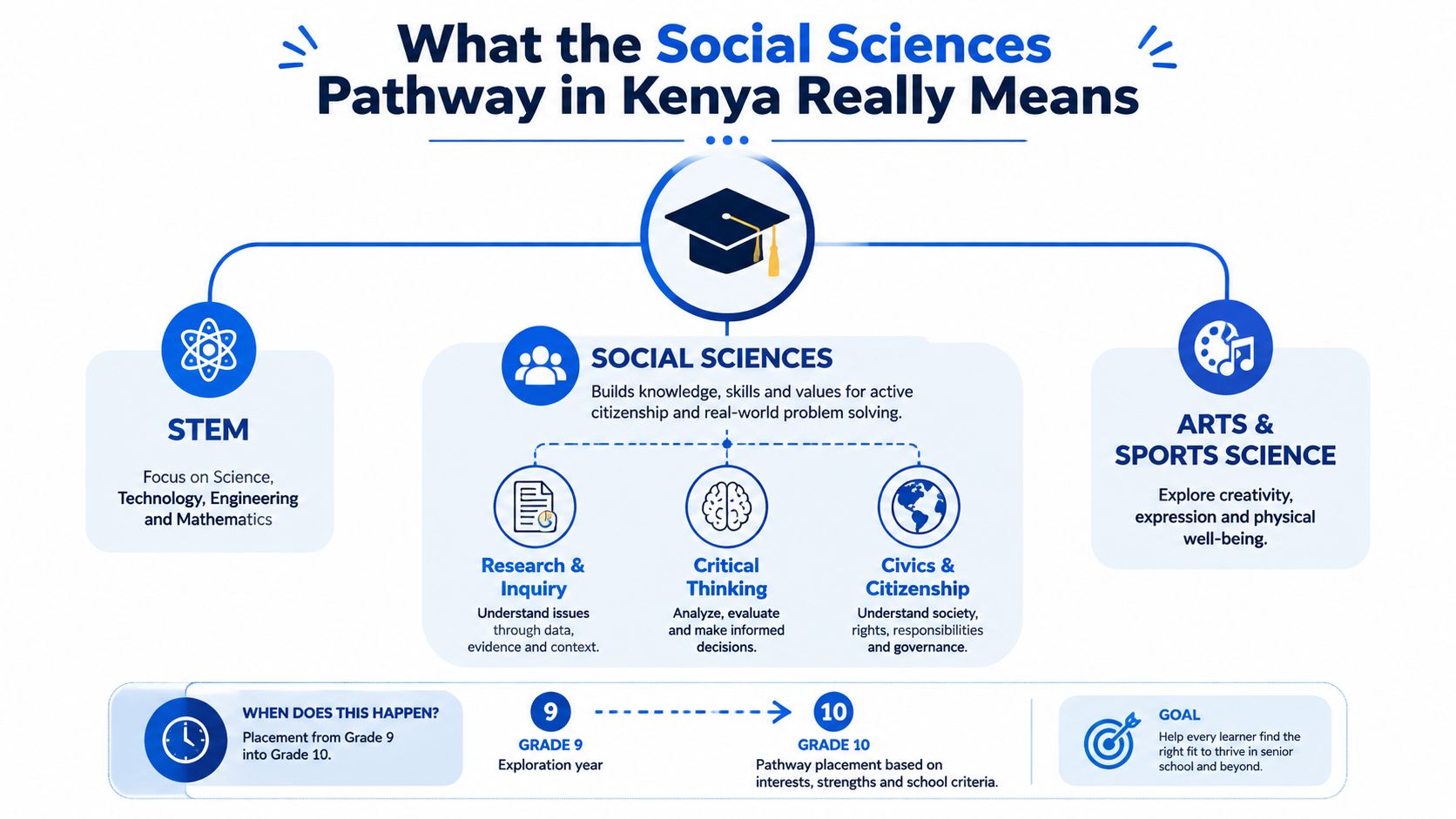
What the Social Sciences Pathway in Kenya Really Means
The Social Sciences pathway starts with a simple question: how does this learner think, communicate and respond to the world around them? A learner who enjoys explaining historical causes, interpreting maps, discussing fairness, organising a small enterprise or presenting an argument may suit this route.
It is not a fallback. It is a deliberate senior school option within Kenya's competency based system. The pathway sits in Grades 10 to 12, where learners move from broad junior school learning to focused subject choices. The national roadmap identifies Social Sciences as one of the main senior school pathways and the official Grade 10 pathway portal includes it as an active choice (selection.education.go.ke).
A route built around people and systems
A useful way to think about the pathway is through three broad abilities:
- Civic understanding, including history, citizenship, governance, ethics, and community life.
- Commercial awareness, including business thinking, enterprise, financial decisions, and market behaviour.
- Communication and interpretation, including languages, written argument, reading sources, and presenting ideas clearly.
A learner might analyse county services, compare historical sources, conduct a community survey, or explain a geographical pattern. These tasks ask learners to gather information, judge evidence, identify relationships, and communicate a defensible conclusion.
Families should see the pathway as a foundation, not a career label. It can support later study in law, education, governance, business, media, development, public administration, tourism, or communication.
What parents should decide at placement
Parents should not ask only, "Which pathway has the highest status?" A better discussion asks:
- Which subjects does the learner approach with sustained curiosity?
- Can the learner explain ideas in speech and writing?
- Does the learner notice patterns in society, places, business, or public life?
- Does the school have the teachers and timetable capacity for the selected combination?
- Does the learner's assessment evidence support the proposed choice?
The competency-based curriculum explanation helps families see why the decision should reflect demonstrated ability and interest, not parental prestige.
Subjects and Tracks Inside the Pathway
Social Sciences is not one subject. It is a pathway with approved subject options across areas such as Humanities, Business Studies, Literature, Languages, and Religious Education, with combinations shaped by the school's approved offering and timetable. Public summaries of senior school structure commonly state that learners take 7 examinable subjects, 4 core subjects and 3 electives, within their pathway (cbcedukenya.com, educationnews.co.ke).
The safest way to describe the structure is this: English, Kiswahili, Mathematics, and Community Service Learning are commonly described as the senior school core subjects in public summaries. Public guidance also notes approved adjustments, such as Kenyan Sign Language for some learners, and pathway-related mathematics distinctions (cbcedukenya.com, educationnews.co.ke). Social Sciences choices then add civic, commercial, literary, religious, and geographical study.
The main subject families
The table below is a practical guide, not a replacement for the school's approved curriculum documents.
| Category | Subject | Status | Typical Focus |
|---|---|---|---|
| Common senior school core | English | Commonly described as core in public summaries | Comprehension, communication, composition, and interpretation |
| Common senior school core | Kiswahili, or Kenyan Sign Language where applicable | Commonly described as core or approved adjustment | Oral communication, grammar, literature, and cultural expression |
| Common senior school core | Mathematics | Commonly described as core in public summaries | Numeracy, reasoning, data interpretation, and problem solving |
| Common senior school core | Community Service Learning | Commonly described as core in public summaries | Service, reflection, responsibility, and community engagement |
| Humanities | History and Citizenship | Pathway option | Historical evidence, citizenship, governance, identity, and social change |
| Humanities | Geography | Pathway option | People, places, environment, resources, mapping, and field inquiry |
| Commerce | Business Studies | Pathway option | Enterprise, markets, financial awareness, management, and business decisions |
| Values and religion | CRE, IRE, or HRE | Pathway option | Ethics, faith, values, responsibility, and social questions |
| Literature and languages | Literature in English, Fasihi ya Kiswahili, French, German, Arabic, Mandarin, indigenous languages, or Kenya Sign Language where offered | Pathway option where approved | Language proficiency, communication, culture, and literary interpretation |
| Digital option | Computer Studies | Pathway option where approved | Digital skills, applications, and problem solving |
Public summaries of the Social Sciences pathway list subjects such as History and Citizenship, Geography, Business Studies, religious education, Literature in English, Fasihi ya Kiswahili, languages, and Computer Studies, depending on what a school is approved and staffed to offer (theonlinekenyan.com, educationnews.co.ke).
How combinations create emphasis
A learner interested in commerce might take Business Studies alongside other approved Social Sciences options. Another learner interested in civic or community issues may prefer History and Citizenship, Geography, and religious education. A learner drawn to communication may combine literature or a language with other approved pathway subjects, where offered and approved by the school.
Before placement, ask for the actual subject combinations, teacher availability, timetable arrangement, and progression requirements.
Planning rule: Choose a combination the school can deliver consistently, not just one that looks attractive on paper.
Teachers also need to keep curriculum terms distinct. A subject is the broad area, such as Geography. A strand is a major organiser within that subject. A learning outcome states what the learner should be able to do in a lesson or sequence. A competency is the broader ability shown across tasks and contexts. Mastery describes how securely the learner can demonstrate that expected performance over time. The strand and sub-strand guide can help teachers turn a broad subject title into teachable lesson targets and evidence.
How Assessment and Mastery Shape Learning in Social Sciences
A Social Sciences classroom should not wait for an end-of-term exam to discover that learners can recite definitions but cannot use evidence. In Kenya's assessment language, the formal term is Competency Based Assessment, or CBA, while classroom and school-based assessment describe how evidence is gathered during learning (education.go.ke, cbc.co.ke).
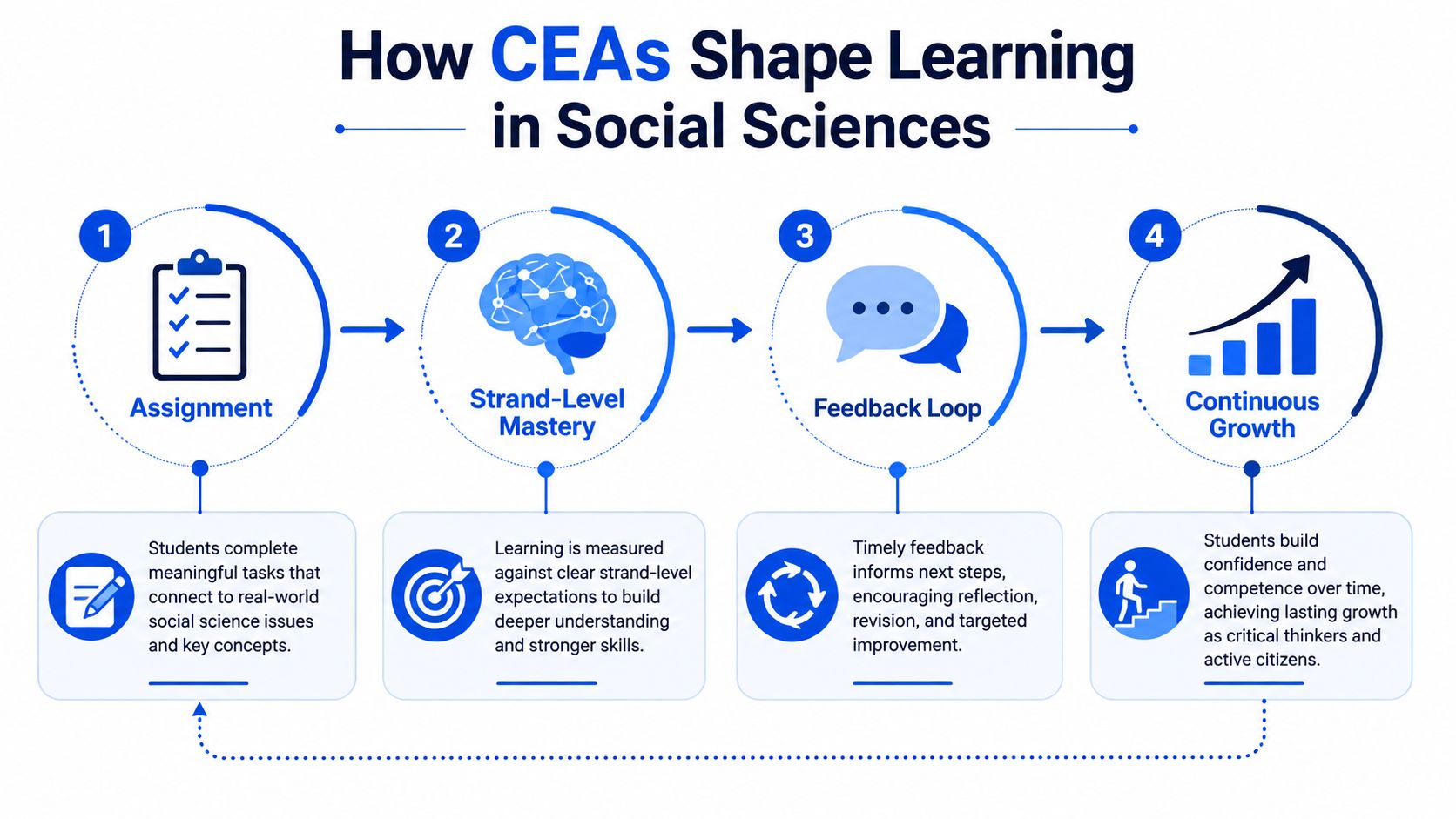
A useful assessment cycle starts with a clear learning outcome. The teacher chooses a task that makes that outcome visible, gathers evidence, gives feedback, and records the learner's current level of performance. The next lesson or revision activity should respond to that evidence.
A practical assessment cycle
A teacher might organise the work like this:
- Select the learning outcome. For example, learners should interpret evidence about a community issue.
- Set the task. Learners review short sources, conduct a simple survey, or analyse a local case.
- Collect evidence. The teacher checks questions, data handling, explanation, collaboration, and presentation.
- Give targeted feedback. The teacher identifies whether the difficulty is in source selection, reasoning, writing, or communication.
- Plan the response. Learners revisit the weak area through a new exercise, conference, or guided example.
A Social Sciences assessment does not have to be a long project. It could be a source-based written response, map interpretation, business case, structured debate, presentation, or community investigation. The task should match the intended learning outcome and competency.
Example from a Geography strand
Suppose a class is learning about human settlement and local services. The teacher asks learners to identify a service in their area, gather information through observation or a short interview, organise the findings, and explain why access differs between locations.
The rubric might look at:
- Information gathering, whether the learner collected relevant evidence.
- Interpretation, whether the learner identified a reasonable pattern.
- Communication, whether the report or presentation is clear.
- Civic connection, whether the learner relates the issue to community needs.
- Reflection, whether the learner can explain what they would investigate next.
A parent reading the result should look beyond a single mark. Ask, "Which part of the process is secure, and which part needs support?" A learner may understand the geographical idea but struggle to structure a report. Another may write fluently but rely on weak evidence.
The CBA workflow can be supported by competency-based assessment examples, especially when teachers need task ideas that move from learning outcome to observable evidence.
When results return, the teacher should adjust instruction. A weak result is not just a label. It is a prompt to reteach, model, practise, and reassess the specific strand or skill.
Social Sciences Versus STEM and Arts Pathways
Pathway choice becomes clearer when families compare learning behaviour rather than status. A learner who enjoys investigating social questions may thrive in Social Sciences, while a learner who prefers experiments, technical systems, or numerical modelling may be more comfortable in STEM. A learner who communicates through movement, performance, design, or visual expression may find a better fit in Arts & Sports Science.
| Dimension | Social Sciences | STEM | Arts & Sports Science |
|---|---|---|---|
| Learner profile | Curious about society, communication, commerce, history, places, and public life | Interested in experiments, systems, numbers, technology, and scientific explanations | Drawn to creative expression, performance, design, movement, or sport |
| Typical learning evidence | Essays, source analysis, field investigations, debates, case studies, and presentations | Practical investigations, calculations, models, laboratory work, and technical tasks | Performances, portfolios, rehearsals, creative projects, and demonstrations |
| Main classroom question | What happened, why did it happen, and what does it mean for people and institutions? | How does the system work, and can we test or calculate the result? | How can the idea be expressed, performed, designed, or improved? |
| Planning needs | Reading materials, discussion time, fieldwork, writing support, and source resources | Laboratories, equipment, problem sets, technical resources, and practical supervision | Studios, performance space, instruments, equipment, coaching, and portfolio time |
| Possible post-school direction | Law, business, governance, communication, education, development, and related social fields | Science, engineering, medicine, computing, agriculture, and technical fields | Creative industries, sport, design, performance, media, and related practical fields |
The table is not a ranking. It is a fit check. Teachers should use assessment evidence, learner conversations, and school capacity together.
Career and Tertiary Routes for Kenyan Learners
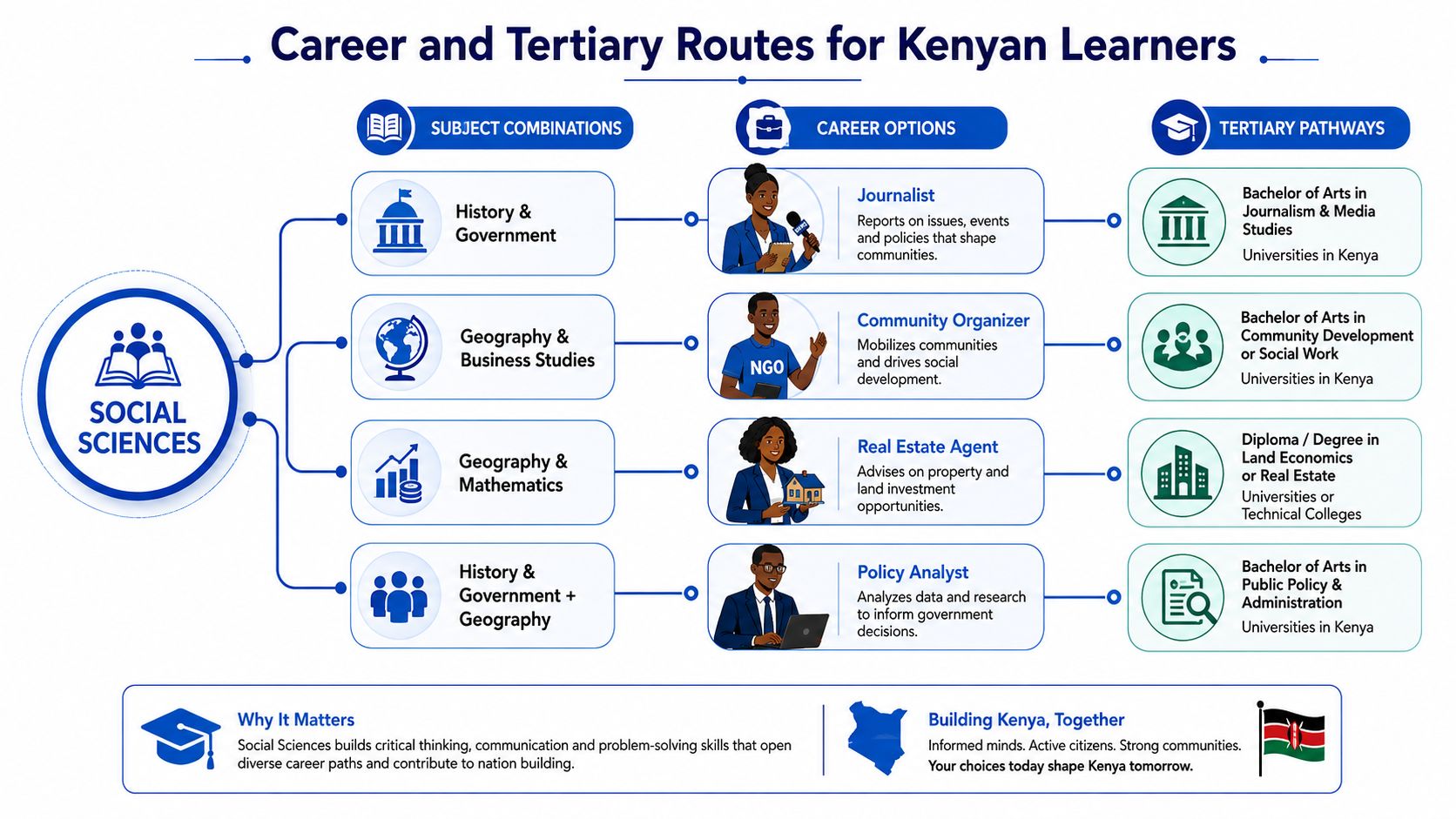
The strongest case for Social Sciences is broader than the familiar list of law, journalism, and diplomacy. The pathway develops interpretation, communication, commercial awareness, civic understanding, and institutional knowledge. Those abilities can apply in universities, colleges, TVET environments, public institutions, county programmes, businesses, civil society organisations, and public-facing services.
A learner combining History and Citizenship with Geography may later explore governance, development, urban planning, environmental policy, tourism, or community research. These routes still require the right tertiary qualifications and admissions conditions, so subject selection should be checked against the requirements of the intended programme.
Commerce and communication routes
Business Studies can support later study in business administration, accounting-related fields, banking, marketing, entrepreneurship, supply chain work, and financial services. Learners who add strong communication skills may also consider public relations, customer experience, journalism, content work, market research, or communications roles.
A language or literature combination can widen communication and cultural routes. Depending on the institution and entry rules, learners may progress towards translation, tourism, international business, teaching, publishing, media, or public-facing administration.
County and public service possibilities
Kenya's devolved system creates community-facing work across counties and local institutions. Examples include county administration support, community development work, civic education, public participation, records and programme coordination, and research assistance. These are not automatic jobs for every graduate. They are fields where Social Sciences knowledge can matter when combined with the required diploma, degree, professional experience, or public service conditions.
Learners can consider different tertiary levels. A diploma may provide focused entry into business, communication, community development, tourism, or public administration. A degree may lead to broader study in education, governance, development, economics, business, communication, geography, or related fields. Institutions such as Kenyatta University, Moi University, and the Kenya School of Government represent different types of tertiary routes, but families should verify current programme requirements directly.
Career advice for families: Start with a subject combination, then check the entry requirements for the actual programme. Do not promise a career from a pathway title alone.
The People Daily discussion of CBE pathways, tracks, and learning areas also reflects the need to view Social Sciences as a mixed civic, commercial, and communication route.
Practical Planning with Keybaki for Teachers and Families
Good pathway decisions need a learning system that continues after placement. Teachers need to know what to teach each week, learners need focused practice, and parents need enough visibility to support progress.
For teachers
Start by mapping the term's work in subjects such as History and Citizenship, Geography, Business Studies, or religious education to specific strands and lesson-level learning outcomes. Use the weekly planner to place lesson objectives, activities, materials, and assessment tasks in the same sequence.
Keybaki publicly presents an AI-assisted lesson planner, timetable-linked planning, and support for daily teaching flow (keybaki.com/lesson-planner, app.keybaki.com/help/plans/create-wizard). It also describes parent progress access, assessments, and reporting features on its main site (keybaki.com, keybaki.com/features).
For parents
Use the parent view to look for patterns across strands rather than react to one disappointing result. A learner may be strong in historical explanation but need help with source evaluation. Another may understand business concepts but struggle to present calculations clearly.
Ask three practical questions during a review:
- What is secure? Which strands or skills does the learner demonstrate independently?
- What is developing? Where does the learner succeed with prompts or examples?
- What needs action? What specific practice should happen before the next assessment?
For learners
Build revision around tasks, not just chapter reading. Practise turning a source into a short argument, interpreting a map or table, writing a structured essay, explaining a business decision, and presenting findings from a community issue.
A simple weekly routine can include one reading task, one written response, one discussion or oral explanation, and one review of feedback.
Keybaki says its digital library is live for Grades 7 to 10, while Grades 11 and 12 are coming soon (keybaki.com). That makes it important to describe product support carefully rather than assume full live coverage across all senior school grades.
Short FAQ
What is the Social Sciences pathway in Kenya?
The Social Sciences pathway in Kenya is one of the three senior school pathways under the competency-based system. It is designed for learners interested in humanities, business, languages, geography, literature, communication, and civic life.
Which subjects are in the Social Sciences pathway in Kenya?
Subjects commonly offered in the Social Sciences pathway include History and Citizenship, Geography, Business Studies, CRE, IRE, HRE, Literature in English, Fasihi ya Kiswahili, languages, and Computer Studies. The exact combination depends on what a school is approved and staffed to offer.
How many subjects do learners take in Grade 10 in Kenya?
Learners in Grade 10 are commonly described in public summaries as taking 7 examinable subjects. These are usually organised as 4 core subjects and 3 electives within the selected pathway (cbcedukenya.com, educationnews.co.ke).
What careers can the Social Sciences pathway lead to in Kenya?
The Social Sciences pathway can lead to further study and careers in business, communication, education, governance, development, tourism, public administration, and related social fields. The final route depends on the learner's subject combination and the entry requirements of the chosen college or university programme.
How do parents choose the Social Sciences pathway in Grade 10?
Parents should choose the Social Sciences pathway by looking at the learner's interests, assessment evidence, strengths in subjects such as humanities or business, and the school's approved subject combinations. The best choice is the one that matches both learner ability and school capacity.
Common Misconceptions About the Social Sciences Pathway
"Social Sciences is for learners who can't handle STEM." This confuses different kinds of difficulty. History requires evidence-based interpretation, Geography can involve field inquiry and spatial reasoning, Business Studies requires commercial judgement, and religious education can demand careful ethical analysis.
"It only leads to law or teaching." Those are possible routes, but not the whole picture. Social Sciences can support later study and work connected to business, public administration, communication, development, tourism, community programmes, market research, and county services.
"The pathway closes university options." Subject combinations do matter, and families should check KUCCPS and institutional requirements before making promises. However, a well-chosen combination can support several tertiary directions in business, communication, governance, education, development, geography, and related fields.
The better test is fit. If a learner is strong in critical thinking, communication, social interpretation, enterprise, and understanding institutions, Social Sciences may be a strategic choice. Teachers and parents should judge the pathway by the learner's evidence and goals, not by old 8-4-4 stereotypes.
Keybaki offers CBE mapped lesson planning, learning resources, assessments, and shared progress views for teachers, learners, and families. Visit Keybaki to connect Social Sciences planning, classroom evidence and targeted revision in one weekly learning loop.
Comments
Loading…