· competency-based evaluation
Portfolio Assessment in CBE: A Practical Teacher Guide
14 min read

You can tell when a portfolio cycle is going off the rails. The folder is full, the grading pile is growing, and half the class has work in three different places, a notebook, a phone gallery, and a dusty exercise book at the back of the room. In a CBE classroom, that kind of scatter is not just messy, it weakens the evidence you need to show real competency growth.
Portfolio assessment only works when it behaves like evidence management, not storage. In Kenya's CBE system, the portfolio is meant to show progress over time through learner work, self-assessment, goal statements, projects, and teacher judgement linked to clear outcomes, not a single end-point mark Basic Education Curriculum Framework. That matters even more now that project and performance-task evidence carries weight in the post-2025 KJSEA environment, where schools have to think carefully about traceability, moderation, and retrieval.
Table of Contents
- What Portfolio Assessment Means Inside CBE
- Setting Up the Portfolio Before Collecting Anything
- Collecting Evidence Week by Week
- Designing Rubrics and Grading Criteria That Hold Up
- Mapping Evidence to Strands and the Next Lesson
- Common Pitfalls and a Teacher-Side Audit
- A Weekly Portfolio Cycle You Can Start on Monday
What Portfolio Assessment Means Inside CBE
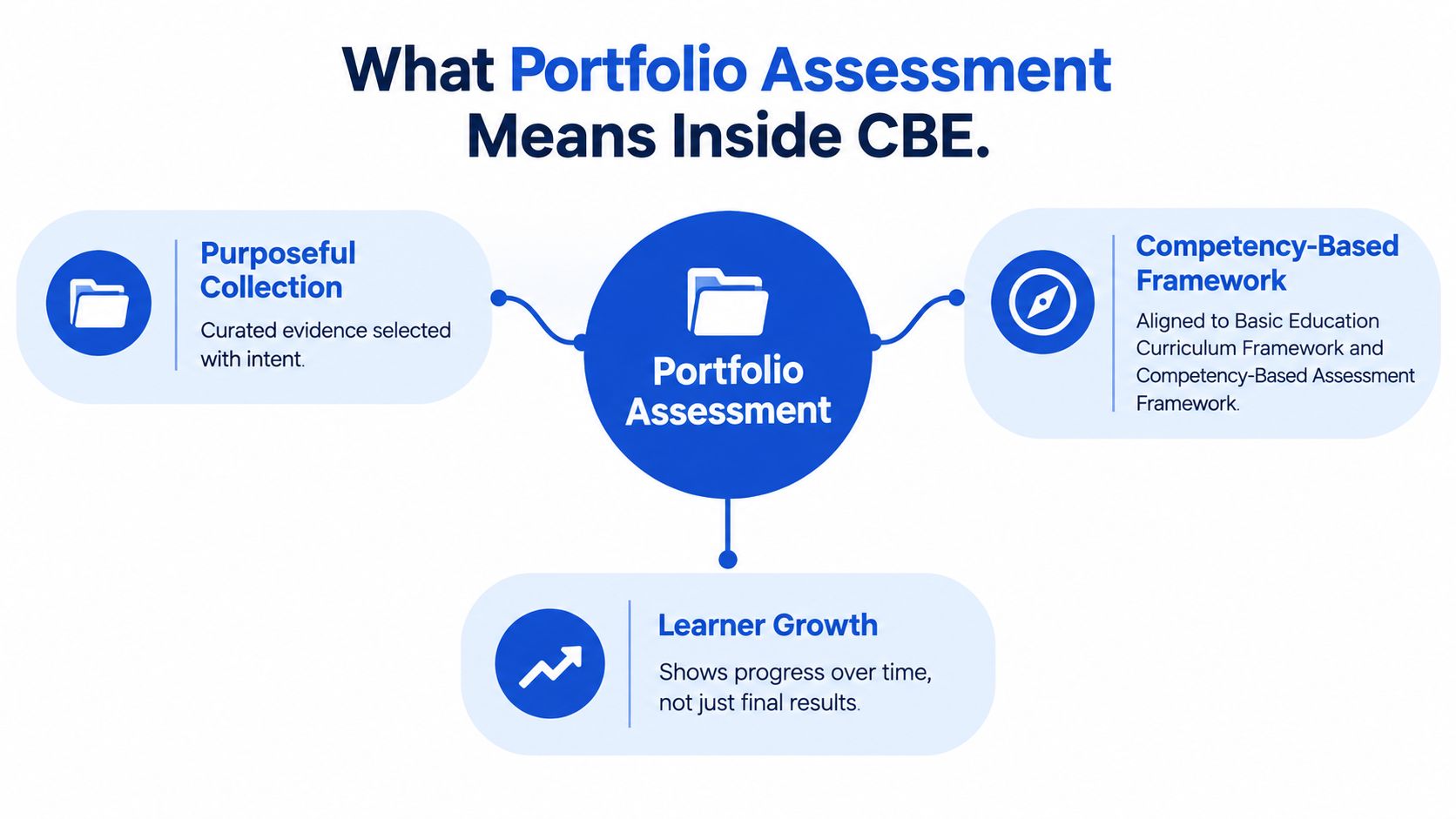
A portfolio in CBE is not a neat folder of “best work”. It is an evidence trail. Kenya's curriculum framework treats portfolio assessment as a purposeful collection of learner work samples, self-assessments, goal statements, major learning activities, and related records used to show progress over time.
The Competency-Based Assessment Framework takes the same line. KNEC describes a portfolio as a systematic collection of work produced over time in response to learning outcomes, alongside journals, rating scales, oral questioning, and observation tools. That places portfolio work inside the main assessment system, not at the edges. It is one of the ways teachers show whether a learner can apply knowledge and skill in a task.
Why the distinction matters
A test captures a moment. A portfolio captures a trail. In class, that trail lets teachers, learners, and parents see how work developed, what was revised, and which competency was demonstrated. That matters more when evidence has to stand up to review after the post-2025 KJSEA transition.
Practical rule: if an artefact cannot be tied to a strand, a date, and a learner judgement, it is not portfolio evidence, it is saved work.
For Kenyan classrooms, every item should answer three questions. What competency does it show? When was it produced? What did the teacher decide after seeing it? If those answers are missing, the file may look full, but the evidence is weak.
A good portfolio also sits beside the rest of CBE practice. The broader logic of the competency based curriculum is useful here because it keeps attention on demonstrated performance, not on storage for its own sake.
For a clean contrast between ongoing evidence and end-point grading, I often point colleagues to formative and summative explained. It helps teachers separate the role of daily evidence from the role of final judgement.
Setting Up the Portfolio Before Collecting Anything
The biggest mistake I see is starting collection before the structure exists. That always looks faster in week one and slower by midterm. If you want portfolios that survive a full term, you need a simple filing logic before the first artefact arrives.
Build the minimum structure first
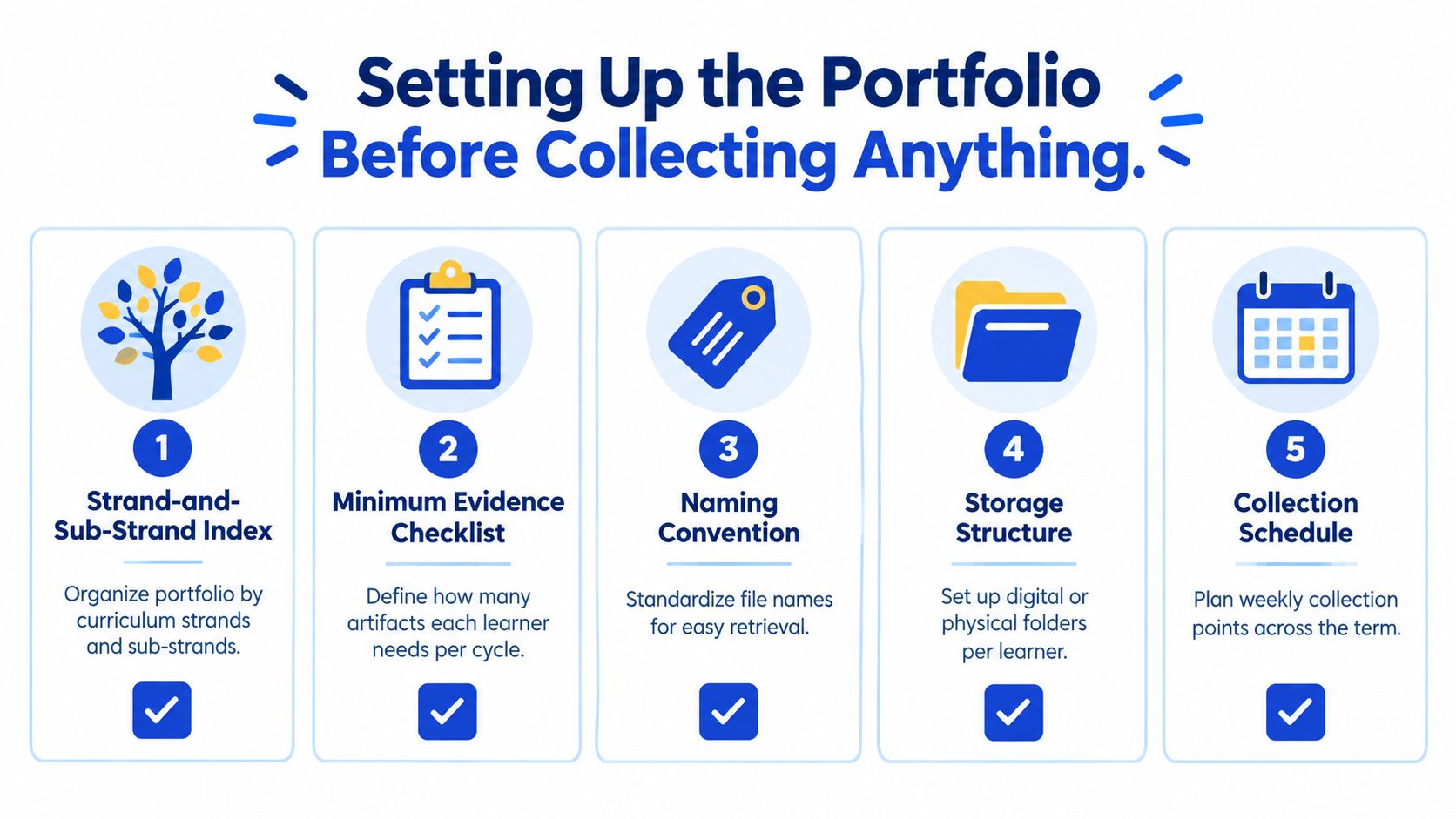
Start with a strand-and-sub-strand index for each class. That index is the backbone, because it gives you a place to file every task without guessing later. Then add a minimum evidence checklist so you and the learners know what counts as enough for the cycle, rather than collecting random extras that never get reviewed.
A naming convention matters more than people think. If the teacher opens files called “assignment 1”, “new version”, and “final final”, the audit trail is already breaking down. Use a format that includes class, learner, strand, date, and task type. Keep it boring, consistent, and easy to read on a shared family phone.
Practical rule: if you can't retrieve an artefact in under a minute, the structure is too loose.
The four fields every entry must capture are simple:
- Competency or strand: the exact learning area the evidence belongs to.
- Evidence type: photo, written task, oral response, project, reflection, or observation note.
- Rubric level: the level awarded from your agreed criteria.
- Feedback-to-action decision: what the learner should do next.
Choose storage that matches your reality
Paper folders are still useful when devices are scarce or internet is unreliable. Shared drives work better when you can name and retrieve files properly. Offline-first capture is often the most realistic option in Nairobi classrooms, because the main issue is usually not willingness, it's bandwidth, device access, and time. If you're using a digital tool, it should help you keep the structure, not tempt you into dumping everything into one long gallery.
For teachers who want a prepared learner folder structure, the guide on learner portfolio CBC is worth comparing with your own class routine.
Before you collect anything, photocopy or duplicate this:
- Strand and sub-strand index
- Minimum evidence checklist
- File naming rule
- Storage location for each learner
- Collection dates for the term
Collecting Evidence Week by Week
The only way portfolio assessment stays humane is if collection is small and regular. I've found that one high-value artefact per learner per cycle is usually enough, provided it's tied to the right strand and includes a short reflection or teacher note. Anything more, and the marking load starts eating into teaching time.
A realistic weekly rhythm
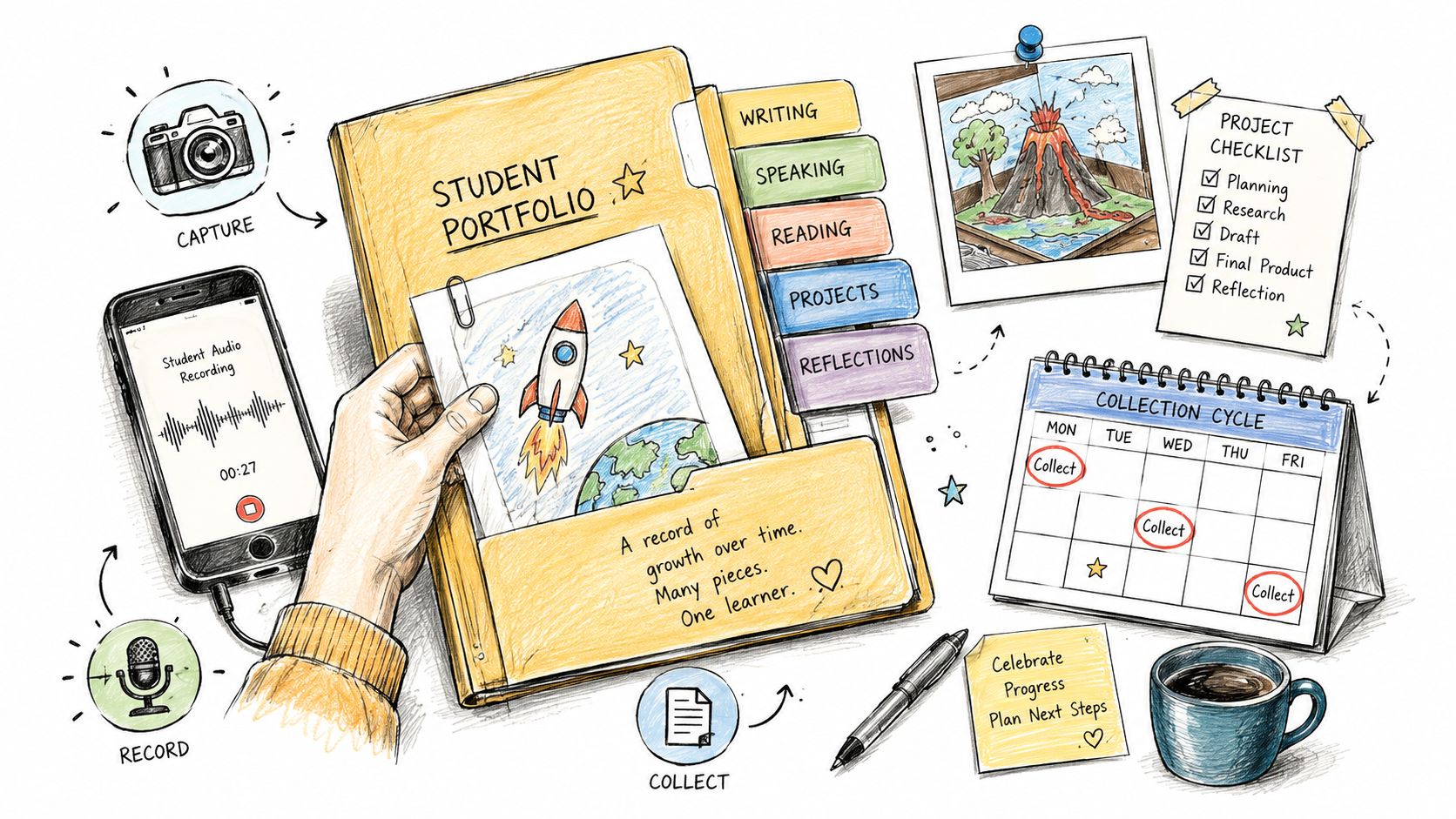
In a normal 40-minute lesson, don't try to capture everything. Pick the most revealing task, collect the strongest evidence, and move on. A written response works for some strands, a photo of group work fits others, and an audio response can be the right call when the learner's spoken explanation matters more than handwriting.
Here's a simple rhythm many teachers can adapt:
- Monday: identify the weak strand from last week's evidence.
- Tuesday: set one task that produces usable portfolio evidence.
- Wednesday: capture the artefact, even if it's only a photo or short voice note.
- Thursday: tag it to the strand and add the rubric note.
- Friday: write the next-step feedback and file it.
That rhythm keeps the portfolio close to teaching instead of turning it into a weekend chore.
Capture what matters, not everything
A low-bandwidth classroom needs judgement. If a learner can't upload a polished document, a clear photo of a page, a short voice memo, or an offline note can still count, as long as the evidence is legible and linked to the learning outcome. Shared family phone workflows also work better when you keep entry times short and avoid asking parents or learners to retype long responses.
A tool like Keybaki can route strand-tagged artefacts from the lesson planner into a shared learner record, which reduces retyping and keeps the strand link intact. The point isn't the tool itself, it's the discipline of moving evidence once and naming it properly.
If you need a broad reminder of why weekly teaching and assessment should stay connected, the idea of data driven decision making education fits this workflow well.
Portfolio evidence gets weak when teachers wait for a perfect task. Use the best available artefact from the lesson that actually revealed the competency.
A hand-me-down laptop, a class phone, or a paper folder can all work if the evidence is tagged the same way every time. The medium changes. The discipline doesn't.
Designing Rubrics and Grading Criteria That Hold Up
Most portfolio confusion starts at the scoring stage. Teachers know what they want to see, but they don't always agree on what counts as enough evidence or how to separate the learner's process from the final product. Once those parts get blended together, the score stops telling you much.
Separate process, product, and reflection
A strong portfolio entry has at least three kinds of evidence. Process evidence shows how the learner worked. Product evidence shows what was produced. Reflection evidence shows what the learner understands about the task and the next step. If you combine all three into one undifferentiated mark, you hide the competency signal.
That's why department calibration matters. Use three anonymised artefacts, have teachers score them independently, then compare where the disagreement sits. You're not chasing perfect agreement. You're trying to agree on evidence thresholds before the class work begins.
The article on CBC assessment rubrics is a useful comparison point when you're refining descriptors for your own department.
A compact rubric pattern that works
For a Grade 8 English oral strand, keep the rubric short and observable:
| Level | Process evidence | Product evidence | Reflection evidence |
|---|---|---|---|
| Emerging | Needs repeated prompts to prepare and rehearse | Speaks with limited organisation | Gives a brief comment with little detail |
| Developing | Prepares with some support and uses a basic plan | Presents ideas clearly in parts | Identifies one strength and one gap |
| Secure | Works independently and uses feedback to improve | Delivers a clear, coherent oral response | Explains what improved and why |
| Strong | Revises after feedback and supports others | Presents with control and purpose | Links performance to the strand and next goal |
For a Grade 10 Science strand, the same logic applies, but the evidence changes. The process might be how the learner plans an investigation, the product might be a report or model, and the reflection should show whether the learner can explain the result and the limitation of the task. Keep the language tied to the strand, not to vague effort words like “good” or “neat”.
Mapping Evidence to Strands and the Next Lesson
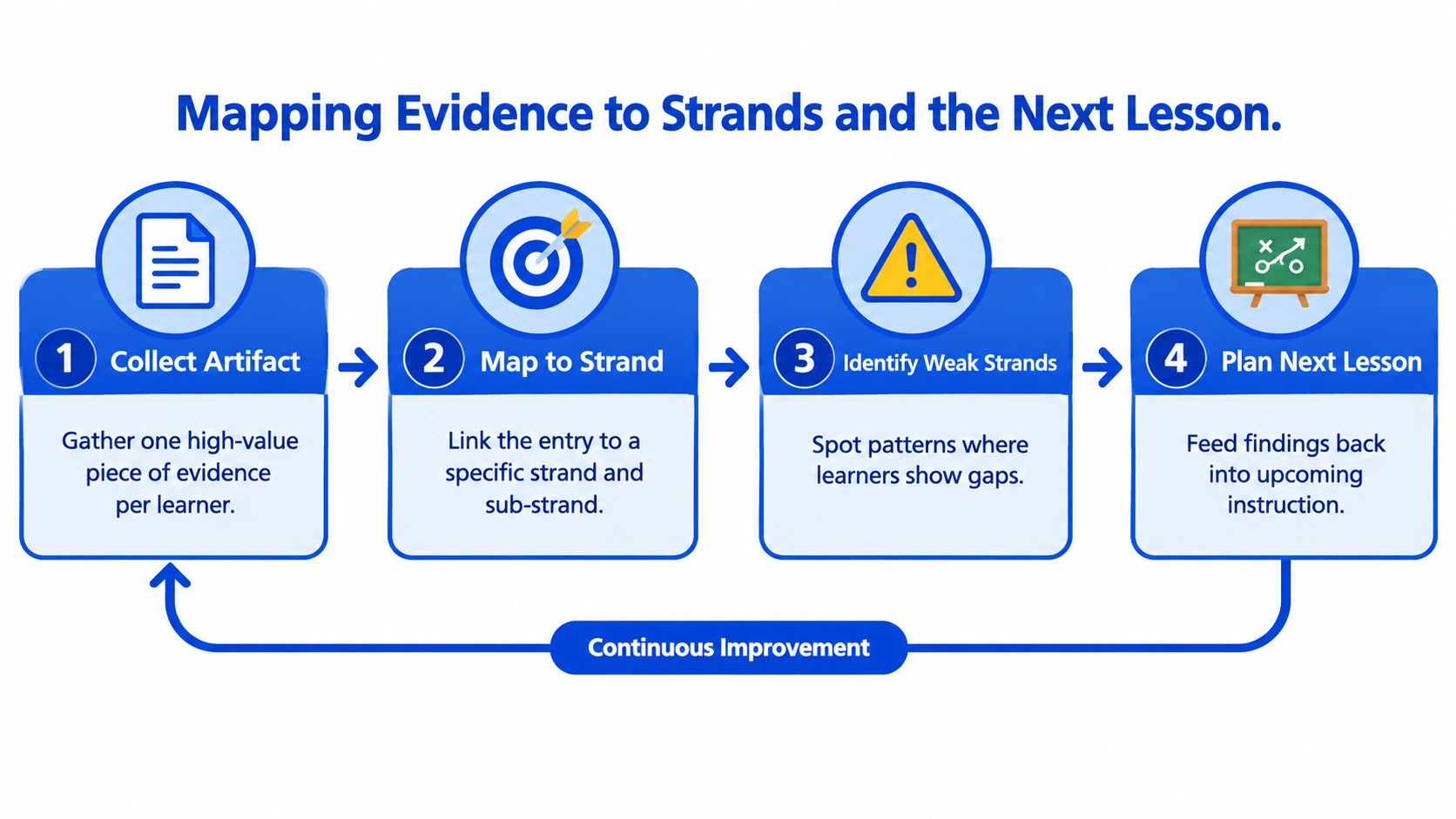
A portfolio only earns its keep when it changes the next lesson. If the evidence stays in a folder and never reaches planning, you have an archive, not a teaching system. The task is to connect each artefact to a strand and decide what happens next.
Close the loop on every entry
When learner evidence exposes a weak strand, log it in the same format every time. Keep the artefact, the strand link, the rubric score, and the reteach note in one row of your weekly map. That way, Monday planning starts from last week's gap instead of rereading the definition.
The KNEC Competency-Based Assessment Framework backs that kind of use. Portfolios are built from work gathered over time and judged against learning outcomes, so the record should drive instruction, not sit there for filing. A good weekly map keeps that logic visible for data driven decision making education.
What the audit trail should contain
For KJSEA-related project and performance-task work, schools should keep the portfolio item, photographs, project records, rubrics, and scoring evidence in a form that is easy to retrieve for moderation and pathway decisions. The point is defensibility. If a parent, HOD, or moderator asks why a learner received a particular mark, the chain of evidence must still be intact.
A simple weekly map looks like this:
- Collect the artefact from one lesson.
- Tag the strand and sub-strand immediately.
- Mark the weak area using the rubric.
- Plan the follow-up task for the next week.
- Carry the gap forward until the learner shows improvement.
One practical option is to use a platform that keeps lesson planning, assessment, and strand history in one place. Keybaki does that by linking CBE planning to continuous assessments, so the weak strand from one week can appear in the next week's planner without retyping. That does not replace teacher judgement, but it cuts the paperwork drift that usually breaks the cycle.
Common Pitfalls and a Teacher-Side Audit
The biggest trap in portfolio assessment is volume. Teachers collect everything because they fear missing something, then end up with too much to review and too little that tells a clear competency story. More artefacts don't automatically mean better evidence.
What quietly weakens the cycle
Parent silence is often treated like consent or understanding. It isn't. If parents don't know how to read the portfolio notes, the feedback loop breaks even when the files look complete. The same problem appears when teachers assume that high usage equals quality. A class can produce lots of uploads and still leave the weak strands untouched.
Paper files can drift out of date too. Once the folder stops reflecting the latest judgement, it becomes hard to defend in a meeting. Workload is another real constraint, especially in large classes and in schools with limited materials or ICT support, so the answer is not to demand more from the teacher. It's to make the cycle tighter.
A short end-of-cycle audit
Use this audit at the end of each cycle:
- Completion rate: which learners have the required evidence?
- Rubric agreement: did different markers read the criteria the same way?
- Feedback turnaround time: how long did it take before the learner got useful response?
- Reteaching proof: which weak strands got documented follow-up?
Practical rule: if a weak strand never leads to reteaching, the portfolio is not doing its job.
Then act on the result. Missing completion points mean the minimum evidence checklist is too ambitious. Low rubric agreement means the department needs another calibration round. Slow feedback means the cycle is too large for the timetable. Weak strands without reteaching mean planning and assessment are still separate jobs, and they shouldn't be.
A Weekly Portfolio Cycle You Can Start on Monday
The cleanest portfolio cycle is also the smallest one that still works. Start with one weak strand, one task, one artefact, one rubric pass, one feedback note, and one lesson adjustment. That is enough to make the portfolio useful without turning your evenings into data entry.
A Monday-to-Friday routine
On Monday, identify the strand that needs attention. On Tuesday, set an activity that can produce visible evidence. On Wednesday, collect one strong artefact and tag it correctly. On Thursday, score it with your rubric and write a short next-step note. On Friday, carry the weakness into next week's plan.
That cycle works because it respects the classroom timetable. It also keeps parents, learners, and teachers looking at the same evidence instead of three different versions of the truth.
Quick FAQ
How is this different from a CEA? A CEA usually checks a strand or sub-strand directly. A portfolio keeps the evidence trail around that check, including process, reflection, and teacher judgement.
What if we're offline? Use paper, photos, or short voice notes, then sync later. Keep the same naming pattern so nothing gets lost.
What should parents see? Show the strand, the level, the feedback, and the next action. Parents don't need a full file dump, they need a readable summary.
Where do digital tools fit? They should connect artefacts to strands and keep the record searchable. If they don't reduce retyping or make retrieval easier, they're adding noise.
Keybaki supports the kind of portfolio discipline Kenyan CBE classrooms need, where planning, evidence, and next-step teaching stay connected in one weekly loop. It gives teachers a way to keep strand-tagged evidence organised without losing the judgement that still belongs to the classroom teacher. If you want to build a portfolio cycle that is traceable, auditable, and easier to maintain across a term, visit Keybaki and see how the workflow fits your classes.
Comments
Loading…