· Keybaki
Online Learning Platform - Kenya
17 min read

On many Sunday evenings in Nairobi, a teacher or parent is doing the same small, tiring maths. One pile is marked books. Another is the scheme of work. A third is mental. Which learners understood last week's work, which ones copied notes without grasping the idea, and what should change before Monday morning?
That is where most conversations about an online learning platform in Kenya go wrong. People ask about videos, dashboards, and logins. The harder question is simpler. Can this platform help a teacher take messy assessment evidence from this week and turn it into a better lesson plan for next week?
Under CBE, that weekly turn matters more than shiny features. A platform only becomes useful when it helps a teacher see weak strands quickly, reteach with purpose, and give parents a clear picture of what their child should practise at home.
Table of Contents
- Sunday Evening Planning and the Gap an Online Learning Platform Can Close
- What an Online Learning Platform Actually Is for CBE Schools
- Core Building Blocks Every Kenyan Platform Should Have
- How a CBE Learning Platform Runs in a Real Kenyan Week
- How to Evaluate an Online Learning Platform in Kenya
- How Keybaki Fits These Needs for Grades 7 to 12
- Choosing and Piloting the Right Platform for Your School or Home
Sunday Evening Planning and the Gap an Online Learning Platform Can Close
A Grade 8 Science teacher has just finished marking. The topic was genetics. Some learners could explain inherited traits in class, but their written answers were thin. A few got the correct answer but used memorised phrases. Others missed the idea completely. Now the teacher has to decide Monday's lesson.
Should the class move on? Should the teacher repeat the same content? Should the stronger learners get extension work while others revisit the basics?
This is the weekly bottleneck in Kenyan CBE classrooms. The problem isn't only teaching content. It's converting scattered clues into the next practical move. Exercise books show one thing. Oral answers show another. A short quiz may reveal a different gap again.
The Sunday problem is usually a planning problem
For many teachers, Sunday planning looks organised from the outside but feels uncertain from the inside. You have marks, comments, notebooks, and a timetable, but not always a clean view of performance by strand or sub-strand.
Parents face a similar version at home. They know their child sat with a phone, tablet, or textbook. They know homework was “done”. But they can't easily tell whether the learner improved in a specific area or just spent time on tasks.
A useful platform should work like a Sunday-evening co-planner. It should organise evidence, not just store files.
That's why a proper platform is more than a digital shelf. It should help a teacher move from “I think many struggled” to “this group needs reteaching on this sub-strand, and that group can attempt independent practice”.
What that help looks like in practice
A platform that closes this gap usually does three things well:
- It gathers learning evidence in one place: classwork, short quizzes, revision tasks, and teacher notes stop living in separate corners.
- It links evidence to the curriculum: results should connect to strands and sub-strands, not just an overall score.
- It shortens lesson turnaround: instead of rebuilding every plan from scratch, the teacher can adjust next week's lesson with better direction.
If you've ever wished that your marks could organise themselves into a clearer Monday plan, that's the role of a digital planner. A tool such as a shared lesson planner for CBE teaching is useful when it reduces guesswork between marking and reteaching.
What an Online Learning Platform Actually Is for CBE Schools
Many people hear “online learning platform” and think of a website full of videos. That's too narrow for a Kenyan CBE school. A real platform is closer to a library, planner, and report card combined.
The library part holds learning materials. The planner part helps the teacher decide what happens this week. The report card part records what each learner can or can't yet do.
The simplest way to picture it
Think of four connected parts working together:
- A learning management backbone: this is the system that handles classes, subjects, timetables, assignments, and user access.
- A curriculum-mapped content library: this stores notes, activities, practice tasks, and media arranged by strand and sub-strand.
- An assessment engine: this captures learner performance in a way that supports continuous assessment.
- User roles: teachers, learners, parents, and school leaders shouldn't all see the same screen or do the same tasks.
If one part is missing, the school feels the gap quickly. A content library without planning support becomes a storage room. An LMS without CBE structure becomes a generic administration tool. Assessment without curriculum mapping gives you marks, but not direction.
Why generic systems often frustrate CBE schools
A school can install a broad learning management system and still struggle. The reason isn't that the system is bad. It's that many platforms were not built around Kenya's curriculum logic.
CBE asks a teacher to track progress in more specific ways than a simple total score or assignment completion status. Teachers need to relate learning tasks to strands, sub-strands, competencies, and follow-up teaching decisions. That is a different job from merely uploading worksheets.
Practical rule: if a platform cannot help a teacher connect a learner's weak area to the next lesson plan, it's only doing half the work.
This matters because Kenya has formally recognised online learning within policy. In the same policy context used during the COVID-19 response, the Ministry of Education's nationwide review drew 12,925 responses from all 47 counties, and the ICT in Education and Training Policy 2021 explicitly defined both real-time and self-paced online learning, showing that digital learning had become a countrywide system issue rather than a temporary fix (Kenya parliamentary annex on the policy response).
If you want a plain explanation of the system layer underneath all this, this guide to a learning management system is a helpful starting point.
Core Building Blocks Every Kenyan Platform Should Have
When a school evaluates a platform, four components matter most. Not because vendors like listing them, but because each one solves a different classroom problem. If one breaks, the weekly teaching loop breaks with it.
The four parts that must work together
Here is a simple way to inspect any option.
| Component | What It Does | Who It Serves | Kenya-Specific Requirement |
|---|---|---|---|
| LMS backbone | Organises classes, subjects, assignments, schedules, and access | Teachers, learners, school leaders | Should run smoothly on common school devices and handle interrupted connectivity without confusing users |
| Content library | Stores lessons, notes, activities, videos, and revision by strand and sub-strand | Teachers, learners, parents | Should support low-bandwidth use, downloadable or cached materials, and clear CBE mapping for Grades 7 to 12 |
| Assessments | Captures quizzes, tasks, checks for understanding, and continuous assessment records | Teachers, learners, parents, school leaders | Must record performance by strand or sub-strand, not only total marks |
| User roles | Gives each person the right view and permissions | Teachers, parents, learners, principals | Parents should see meaningful progress, and leaders should view class patterns without editing teacher work |
Why the assessment block matters most under CBE
A school can survive with a simple library for a while. It can even cope with a basic assignment tool. But if the assessment block only reports overall scores, the teacher still has to do the hard thinking manually every Sunday.
That's why the most important question is not “does it have tests?” It is “can it show what this learner missed, where they missed it, and what the teacher should revisit?”
A strong platform should let a teacher see patterns such as:
- Whole-class gaps: one sub-strand confused many learners.
- Small-group gaps: one cluster needs reteaching while others can move ahead.
- Individual gaps: one learner may need home revision and a short in-class check-in.
Kenya's practical constraints must shape every component
Many feature lists become unrealistic. Home internet access in Kenya remains limited. Only 17.9% of households had internet access, with learner-level access at 4.0% in primary and 23.9% in secondary, and the rural-urban gap was sharp in both levels. That's why platform design in Kenya has to assume intermittent access, low bandwidth, and offline-first use rather than constant streaming (2019 Census-based analysis of online learning access).
So if a vendor's demo depends on smooth continuous video, pause there. A platform for Kenya should be designed for a learner who may share a family phone, lose connection halfway, and return later without losing progress.
For a practical product example of these building blocks in one place, you can review Keybaki's platform features.
How a CBE Learning Platform Runs in a Real Kenyan Week
A useful platform should feel less like “technology time” and more like the normal school week becoming clearer. The best way to judge it is to follow one week from planning to reporting.
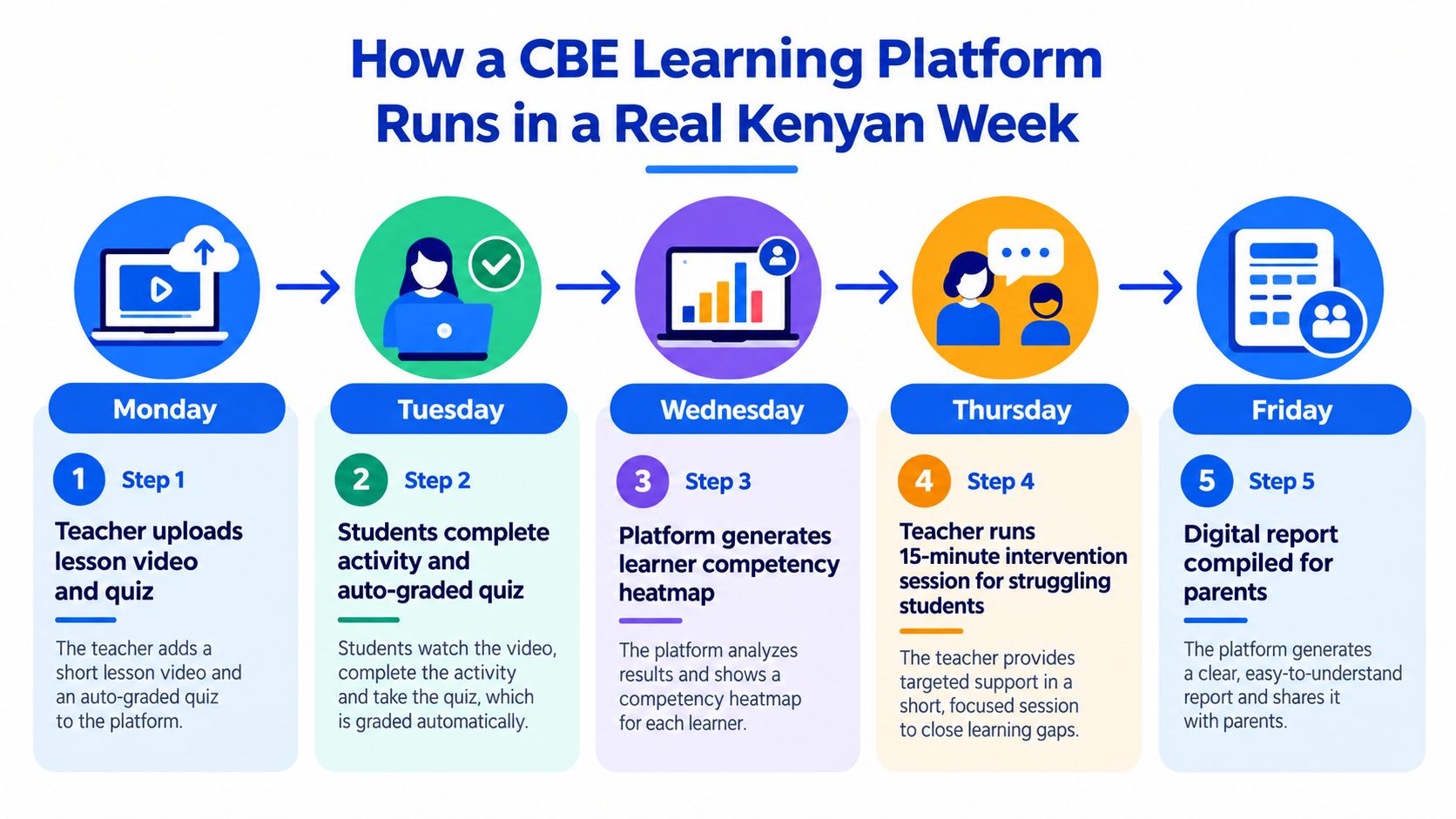
Monday to Tuesday in the classroom and at home
On Sunday or early Monday, the teacher selects the strand focus for the week and prepares tasks. These don't need to be all-digital. A sensible routine mixes short digital inputs with notebook work, discussion, and practical activity.
By Monday and Tuesday, learners access the assigned materials. At school, that may happen through shared devices, a projector, or a computer session. At home, it may happen on a parent's phone for a short revision period.
The important part is that the platform records participation and responses in the background. The teacher doesn't have to reconstruct everything later from memory.
Mid-week adjustment is where the platform earns its keep
By Wednesday, the teacher should be able to open a simple view of who is coping and who isn't. That is the point where CBE becomes manageable. Instead of reteaching everything to everyone, the teacher can pull a small group for intervention and give another group independent work.
Don't judge a platform by the Monday demo alone. Judge it by whether Wednesday decisions become easier.
Access and actual usage are not the same thing. Kenya's school-connectivity review reported 96% population mobile-network coverage, and teacher access to ICT devices in school surveys was 87% in primary and 91% in secondary. But online learning use in schools was reported at only 4%, showing that device presence alone doesn't guarantee regular instructional use (Kenya ICT4E country profile report).
That gap is exactly why a weekly routine must stay simple. If teachers need too many steps, the platform will sit there unused even when devices exist.
Thursday to Friday closes the loop
By Thursday, the platform should support a short reteaching session, a catch-up task, or a targeted quiz. The class doesn't need a dramatic reset. It needs small, informed adjustments.
By Friday, parents should receive a clear summary. Not a flood of messages. Just enough to answer three questions:
- What was covered this week?
- Where did my child struggle?
- What should happen over the weekend?
When that summary is clear, Sunday planning improves. The teacher begins the next week with evidence. The parent begins the weekend with direction. The learner gets one consistent message from school and home.
How to Evaluate an Online Learning Platform in Kenya
A polished demo can hide real weaknesses. The better test is whether the platform survives a normal Kenyan Wednesday with patchy data, shared devices, and a teacher who has six other things to do.
Use a Kenya-first decision matrix
| Criterion | What to Check | Why It Matters in Kenya |
|---|---|---|
| Connectivity fit | Does it work on weak mobile internet, and can content be cached or downloaded for later use? | Many learners and teachers can't depend on uninterrupted home connectivity |
| Device support | Does it run well on Android phones, basic laptops, and shared household devices? | Homes and schools often use mixed devices with different limits |
| CBE alignment | Are lessons, assessments, and reports mapped to strands, sub-strands, and classroom assessment needs for Grades 7 to 12? | Generic systems may store content but fail to support actual CBE planning |
| Data protection | Does it minimise child data, support consent processes, and protect stored learner information? | Schools and parents need compliance with Kenyan child-data expectations |
| Payment flow | Can parents and schools pay through familiar local methods and manageable structures? | A platform that is hard to pay for becomes difficult to sustain |
Check deployment realities, not just curriculum claims
A school may love a platform's content and still fail to use it consistently if the setup burden is too high. In Kenya, the practical bottleneck is often school-level readiness. The 2025 National Broadband Strategy says 54% of schools are connected country-wide, and an ITU-linked school broadband assessment noted that secondary schools were spending at least KES 15,000 per month when broadband was unstable and at least KES 500,000 per year on ICT devices. The same policy context also highlights barriers teachers still report, including limited resources, poor internet, limited digital resources, lack of electricity at school, and insufficient technical support (Kenya National Broadband Strategy).
Those facts should change how a school buys. The first question should not be “Which platform has the most features?” It should be “Which platform can our teachers use every week without drama?”
A quick scoring habit for schools and parents
When comparing two or three options, keep the scoring plain:
- Give high marks for resilience: offline access, light pages, simple logins.
- Give medium marks for flexibility: teacher editing, parent visibility, mixed-device support.
- Be strict on weak points: if assessment data can't feed planning, the platform leaves the core CBE problem unsolved.
Choose the platform that keeps working after the sales call, not the one that looked smooth on office Wi-Fi.
How Keybaki Fits These Needs for Grades 7 to 12
If you apply the matrix above to local options, one useful example is Keybaki. It is built in Nairobi around the Sunday-to-Sunday teaching loop rather than as a generic LMS adapted later for Kenya.
Mapped against the weekly teaching problem
Here is how its parts line up with common school and home needs:
- Planner for lesson turnaround: the platform includes a shared 5E lesson planner that starts from curriculum strands and helps a teacher organise activities, materials, and assessment without rebuilding every plan manually.
- Library tied to curriculum structure: its digital library for Grades 7 to 12 is organised by strands and sub-strands, with lessons, activities, videos, and CEAs grouped in one place.
- Assessment linked back into planning: CEA results feed weak strands into the next planning cycle so the teacher can reteach with clearer direction.
- Parent visibility: parents and learners get a view that highlights weak strands and revision needs instead of only showing that an assignment was submitted.
Mapped against Kenya's operating realities
The fit also matters outside the curriculum layer.
- Connectivity and devices: it supports offline cache, phone-number sign-in, and use on shared family phones, which matches the reality many homes and some schools face.
- Payment flow: it supports M-Pesa tokens and Paystack, which is more practical for many families than card-only checkout.
- Data handling: the platform states that its safeguards are aligned to the Kenya Data Protection Act, including minimal data collection and deletion controls.
Kenyan adoption is real, but uneven. A baseline study found 95% of surveyed learners had interacted with digital learning resources, with Nairobi at 95%, Kiambu at 96%, and Murang'a at 93%. Yet 89% were engaging in only 0 to 3 digital lessons per week, while teachers named limited resources, poor internet, limited access to digital resources, and lack of electricity among the main barriers (ChildFund Kenya digital learning baseline report).
So the right question is not whether digital learning exists. It does. The harder question is whether a platform helps teachers use it regularly enough to shape next week's instruction.
The clearest fit is the closed loop
The strongest local fit is not a single feature. It is the closed loop between planning, teaching, assessment, and parent visibility. That loop is what reduces Sunday guesswork.
If a school is comparing options, that is the lens worth keeping. Not “Which system can upload a PDF?” Most of them can. The useful question is “Which system turns this week's evidence into next week's better teaching with the least friction?”
Choosing and Piloting the Right Platform for Your School or Home
The safest next step isn't a full rollout. It's a small, honest pilot built around one real bottleneck.
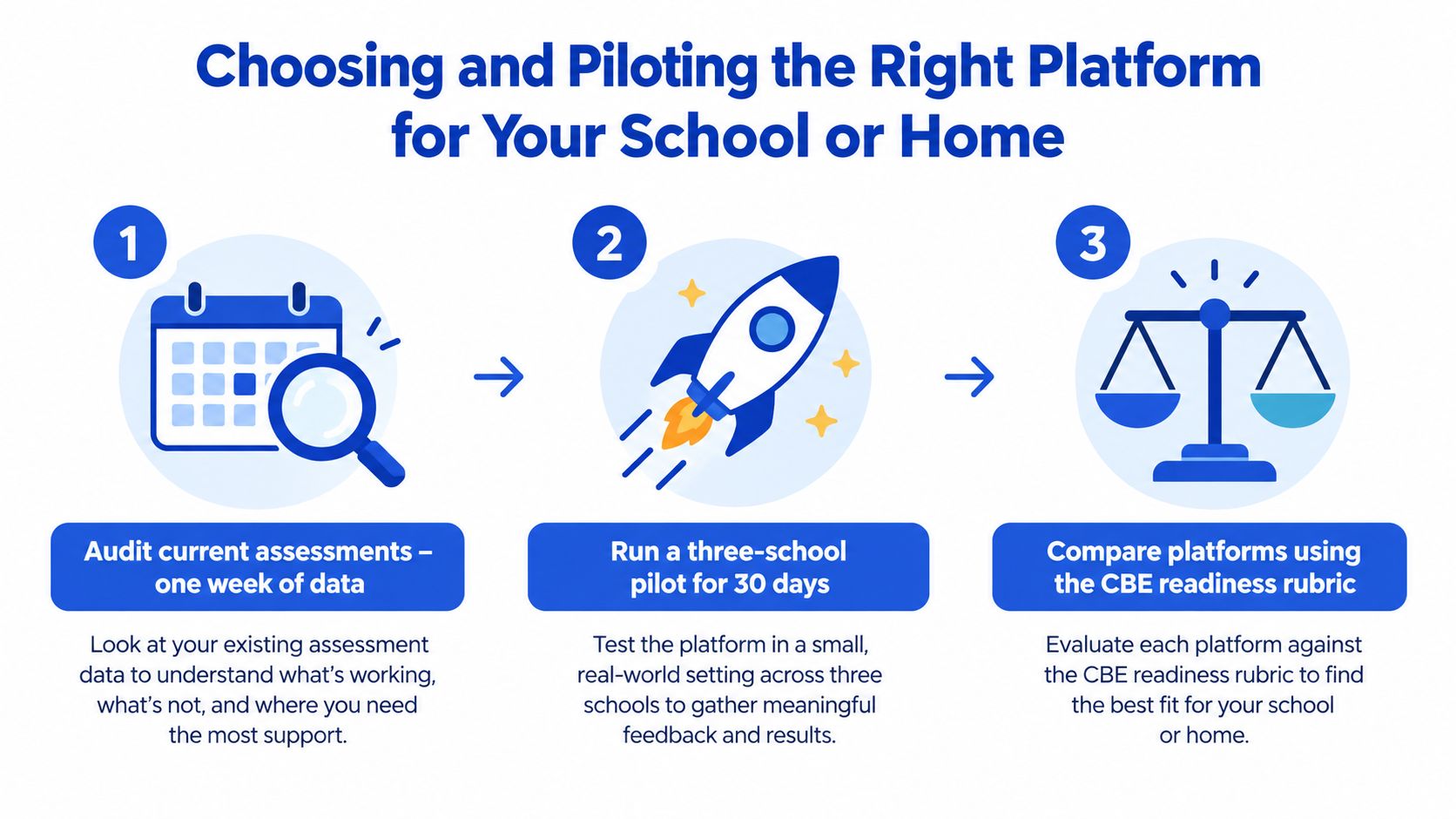
Start with one week of evidence
Pick one subject and look at one ordinary week. Where does the delay happen? Is it in marking, reporting, parent communication, or planning the reteach lesson?
Write that bottleneck down in plain language. For example: “We can assess, but we can't quickly tell which sub-strand to revisit on Monday.” That sentence will help you judge platforms far better than a broad wish list.
Run a small pilot before scaling
Don't begin with every class. Pilot one strand with a small group of learners, one class, or one subject team over several weeks. Watch what happens to the teacher's preparation time, the clarity of follow-up tasks, and the quality of parent feedback.
If you're a parent, do the same at home. Test whether the platform helps you support revision without constant back-and-forth messaging with the teacher.
Review the platform by the Sunday test
At the end of the pilot, ask three direct questions:
- Did the teacher identify weak areas faster?
- Did next week's lesson plan improve because of the recorded evidence?
- Did parents understand what support was needed at home?
Kenya's education planning has increasingly focused on operationalising weekly digital use. National planning documents note 5 digital learning platforms and 3,160 digital contents curated or disseminated, while a World Bank programme document says success is being measured by whether target schools launch at least one approved digital lesson each week, with an 80% weekly-use milestone by 2027 (World Bank programme document on digital lesson implementation). That tells you something important. The challenge now isn't only access to digital learning. It's making it part of routine teaching.
A good online learning platform in Kenya should shorten the distance between what a learner showed this week and what the teacher does next week. If it can't do that, it will always feel busier than it is helpful.
If you want a Kenya-built option that follows this weekly CBE loop, Keybaki brings together a shared lesson planner, curriculum-mapped library, and continuous assessments for Grades 7 to 12. It's designed for the classroom and home routine discussed here, especially the gap between Sunday planning, mid-week checks, and clear parent follow-up.
Comments
Loading…