
· Grade 9 revision
KJSEA Integrated Science: Revision Notes and Practice Activities
17 min read

A few days before KJSEA, it's easy to get stuck rereading summaries and wondering whether you should be attempting questions instead. Use this guide to make a practical choice: check the confirmed paper schedule, review concepts through the official Grade 9 curriculum design, then practise explaining results, interpreting evidence and planning investigations.
The original questions below are revision practice, not official KNEC questions. Work through them before reading the answers, try the self-test without your notes, and use the final-week plan to balance revision with rest. Timed practice matters too: the two papers have different durations, so practise working within each paper's actual time.
Table of Contents
- How to Use This Guide in the Final Week Before KJSEA
- What KJSEA Integrated Science Tests in 2026
- Strands and Sub-Strands to Cover in Your Revision Notes
- Core Concepts and Short Revision Notes by Strand
- Practical Skills and Investigation Habits to Practise
- Practice Activities With Answers and Reasoning
- Common Mistakes That Cost Easy Marks
- Frequently Asked Questions About KJSEA Integrated Science Revision
How to Use This Guide in the Final Week Before KJSEA
If you're a Grade 9 learner with two Integrated Science papers ahead, you may be asking whether to keep reading summaries or try questions. Do both, but use your notes to repair gaps that practice reveals. Reading can refresh a concept; answering shows whether you can use it.
Start by checking the paper schedule below. Then use the curriculum checklist to choose a strand or sub-strand to review. Work through the practice activities without looking at the answers, mark what you missed, and write a brief note explaining the mistake. That explanation is more useful than copying the correct answer.
Focus on competency-based reasoning: explain why something happens, interpret a table or observation, and support a conclusion with evidence. Integrated Science draws on Physics, Biology and Chemistry, so practise making connections rather than treating every subject area as an isolated set of definitions.
A steady routine beats a late-night cram: revise a small area, answer questions, correct your errors, then take a break.
For timed practice, use the actual durations for each paper: 1 hour 40 minutes for Paper 1 and 1 hour for Paper 2. These sessions help you practise reading, planning and answering while the clock is running. Start with the schedule, then move through the checklist, questions, self-test and revision plan in that order.
What KJSEA Integrated Science Tests in 2026
The official KNEC timetable places both Integrated Science papers, code 905, on Thursday, 29 October 2026. Paper 1, 905/1, runs from 8:30 a.m. to 10:10 a.m. Paper 2, 905/2, runs from 2:00 p.m. to 3:00 p.m. Check the official 2026 KJSEA timetable for the full schedule and instructions.
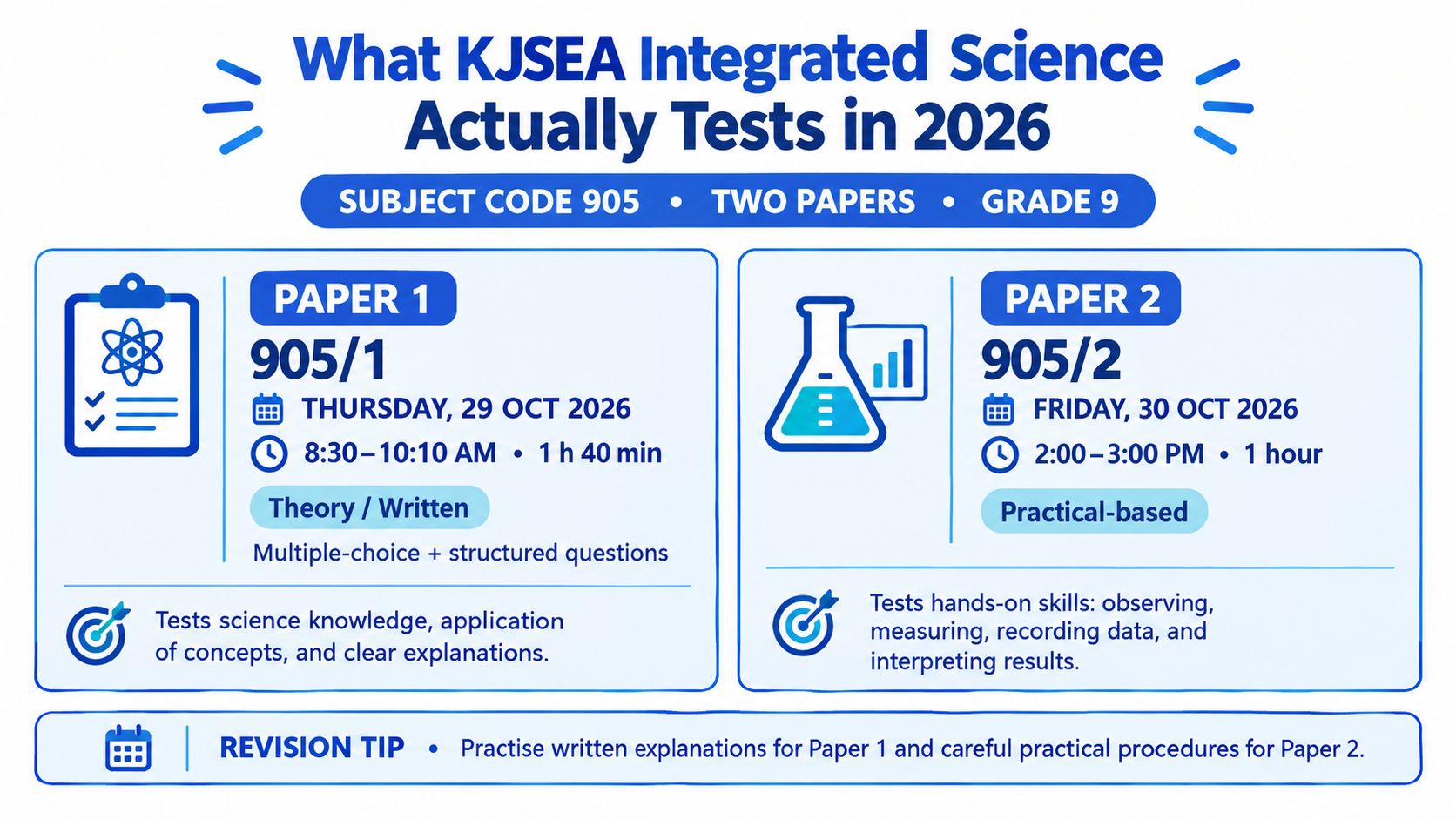
Two papers on one day, with a long break between them. Plan for that gap: rest, eat, and review your error notes rather than trying to relearn a whole strand before Paper 2.
KNEC guidance identifies Physics, Biology and Chemistry as the foundational disciplines covered under both papers. A question can start with a familiar observation, such as water boiling or a seedling wilting, then ask you to explain it using ideas from more than one discipline. Practise moving between concepts, observations and evidence instead of assuming each paper belongs to a single subject.
KNEC's timetable instructions say the time allowed is the duration printed for the paper, with no extra time, and reading time is included unless special instructions say otherwise. Your planning happens inside the clock. Paper 1 gives you a longer working window than Paper 2, so build the habit of reading each question twice and deciding your approach before you write.
KJSEA results are reported using achievement levels, including Below Expectation, Approaching Expectation, Meeting Expectation and Exceeding Expectation. Review the KJSEA grading system to understand the reporting language. The levels reward reasoning, so organise revision by strand and sub-strand and keep checking whether you can explain and apply what you have learned.
Strands and Sub-Strands to Cover in Your Revision Notes
A learner can write “revised” beside a topic and still lose marks if a 905/1 question asks for the evidence behind the answer. Start with labels, then test reasoning. A strand is a broad area of learning; a sub-strand is the narrower part inside it. KICD publishes the approved Grade Nine curriculum designs, including the Integrated Science design, so copy the exact Grade 9 names from that document and your teacher's scheme rather than relying on older topic lists.
Build the checklist around named areas, for example “Living things and their environment” and “Matter and its properties” where your design uses them:
- Named strand or sub-strand: write the exact label, then note whether it mainly asks you to observe, measure, classify, explain or interpret a practical result.
- 905/1 readiness: can you connect the idea to evidence in the question instead of reciting a definition?
- 905/2 readiness: can you read a short practical or familiar situation, keep variables straight and state a conclusion that does not go beyond the data?
- Error note: record each missed question under the same label so a weak sub-strand is easy to find.
Keep a simple mark beside each copied label after you revise it. For a plain-language explanation of how strands and sub-strands are grouped, see this strand and sub-strand guide.
Core Concepts and Short Revision Notes by Strand
Use these notes to practise explaining your thinking. Check each concept against the named strand and sub-strand in your Grade 9 curriculum materials before treating it as part of your examinable scope.
Physics and measurement
- Measurement: A measurement includes a number and a unit. If a ruler shows a length of 12, write the unit shown or requested, such as centimetres, rather than leaving the number on its own.
- Variables: A variable is something that can change in an investigation. If you compare how quickly water passes through different filter layers, the filter material is changed while other conditions should be kept as similar as possible.
- Evidence: An observation describes what you noticed; an explanation gives a reason. “The water looked clearer” is an observation. It doesn't, by itself, prove that every substance has been removed.
Biology and living systems
- Observation first: Describe visible evidence before explaining it. For example, if a plant specimen has changed, record what you can see instead of naming a cause you haven't tested.
- Cause and evidence: A sound answer connects a claim to the information provided. Don't assume that a familiar explanation must apply if the question's observations point elsewhere.
- Misconception check: An observation about one sample doesn't automatically describe every organism or condition. Keep your conclusion within the limits of the evidence.
Chemistry and materials
- Filtration: Filtration separates particles that are trapped by a filter. A change in water clarity doesn't prove that dissolved substances have been removed.
- Fair comparison: If you compare filter materials, keep the sample volume and procedure consistent. Otherwise, a difference in the result may have more than one possible cause.
- Observed change: Describe the change you can see, such as a difference in clarity. Don't label an observation a chemical change unless the evidence supports that explanation.
These short notes aren't a full syllabus summary. Their purpose is to remind you to separate what you observed, what you measured and what you conclude.
Practical Skills and Investigation Habits to Practise
When a question describes an investigation, slow down long enough to identify what the learner is trying to find out. Then look for what changes, what is observed, and what needs to stay the same for a fair comparison.
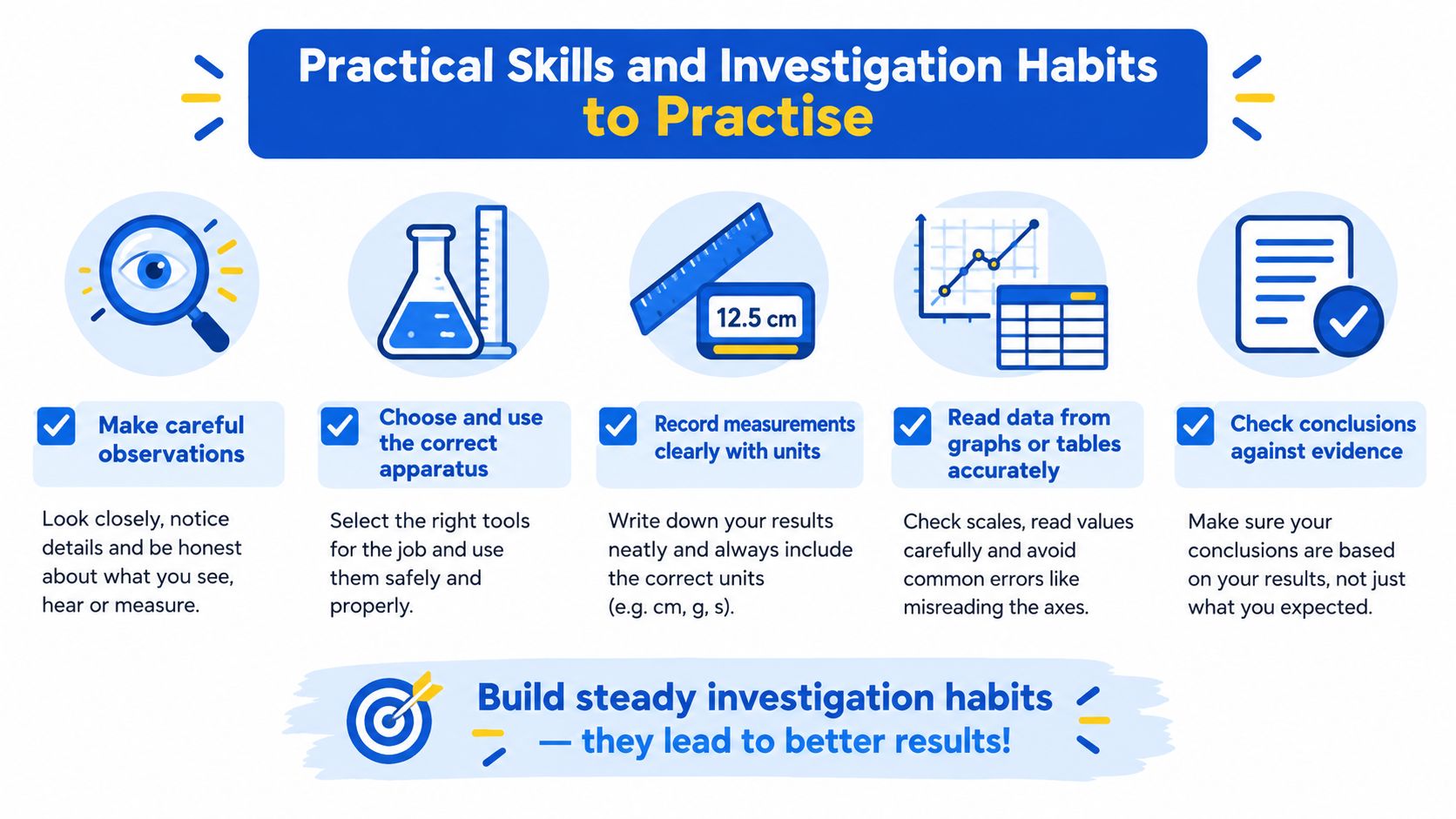
Practise these habits with classroom equipment or safe, low-cost household materials:
- Observe carefully: Record what you see before explaining it.
- Choose suitable apparatus: Match the tool to the task, and use it as intended.
- Identify variables: State what changes, what you measure or observe, and what you keep the same.
- Record measurements clearly: Use a table with headings and units where measurements are taken.
- Read data accurately: Check labels, units and scales on a table, diagram or graph before describing a pattern.
- Conclude from evidence: State what the results support, and don't claim more than they show.
- Work safely: Follow the teacher's directions, avoid tasting or touching unknown materials, and don't handle heat or chemicals without supervision.
A simple investigation template keeps your work organised: question, prediction, variables, procedure, observations, conclusion and safety precaution. You can copy it into a notebook and use it to plan a small investigation with a parent or teacher's guidance. The next activities use the same skills, so apply the checklist rather than trying to memorise a model response.
Practice Activities With Answers and Reasoning
These are original revision practice questions, not official KNEC questions or leaked examination content. Attempt each one before checking the answer. The set includes basic identification, practical reasoning and data interpretation to help you practise skills relevant to both papers.
Foundation questions
1. Short answer: A learner records the length of a leaf as “8”. What important detail is missing?
Answer: The unit is missing. A measurement needs both a value and an appropriate unit, so the learner should check the ruler and record the unit used.
2. Multiple choice: Which statement is an observation?
A. The filter removed every harmful substance.
B. The water looks less cloudy after filtration.
C. The water is safe to drink.
D. The filter changed the water chemically.
Answer: B. It describes something that can be seen. The other options make claims that need evidence beyond the stated observation.
3. Short answer: In a comparison of water passing through different filter materials, what should the learner record?
Answer: Record the results consistently, such as whether the water looks clearer, using the same description or scale for each material. A conclusion should be based on those recorded results.
4. Multiple choice: Why should the same volume of water be used when comparing filters?
A. To make the water change colour.
B. To keep the comparison fair.
C. To remove the need for observations.
D. To ensure that every filter gives the same result.
Answer: B. Using the same volume helps prevent sample size from becoming another explanation for a difference in results.
Application questions
5. Investigation planning: Write a testable question about comparing two filter materials.
Answer: For example, “Which of these two filter materials makes the sample look clearer after filtration?” It names what is being compared and what result will be observed.
6. Identify variables: A learner uses the same amount of water and the same container, but changes the filter material. What is the changed variable?
Answer: The filter material is changed. The learner should also record the outcome consistently and keep relevant conditions, such as the water volume, the same.
7. Explain why: A learner says, “The filtered water is safe because it looks clear.” Is that conclusion justified?
Answer: No. Clear appearance is an observation, but it doesn't establish that dissolved substances or other hazards are absent. The conclusion goes beyond the evidence.
8. Data interpretation: A table says Sample A looked “cloudy” before filtering and “less cloudy” afterwards. What can the learner conclude?
Answer: The sample appeared less cloudy after filtering. The learner shouldn't claim that filtration removed all impurities or made the water safe unless further evidence supports that claim.
Reasoning and communication
9. Practical scenario: A learner uses a different volume of water for each filter. Why is this a problem?
Answer: The comparison may be unfair because the volume could affect the result. Repeat the investigation with the same volume for each filter, using a consistent procedure.
10. Diagram question: A learner draws a filtration setup but labels only the container. What should be added?
Answer: Label the other parts shown in the diagram, such as the filter material and the container collecting the filtered water. Labels should match the apparatus represented.
11. Evidence-based explanation: Write a strong conclusion using the observation that water looked less cloudy after filtration.
Answer: “After filtration, the water looked less cloudy, so the filter trapped at least some visible particles.” This links the conclusion to the observation and avoids claiming that dissolved substances were removed.
12. Spot the error: A learner writes, “The first filter is better,” but gives no results. What needs improving?
Answer: The learner needs to state the observations or measurements that support the comparison. Without results, “better” is an unsupported judgement.
13. Integrated reasoning: A learner observes clearer water after filtering soil through a material. Which part of the answer is the observation, and which is the conclusion?
Answer: “The water looked clearer” is the observation. “The material trapped some visible particles” is a cautious conclusion based on that observation.
14. Short answer: Why should a results table have clear headings?
Answer: Headings show what each entry represents. Units in headings also help readers understand measured quantities without guessing.
15. Explain a correction: Your result differs from your partner's, and you suspect you poured different amounts of water. What should you do?
Answer: Repeat the comparison using the same measured volume and a consistent method. Then record the new results and compare them, rather than choosing whichever result supports your first opinion.
Five-question self-test
Try these without looking at the answers above.
- What two parts should a measurement include?
- In an investigation, what is a variable?
- Is “the sample looks clearer” an observation or a conclusion?
- Why should an investigation keep relevant conditions the same?
- What makes a conclusion evidence-based?
Answer key
- A value and a unit.
- Something that can change in an investigation.
- An observation.
- So the comparison is fair and changes in the result can be interpreted more carefully.
- It is supported by recorded observations or measurements and doesn't claim more than they show.
For additional revision material, use your teacher's curriculum-mapped resources and compare questions with your class notes. You can also browse these secondary school revision materials, then check that any topic you practise matches your Grade 9 curriculum design.
Common Mistakes That Cost Easy Marks
Many learners believe that rereading definitions is enough. It can refresh your memory, but it doesn't show whether you can apply an idea, spot a weak conclusion or explain what a result means. A Nairobi County study reported that 75.0% of teachers did not use assessment practices requiring learners to state relationships between scientific concepts, and 65.9% did not use practices designed to clarify misconceptions (study on Integrated Science assessment practices). That makes it especially useful to practise explaining links and checking whether an answer follows from the evidence.
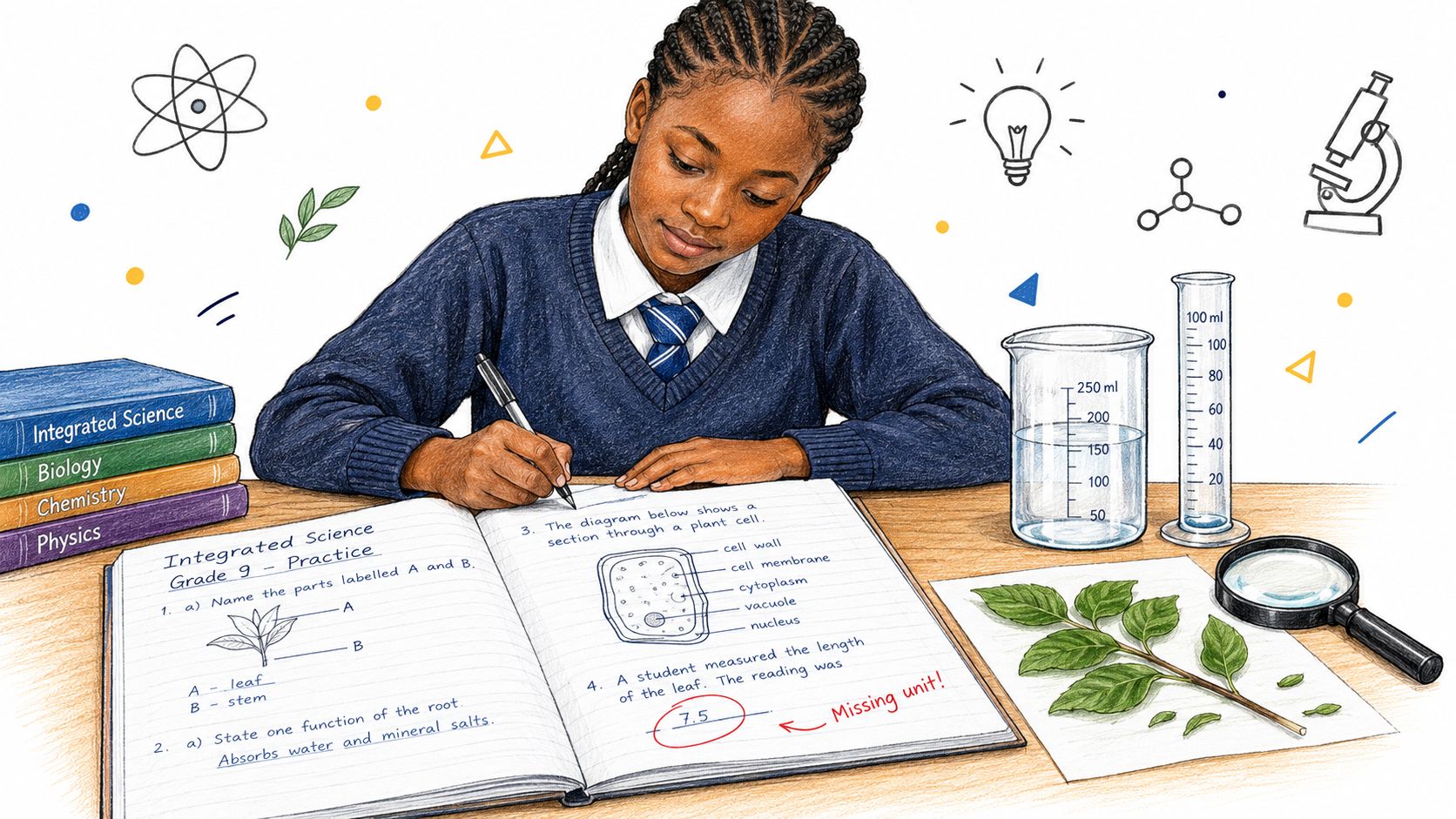
A common weak response reports a result without explaining it. Compare “the water changed” with “the water looked less cloudy after filtration, which suggests that some visible particles were trapped.” The stronger response identifies evidence and makes a measured claim.
Mistakes to correct while practising
- Leaving off units: A number without its unit may not communicate what was measured. Check the table headings and the question before submitting an answer.
- Choosing an answer because it sounds familiar: Read the whole question and test each option against the information provided. Familiar wording isn't proof that it fits.
- Leaving a diagram unlabeled: A neat drawing still needs labels to communicate what each part represents.
- Making an unsupported conclusion: Use observations or measurements in your answer. Don't claim that water is safe just because it looks clear.
- Writing a definition without applying it: If the question asks “why”, give a reason connected to the situation.
- Ignoring the clock: Practise both official time windows, and don't assume there's extra reading time. If you get stuck, make a sensible attempt and manage the remaining time.
Before you move on: reread the question, check your units and ask, “What evidence supports my conclusion?”
For visual support on practical learning, this video can accompany a teacher-led revision discussion. Treat any activity shown as a prompt for safe, supervised learning, not a replacement for your school's instructions.
A practical final-week revision plan
The dates below are a countdown framework, not claims about which days of the week you should study. Count back from the papers, adjust around your other assessments, and keep sleep in your routine.
| Study session | Main focus | What to do |
|---|---|---|
| Earlier in the final week | Physics foundations | Review the matching class notes, then practise measurement, units and explaining observations. |
| Next session | Biology systems | Revise from your Grade 9 design and answer questions that require clear explanations. |
| Next session | Chemistry processes | Review relevant classwork, then practise describing changes and separating observations from conclusions. |
| Next session | Integrated application | Attempt practical scenarios and data questions; revisit the strand or sub-strand linked to each mistake. |
| Practice day | Paper 1 timing | Complete a practice session lasting 1 hour 40 minutes, then review errors and the reasoning behind the corrections. |
| Final preparation | Paper 2 timing and rest | Practise a separate 1-hour session, revisit missed items and leave time for rest and sleep. |
The official papers are on Thursday, 29 October 2026, according to the KNEC timetable. Before exam day, follow your school's instructions about what to bring and how to get to the centre; don't assume an item is permitted unless your school or KNEC says so.
Frequently Asked Questions About KJSEA Integrated Science Revision
How should I revise for KJSEA Integrated Science?
Keep an error log beside your notes. For each mistake, write the strand, the wrong step, and one corrected sentence you could reuse in the exam. An entry might read: "Strand: living things. Wrong step: I wrote that the plant wilted because it was tired. Corrected: it lost more water through its leaves than its roots could replace, so its cells went limp." Rereading that log the night before the papers is faster than rereading a whole strand.
Which Grade 9 Integrated Science topics should I review?
Use the KICD Grade Nine curriculum designs linked in the strands section above and your teacher's materials to confirm the exact strands and sub-strands. Older topic lists can miss content that moved between grades, so check any list against the current design before revising from it.
How can I practise Integrated Science at home?
With an adult's guidance, use a notebook and familiar, safe materials to record observations and compare results. You can also practise interpreting a table or planning an investigation without a physical experiment, which exercises the same evidence-based reasoning Paper 2 questions reward.
How should I use practice questions and revision notes?
Attempt the question first, mark it afterwards, then write down the reasoning you missed rather than only the correct answer. Retry the question from a blank page a day later. If you can explain it only while looking at your notes, you memorised that answer instead of learning the concept.
Where can I find reliable KJSEA revision resources?
Start with your school's notes, the official timetable linked in the final-week plan above, and the KICD designs referenced earlier for scope. On exam morning, bring what your school has instructed and skip last-minute cramming; a rested mind reads data tables more carefully.
Keybaki provides CBE-mapped learning resources and Continuous Evaluation Assessments organised by strand and sub-strand for Grades 7–12. Visit Keybaki to explore curriculum-linked tools for focused revision and learning.
Comments
Loading…