
· KJSEA revision
How to Prepare for KJSEA: A Practical Grade 9 Revision Plan
12 min read
Your phone keeps buzzing with WhatsApp revision tips. A relative recommends another booklet, a classmate sends an incomplete practice paper, and your parent wants to help but isn't sure where to start. With KJSEA approaching next week, the answer isn't to collect more material. It's to use what you already have properly.
How to prepare for KJSEA comes down to three actions: identify weak strands, practise under realistic paper conditions, and correct mistakes before attempting new questions. This practical Grade 9 revision plan protects time for all your learning areas without turning the final week into an exhausting cram.
Table of Contents
- The Week Before KJSEA and What It Really Means
- What the Official 2026 KJSEA Timetable Demands
- A Practical Seven-Day KJSEA Revision Timetable
- Revision Techniques That Actually Move Marks
- Common Last-Minute Mistakes to Avoid
- The Night Before and the Morning of Each Paper
- Questions Learners and Parents Ask Before KJSEA
The Week Before KJSEA and What It Really Means
A learner sits at the kitchen table with Mathematics questions open, an English composition unfinished and revision notifications arriving faster than they can read them. Their parent asks whether they've covered everything. Neither feels reassured.
That's the moment to narrow the task. You don't need to prove that you've read every page. You need to establish which skills you can demonstrate independently and which still require help.
Start with the evidence you already have
Put your latest marked assessments beside your school timetable. Identify recurring errors rather than choosing subjects according to how worried you feel. A repeated mistake in algebra deserves attention; a familiar topic you already answer accurately doesn't deserve another whole evening.
The assessment record matters too. The reported 2025 scoring framework combined 60% from the Grade 9 KJSEA, 20% from KPSEA and 20% from Grades 7–8 school-based assessments. Treat that as the reported framework, and ask your school to confirm the applicable arrangements for your cohort.
Practical rule: Revision can improve your readiness for the remaining papers. It can't rewrite an earlier assessment record.
Ask your teacher which records need checking, then concentrate on work you can still improve. The final week isn't more important than the learning that came before it. It's your opportunity to organise that learning and arrive ready to use it.
What the Official 2026 KJSEA Timetable Demands
Use the school-confirmed KNEC timetable, not a forwarded screenshot. Check the date, paper name and duration for each registered paper before assigning revision sessions. Don't assume an online guide's examination window covers every component.
The official 2026 KJSEA timetable gives the durations below, states that first-session papers begin at 8:30 a.m., and allows no extra time under standard timing. If there's a discrepancy, the time printed on the question paper is authoritative; approved accommodations have their own listed timings.
KJSEA 2026 paper durations and revision focus
| Learning area | Paper duration | Question style | Revision focus |
|---|---|---|---|
| English Language | 1 hour 40 minutes | Follow the particular paper's format | Comprehension, grammar and organised responses |
| Mathematics | 2 hours | Follow the particular paper's format | Working, units and multi-step problems |
| Integrated Science | 1 hour 40 minutes | Follow the particular paper's format | Explanations, diagrams and application |
| Social Studies | 1 hour 30 minutes | Follow the particular paper's format | Interpreting information and clear explanations |
| CRE | 1 hour 30 minutes | Follow the particular paper's format | Relevant knowledge and contextual application |
The revision column is study advice, not an official marking scheme. Use full-paper durations for selected simulations and shorter drills for individual weaknesses.
Build a coverage grid, not just a subject list
The KNEC examiner-training document identifies separate components within learning areas. English includes composition and literary analysis; Integrated Science brings together Physics, Biology and Chemistry; Pre-Technical Studies includes Computer Studies, Business Studies and construction-related areas.
Your grid should cover English, Kiswahili or the applicable language programme, Mathematics, Integrated Science, Social Studies, Agriculture and Nutrition, Pre-Technical Studies, Religious Education, and Creative Arts and Sports. Confirm the exact registered papers with your teacher. Don't let Mathematics and English absorb the whole week.
A Practical Seven-Day KJSEA Revision Timetable
Use this Monday-to-Sunday grid as a suggested routine, not an official examination schedule. Move the subjects around so that the next scheduled paper receives attention earlier, and keep ordinary school attendance and teacher instructions first.
Keep the planner somewhere the family can see it.
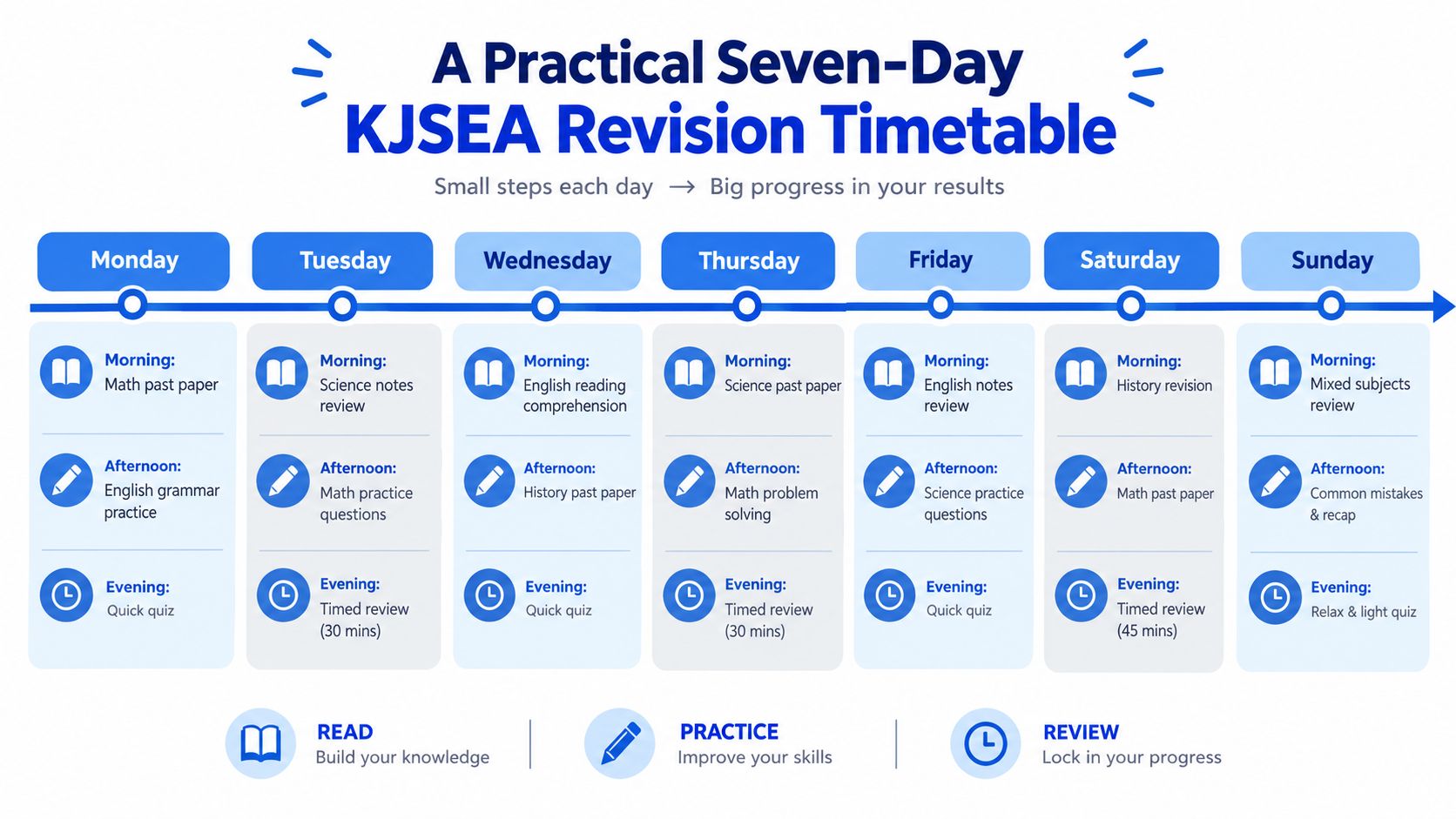
Your suggested weekly grid
| Day | Morning or first available block | Afternoon or after school | Early evening |
|---|---|---|---|
| Monday | Mixed Mathematics diagnostic | Correct the weakest skills | Kiswahili or applicable language practice |
| Tuesday | English Language timed paper using its official duration | Review unsupported answers | Agriculture and Nutrition recall |
| Wednesday | Mathematics worked examples | Integrated Science targeted questions | Religious Education review |
| Thursday | Social Studies timed practice | Pre-Technical Studies applications | Creative Arts and Sports recall |
| Friday | Closed-book language questions | Full Mathematics paper using its official duration | Review only, no new booklet |
| Saturday | Integrated Science paper using its official duration | Mathematics error retest | Prepare summaries for upcoming papers |
| Sunday | Light review of the next paper | Rest afternoon | Pack and settle |
Mathematics receives four focused sessions in this suggested plan. That priority reflects the 2025 results reporting: 32.44% met or exceeded expectations in Mathematics, compared with 22.14% in Kenyan Sign Language. Those national figures justify early checking, but your own marked work should determine the actual targets.
Between blocks, leave the desk, drink water and move around. Stop studying by 9:00 p.m. and protect at least eight hours for sleep as a household planning rule, not a KNEC requirement.
Gather your materials before starting
- Revision tools: Index cards, marked assessments and a trusted textbook.
- Practice supplies: Two sharpened pencils, an eraser and a working watch.
- Planning reference: A printed school-confirmed timetable.
Use the self-learning guide to organise independent work rather than waiting for someone to prompt every answer.
If video helps you get started, keep it within the planned session rather than allowing it to replace practice.
Revision Techniques That Actually Move Marks
A wrong answer is useful only if you find out why it was wrong. Copying the marking scheme leaves that job unfinished.
Use this cycle to organise each difficult strand.
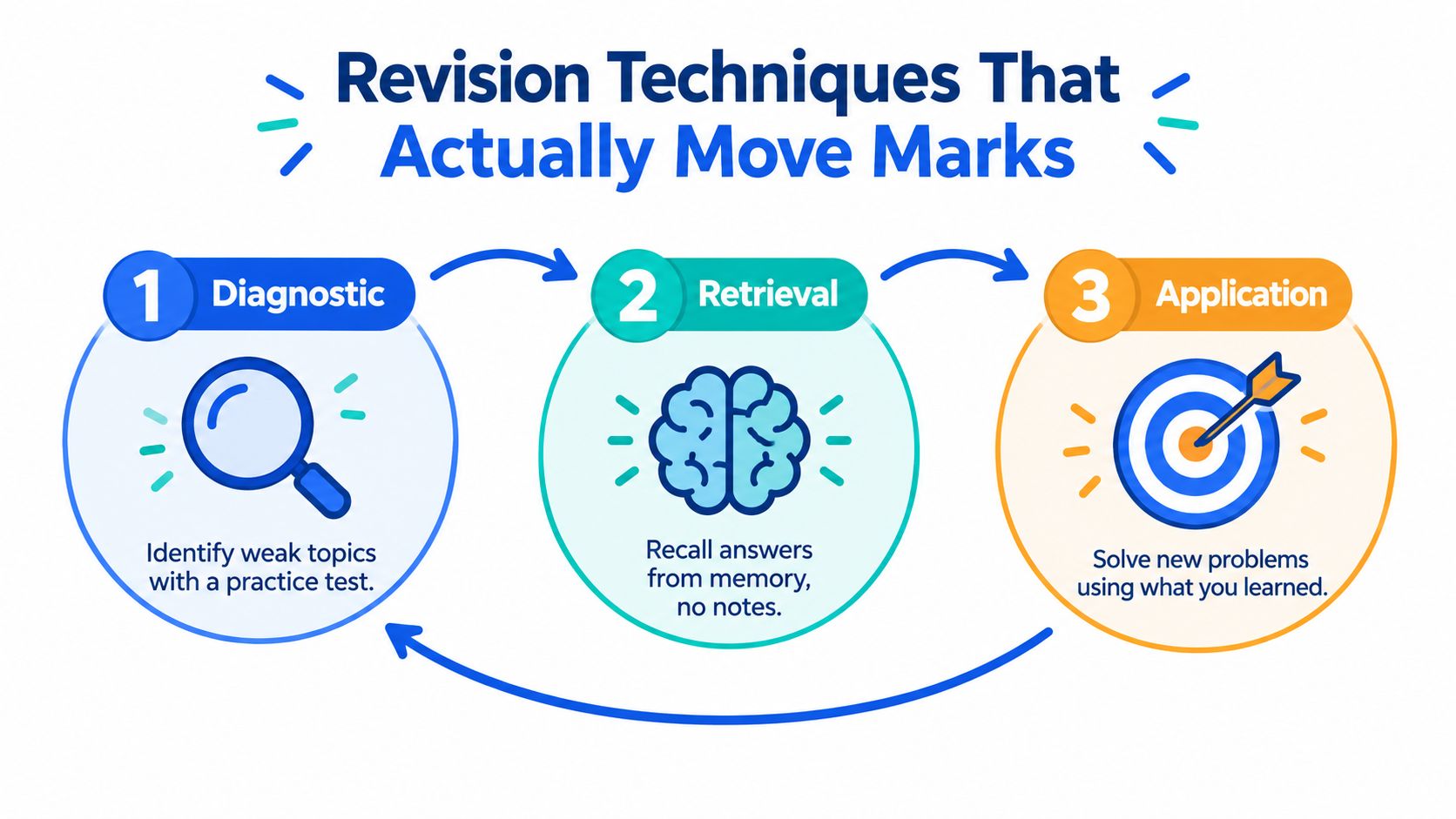
Diagnose, retrieve and apply
The KJSEA feedback reporting informs a practical protocol: begin with a 20–30-minute diagnostic across at least four strands, then focus reteaching on the two weakest skills. Treat this as a revision method, not an examination regulation.
On Monday, attempt the diagnostic without notes. On Tuesday and Wednesday, study worked examples for the identified weaknesses. On Thursday, retrieve the method from memory and apply it to an unfamiliar task; on Friday, attempt a timed mini-paper. Saturday is for analysing errors and choosing the next targets.
What a proper correction looks like
For a Mathematics rates problem, identify the quantity requested before calculating. Write the relationship between distance, time and speed, keep units consistent, and check whether the answer makes sense in context.
For an English structured response, underline the command word. If asked to explain, make the point and show how the passage supports it rather than copying an unrelated sentence.
A correction card should explain the concept, demonstrate the procedure and answer a fresh application question. The copied answer alone isn't enough.
Label errors clearly: misreading, missing knowledge, faulty procedure or unsupported explanation. Ask a teacher for help when you can't explain the correction.
Keep the secondary-school revision materials guide alongside your school-approved resources. For an additional study-method reference, consider Kohru's evidence-backed exam study tips, while keeping KNEC documents as your authority on examination requirements.
Common Last-Minute Mistakes to Avoid
Don't confuse a busy evening with useful revision. A learner can fill pages, watch tutorials and highlight notes without answering a single unfamiliar question independently.
These are the habits to replace.
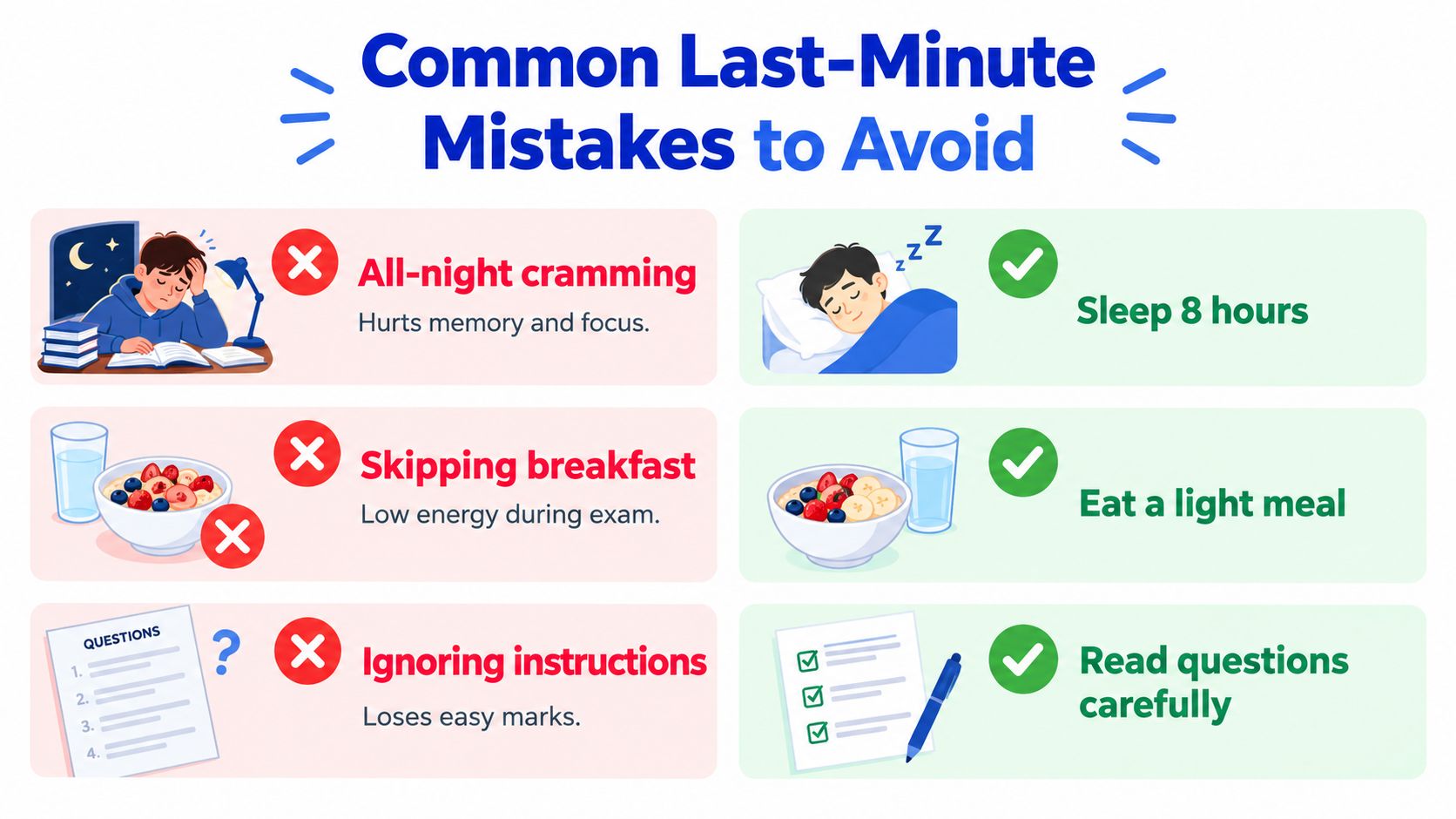
Stop trying to rescue preparation overnight
All-night cramming is not a sensible final-week strategy. Set a stopping time and honour it, even when a topic remains unfinished. Bring that topic to a teacher or tackle it in the next planned block instead of extending study into the night.
Passive rereading is another trap. Looking at a familiar explanation doesn't establish that you can reproduce it. Close the book, attempt the question and check the result before deciding that you understand.
Then there's resource-hopping: a YouTube tutorial, a photocopied paper, a church-group booklet and another forwarded prediction pack. Choose a trusted main resource for each session and finish the correction process before opening another.
National subject results don't tell us which learners crammed or why individual candidates struggled. Use those results to set diagnostic priorities, not to invent stories about other children's study habits.
Parents should organise, not interrogate
Your role isn't to become the subject teacher overnight. Provide a quiet space, reduce unnecessary chores around study blocks and confirm that the timetable is available.
Prepare breakfast, a later meal and drinking water for examination days. Check transport arrangements early enough to resolve problems without rushing the learner.
Ask these questions in the early evening:
- Progress: What did you revise today?
- Uncertainty: What are you least sure about?
- Support: What do you need from me tomorrow?
Listen to the answers. If the learner identifies a specific difficulty, help them contact the teacher rather than telling them to work harder at everything.
Don't compare them with cousins or neighbours who sat KJSEA last year. Don't introduce a surprise quiz at bedtime, and don't make predictions about their future from one disappointing practice result.
For parents: Your child needs a dependable routine more than a running commentary on how important the examination is.
If anxiety rises, ask the learner to name the immediate concern. An unclear transport plan needs organising; an unfamiliar question needs explanation. Neither problem is solved by another warning about grades.
Put this reminder above the desk
- Attempt before checking: Don't read the answer first.
- Finish the correction: Don't abandon an error because another resource looks easier.
- Protect the stopping time: Don't negotiate away the night's rest.
- Keep the household calm: Parents should settle early too.
The Night Before and the Morning of Each Paper
Make the evening ordinary. You're preparing to demonstrate learning, not beginning another revision campaign.
Use the checklist as a reminder, but ask the school which materials are permitted. An item shown in a general preparation graphic isn't automatically allowed inside the examination room.
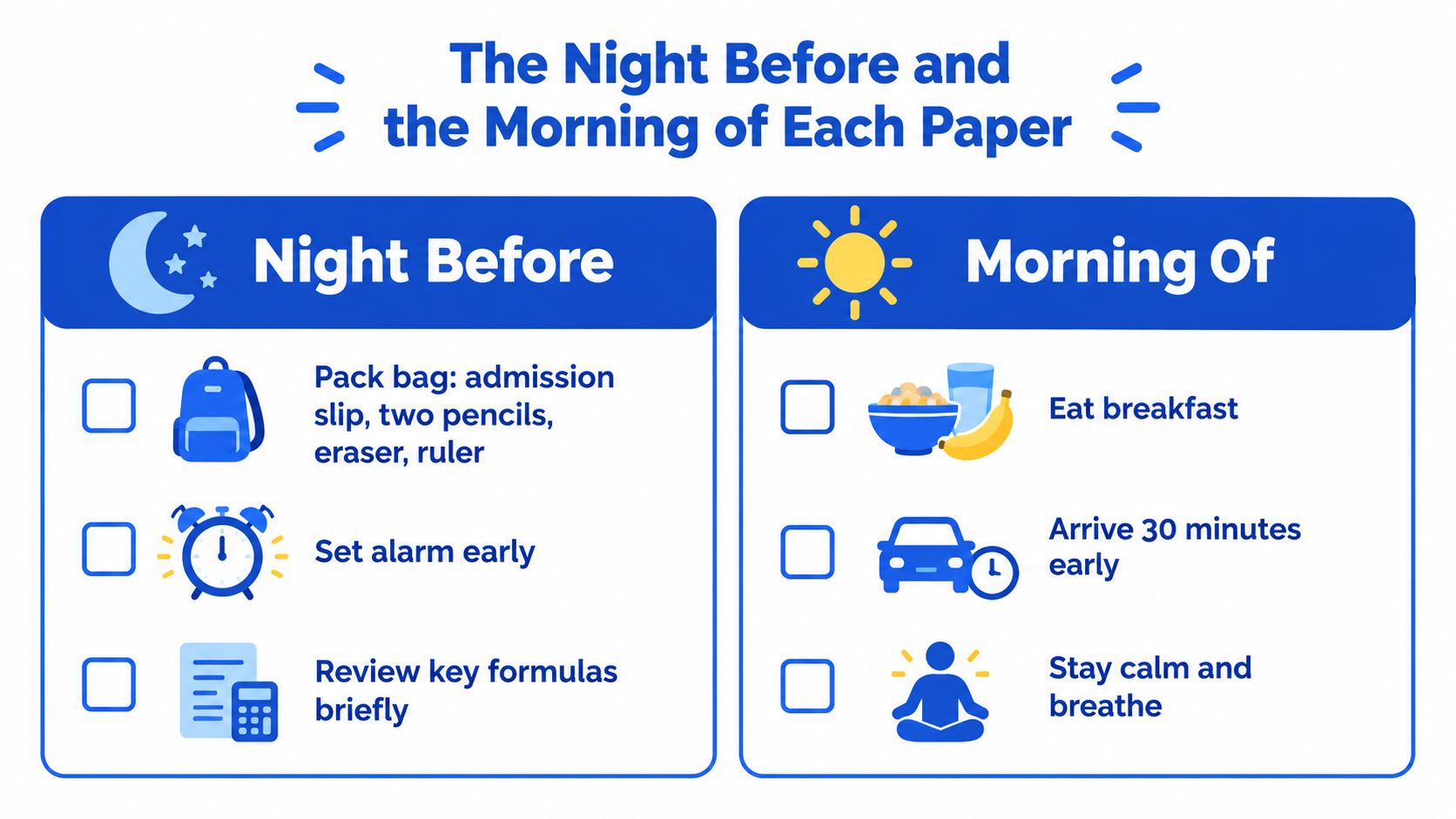
The evening checklist
- Pack approved items: Required identification or admission documents and school-confirmed writing materials.
- Check restrictions: Confirm rules for watches, water and snacks. Don't bring loose rough paper into the room unless expressly authorised.
- Review briefly: Read your weakest-strand summary, then put it away.
- Prepare for departure: Lay out clothes, confirm transport and set a backup alarm.
The morning checklist
- Eat before leaving: Have a familiar breakfast and allow time to get ready calmly.
- Check the paper: Confirm the subject and centre arrangements.
- Allow a travel buffer: Follow the school's reporting time, accounting for traffic.
- Avoid gate-side panic: Don't join hurried discussions about predicted questions.
The official KNEC management guide states that KJSEA covers Grades 7, 8 and 9, includes multiple-choice and structured questions, and uses personalised optical-mark-recognition answer sheets. Careful marking of the correct digit and following paper instructions are examination skills, not minor administrative details.
Once instructed to begin, read the paper directions and plan your time across sections. Don't sacrifice careful answer-sheet handling to hurry through the opening questions.
Questions Learners and Parents Ask Before KJSEA
What should we do if an SBA or project record looks incomplete?
Ask the teacher to check the assessment ledger and submission evidence immediately. Reporting on cumulative placement and school-based assessment concerns highlights why records deserve attention alongside revision. Request documented clarification, not an informal promise.
Can final-week revision change earlier assessment scores?
No. Separate record verification from preparation for remaining papers. The KJSEA grading-system guide can help families understand reported achievement levels.
How should I manage Mathematics paper time?
Allocate time according to the paper's sections and marks. If you're stuck, move on and return later, following the paper's instructions. Leave room to check calculations and units.
Can I retake KJSEA?
Don't assume a retake arrangement exists. Ask your school or KNEC for current official guidance rather than relying on social-media advice.
Do results guarantee my preferred senior-school pathway?
Don't treat a competency result as a placement guarantee. Discuss your interests and evidence of strengths with your teacher, then follow current official placement guidance.
What should I do after the final paper?
Rest, keep school communications accessible and discuss next steps calmly. There's no benefit in repeatedly comparing remembered answers with classmates.
Keybaki offers CBE-mapped learning resources and continuous assessments that help learners identify weak strands and organise revision. Visit Keybaki to explore support for your Grade 9 learner, and share this guide with another parent or class group that needs a calm, practical plan.
Comments
Loading…