· grade 10 lesson plan
Grade 10 Lesson Plan: A Practical 5E Template for CBE
16 min read
You've opened the curriculum documents on Sunday evening, copied a promising activity into Word, and then noticed that it doesn't fit the class, the available materials, or the period on Monday's timetable. The plan may look complete, but it still leaves the practical questions unanswered: what should learners do first, how will you check understanding, and what will change in the next lesson?
A usable Grade 10 lesson plan has to do more than display curriculum language. It must connect the chosen pathway and strand to learner activity, assessment, differentiation, and reflection. Kenya's senior-school structure includes four compulsory learning areas, Kiswahili or Kenyan Sign Language, Mathematics, and Community Service Learning, alongside three elective subjects selected through the STEM, Social Sciences, or Arts and Sports Science pathways. That means planning must respond to the learner's subject choice rather than rely on one uniform subject template. Kenya's Grade 10 curriculum planning guidance sets out this pathway-based basis for senior-school preparation.
Table of Contents
- The Sunday Planning Trap and a Better Loop
- The 5E Lesson Plan Structure at a Glance
- A Worked Grade 10 Lesson Plan Mapped to a CBE Strand
- CEAs, Marking, and Closing the Loop into Next Week
- Differentiation for Mixed-Ability Grade 10 Classes
- Low-Bandwidth Delivery and a Parent Brief
- Your Weekly Planning Checklist and Decision Rules
The Sunday Planning Trap and a Better Loop
The usual Sunday trap starts with good intentions. You open a KICD document, check the scheme of work, search for a downloadable plan, and paste the content into a familiar school template. Then the problems appear. The activity needs a laboratory, the period is shorter than expected, the stated outcome belongs to another sub-strand, or the assessment asks learners to produce work you haven't allowed time to complete.
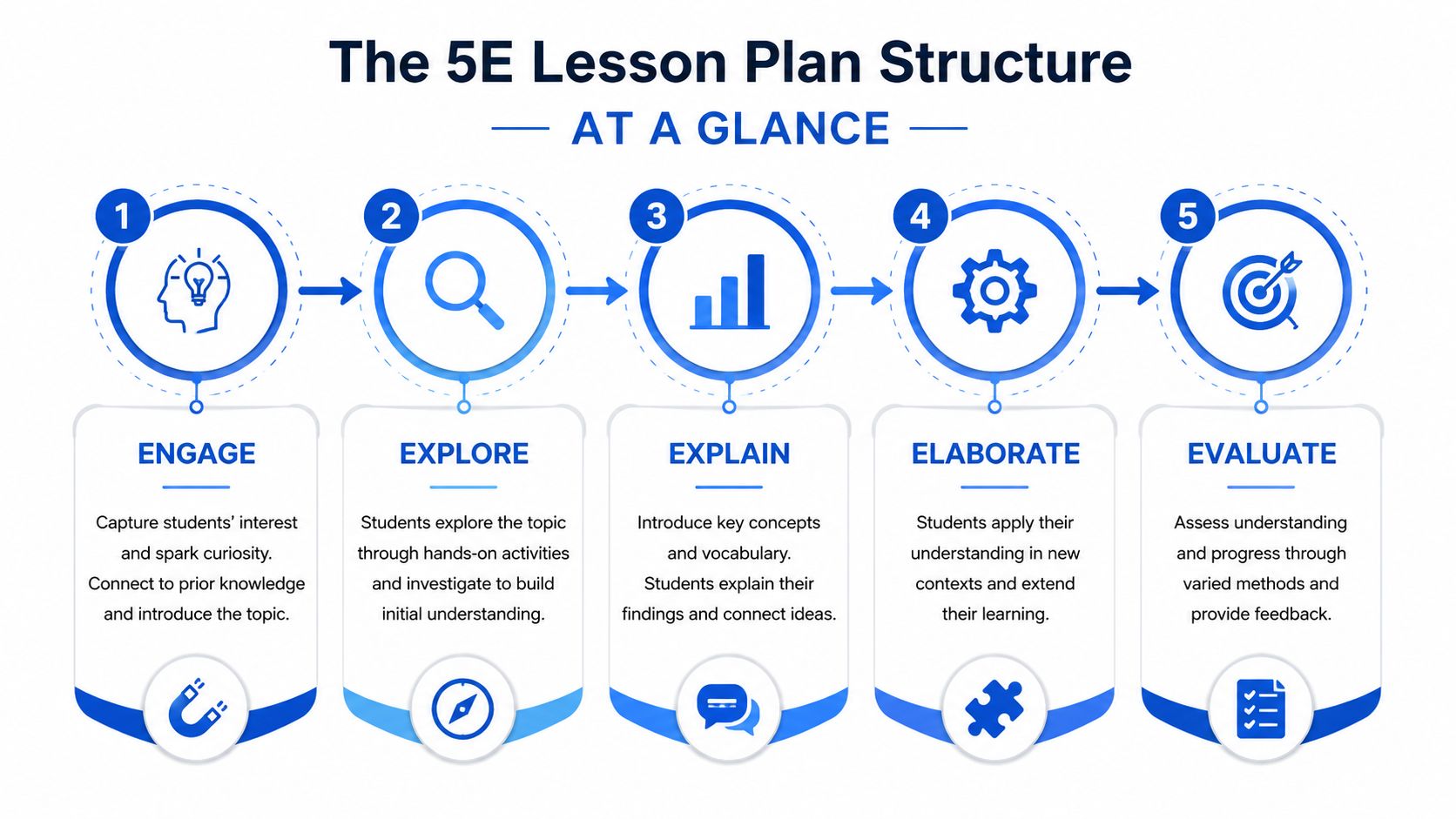
The answer isn't another attractive template. It's a fixed planning loop that forces every decision to stay connected. The 5E model, Engage, Explore, Explain, Elaborate, and Evaluate, works as that skeleton because it gives each part of the CBE lesson a place without dictating one teaching style.
Start with the strand, not the activity
Kenya's State Department for Basic Education expects teachers to prepare a lesson plan for every lesson and use it to break the scheme of work into teachable units. The Kenya-focused lesson-plan guidance supports the same practical sequence: derive the lesson from the scheme, divide the content into teachable steps, and connect every step to a specific learning outcome.
Use this order:
- Identify the strand and sub-strand. Write the exact curriculum reference before choosing an activity.
- State the learner outcome. Use an observable verb such as identify, explain, compare, analyse, construct, or demonstrate.
- Choose the evidence. Decide what learners will say, write, draw, solve, classify, or perform.
- Fit the evidence into the period. Remove activities that consume time without producing useful evidence.
- Record the follow-up. Note the misconception or weak response that must influence the next lesson.
The five phases map neatly onto a normal CBE flow. Engage serves as the starter and prior-knowledge check. Explore and Explain form the main lesson development. Elaborate gives learners an opportunity to apply the idea, while Evaluate supplies formative evidence. Reflection then records what worked, what slipped, and what needs adjustment.
Practical rule: A downloaded plan is a draft. Your timetable, learners, resources, and assessment evidence turn it into a lesson.
This approach also respects the reality of varied lesson lengths. Kenya-focused guidance describes typical periods ranging from 35 to 80 minutes, with a common pattern of 5–10 minutes for introduction, 20–40 minutes for activity, 10–15 minutes for assessment, and about 5 minutes for closure. The lesson-planning reference links the structure to starter activity, teacher input, guided practice, independent work, assessment, remediation, and reflection.
Keep one editable master template for each subject. On Sunday, duplicate it, replace the strand-specific content, adjust the resources, and write the assessment prompt. The work becomes a controlled revision exercise instead of a search through unrelated documents.
The 5E Lesson Plan Structure at a Glance
The 5E model works when each phase has a clear learner action and a clear reason for being there. It shouldn't become five labels added to a conventional lecture. In a crowded Grade 10 classroom, every phase must either activate thinking, create evidence, build understanding, or test transfer.
Engage
Use a short hook that reveals what learners already know. It might be a provocative question, a familiar image, a brief demonstration, a sentence that contains a persuasive technique, or a problem drawn from the local community. Ask learners to make a prediction before you explain anything.
Record the prompt and the expected prior knowledge in the starter section. If most learners give the same incorrect explanation, don't treat it as wasted time. It tells you what the Explore phase must address.
Explore
Give learners something to investigate in pairs or small groups. They might compare sources, examine a diagram, classify examples, test a simple procedure, or solve a problem using available materials. Pair work is often more manageable than large groups because each learner has a speaking and recording role, while the teacher can circulate and listen.
Write the resource list precisely. “Textbook” is less useful than “the assigned textbook pages, a copied diagram, Manila paper, and a phone containing offline content”. Your plan should also state what you'll observe, such as correct classification, use of subject vocabulary, or a logical explanation.
Explain
Explanation comes after learners have encountered the idea. Ask groups to report their reasoning, then consolidate the vocabulary and concept using their responses. Correct errors directly, but keep the explanation tied to the evidence learners have produced rather than returning to a long lecture.
The plan should include two or three teacher prompts and the key terms learners must use. This makes the phase teachable and gives you a record of the language needed for assessment.
Elaborate
Use a new context, not another identical exercise. A learner who classified examples correctly may now have to justify a classification. A learner who identified a feature in a diagram may have to explain its importance in a real situation. The competency becomes visible beyond recall.
Evaluate
Keep the assessment small enough to complete and mark. An exit ticket, a rubric check, a short quiz item, or a one-minute explanation can show whether the objective was met. Write the exact prompt in the plan, then code the response by strand or sub-strand so it informs your next planning decision.
Use the lesson-plan fields for timing, resources, core competencies, values, pertinent and contemporary issues, assessment method, and reflection. Kenya-focused senior-school guidance identifies these elements as part of a complete Grade 10 plan, while also emphasising inquiry, collaboration, and problem solving over lecture-only delivery. The Kenya Grade 10 lesson-plan resource also advises teachers to adapt downloaded materials to the actual class context.
A Worked Grade 10 Lesson Plan Mapped to a CBE Strand
The example below uses Biology, Strand 1, the cell division sub-strand. The purpose isn't to prescribe a particular official code or replace the approved curriculum document. It shows how to turn a selected sub-strand into an auditable lesson using resources available in an ordinary school.
The learning objective should be checked against the approved subject curriculum before teaching. In this example, learners will identify and describe the main stages of cell division using a labelled sequence, then explain why the sequence matters for growth and repair.
The lesson uses a textbook, Manila paper, marker pens, and a phone with previously saved diagrams or notes. No live internet connection is required.
| 5E Phase | Time | Teacher Action | Student Activity | CBE Strand Link | Assessment Check |
|---|---|---|---|---|---|
| Engage | 5 minutes | Display two simple cell diagrams and ask, “How can one cell become two cells with the same information?” | Learners make individual predictions, then share with a partner. | Activates prior knowledge about cells and reproduction. | Teacher records common ideas and misconceptions. |
| Explore | 10 minutes | Give pairs a mixed sequence of stage cards or textbook diagrams. Ask, “What changes from one diagram to the next?” | Learners arrange the sequence, label visible changes, and justify their order. | Learners observe and organise evidence from the cell division sub-strand. | Teacher listens for correct ordering and use of observable features. |
| Explain | 8 minutes | Invite two pairs to explain their sequence. Consolidate the stage names and correct the order using the board or Manila paper. | Learners compare their sequence with the class explanation and amend labels. | Builds accurate subject vocabulary and conceptual understanding. | Teacher checks whether learners connect each stage name to a visible feature. |
| Elaborate | 10 minutes | Present a new diagram and ask learners to identify the stage and explain the evidence. | Learners answer individually, then compare explanations in pairs. | Applies the idea to an unfamiliar representation. | Teacher uses a quick rubric for identification, evidence, and vocabulary. |
| Evaluate | 7 minutes | Give the exit ticket: “Name the stage shown, identify one feature that supports your answer, and state why correct cell division matters.” | Learners complete the response independently. | Provides evidence for the stated outcome. | Teacher sorts responses into secure, developing, and reteach groups. |
The table is only useful if the prompts remain visible in the actual plan. Include the key inquiry question, the core competencies being practised, the values or contemporary issue connected to the lesson, and the learning resources. For instance, collaboration appears during pair sequencing, communication appears during explanation, and critical thinking appears when learners justify a stage from visual evidence.
You can also use a strand and sub-strand guide while checking that the activity, outcome, and assessment belong to the same curriculum location. The plan should then carry two short records after teaching: what learners achieved and what evidence requires follow-up.
The exit ticket feeds directly into the CEA and reflection sections. If learners can name stages but can't justify their answer, the next lesson should strengthen observation and explanation rather than repeat the same notes.
CEAs, Marking, and Closing the Loop into Next Week
Teachers often use CBA and CEA as if they mean the same thing. In practice, a classroom-based assessment describes the setting and purpose of an assessment activity, while a Curriculum-Based Assessment, or CEA, ties evidence to a particular curriculum strand or sub-strand. Weekly checks, end-of-strand tasks, and mock assessments can all sit on one tracking sheet, provided the teacher records what each task measured.
The assessment doesn't need to create a marking burden. For an open response, use three simple anchors:
- Accuracy: Is the central idea correct?
- Evidence: Has the learner used a relevant example, feature, calculation, or reason?
- Communication: Is the response understandable and uses appropriate subject language?
For the Biology example, the teacher can mark the exit ticket by checking stage identification, supporting feature, and significance. A quick code such as S for secure, D for developing, and R for reteach makes the result easier to use than a long comment on every script.
Separate the score from the decision
A score only becomes useful when it changes the next lesson. The table below shows a planning interpretation for a 30-mark CEA. These bands are a local teacher-tracking example, not a national grading scale, so your department should agree on descriptors before using them.
| Class mastery % | CEA band | Next week's action | Evidence to log |
|---|---|---|---|
| 80% or above | Competent | Close the sub-strand and use an elaboration task. | CEA summary, common strengths, and extension activity. |
| 60% to 79% | Developing | Revisit the weakest skill through a short guided task, then reassess. | Item analysis and selected learner work. |
| Below 60% | Reteach | Rebuild the concept with a different stimulus and smaller steps. | Misconception record and revised lesson plan. |
Kenya-focused guidance identifies formative assessment and reflection as essential parts of the competency-based loop. Skipping them leaves weak strands unidentified, even when the lesson appears to have been completed. These competency-based assessment examples can help when you're deciding how to connect an assessment activity to the competency and evidence you want to observe.
A practical weekly rhythm is simple. Use lesson exit tickets for immediate decisions, use the CEA for a broader strand check, and use the reflection record to explain why the next plan changes. If Thursday's responses show that learners confuse two stages, Friday's reteach should address that confusion with a new diagram or sorting task, not copy Monday's explanation.
Marking principle: Mark for the decision you need to make next. A comment that doesn't alter teaching is documentation, not feedback.
Differentiation for Mixed-Ability Grade 10 Classes
A Grade 10 stream can contain confident readers, learners who need support with academic English, quick finishers, hesitant speakers, and learners who understand a practical idea better than they can write it. “Differentiate the lesson” isn't enough. The plan must show where the adjustment happens.
During Engage, let learners first write or sketch a response before speaking. During Explore, prepare a core task and a stretch prompt. The core task might ask pairs to arrange diagrams, while the stretch prompt asks them to defend an alternative order or explain a consequence.
During Explain, provide sentence frames such as:
- “I identified this stage because I can see…”
- “The evidence differs from the previous diagram because…”
- “This process matters because…”
Use a labelled visual and put difficult terms on the board. If a key idea is blocked by language, clarify the term briefly in Kiswahili, then return to the English subject vocabulary learners need for written work. Pair-and-share gives quieter learners rehearsal time before whole-class reporting.
Make practical work resilient
A missing laboratory doesn't automatically cancel the practical competency. A teacher can demonstrate the process using a board sketch, a textbook diagram, or paper representations, then ask learners to sketch, label, sequence, and explain what they would observe. The plan should state what the substitute evidence is and what it cannot demonstrate.
In the Elaborate phase, set up stations with different levels of support. One station can provide a partially labelled diagram, another can require independent labelling, and a third can ask learners to interpret an unfamiliar example. While learners work, pull a small group for direct support.
Planning test: If the activity works only for the fastest learners, it isn't yet a Grade 10 activity. Add an entry point, a language support, and a meaningful extension.
Low-Bandwidth Delivery and a Parent Brief
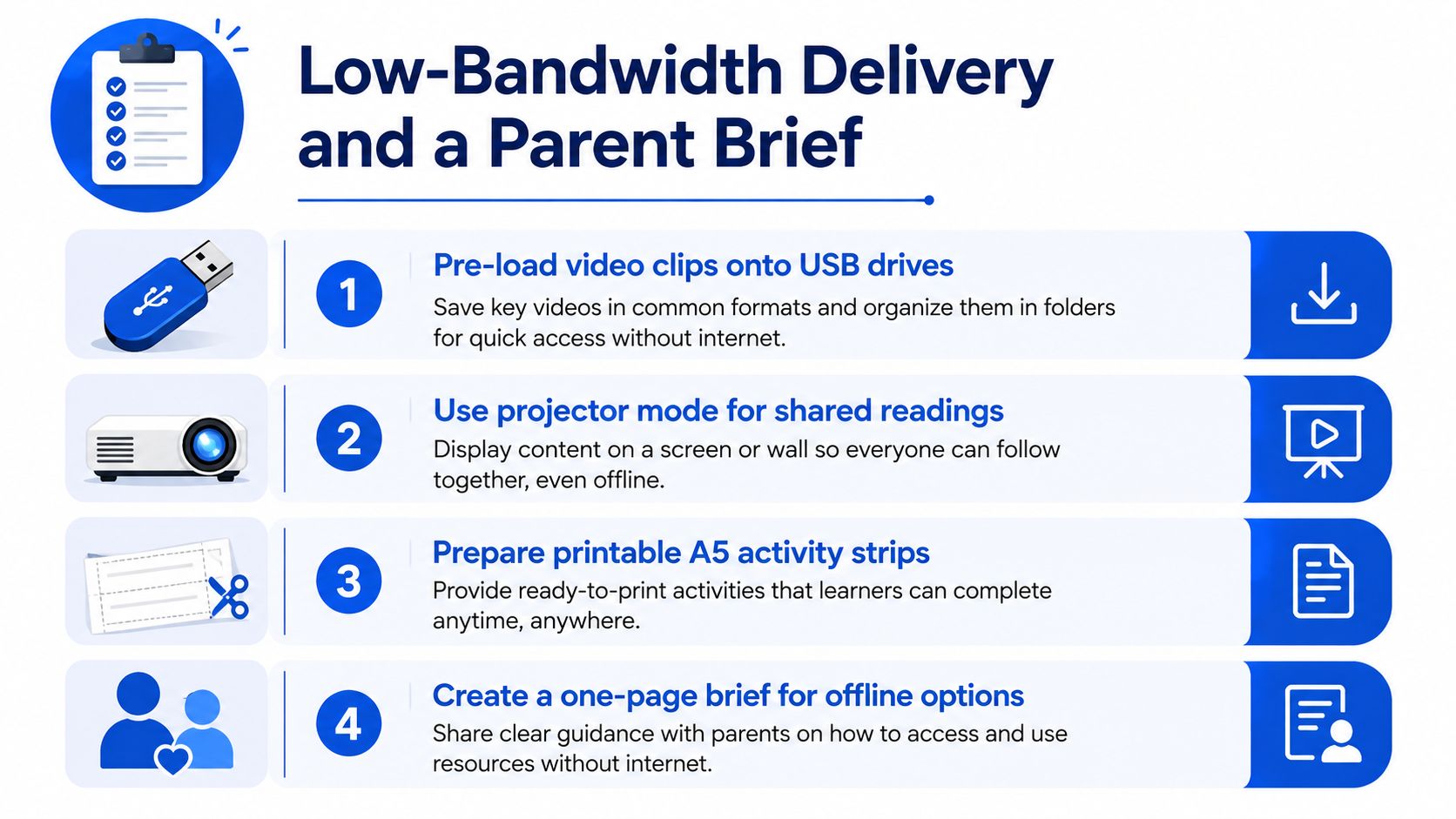
Bandwidth belongs in the lesson plan from the beginning. If the lesson depends on a video that only streams successfully for some learners, the teacher has planned a disruption rather than a learning experience.
Use offline alternatives deliberately:
- Preload content: Save a short video clip, diagram, or audio explanation to a USB drive before the lesson.
- Share one screen: Use projector mode for a shared reading or diagram, then let pairs work from printed prompts.
- Print activity strips: Prepare small A5 strips with questions, examples, stage cards, or sentence frames.
- Send a plain summary: Share the objective and home task through an existing WhatsApp group or an SMS-friendly message.
A parent message should explain the learning in ordinary language, not reproduce curriculum terminology. It also needs to avoid implying that parents must teach the topic or buy materials.
Parent brief
This week, learners studied how cells divide and practised identifying stages from diagrams. Your learner should be able to name a stage, give one visible reason, and explain why cell division supports growth and repair. At home, ask the learner to draw and label the sequence from the textbook, then explain one stage to you. No internet or special equipment is needed.
Send the brief through the class WhatsApp group if families already use it, or print slips for learners to carry home. Avoid requiring a new application, a large download, or a live online session. A shared phone and a textbook can support useful reinforcement when the task is short and specific.
For planning and delivery options designed around unreliable connectivity, see offline tools for running a school without reliable internet. Whether you use a digital platform, printed materials, or a projector, keep the same strand, objective, and evidence visible across school and home.
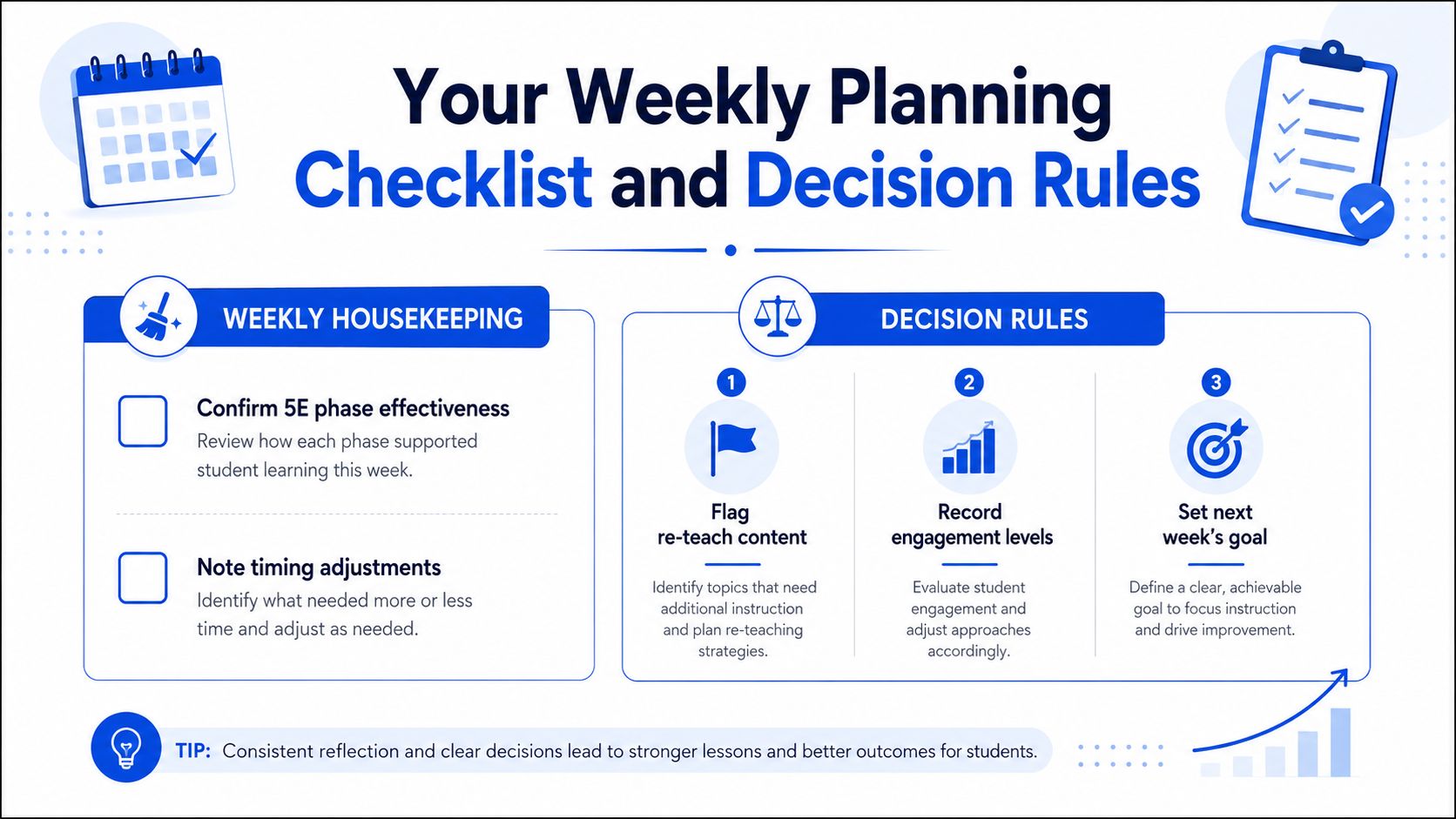
Your Weekly Planning Checklist and Decision Rules
Run the checklist on Friday, while the week's evidence is still fresh. Start by checking which 5E phase worked, where the timing slipped, and whether the planned resources were available. Then record the week's exit-ticket and CEA evidence against the relevant strand and sub-strand.
Friday planning check
- Confirm the phase: Note whether Engage surfaced prior knowledge and whether Explore produced usable evidence.
- Record the adjustment: Write where learners needed more time and what you cut or moved.
- Find the weak strand: Identify the strand or sub-strand with the lowest class performance.
- Choose the next evidence: Decide what learners must demonstrate after reteaching.
- Prepare the family message: State the objective and one offline activity in plain English.
Use firm decision rules, but don't treat them as a substitute for professional judgement. If 30% or more of the class scores below the selected band, reteach the same concept through a different 5E phase or stimulus, as suggested by the planning benchmark in the brief. If at least 70% reach mastery, move to the next sub-strand while giving the remaining learners a targeted support task. If the gap persists for two consecutive weeks despite targeted reteaching, record the evidence and escalate the issue to the HoD.
These thresholds should be documented as your department's working rules, not presented as universal national grading requirements. The official planning expectation remains clear: the lesson should be traceable from scheme of work to teachable steps, learning outcome, assessment, remediation, and reflection. Kenya's Grade 10 planning resources also reflect the growing need to coordinate lesson plans, schemes of work, records of work, topical questions, and pathway-specific coverage rather than manage isolated downloads.
The worked Biology plan closes the loop when its exit ticket changes Friday's decision. That is the point of the template. It should help you decide what to teach next, not merely prove that you filled in a form.
Keybaki gives teachers a CBE-mapped digital library, an editable 5E lesson planner, strand-based CEAs, and planning tools that can support the weekly link between teaching and assessment. Visit Keybaki to explore a Grade 10 planning workflow you can adapt to your subject, timetable, learners, and available resources.
Comments
Loading…