· strands sub-strands
Curriculum Coverage Tracking in CBE Schools
16 min read

A teacher closes the register after a crowded junior secondary lesson and still can't answer a simple question: what exactly was covered, what was only introduced, and what must be taught again? The scheme of work says one thing, learners' exercise books suggest another, and the assessment marks sit in a separate file. By Friday, the teacher is choosing between updating records and preparing the next lesson.
That tension is the curriculum coverage problem in Kenyan CBE schools. Tracking matters, but a system that demands a long form after every lesson will fail under normal teaching conditions. The workable approach is a minimum evidence routine that proves delivery, identifies gaps, and connects assessment to the next teaching decision without turning teachers into full-time data clerks.
Table of Contents
- What Curriculum Coverage Tracking Actually Means in CBE
- Defining Strand-Level Coverage Metrics That Survive Audit
- Running the Weekly Closed-Loop Coverage Workflow
- Linking CEAs and Assessments to Coverage Evidence
- Role-Based Views for Teachers, Heads, Parents, and Students
- Coverage Tracking in Low-Resource and ASAL Classrooms
- Your 30-Day Curriculum Coverage Tracking Rollout
What Curriculum Coverage Tracking Actually Means in CBE
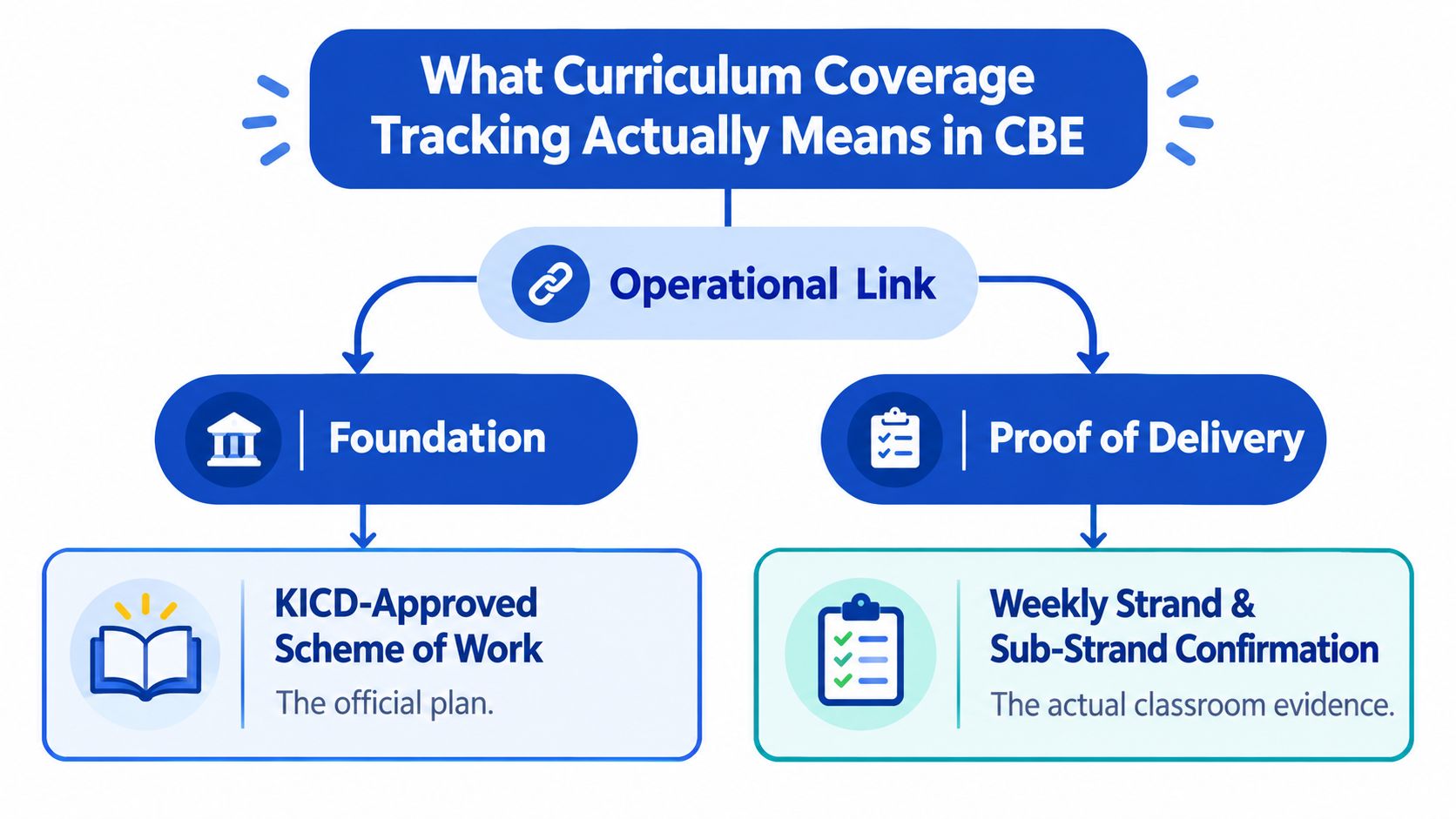
Curriculum coverage tracking is the operational link between the KICD-approved scheme of work and weekly proof that a strand or sub-strand was delivered. It isn't the same as recording attendance. A class can attend every lesson while a teacher runs out of time, skips an activity, or rushes through a sub-strand without enough evidence of learning.
It also isn't the same as formative assessment. A good score may show that some learners understood a concept, but it doesn't prove that every planned sub-strand was taught. Coverage asks, “Was the planned learning experience delivered?” Assessment asks, “What evidence do learners now show?”
The four records that keep the system usable
A teacher doesn't need a separate narrative for every lesson. The minimum practical set is four linked artefacts:
- Strand map: The approved strands and sub-strands, with planned teaching weeks and lesson references.
- Weekly coverage log: A short record showing what was taught, partially taught, postponed, or absent.
- Reteach register: A list of sub-strands needing another explanation, practice activity, or targeted support.
- Term summary: A clean, NEMIS-aligned summary that can be reviewed by the subject lead and school administration.
Kenya's education data systems are moving towards stronger national connectivity. The Ministry of Education said in 2025 that KEMIS is planned to launch in January 2026, connect learning institutions from nursery through university, assign each learner a unique digital identifier, and link agencies including KNEC and KICD, as reported in this Kenya education management information system announcement. That direction makes local records more important, not less, because reliable national reporting begins with consistent school-level evidence.
The rest of the system should answer seven practical questions: what was planned, what was taught, how thoroughly it was taught, what evidence exists, who needs reteaching, who reviews the gap, and what appears in the term summary. If a record doesn't help answer one of those questions, it probably belongs outside the minimum workflow.
Defining Strand-Level Coverage Metrics That Survive Audit
“Covered” is too blunt for CBE. A teacher may have introduced a sub-strand, completed the planned activity, or revisited it after learners struggled. Those are different instructional states, and collapsing them into one percentage creates false confidence.
Kenya's 2024 Education Sector Report reported NEMIS coverage across all secondary schools and described primary-school coverage reaching full reported coverage across successive reporting periods, after earlier lower reporting levels, as documented by the Kenya CBC education resource. The administrative lesson is straightforward: coverage data becomes useful only when schools capture it consistently at the level where teaching decisions happen.
Use four fields, not a complicated score
For each sub-strand, record four items:
- Coverage status: Not started, in progress, delivered, or revisited.
- Depth rating: Introduced, practised, applied, or assessed.
- Reteach count: The number of planned follow-up actions still open.
- Mastery signal: Emerging, expected, or exceeding, based on the latest valid classroom evidence.
A teacher can update these fields quickly if the strand map already contains the codes. The evidence should be a lesson plan, learner task, observation note, checklist, rubric, portfolio item, or assessment record. Kenya's CBE assessment model expects mixed evidence, including observation schedules, checklists, rubrics, portfolios and related records, so marks alone shouldn't carry the whole proof burden.
The table below keeps the data small enough for weekly use while making the audit trail clear.
Strand-level metric set for CBE junior secondary
| Metric | Definition | Source | Update Cadence | Audit Use |
|---|---|---|---|---|
| Coverage status | Current delivery state of each sub-strand | Weekly coverage log | Weekly | Shows whether planned content was delivered |
| Depth rating | The level of classroom engagement reached | Lesson plan and learner activity | At lesson close | Distinguishes introduction from meaningful practice |
| Reteach count | Open follow-up actions linked to the sub-strand | Reteach register | Weekly | Shows how gaps are being addressed |
| Mastery signal | Latest learner evidence state | CEA, rubric, checklist, or portfolio | After evidence is reviewed | Connects coverage to learner response |
A headline such as “most of the syllabus is covered” won't tell a head of department whether a core sub-strand was skipped. It also won't help a parent understand whether a learner needs practice or whether the class hasn't reached the content. Strand-level records prevent that confusion and reduce the late-term reconciliation that happens when teachers try to rebuild delivery history from memory.
For a practical reference when creating the map, use this strand and sub-strand guide to keep the labels consistent across schemes, lesson plans, assessments, and summaries.
Practical rule: If a teacher can't update the record while the lesson is still fresh, the metric set is too heavy.
Workload must shape the design. A Kenya-based syllabus coverage study found that 76.6% of respondents agreed or strongly agreed that teacher workload influences effective coverage, and the source describes teachers handling about 28 lessons per week alongside marking, meetings, parent communication, and co-curricular duties (Kenya syllabus coverage findings). That is why a four-field record is more realistic than a detailed narrative after every period.
Running the Weekly Closed-Loop Coverage Workflow
A Grade 8 English or Grade 10 Biology teacher needs a routine that closes gaps quickly. The workflow below is deliberately repetitive, because reliable coverage evidence comes from small actions performed at the same point each week.
Seven stages from plan to reteach
Sunday, review the scheme. Check the next planned sub-strand against the timetable and available materials. Produce one short weekly target list. If the week contains examinations, trips, or public duties, adjust the plan before Monday rather than recording predictable failure later.
Monday, open the log. Copy the planned strand and sub-strand codes into the weekly coverage log. Add the class, teacher, subject, and expected evidence type. This takes less time when the scheme map is stable.
Mid-week, check depth. Look at one learner task, exercise-book sample, observation note, or class activity. Mark whether the class has only been introduced to the concept or has practised and applied it. Don't wait until Friday to discover that the lesson sequence is behind.
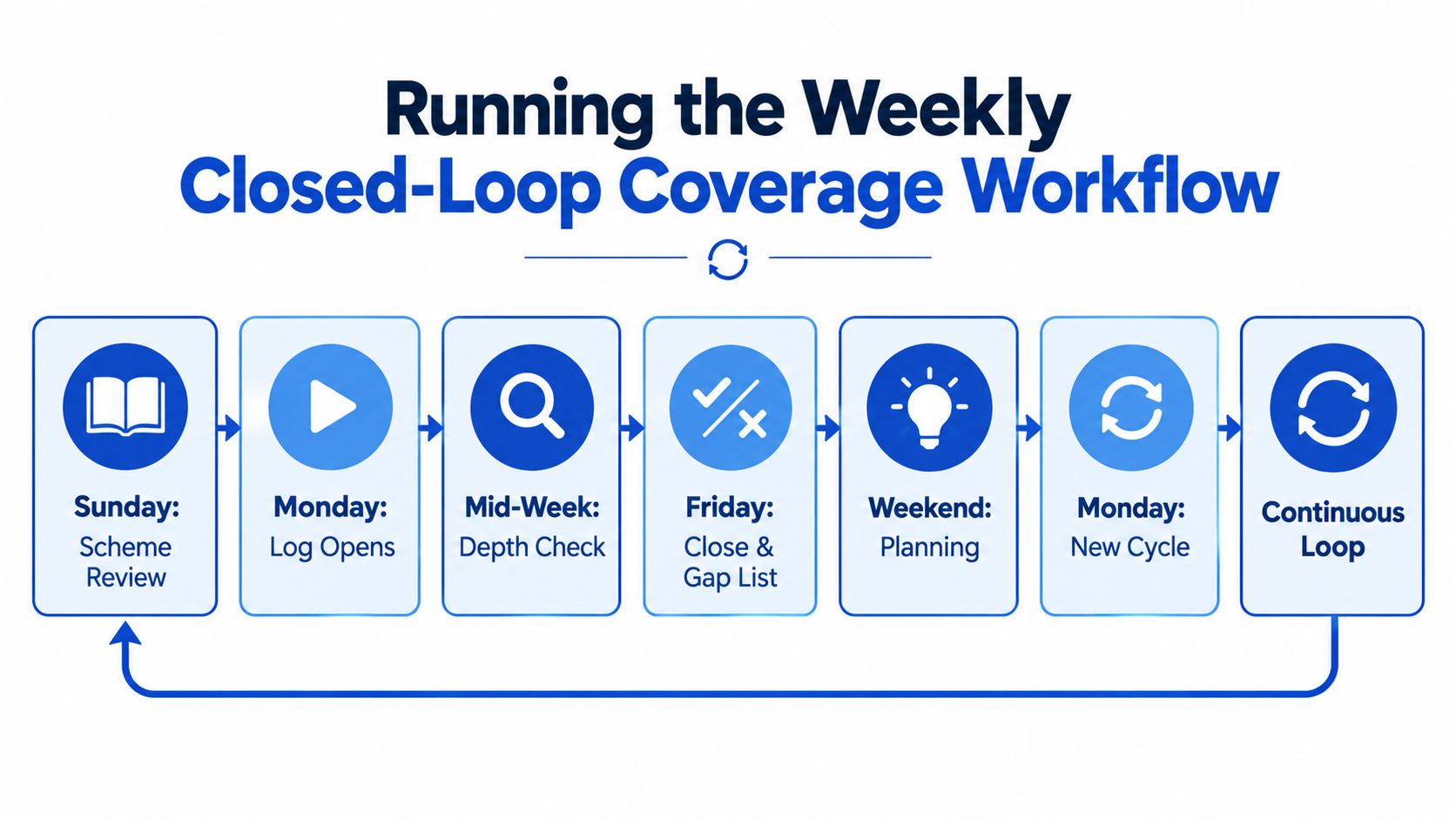
Friday, close the record. Mark each item delivered, partial, postponed, or absent. Add a one-line reason for any gap, such as lost lesson time, unavailable materials, or learner difficulty. Create the gap list before leaving school.
Over the weekend, plan reteaching. Choose the smallest useful response. It may be a five-minute retrieval activity, a worked example, a small-group task, or a full lesson adjustment. Link the action to the specific sub-strand instead of writing “revise topic”.
On Monday, run the reteach block. Use the next suitable lesson opening or practice activity. Record whether the gap was addressed and whether new evidence is needed. A closed loop doesn't merely identify missed content. It documents the response.
At term end, assemble the evidence pack. Keep the strand map, weekly logs, open and closed reteach entries, selected assessment evidence, and reviewed summary. The pack should tell the story of planned delivery, actual delivery, learner response, and action taken.
A subject lead checks the weekly gap list, while the head of department reviews patterns across classes and teacher load. The teacher remains responsible for the classroom judgement. During exam weeks, shorten the loop to the Friday close and a brief reteach note. Where one teacher handles several classes, use one shared strand map and separate only the class status fields.
The minimum fallback after sickness, a strike, a lost phone, or a network failure is a dated paper note containing the class, sub-strand code, status, reason for any gap, and next action. That small record is more valuable than trying to reconstruct a whole week from memory.
The workflow can be adapted alongside the practical ideas in this curriculum coverage tracking video.
Linking CEAs and Assessments to Coverage Evidence
An assessment becomes useful for coverage tracking when its result points back to the exact strand and sub-strand that produced it. Without that link, a teacher has marks but no clear answer to whether the planned learning was delivered or which part needs reteaching.
Start during scheme preparation. Give each sub-strand a short internal code, then add that code to the CEA, formative check, rubric, checklist, or portfolio task. A single task can cover more than one code, but the teacher should record the link before reviewing the results. That prevents a common end-term problem, where staff try to guess what an assessment measured.
The one-column bridge
A simple bridge sheet can contain the learner or group identifier, sub-strand code, evidence type, mastery signal, and next action. Teachers don't need to retype every mark into a separate coverage file. They only need to carry the coverage-relevant outcome into the strand record.
| Assessment artefact | Strand / sub-strand code | Mastery level recorded | Storage location |
|---|---|---|---|
| CEA quiz | Confirmed sub-strand code | Emerging, expected, or exceeding | Assessment register |
| Observation schedule | Confirmed sub-strand code | Emerging, expected, or exceeding | Teacher evidence file |
| Rubric task | One or more linked codes | Emerging, expected, or exceeding | Learner portfolio |
| Summative test | Tested sub-strand codes | Overall signal plus reteach note | Term assessment record |
The four role views should then stay separate. The teacher needs the detailed item and next action. The head of department needs class-level patterns and open gaps, not every learner comment. The parent needs plain-language progress and a useful next step. The student needs a personal target, not a public comparison.
For rubric design and evidence language, teachers can consult this CBC assessment rubrics resource. The important practice is not the platform or template. It is the discipline of mapping each result to a curriculum location before the data reaches a dashboard.
A CEA should change the next planner. If a sub-strand is marked emerging, the following week's plan should contain a reteach activity or additional practice. If the evidence is expected, the teacher can move towards application. That is how assessment stops being a filing exercise and becomes part of curriculum coverage tracking.
Role-Based Views for Teachers, Heads, Parents, and Students
A single dashboard rarely serves four audiences well. Teachers need operational detail, while parents need a readable summary. Students need direction, and heads need enough comparison to identify support requirements without turning the dashboard into a ranking tool.
The safest design is to decide what each role can act on, then hide everything that encourages unnecessary marking or public comparison.
Decision matrix for coverage dashboards
| Role | Primary need | Must-see fields | Hidden by design |
|---|---|---|---|
| Teacher | Deliver the next lesson and close gaps | This week's strands, missed sub-strands, pending CEA records, reteach queue | Class ranking and parent-facing wording |
| Head of department | Support departments and monitor pacing | Class coverage, open gaps, teacher load, evidence completion | Detailed learner comments unless intervention is required |
| Parent | Understand progress and support practice | Plain-language learning area update, current need, suggested home action | Raw marks, teacher notes, other learners' data |
| Student | Know the next personal target | Own mastery signal, next task, feedback, completed evidence | Class averages and other learners' records |
The teacher view should open with action, not a report. “Reteach fractions through a worked example” is more useful than a large percentage with no context. Include a clear distinction between not taught, partly taught, and taught but needing support, because each status requires a different response.
For heads, the useful comparison is not “which teacher is best?” It is whether several classes are missing the same sub-strand, whether a timetable interruption affected delivery, or whether workload is compressing preparation. Kenya-focused evidence has linked high teacher-student ratios to reduced lesson-preparation time, and the documented workload pressure makes supportive monitoring more sensible than punitive scoring (Kenya teacher workload and ratio evidence).
Parent and student views should be read-only snapshots. They can show a current target and a simple next action, but they shouldn't become live grading surfaces that tempt teachers to update records merely to satisfy visibility. The dashboard must protect preparation time as carefully as it displays progress.
Coverage Tracking in Low-Resource and ASAL Classrooms
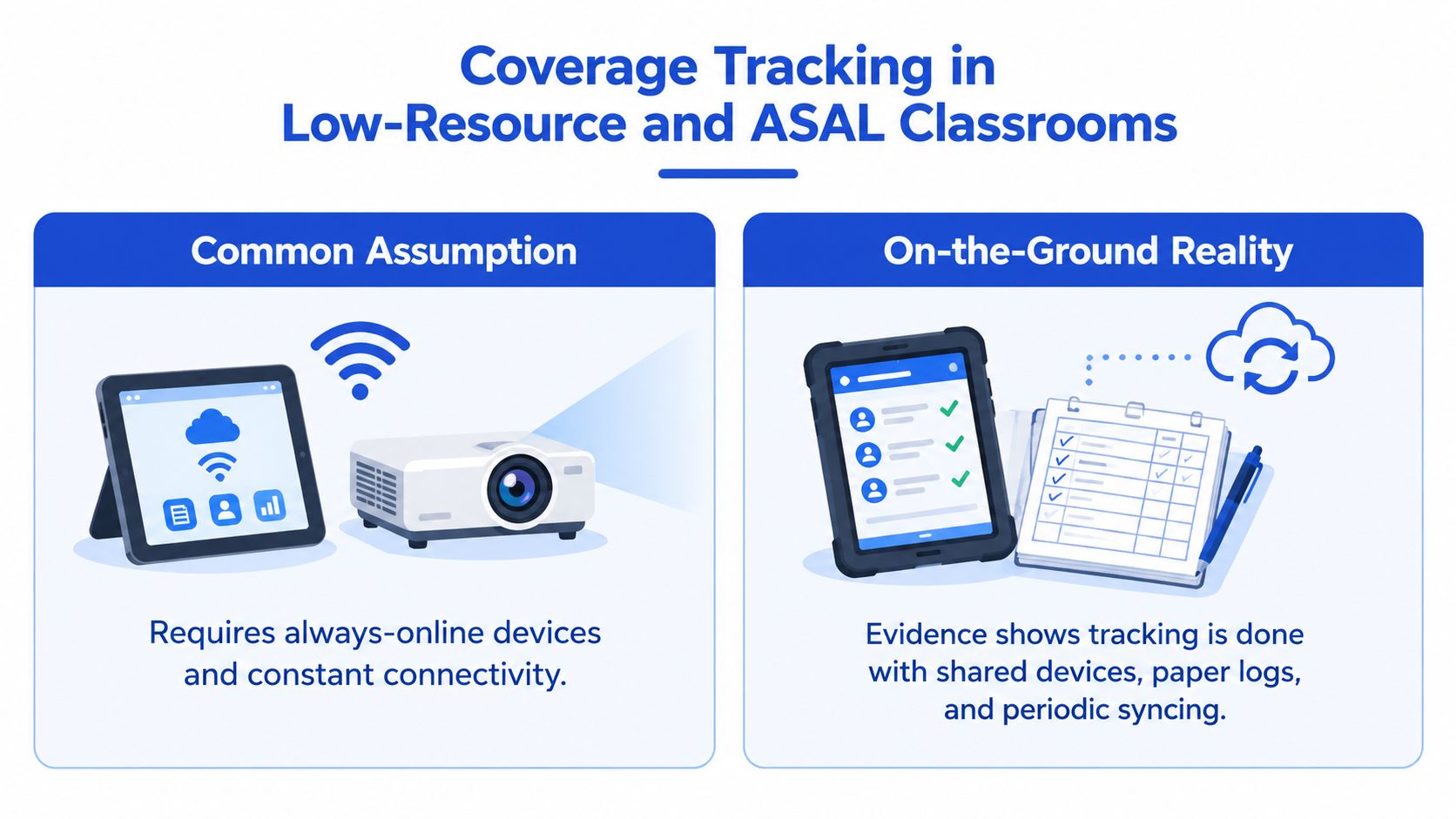
A coverage system that assumes every teacher has a personal smartphone, reliable data, and a functioning projector is not a national solution. A systems review of CBE implementation identifies uneven access to teacher preparation, learning resources, digital tools, infrastructure, and parental engagement, with particular difficulty in ASAL settings (CBE implementation and equity review).
The practical question isn't whether a school has a digital platform. It is whether a teacher can preserve usable evidence when the network disappears, a device is shared, or the lesson runs from printed materials.
Three operating modes
Paper-first mode works when devices are scarce. Keep one class register with the sub-strand code, status, evidence reference, gap reason, and next action. A teacher or subject lead can conduct a Friday scanning or transcription session when connectivity returns.
Shared-phone mode suits schools where several teachers use one device. Prepare a short offline form, capture the essential fields, and assign a clear person responsible for syncing. Don't make the entire scheme depend on real-time submission.
Printed-grid mode supports class-level review. Display or photocopy a strand grid, let the teacher mark delivery and gaps, then transfer only unresolved items into the formal record. This is especially useful where a low-resolution screen makes long forms difficult to read.
Keep the weekly minimum small
Every class should have a dated record of the sub-strand taught, delivery status, one evidence reference, and the next action if there is a gap. If a teacher is absent or assigned to duty, the replacement teacher can record what was delivered without pretending the original plan was completed.
Connectivity loss should be treated as normal. Use local dates and stable codes, never rely on a temporary message thread, and sync records in batches when the network returns. If two entries conflict, retain the paper or locally dated version and let the subject lead resolve the status during review.
Design choices should also support varied access needs. The universal design for learning guide is useful when deciding whether evidence can be produced through writing, oral response, observation, group work, or printed activity rather than one digital format.
Your 30-Day Curriculum Coverage Tracking Rollout
A rollout should begin with one grade, one subject, and one stable scheme. Trying to digitise every class before teachers have agreed on what “covered” means usually produces inconsistent records at scale.
Four weeks to a workable first version
| Week | Focus | Key Actions | Owner | Deliverable | Ready? |
|---|---|---|---|---|---|
| Week 1 | Strand definition | Select one Grade 8 or Grade 10 scheme, code strands and sub-strands, agree status and depth fields | Curriculum lead and subject teacher | Approved strand map | ☐ |
| Week 2 | Evidence links | Match CEAs and formative tasks to sub-strand codes, prepare the weekly log, create the teacher view | Subject lead | Assessment-to-strand crosswalk | ☐ |
| Week 3 | Review views | Build head, parent, and student summaries, test the Friday close-out meeting, define escalation rules | Head of department | Role-based reporting views | ☐ |
| Week 4 | Resilience test | Run paper, shared-phone, offline, and photo-evidence workflows, then reconcile records after syncing | School implementation team | Version-one operating pack | ☐ |
The readiness check
Before launch, confirm that:
- NEMIS alignment exists: School, class, learner, subject, and curriculum identifiers follow the records the school already uses.
- CEA linkage is complete: Each assessment artefact points to a strand or sub-strand.
- Paper fallback is available: A teacher can record the minimum evidence without a device.
- Review cadence is agreed: The teacher closes the week, the subject lead checks gaps, and the head reviews patterns.
- Reteach actions are visible: An open gap has an owner and a next instructional response.
- Access is realistic: The process works with shared phones, printed resources, and interrupted connectivity.
Don't ship the system until a teacher can complete the weekly close without duplicating marks, a head can distinguish missed teaching from weak mastery, and a parent can read the summary without needing curriculum codes. Don't ship it until the paper fallback has been tested in an actual class and the Monday reteach queue comes from evidence rather than memory.
Keybaki offers a CBE-mapped library, lesson planning, timetable tools, strand-linked CEAs, and shared parent and student views that connect planning, teaching, and evaluation in a weekly workflow. If you want to test how that approach could fit your school's minimum evidence routine, visit Keybaki and review the available CBE tools.
Comments
Loading…