· cbc schemes of work
CBC Schemes of Work 2026 Kenya: KICD-Aligned Guide for Grades 7–12
20 min read
Sunday evening. Laptop open. Last week's scheme on one side, the Curriculum Design on the other. Monday's double period is fixed. Yet the template in front of you still assumes a perfect week. It ignores assembly, diagnostic work, shared textbooks, and learners who missed the last concept.
That is why many CBC schemes of work fail in real classrooms. They look complete on paper but break under pressure. They do not help when a CEA exposes a weak sub-strand. They do not show how to run a 5E lesson with limited resources. A useful scheme links the official design, the real timetable, classroom activity, assessment evidence, and next week's decisions.
CBC schemes of work help Kenyan teachers turn KICD Curriculum Designs into workable weekly plans. They organise strands, sub-strands, specific learning outcomes, learning experiences, resources, assessment, and reflection into teaching that fits real classrooms.
That matters even more in 2026. The pioneer CBC cohort entered Grade 10 Senior School in January 2026, pushing teachers to plan more carefully across Junior School, often searched as Junior Secondary, and into Senior School under the wider CBC/CBE shift.
Table of Contents
- How to Prepare a CBC Scheme of Work in Kenya
- How to Use KICD Strands, Sub-Strands and Learning Outcomes
- How to Create Weekly CBC Schemes of Work Using the 5E Model
- CBC Schemes of Work by Grade
- CBC Schemes of Work for Term 1, Term 2 and Term 3
- Plan CEAs, Mocks, and Revision Across the Term
- Plan for Real Classroom Constraints
- CBC Scheme of Work vs Lesson Plan
- How to Update a CBC Scheme of Work Using Assessment Data
- Use Templates and Protect Time on the Timetable
How to Prepare a CBC Scheme of Work in Kenya
A workable scheme starts with the Curriculum Design, not a generic template. Official Junior School guidance expects teachers to build schemes from Curriculum Designs. It also expects key administrative details, weeks, lessons, strands, sub-strands, specific learning outcomes, learning experiences, key inquiry questions, resources, assessment, and reflection. The scheme should be ready by the first week of term, as set out in the official Junior Secondary implementation guidelines.
CBC Scheme of Work Format at a Glance
A practical CBC scheme of work format should include:
Week and lesson
Strand
Sub-strand
Specific learning outcomes
Learning experiences
Key inquiry questions
Core competencies
Values and PCIs
Resources
Assessment
Reflection
This format keeps the scheme aligned to KICD schemes of work expectations while staying usable in real classrooms.
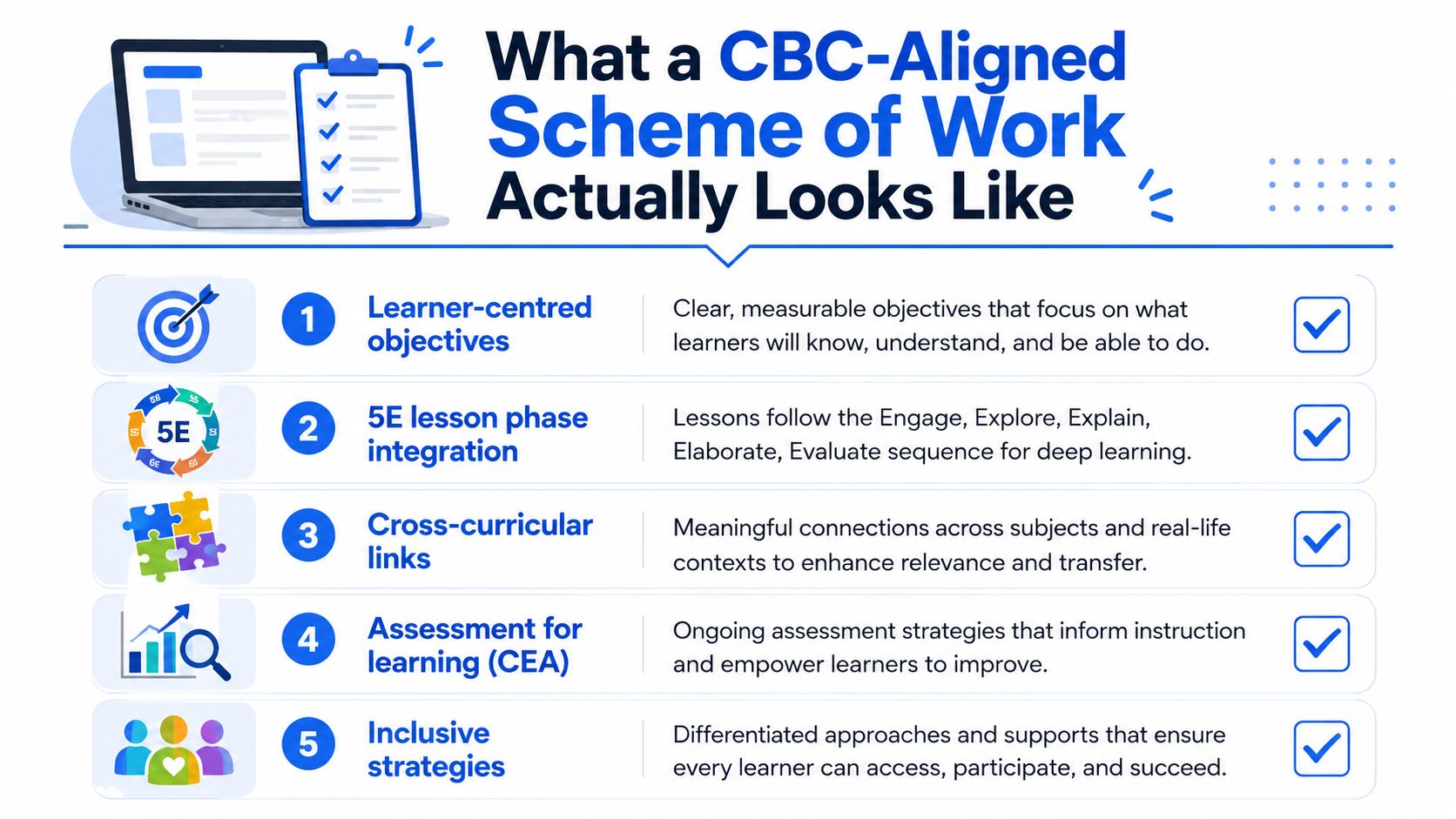
Essential Fields in a CBC Scheme of Work
Strand and sub-strand reference: Anchor the week to the official design. Without it, the scheme drifts into textbook topics and loses sequence.
Learning outcome: State what learners will do. Use verbs such as explain, identify, compare, create, demonstrate, or justify.
Learning experiences: Show how the outcome becomes classwork. Name the task, such as sorting local materials, reading a diagram, making a guided observation, or presenting a group decision.
Key inquiry questions: Keep the lesson problem-centred. A strong question drives thinking and shapes the task.
Core competencies and values: Place these beside the activity where they appear. Communication, collaboration, critical thinking, creativity, responsibility, and respect should be visible in classroom work.
Resources: List what the teacher can actually use. A chalkboard, soil samples, bottle tops, a shared textbook, a printed card, and one laptop are more useful than the vague label "ICT resources".
Assessment: Identify the evidence to collect. This may be an exit ticket, labelled drawing, oral explanation, practical observation, peer feedback, or a short written response.
Reflection and feedback: Record what learners struggled with, what helped, and what to adjust next week.
Values and PCIs: Show where citizenship, responsibility, environmental awareness, health issues, safety, or other pertinent and contemporary issues appear in the learning task.
If the scheme has no place for last week's evidence, it is a record, not a teaching tool.
The curriculum structure itself is built around strands, sub-strands, learning outcomes, and competencies rather than topic lists alone. The Ministry of Education's revised CBC reform document describes the Grade 10 to 12 development and rollout phase from 2026 to 2028. That reinforces the need for grade-specific plans that remain auditable against official designs.
How to Use KICD Strands, Sub-Strands and Learning Outcomes
Open the Grade 8 Integrated Science Curriculum Design and start with the strand, the broad area of learning. In this example, use Mixtures or another relevant strand from the official design. The sub-strand narrows the work to a teachable focus. Do not copy the whole strand into the weekly plan. Use it as the reference point. Then build lessons from the specific outcomes and suggested experiences.
Read down the outcome column and ask three questions. What must the learner know? What must the learner do? What evidence would prove it? If the outcome involves separating materials, the scheme should allow for observation or practical handling, not only notes on definitions.
The suggested learning experiences point to the classroom action expected. They do not remove professional judgement. A school with laboratory equipment may use a practical investigation. A school without it may use labelled containers, sieves, water, sand, stones, and other local materials. The outcome stays fixed. The route can change.
Key inquiry questions sit beside the learning work. Treat them as prompts for thinking, not lines to recite. The values column matters too. If learners work in groups to select a separation method, the teacher can deliberately observe cooperation, responsibility, respect for others' ideas, and care with materials.
| Curriculum Design Column | What It Means | Scheme of Work Action |
|---|---|---|
| Strand | The broad curriculum area | Record the official strand name and code where available |
| Sub-strand | The narrower learning focus | Break it into realistic weekly lesson blocks |
| Specific learning outcomes | What learners should achieve | Rewrite as observable learner actions |
| Suggested learning experiences | Possible routes to the outcome | Select activities suited to time, class size, and resources |
| Key inquiry questions | Questions that guide investigation | Use one or two to shape Engage and Explore |
| Core competencies and values | Capacities and dispositions practised | Attach them to specific activities and evidence |
A common mistake is treating a learning outcome as a heading. It needs an activity in which learners identify, choose, explain, and produce assessable evidence.
Another mistake is lifting inquiry questions word for word and dropping them into a column without changing the lesson. Use the question to create the problem. Then the plan becomes active.
For a clear explanation of how these curriculum levels connect, use this strand and sub-strand guide while checking the wording against the official Curriculum Design.
How to Create Weekly CBC Schemes of Work Using the 5E Model
A strand becomes manageable when you allocate it across a 5E block: Engage, Explore, Explain, Elaborate, and Evaluate. The phases do not need five perfect periods. They provide a sequence that moves learners from a problem to evidence of understanding.
Take Grade 7 Agriculture and a week on soil fertility. Start by checking the actual timetable. A 35-minute single period may support a focused Engage or Evaluate activity. It will not carry a long practical, group reporting, and written reflection.
CBC Scheme of Work Sample
Below is a simple CBC scheme of work sample using Grade 7 Agriculture. Teachers should verify the exact wording of strands, sub-strands, and learning outcomes against the relevant KICD Curriculum Design.
| Week | Lesson | Strand | Sub-strand | Learning Outcome | Learning Experience | Resources | Assessment | Reflection |
|---|---|---|---|---|---|---|---|---|
| 4 | 2 | Crop Production | Soil Fertility | Learners should be able to describe factors that affect soil fertility | Learners observe three local soil samples, compare colour and texture, discuss why crop performance differs, and recommend one improvement for a school plot | Soil samples, chalkboard, manila paper, shared textbook | Exit ticket on factors affecting fertility and one justified improvement | Many learners identified factors correctly but struggled to justify the best improvement. Begin next lesson with a short decision task. |
Plan a Soil Fertility Week
Engage: Open with a picture or real example of wilted maize. Give learners 10 minutes to discuss why two plots might produce different crops. Then start a KWL chart.
Explore: Use three local soil samples at stations. Learners observe colour, texture, moisture, and visible organic matter. Then they record differences.
Explain: Draw a simple board diagram showing how nutrients support plant growth. Introduce NPK ratios only after learners have described what they observed.
Elaborate: Give groups a school-plot problem. They must recommend a fertiliser or soil improvement approach and justify it using the evidence gathered.
Evaluate: Use a short CEA-style exit ticket with three structured questions. Ask learners to name one factor affecting fertility, interpret a simple situation, and justify an appropriate improvement.
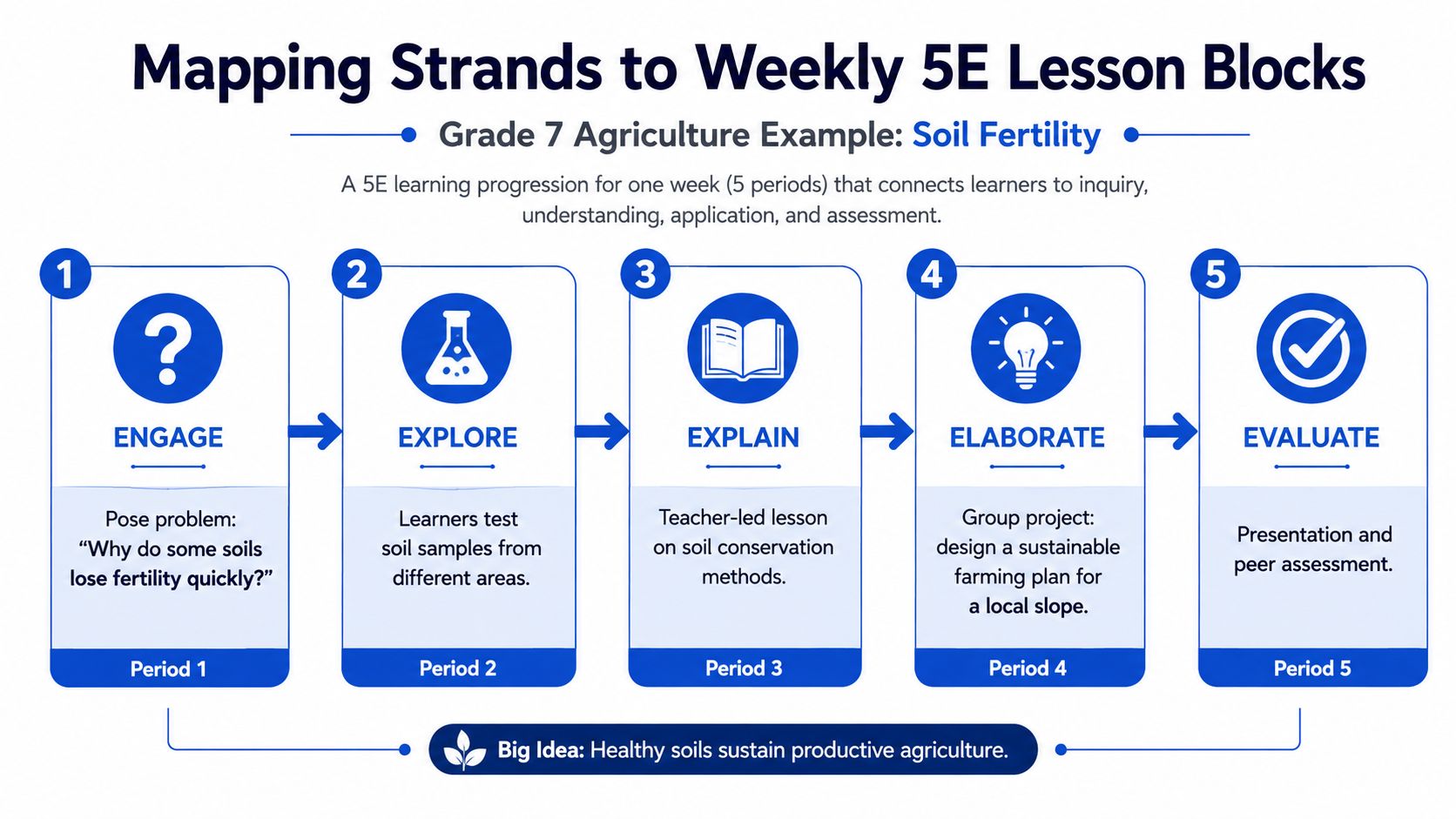
A five-period week can give each phase a main slot. Protect the learning purpose rather than forcing equal timing. If one period runs short, reduce the number of samples or questions. Do not remove the evidence-gathering step.
Grade 10 Biology can use the same structure with more independent writing. Learners may formulate a prediction in Engage, analyse provided data in Explore, write a structured explanation, apply it to a new context in Elaborate, and complete a short evaluation using evidence.
Every 5E phase should produce evidence you can see, hear, collect, or record.
Before finalising the weekly grid, compare it with your lesson-plan format and timetable. The lesson plan guide can help you keep the daily delivery record consistent with the wider scheme.
CBC Schemes of Work by Grade
Planning depth changes across the grades. The core principle stays the same, but learner independence, assessment demand, and application should increase.
Grade 7 CBC Schemes of Work
Grade 7 CBC schemes of work should emphasise transition into Junior School. Use clear routines, concrete activities, guided group work, and frequent checks for understanding.
Grade 8 CBC Schemes of Work
Grade 8 CBC schemes of work should build stronger learner explanation and comparison. At this level, schemes should show more deliberate use of practical work, inquiry questions, and short written evidence.
Grade 9 CBC Schemes of Work
Grade 9 CBC schemes of work should prepare learners for more confident application and assessment readiness. Teachers should plan tighter links between sub-strands, CEAs, and targeted reteaching.
Grade 10 CBC/CBE Schemes of Work
Grade 10 CBC/CBE schemes of work should reflect entry into Senior School. Learners should handle more independent reading, analysis, and written justification, while teachers track pathway-specific expectations.
Grade 11 CBC/CBE Schemes of Work
Grade 11 CBC/CBE schemes of work should deepen subject mastery. Schemes should include more extended application, structured investigations, and stronger evidence of competencies.
Grade 12 CBC/CBE Schemes of Work
Grade 12 CBC/CBE schemes of work should focus on consolidation, advanced application, and readiness for final assessments. Planning should be tighter, leaner, and driven by evidence from revision and prior mastery gaps.
CBC Schemes of Work for Term 1, Term 2 and Term 3
Teachers should not treat one file as a fixed year-long script. CBC schemes of work Term 1, CBC schemes of work Term 2, and CBC schemes of work Term 3 should all be adjusted to actual teaching weeks, holidays, assessment windows, school events, revision periods, and previous learner mastery.
In practice, CBC schemes of work 2026 should reflect the real school calendar rather than an assumed one. That matters whether a teacher is preparing KICD schemes of work, downloading editable templates, or adapting CBC schemes of work Kenya departments already use.
Term 1 often needs more diagnostic work and classroom routine-setting. Term 2 usually allows longer teaching runs, but sports, meetings, and mid-year assessments still interrupt coverage. Term 3 often carries the greatest pressure from revision, exams, and completion of pending strands. Good schemes respond to those differences.
Plan CEAs, Mocks, and Revision Across the Term
A term calendar should expose pressure points before the scheme reaches the classroom. A term may appear to have many teaching weeks. Administration, assessments, marking, meetings, and school events cut that time fast. Kenyan CBC scheme pages repeatedly advise teachers to compare a downloaded scheme with the school timetable and actual teaching weeks, and school calendar guidance for Kenya is useful when building the first draft.
The grid below protects teaching blocks while making assessment visible. It uses a 14-week planning frame. The opening week is reserved for diagnostic work. Later weeks allow analysis and reteaching.
| Week | Primary 5E Phase | Assessment / Admin Event | Planning Focus |
|---|---|---|---|
| 1 | Engage | Opening administration and diagnostic assessment | Form groups, identify prior knowledge, confirm usable periods |
| 2 | Explore | Informal observation | Begin the first practical or collaborative learning block |
| 3 | Explain | Short checks during lessons | Address misconceptions and introduce essential concepts |
| 4 | Evaluate | CEA 1 | Collect evidence against the first set of outcomes |
| 5 | Engage and Explore | Feedback, marking, and reteaching | Use CEA evidence to rebuild weak foundations |
| 6 | Explain | Formative questioning | Teach the next linked concept with differentiated support |
| 7 | Elaborate | Practical or application task | Require learners to transfer understanding |
| 8 | Evaluate | CEA 2 | Check progress and record sub-strand evidence |
| 9 | Engage and Explore | Feedback, marking, and adjustment | Reteach before introducing additional complexity |
| 10 | Explain and Elaborate | Targeted revision | Consolidate areas likely to affect mock performance |
| 11 | Evaluate | Mock examination window | Use the mock to identify content and skill gaps |
| 12 | Elaborate | CEA 3 preparation | Apply learning through structured revision tasks |
| 13 | Engage and Explore | CEA 3 feedback and reteaching | Revisit weak outcomes using short focused activities |
| 14 | Explain, Elaborate, and Evaluate | Term review and learner reflection | Complete essential work, record evidence, and prepare the next plan |
This arrangement places CEA checkpoints at the end of weeks 4, 8, and 12. The following week is available for analysis and response. The mock sits in week 11, after targeted revision in the preceding blocks. That matters because a mock should inform the next teaching decision, not interrupt the scheme.
Protect the Evaluate phase from avoidable disruption. If assembly regularly affects a particular period, do not place the only evidence task there. In a triple-stream school, use a common assessment window where possible. Then give each teacher a clear marking and feedback deadline so one stream does not move ahead without adjustment.
Plan for Real Classroom Constraints
A scheme fails quickly when its activities assume every learner has a device, every room has power, and every subject has a fully equipped laboratory. In many county and sub-county schools, teachers work with shared textbooks, intermittent connectivity, large classes, and phones that double as personal and teaching devices. The scheme should name substitutions before the lesson begins.
Use one outcome with different entry points. The core task gives learners the minimum evidence required for the week. A stretch task asks confident learners to connect the idea to the next sub-strand or justify a more complex decision. A concrete entry task gives learners who need support something to handle, sort, draw, label, or describe before they move to abstract vocabulary.
Printed 5E activity cards can replace a digital presentation. Laminate a small set for repeated use, or keep master copies in the department file. A single teacher laptop can hold pre-loaded clips for the Explain phase, while the chalkboard carries the concept map that learners copy and complete. Front-load difficult strand vocabulary with picture-word cards, especially where learners need support moving between everyday language and subject language.
| Constraint | 5E Phase Most Affected | Practical Adjustment |
|---|---|---|
| No projector | Explain | Use a board diagram, printed sequence cards, or a teacher demonstration |
| No laboratory | Explore | Use safe household or locally sourced materials, labelled samples, and observation tables |
| Large class | Explore and Elaborate | Assign roles, rotate stations, and use group recorders to reduce movement |
| Intermittent power | Engage and Explain | Download resources beforehand and keep a board-based alternative ready |
| Few textbooks | Explore and Evaluate | Prepare shared extracts, question cards, and one common reference sheet |
| Mixed language confidence | Engage and Explain | Pre-teach vocabulary with picture-word cards and permit structured oral rehearsal |
Differentiation does not mean writing separate schemes for every learner. It means identifying where the same weekly outcome can be reached through different supports and levels of challenge. Record those supports in the resources or learning-experience column so another teacher can understand the plan.
Teacher preparedness remains central. Research from Kabianga University links teacher preparedness with successful CBC implementation and identifies continuing gaps in pedagogical knowledge, resources, and professional development in its teacher-prepared CBC implementation research. A neat template will not solve an activity the teacher has no practical route to deliver.
CBC Scheme of Work vs Lesson Plan
Teachers often use the two terms interchangeably, but they do different jobs.
| Feature | CBC Scheme of Work | Lesson Plan |
|---|---|---|
| Time span | Covers several weeks or a term | Covers one lesson or teaching session |
| Main purpose | Maps curriculum sequence | Explains detailed classroom delivery |
| Focus | Strands, sub-strands, outcomes, assessment, pacing | Activities, timing, questions, instructions, and lesson flow |
| Best use | Long-range planning and coverage control | Daily teaching and evidence collection |
Use the scheme to organise the term. Use the lesson plan to deliver one class well. For daily planning, this lesson plan guide helps align classroom delivery with the wider weekly scheme.
How to Update a CBC Scheme of Work Using Assessment Data
The scheme should change after assessment. Start with a simple spreadsheet after marking a CEA. Use columns for learner ID, sub-strand code, learning outcome, question reference, and mastery level from 1 to 4. Tag each question to the outcome it measures. A total topic mark can hide the fact that learners understood one outcome but struggled with another.
For each sub-strand, calculate the percentage of learners reaching the agreed mastery level. Flag any sub-strand below 70 percent and cite the teacher guidance on adapting CBC schemes to real teaching weeks when designing the local workflow. The threshold is a planning rule, not a national claim. Departments can refine it. But they should use one consistent rule so teachers make comparable decisions.
Follow This Weekly Feedback Loop
Mark and code: Enter the response against the relevant outcome, not just the topic name.
Group the need: Separate learners needing immediate support from those ready for extension.
Flag the scheme: Highlight the weak outcome in the next weekly grid.
Change the sequence: Replace the planned Engage prompt with a focused reteach mini-block. Move the original topic into Explore where learners can meet it with fresh support.
Check again: Use a brief Evaluate activity to confirm whether the reteaching worked.
For example, if learners can name soil nutrients but cannot choose an appropriate improvement for a school plot, the next week should not begin with another definition. Engage should present a short decision problem. Explore should provide contrasting cases. Explain should correct the misconception. Elaborate should require a justified recommendation.
Keep the spreadsheet light enough to update on a shared device. A teacher does not need a complex dashboard to make a better decision. The essential link is between question, outcome, mastery evidence, and next lesson action.
The strongest scheme changes for a clear reason.
Use Templates and Protect Time on the Timetable
Keep four working documents where the department can reach them. The first is a blank 5E weekly grid, with periods down the side and the five phases across the working area. The second is a CEA tracker, which records outcomes, questions, learner evidence, and follow-up. The third is a mastery feedback loop card, small enough to sit beside the marking book. The fourth is a term-at-a-glance calendar, where teaching weeks, assessments, revision, and school events are visible together.
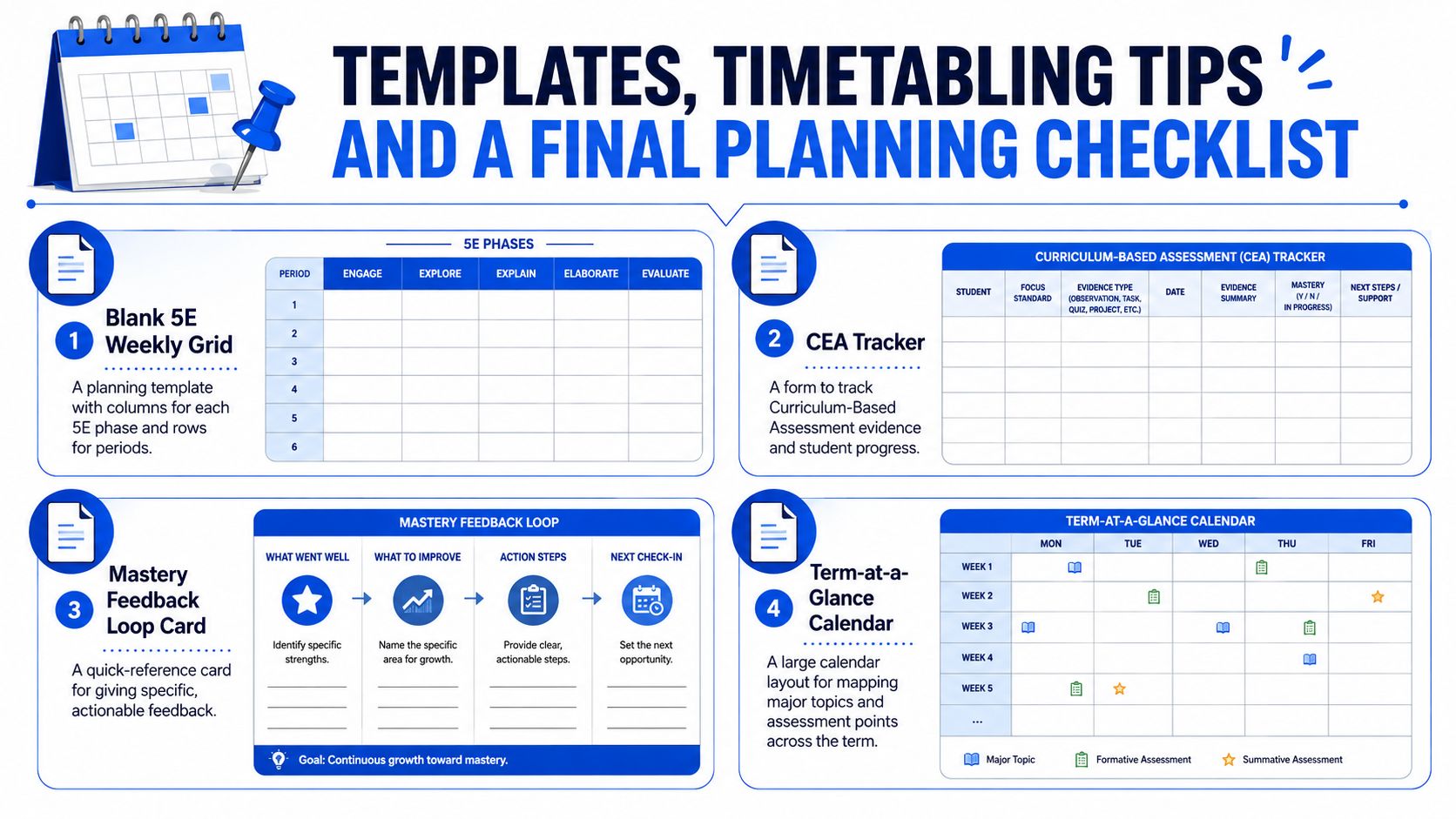
Make These Timetabling Moves
In a triple-stream school, place related 5E periods back to back where the timetable permits. Put Engage activities early in the week, especially on Monday, so learners enter the sequence with a shared question. Protect Evaluate periods from assembly and routine interruptions. If disruption is unavoidable, move the short evidence task to the next reliable period and record the change rather than pretending the original plan was delivered.
A practical Word-and-Excel bundle should include an editable weekly 5E grid, a term calendar, a CEA tracker with outcome fields, and a feedback card for reteaching decisions. Keep a print-ready version for the staffroom and an editable copy for the department device. The file should support adaptation, not lock the teacher into a generic PDF.
Use this final check before signing off the scheme:
Strands decoded: Every week points to the correct strand and sub-strand.
Outcomes made learner-first: Each outcome describes observable learner work.
5E slots completed: Engage, Explore, Explain, Elaborate, and Evaluate have purposeful activities.
Competencies included: The plan states where communication, collaboration, critical thinking, creativity, or values will be observed.
Resources named: Digital and non-digital alternatives are listed.
CEAs dated: Assessment points fit the calendar, not an assumed one.
Mastery carried forward: The next week contains a response to previous evidence.
Elaborate protected: Application is not left as homework by default.
Term review scheduled: The department has a date to examine coverage, evidence, and adjustments.
Keybaki provides a shared lesson planner, CBE-mapped digital library, 5E planning blocks, timetable tools, and strand-linked CEAs for Grades 7 to 12, with offline cache and phone-based access designed for constrained devices. Visit Keybaki to connect your CBC scheme, classroom activities, and assessment follow-up in one weekly workflow.
Comments
Loading…