
· Grade 9 Mathematics Kenya
KJSEA Mathematics Revision: Practice Questions and Explained Answers
16 min read
You have finished a practice question, pressed the calculator keys carefully, and written an answer that looks almost right. Then you check the worked solution and spot the problem. A negative sign disappeared in the second line, and everything after it followed the wrong path. Your method was not completely wrong, but one small slip changed the result.
That moment is why this KJSEA Mathematics Revision: Practice Questions and Explained Answers guide focuses on method, not speed alone. You'll work through original Grade 9 questions, read the step-by-step reasoning, name the exact error you made, and try again later without looking. That's how a wrong answer becomes useful. It tells you whether the gap is in fractions, algebra, units, or reading the question properly.
These questions are original practice questions. They are not official KNEC questions, and they aren't reproduced from past papers. They can't promise what will appear in the assessment or guarantee a grade. What they can do is strengthen the skills you control, such as clear working, sensible checks, and calm problem-solving under time pressure.
Use this routine for every item below. Attempt it alone first, cover the solution, write each step on its own line, then compare. If you're wrong, don't just copy the answer. Circle the first line where your working changed direction.
Table of Contents
- 1 Fractions and Decimals Practice Adding and Subtracting Fractions
- 2 Percentages Practice Discounts and Reverse Percentage Change
- 3 Ratio and Proportion Practice Sharing a Quantity
- 4 Algebra Practice Linear Equations Substitution and Negative Numbers
- 5 Order of Operations BODMAS Practice
- 6 Volume and Unit Conversion Practice Water Tanks
- 7 Pythagoras Theorem Practice Ladder Against a Wall
- 8 Data and Probability Practice Mean Median and Chance
- KJSEA Mathematics Practice Resources: 8-Topic Comparison Matrix
- Turn Every Wrong Answer into a Stronger Method
1 Fractions and Decimals Practice Adding and Subtracting Fractions
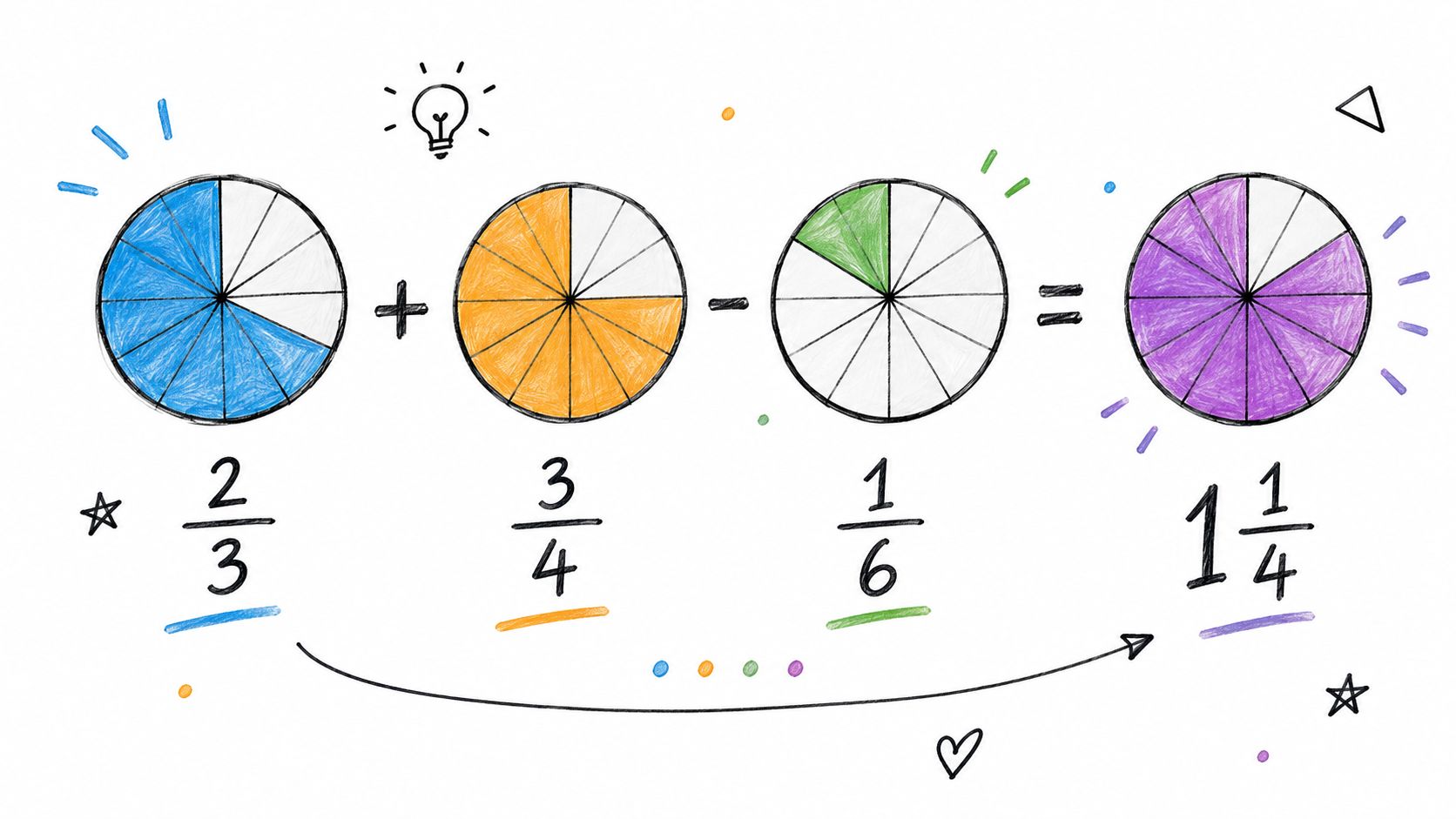
Question 1. Calculate 2/3 + 3/4 - 1/6. Give your answer as a fraction in its simplest form and as a decimal. Try it before reading any further, and don't rush to a calculator.
The key idea is that fractions can only be added or subtracted directly when they share the same denominator. Thirds, quarters, and sixths are different-sized pieces. You need to rewrite them as equivalent fractions first.
Worked Solution
The lowest common denominator of 3, 4, and 6 is 12. Convert each fraction to twelfths. 2/3 = 8/12, 3/4 = 9/12, and 1/6 = 2/12.
Now combine the numerators while keeping the denominator. 8/12 + 9/12 - 2/12 = 15/12. Simplify by dividing the numerator and denominator by 3. 15/12 = 5/4 = 1 1/4, and as a decimal that's 1.25.
Practical rule: Write down the lowest common denominator before you convert a single fraction. It stops you mixing methods halfway through.
A common mistake is adding the denominators, such as writing 2/3 + 3/4 = 5/7. That's incorrect because you haven't made the pieces equal in size. If you share a 3-litre drink and use 1/2 at break and 1/4 at lunch, you still convert to a shared denominator before adding.
For broader classroom ideas on building this habit, see these mathematics teaching strategies for step-by-step practice. Practise five to ten fraction questions daily for a week, and always simplify before you finish.
2 Percentages Practice Discounts and Reverse Percentage Change
A discount question often looks easy until it asks you to work backwards. Question 2. A jacket costs KES 2,500. A shop offers a 20% discount. What's the sale price, and what percentage increase on the sale price returns it to KES 2,500?
Work in two separate stages and keep the base value clear each time. First, 20% of 2,500 = 500. Subtract it from the original price. 2,500 - 500 = KES 2,000, so the sale price is KES 2,000.

Working Backwards
To return from KES 2,000 to KES 2,500, the increase is KES 500. This time the base is 2,000, not 2,500. So calculate 500 ÷ 2,000 × 100 = 25%. The required increase is 25%.
Many learners assume a 20% increase will undo a 20% discount. It won't. A 20% increase on 2,000 gives KES 2,400, because the starting amount has changed. That's the central lesson in reverse percentage questions.
- Identify the base first: Write "percentage of what?" beside every calculation.
- Check by reversing: Apply your second percentage to your result and confirm you return to the starting value.
- Keep an error list: Note percentage mistakes you repeat and review that list weekly.
You'll meet the same thinking when a Nairobi shop cuts school uniform prices, or when a price rises after a sale ends. The figures change, but the base value question stays the same every time.
3 Ratio and Proportion Practice Sharing a Quantity
Question 3. KES 960 is shared between Amina and Brian in the ratio 3:5. How much does each person receive? Read the ratio as parts of one whole amount, not as two separate divisions.
Start by adding the parts. 3 + 5 = 8 parts in total. The full KES 960 is spread across those eight equal parts. One part is therefore 960 ÷ 8 = KES 120.
Finding Each Share
Amina has three parts, so she receives 3 × 120 = KES 360. Brian has five parts, so he receives 5 × 120 = KES 600. Check the total before you move on. 360 + 600 = 960, so the shares account for the whole amount.
A frequent error is dividing 960 by 3 and then 960 by 5 separately. That treats the full amount twice and gives shares that add up to far too much. Another slip is forgetting to add the ratio parts first, which means you never find the value of one part.
If a ratio question feels abstract, draw a bar split into eight equal boxes, shade three for Amina and five for Brian, and label each box KES 120.
The same method works for mixing cement, sand, and ballast in a building ratio, or dividing harvest income between family members who contributed different amounts of work. In each case, you find the total parts, value one part, then multiply. Always finish with the addition check, because it catches most ratio errors in seconds.
4 Algebra Practice Linear Equations Substitution and Negative Numbers
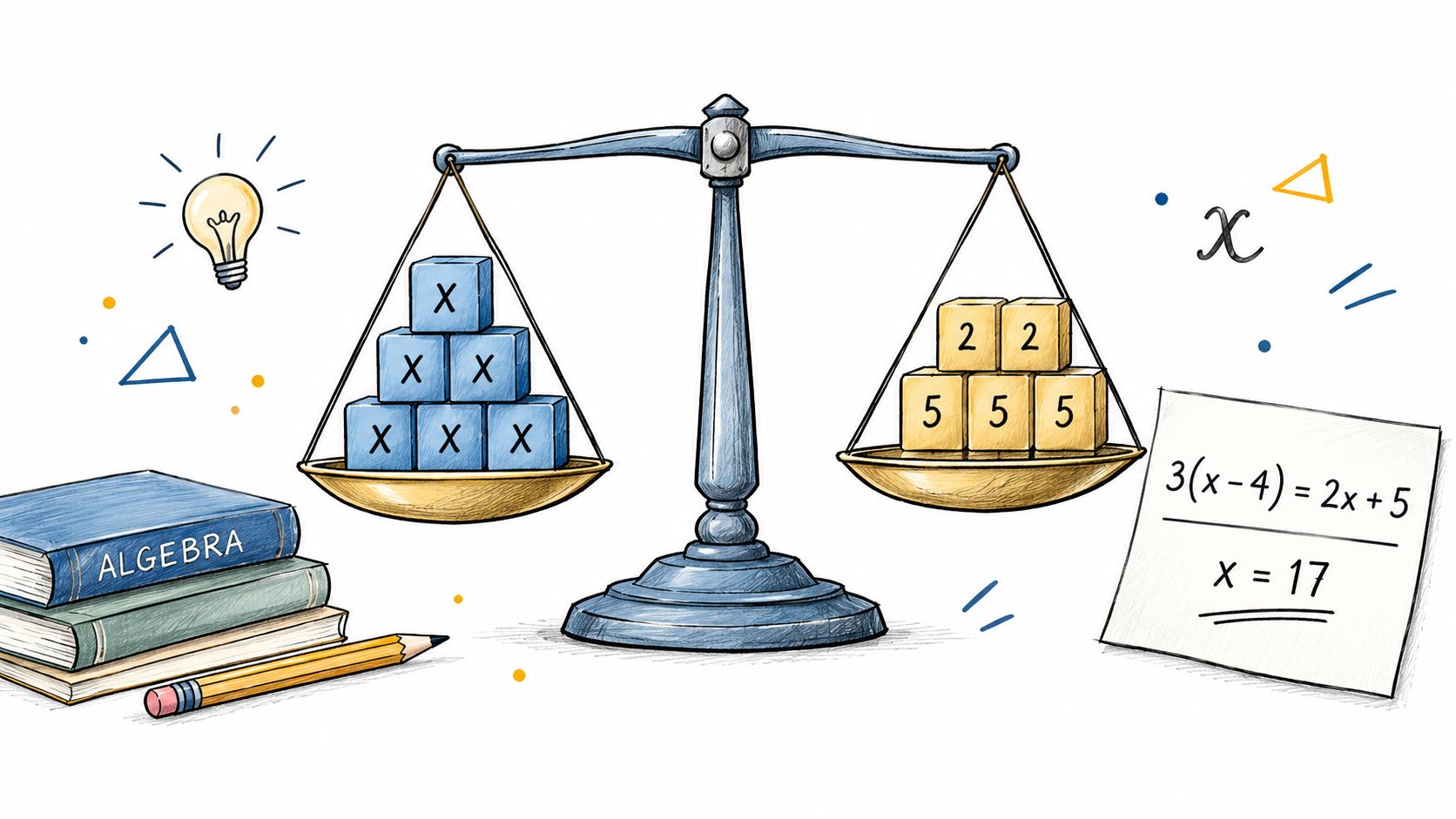
Algebra questions reward tidy, balanced working. Question 4A. Solve 3(x - 4) = 2x + 5. Question 4B. Evaluate 2a² - 3b when a = -2 and b = 4. Do them one at a time.
For 4A, expand the bracket fully first. 3(x - 4) = 3x - 12, so the equation becomes 3x - 12 = 2x + 5. Subtract 2x from both sides to get x - 12 = 5. Add 12 to both sides, giving x = 17.
Checking and Substituting
Check 4A by substituting back. The left side is 3(17 - 4) = 39, and the right side is 2(17) + 5 = 39. Both sides match, so x = 17 is correct. A common mistake is expanding 3(x - 4) as 3x - 4, which drops the multiplication of the second term.
For 4B, write substituted values in brackets. a² = (-2) × (-2) = 4, so 2a² = 8. Also, 3b = 3 × 4 = 12. Therefore 2a² - 3b = 8 - 12 = -4. Don't write (-2)² as -4, because a negative multiplied by a negative gives a positive.
These skills help you find the cost of one exercise book from a total bill or a missing length from a perimeter. For longer-term habits, read this guide on how to pass mathematics in high school, then re-read your final sign twice before writing any answer.
5 Order of Operations BODMAS Practice
Question 5. Calculate 18 ÷ 3 × 2 + 4² - 5. There's no bracket to guide you, so the order of operations does all the work. Write one step per line and resist doing several operations at once.
Start with the power. 4² = 16. The expression becomes 18 ÷ 3 × 2 + 16 - 5. Division and multiplication have equal priority, so you handle them strictly from left to right.
Left to Right Matters
First, 18 ÷ 3 = 6. Then 6 × 2 = 12. Now you're left with 12 + 16 - 5. Addition and subtraction also run left to right, so 12 + 16 = 28, and 28 - 5 = 23. The answer is 23.
The tempting mistake is calculating 3 × 2 before 18 ÷ 3, because multiplication is sometimes memorised as coming first. That gives 18 ÷ 6 = 3 and leads to a wrong final answer of 18. BODMAS doesn't put multiplication ahead of division. They're partners at the same level.
- Powers before everything else here: Square the 4 before you touch the division.
- Same level means left to right: Division and multiplication take turns by position, not by name.
- One line per step: A fresh line makes it easy to spot where a slip began.
You'll use the same discipline when totalling several items bought at different prices or averaging a list of marks. Slow, visible steps beat fast mental shortcuts in this strand every time.
6 Volume and Unit Conversion Practice Water Tanks
Measurement questions often fail on units rather than arithmetic. Question 6. A rectangular water tank measures 1.2 m long, 0.8 m wide, and 0.5 m high. Find its volume in cubic metres and convert the answer to litres, given that 1 m³ = 1000 litres.
Use V = length × width × height, with every dimension in the same unit. Here they're already in metres, so you can multiply directly. 1.2 × 0.8 = 0.96, then 0.96 × 0.5 = 0.48. The volume is 0.48 m³.
Converting to Litres
Now convert using the stated relationship. 0.48 × 1000 = 480 litres. Write the unit at each stage, cubic metres first and litres second, so you can see exactly what changed. The tank holds 480 litres.
Two mistakes appear again and again. Learners sometimes multiply dimensions that are still in mixed units, such as centimetres beside metres. Others convert cubic metres to litres by multiplying by 100 instead of 1000, which makes the answer ten times too small.
Unit check: If your capacity for a household tank comes out smaller than a bucket, stop and check your conversion before anything else.
Remember that 1 litre equals 1000 cm³ and 1 m³ equals 1000 litres. The same care helps when you estimate water stored at home or the capacity of a school classroom. Convert first, calculate second, convert again only if the question asks.
7 Pythagoras Theorem Practice Ladder Against a Wall
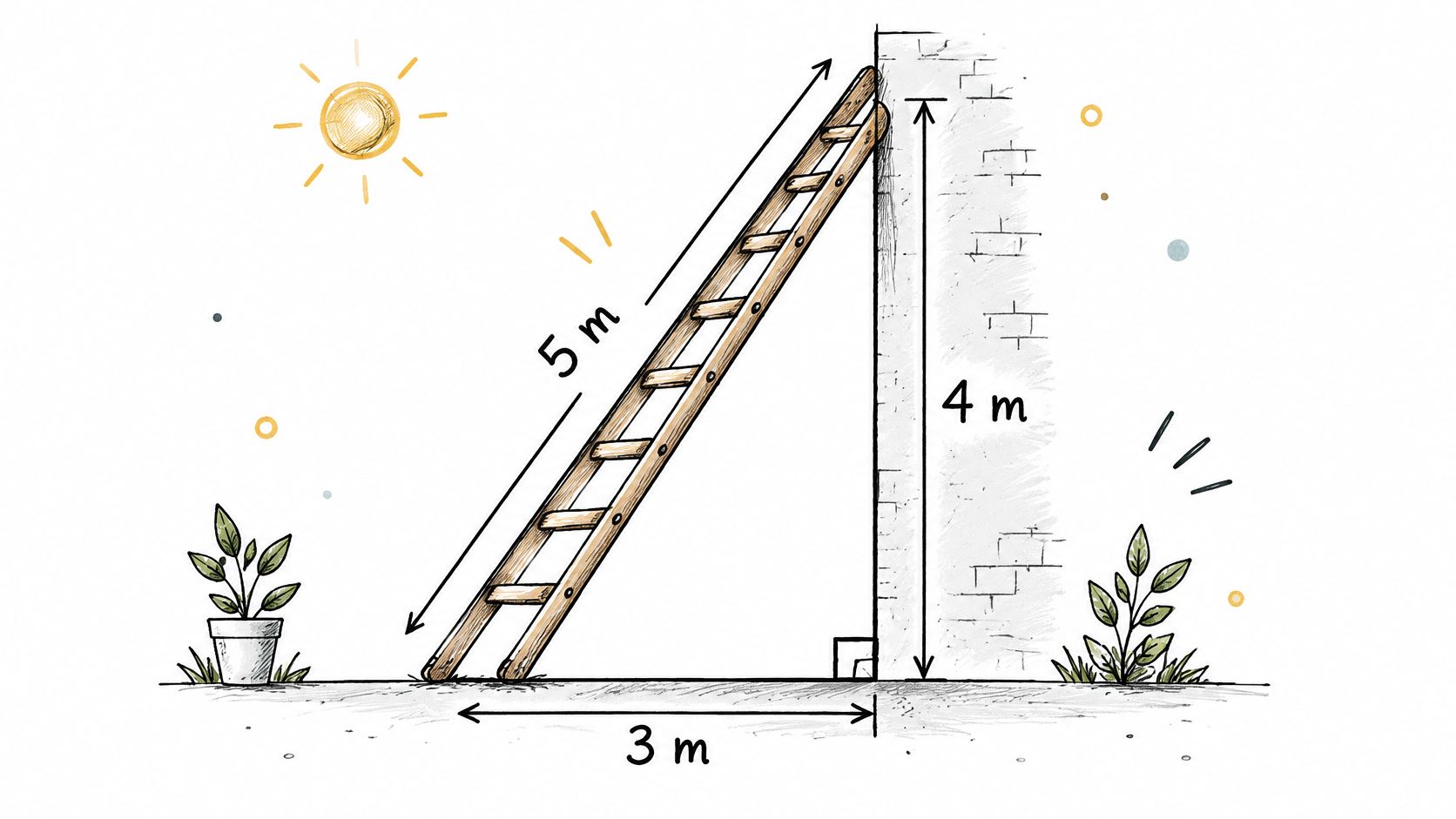
Question 7. A 5 m ladder leans against a vertical wall. Its foot is 3 m from the base of the wall. How high up the wall does the ladder reach? Draw the triangle before you write any formula.
The ladder, wall, and ground form a right-angled triangle. The ladder is opposite the right angle, so it's the hypotenuse, the longest side. Call the unknown height h. The ground distance is the other shorter side.
Applying the Theorem
Use a² + b² = c², where c is the hypotenuse. Substitute carefully. 3² + h² = 5², so 9 + h² = 25. Subtract 9 from both sides to get h² = 16. Take the square root, giving h = 4. The ladder reaches 4 m up the wall.
Check that the answer is sensible. The height must be less than the ladder length of 5 m, and 4 m passes that test. It also completes the familiar 3, 4, 5 triangle, which is worth recognising on sight.
The classic mistake is adding the wrong way, writing 5² + 3² = h². That treats the unknown height as the hypotenuse, even though the ladder already holds that position. Labelling the hypotenuse on your diagram prevents it.
You'll meet the same reasoning when checking whether a school gate frame is square or finding the length of a diagonal support. Draw, label, substitute, then judge whether the number makes sense.
8 Data and Probability Practice Mean Median and Chance
Question 8A. The scores of six learners in a quiz are 4, 7, 7, 9, 12, and 15. Find the mean, median, and mode. Question 8B. A bag contains 3 red, 5 blue, and 2 green marbles. What's the probability that a marble picked at random is not blue?
For the mean, add first. The sum is 54, and there are six scores, so the mean is 54 ÷ 6 = 9. The data is already in order, and with six values the median sits between the middle pair, 7 and 9. So the median is (7 + 9) ÷ 2 = 8. The mode is 7, because it appears most often.
Probability and Careful Reading
For 8B, count the total first. There are 10 marbles. The marbles that aren't blue are the red and green ones, 3 + 2 = 5. So P(not blue) = 5/10 = 1/2. Using 5 blue marbles as your numerator would answer the opposite question.
- Order before the median: Never pick the middle of an unordered list.
- Total outcomes first: Write the denominator before you choose favourable outcomes.
- Watch small words: Terms like "not" and "at least" change the whole question.
These methods support everyday tasks such as averaging rainfall figures or judging chance from weather records. If you want more structured sets, explore these secondary school revision materials organised for practice and keep ordering your data before calculating.
KJSEA Mathematics Practice Resources: 8-Topic Comparison Matrix
| Practice Item | CBE Focus | Key Skills | Learning Support | Common Challenge |
|---|---|---|---|---|
| Fractions and Decimals | Grade 9 Numbers | Common denominators, simplifying, decimal conversion | Step-by-step solution; fraction-to-decimal check | Finding common denominators |
| Percentages | Grade 9 Mathematics | Discounts, percentage change, reverse percentages | Worked shopping example; explains the base value | Assuming the reverse increase is the same percentage |
| Ratio and Proportion | Proportional reasoning | Sharing quantities, finding part values, checking totals | Step-by-step method with a sum check | Confusing ratio parts with the total |
| Algebra | Grade 9 Algebra | Expanding brackets, solving equations, substitution | Worked examples with substitution checks | Sign errors and negative numbers |
| Order of Operations | Grade 9 Mathematics | Powers, multiplication and division, addition and subtraction | Clear sequence of calculation steps | Applying equal-priority operations in the wrong order |
| Volume and Unit Conversion | Geometry and Measurement | Cuboid volume, consistent units, converting to litres | Practical water-tank example | Mixing units or using the wrong conversion factor |
| Pythagoras' Theorem | Geometry | Identifying the hypotenuse and solving right triangles | Practical ladder example with a reasonableness check | Applying the theorem to the wrong sides |
| Data and Probability | Statistics and Probability | Mean, median, mode, and simple probability | Familiar quiz and marble examples | Misreading probability wording or ordering data incorrectly |
Turn Every Wrong Answer into a Stronger Method
You've now seen the pattern that runs through every strand. The arithmetic is rarely the whole problem. Errors usually begin with a skipped unit, a misread word, a rushed bracket, or a percentage applied to the wrong base. Naming that exact cause is what turns practice into progress.
The national picture shows why this diagnosis matters. KNEC reported that only 32.44% of candidates met or exceeded expectations in Mathematics in the 2025 assessment of approximately 1.13 million Grade 9 learners, according to reporting of the KNEC 2025 KJSEA and KCSE reports. Roughly two-thirds of the cohort didn't reach that benchmark. You're not revising against a personal weakness alone. You're building skills that challenged learners across the whole country.
Your Seven-Day Routine
Use the next seven days as short, repeated cycles rather than one long cramming session. On each day, attempt a small set independently, compare your working line by line, write down the precise error, and retry the same question later without looking. Next day, start by re-attempting yesterday's errors before you open anything new.
- Day one to two: Cover fractions, percentages, and ratio, keeping an error list for denominators and base values.
- Day three to four: Move to algebra and BODMAS, substituting answers back and writing one step per line.
- Day five to six: Practise volume, Pythagoras, data, and probability, checking units and diagrams every time.
- Day seven: Sit a timed mixed set, mark it, and retry every question you missed.
Timing matters because the official timetable lists Mathematics, paper code 903, on Wednesday, 28 October 2026, from 8.30 a.m. to 10.30 a.m., in the official 2026 KJSEA timetable. Practise finishing within that two-hour window, including reading and checking time. If studying alone at home feels hard to sustain, study accountability coaching ideas can help you keep the daily routine honest.
Where you need more structure, Keybaki's CBE-mapped Grades 7 to 12 resources include editable Kiswahili 5E lesson blocks, projector-ready activities, and strand-linked continuous assessments. They don't guarantee results, and they aren't official KNEC content. Used well, they connect the skill you just practised to the next question you should attempt.
Share this guide with a classmate, parent, or teacher who is also preparing for KJSEA. Explaining a method to someone else is itself strong revision. Then pick your weakest strand and start today's cycle.
Visit Keybaki to explore CBE-mapped Mathematics lessons, activities, and strand-linked assessments for Grades 7 to 12. Use them to target your weakest strand, retry questions you missed today, and keep your KJSEA Mathematics revision organised in one place.
Comments
Loading…